The biggest roadblock for MSP leadership is an unpredictable pipeline, driven by fierce competition and long sales cycles. Treating Paid Search (PPC) as a quick coupon test guarantees failure. To create a controlled growth lever that connects Customer Acquisition Cost (CAC) directly to Monthly Recurring Revenue (MRR), you must operationalize the system. This methodology provides 10 best practices for high-performing MSP adwords management. When engineered correctly, paid search delivers immediate data and speed, complementing the compounding authority of SEO and delivering predictable growth. Begin by determining if PPC is economically rational for your firm.
1. Establish the Economic Floor with Target CPA Modeling
MSP adwords management often fails because campaigns launch without a fixed economic model. Before Google serves a single impression, calculate the maximum Customer Acquisition Cost (CAC) your business can tolerate. To establish this financial floor, align PPC with the unit economics derived from your Ideal Customer Profile:
- Average Contract MRR: (Monthly Recurring Revenue)
- Gross Margin %: (Crucial for profit alignment)
- Average Client Retention/Term: (The lifespan of the contract)
- Close Rate: (Qualified sales meeting to signed contract)
These variables translate directly into a Target CPA—the maximum you can pay for a qualified sales opportunity (a booked meeting, not just a form fill) while still hitting your required payback period. Commit to a 90-day data maturity phase. During this period, reporting must focus on investor-grade metrics within your MSP business plan: CAC, Payback Period, and Pipeline Value influenced. Scale spend only when the actual cost per opportunity consistently stays below the calculated Target CPA.
2. Target Specific Buyer Contexts, Not Generic Services
The single biggest drain on an MSP’s PPC budget is the obsession with broad, low-intent terms like “IT support near me.” Success in MSP Adwords management requires targeting specific buyer contexts, not generic services. This means defining vertical expertise and focusing on high-pain “marketable moments”—compliance deadlines (HIPAA, CMMC) via a compliance marketing playbook, infrastructure migrations, or post-incident recovery.
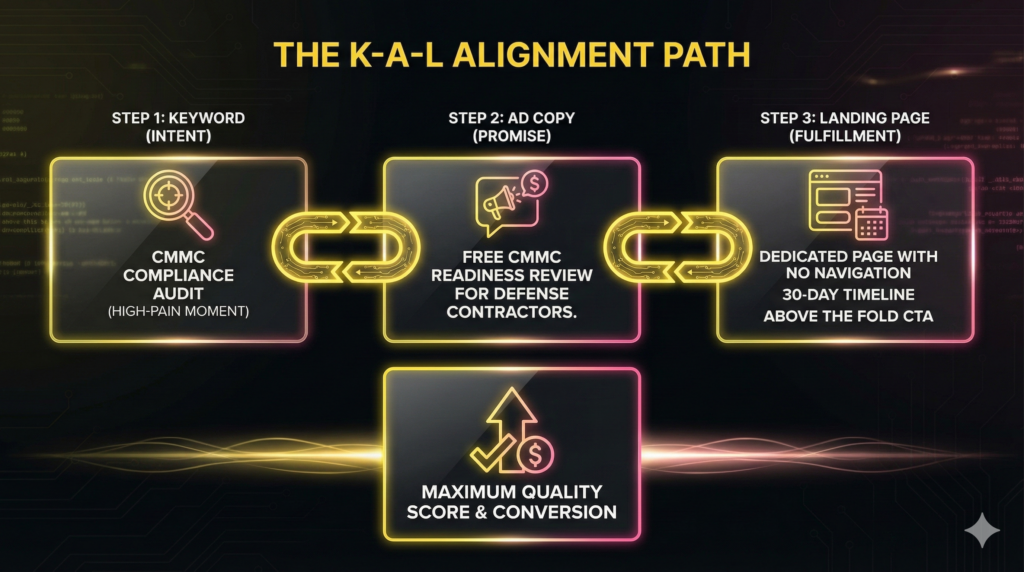
Instead of advertising “Managed IT Services,” craft an offer aligning vertical and pain: “Free HIPAA Compliance Gap Assessment for Dental Clinics” or “CMMC Readiness Review for Defense Contractors.” If you cannot describe your PPC offer in one sentence, the ad copy is too vague. Build conversion-driven keyword themes around this intersection (e.g., “IT support for dentists,” “CMMC compliance audit”). This specificity drastically increases click-through rates, attracts qualified prospects ready to convert, and ensures you hit your calculated Target CPA.
3. Implement Closed-Loop Revenue Attribution via CRM Integration
MSP sales cycles often stretch six to twelve months, rendering last-click attribution data worthless. To provide the CFO with credible ROI for MSP Adwords management, you must trace the initial ad click directly to the closed-won deal.
This requires technical rigor:
- Enable Google Ads auto-tagging.
- Capture the GCLID (Google Click Identifier) on every form submission.
- Store the GCLID with the lead record in your CRM, ensuring persistence through every pipeline stage.
The final step is importing these qualified conversions back into Google Ads (ideally via an automated connector) with accurate revenue values and timestamps. Define a conversion ladder: Raw Lead $\rightarrow$ Qualified Lead $\rightarrow$ Booked Meeting $\rightarrow$ Closed-Won. This allows optimization based on verifiable revenue, not just raw form fills. If your technology stack complicates this essential process, engaging a marketing technology partner is critical for credible ROI reporting.
4. Architect Campaigns and Ad Groups for Outcome-Driven Controllability
A sprawling, poorly structured account is the fastest way to hemorrhage budget and muddy your data. Do not manage all MSP Adwords management under a single campaign; you lose the ability to isolate variables and optimize quickly. Regain control by structuring campaigns based on Service Intent (Cybersecurity, Compliance, Cloud Migration) or Vertical Niche (Legal, Dental).
Within each campaign, create hyper-specific ad groups with tight keyword themes—no more than 5–15 related terms—to maximize Quality Score. Crucially, align the messaging: every keyword must be matched by 2–3 ad copy variations that promise the exact solution, which must be fulfilled on the dedicated landing page. This strict K-A-L alignment drives relevance and conversion.
Finally, begin defensive maintenance early: aggressively pre-load negative keywords (e.g., “jobs,” “training,” “salary,” “free”) to immediately block low-intent spend, protecting your Target CPA from day one.
5. Engineer Dedicated Landing Page Conversion Paths
The landing page is the dedicated conversion machine that maximizes return on your MSP Adwords management budget, moving beyond generic site pages. Every campaign requires a controlled conversion path.
This path must be structurally tight: the headline must precisely mirror the search intent and ad copy (K-A-L alignment). Crucially, the primary Call to Action (CTA) must sit above the fold, offering immediate, high-value engagement: “Book an Assessment” or “Request a Discovery Call.”
Back this CTA with the only trust assets that matter to MSP buyers: tangible SLA guarantees, verifiable certifications (CMMC, HIPAA), and relevant case studies. Eliminate all distractions—remove full-site navigation, sidebars, and links that pull the prospect away.
Finally, include a secondary, lower-friction CTA (e.g., a downloadable compliance checklist) to capture and nurture early-stage visitors, ensuring you optimize the overall conversion rate.

6. Define Initial Governance Policies for Launch Control
Effective MSP Adwords management requires strict governance. Treat the launch as a disciplined experiment to collect predictable conversion data, not scale spend prematurely.
Limit scope immediately: Focus exclusively on Search campaigns, bypassing low-intent PMax or Display networks until a positive Target CPA is established. Set critical boundaries:
- Geo Targeting: Map your service area precisely by zip code or radius. Immediately exclude irrelevant regions to prevent spend on unqualified leads.
- Ad Schedule: Align ad visibility with operational reality. Run ads only during weekday business hours when sales coverage is guaranteed; expand only after conversion data dictates.
- Budgeting and Daily Caps: Start with a budget that is large enough to capture conversion signal but small enough to survive the learning curve. Implement strict daily caps for financial control.
- Testing Patience: Allow ad creative variants (3–4 per ad group) to run long enough—at least 5,000 impressions—before optimizing. Prematurely pausing tests guarantees unreliable data.
7. Integrate Local Service Ads (LSAs) for Verified Local Leads
Local Service Ads (LSAs) secure the most prominent local SERP placement, delivering pre-vetted, Google Guaranteed leads via an advantageous pay-per-lead model. This channel is crucial for localized MSP growth and often overlooked by competitors.
Before deployment, strict eligibility must be confirmed: LSA availability relies entirely on your region and service category. Operational discipline is non-negotiable; lead handling speed is a decisive ranking factor. Treat immediate contact like a strict Service Level Agreement (SLA), as swift response time dictates your ad prominence and visibility.
To maintain financial rigor, integrate LSA lead data into your CRM. Screen low-quality leads, track conversion, and utilize Google’s dispute process to reconcile unqualified charges. LSAs complement Search campaigns—they do not replace them. Use both channels to dominate separate SERP real estate, ensuring comprehensive local pipeline coverage without keyword cannibalization. This verified lead source often yields a Customer Acquisition Cost (CAC) that easily adheres to established economic floors.
8. Implement Strategic Retargeting to De-Risk the Conversion
Many MSPs treat retargeting as a generic volume play, utilizing broad banners that risk brand damage. Retargeting serves as a CPA reducer only when it is strategically segmented and tied to defined, measurable offers. Crucially, launch retargeting only after core search campaigns are stable; failure to do so amplifies weak targeting and poor messaging across a wider audience.
Effective MSP Adwords management demands intelligent audience segmentation. Target high-intent visitors (those who viewed pricing or started a form) with specific, de-risking content. Instead of repeating the primary service pitch, offer a high-value, complimentary asset—a case study, compliance checklist, or free assessment—to accelerate trust. Implement strict frequency caps to prevent audience fatigue, particularly in smaller, localized markets. Success must be measured beyond impressions; track assisted conversions and downstream meeting rates to validate retargeting’s influence on the sales pipeline. This strategy converts qualified browsers into booked sales opportunities.
9. Establish a High-Leverage Operating Rhythm for Continuous Control
The most precise PPC machine will rapidly decay without a predictable operating rhythm, consuming budget without delivering qualified leads. Effective MSP Adwords management requires rigorous, predictable governance designed to protect your Target CPA.
- Near-Daily: Review Search Query Reports (SQRs)—your first line of defense. Immediately add negative keywords to pause obvious budget waste (low-intent queries or non-service terms).
- Weekly Audit: Evaluate performance by intent cluster (not single keywords). Rotate new ad copy tests and review landing page conversion rates.
- The Lead-Quality Loop: Qualitatively tag every new CRM lead (e.g., wrong geography, price shopper). Feed this data back to refine targeting and optimize bids away from poor-fit prospects.
- Automate Cautiously: Deploy automation rules or scripts only after KPIs are locked in and the manual quality loop verifies account stability.
Crucially, CPL is not the KPI. Leadership demands Cost Per Qualified Lead (CPQL) and Cost Per Booked Meeting—the only financial metrics tied to revenue outcomes.
10. Integrate PPC and SEO for Total Market Dominance
Treating MSP Adwords management and SEO as separate budget silos is the strategic error that stifles predictable growth. SEO is the long-term authority machine, building trust and capturing demand through organic content, case studies, and compliance explainers. PPC serves as the short-term validation engine, using paid search to quickly test market messaging and service offers.
The data flow must be unified: winning PPC ad copy and high-converting keywords must feed directly into the SEO content roadmap. Visibility is rapidly shifting; AI summaries and LLM assistants now reward trusted brands with robust structured data and conversion proof, moving beyond traditional blue links. To future-proof your pipeline, operating a unified paid and organic system is non-negotiable.
Practical steps include: diversifying placements (Search, LSAs, retargeting), prioritizing first-party measurement, and maintaining high creative testing velocity. If you need investor-grade reporting that connects long-term authority (SEO) with immediate data (PPC), integration is the only path to total market dominance.
الأسئلة الشائعة
PPC is strategically viable if your unit economics support it and your infrastructure is ready. First, calculate your Target CPA (Cost Per Acquisition) based on your average MRR and close rate; if the local Cost Per Click (CPC) makes hitting this CPA impossible, fix your margins first. Operationally, you must have a clear, high-value offer, a dedicated landing page (see Section 5), and a disciplined sales follow-up process in place. Commit to a 90-day learning window before making a final determination on viability.
Initial budget setting should be tied to the local CPC reality, ensuring you generate enough clicks to achieve statistically significant data within 30 days. Avoid “too small to learn” budgets. Start with strict daily caps to control financial risk (see Section 6), dedicating a controlled sum toward high-intent Search campaigns and testing offers. Consider diversifying tests across Google Search and Microsoft Ads to capture varied cost structures and audience profiles, which can help lower the blended CPQL.
Traffic generation is immediate, but seeing stable, optimized performance—results that consistently meet your Target CPA—takes weeks to months. The first four weeks focus on data hygiene, aggressively pre-loading and reviewing Search Query Reports (SQRs) to mature your negative keyword list. By months two and three, you should have sufficient conversion volume to optimize toward Cost Per Qualified Lead (CPQL) and confidently scale the campaigns delivering high-quality sales pipeline opportunities.
Neither should be ignored; they serve different strategic functions. SEO builds long-term brand authority and trust, creating compounding organic growth. PPC offers speed, allowing you to instantly test messaging and capture immediate market demand. The optimal strategy is sequencing: build the technical SEO foundation while deploying MSP Adwords management to accelerate learning, test new offers, and capture pipeline gaps. Use the high-converting keywords from PPC to inform and optimize your SEO content roadmap for total market dominance.
The future involves higher automation and increased reliance on brand authority, as AI-driven search results may reduce the visibility of traditional ad formats for some queries. MSPs must prioritize technical rigor now. Double down on first-party tracking, ensuring flawless integration of offline conversions (see Section 3). Use PPC to consistently test and deliver expertise-driven content that builds trust. If internal resources are strained, partner with a specialist to maintain testing velocity and measurement integrity against these rapidly changing digital landscapes.