Reliance on unpredictable referrals is no longer a viable growth strategy. Intense competition and private equity scrutiny demand predictable pipelines built on measurable unit economics and repeatable plays, not random tactics. This **MSP Marketing Playbook** delivers that board-ready predictability, detailing exactly what to do, in what order, and how to measure ROI. It specifically addresses the technical and strategic structural gaps most other marketing guides miss. To build this predictable growth engine, we start by reverse-engineering your revenue targets into a robust pipeline model.
1. Reverse-Engineer Your Revenue Goals with a Pipeline Model
When owners or investors question marketing spend, the defense often focuses on disconnected tactics (“We need more LinkedIn ads” or “better SEO”). This fails because it treats marketing like an art, not a science. To secure budget and achieve **predictable growth**, you must first define the pipeline mathematics. Your strategy must begin with a quantitative model that converts the annual revenue target into concrete monthly lead goals. This **pipeline model** makes every marketing activity accountable to a clear financial outcome.
Building this model requires five critical inputs:
* **Target Net-New MRR:** The total monthly recurring revenue (MRR) the business needs to secure this year.
* **Average MRR per Client:** The typical monthly value of a new managed services contract.
* **Close Rate (SQL → Closed):** The percentage of sales-qualified opportunities that sign a deal.
* **Meeting Rate (MQL → SQL):** The rate at which marketing-qualified leads convert into sales meetings.
* **Conversion Rate (Visit → Lead):** The rate at which anonymous website traffic becomes a known contact (MQL).
The model’s output is a set of mandatory monthly targets for **MQLs, SQLs, and meetings**. These figures dictate your channel mix and resource allocation—ensuring every tactic feeds a measurable revenue requirement.
The core measurement rule for this **MSP Marketing Playbook** is scale-limiting: If you cannot track the full MQL→SQL→Closed journey within a single, reliable CRM, you cannot scale predictably. Start with conservative conversion ranges, then tighten these assumptions every 30 days based on verifiable CRM data.
2. Define and Attack Your Ideal Customer Profile (ICP) Wedge
The generic promise—”We provide IT support for anyone”—is the single greatest destroyer of **MSP Marketing Playbook** budgets. This unfocused approach dilutes messaging, wastes ad spend, and plummets conversion rates. To achieve predictable growth, precision is required.
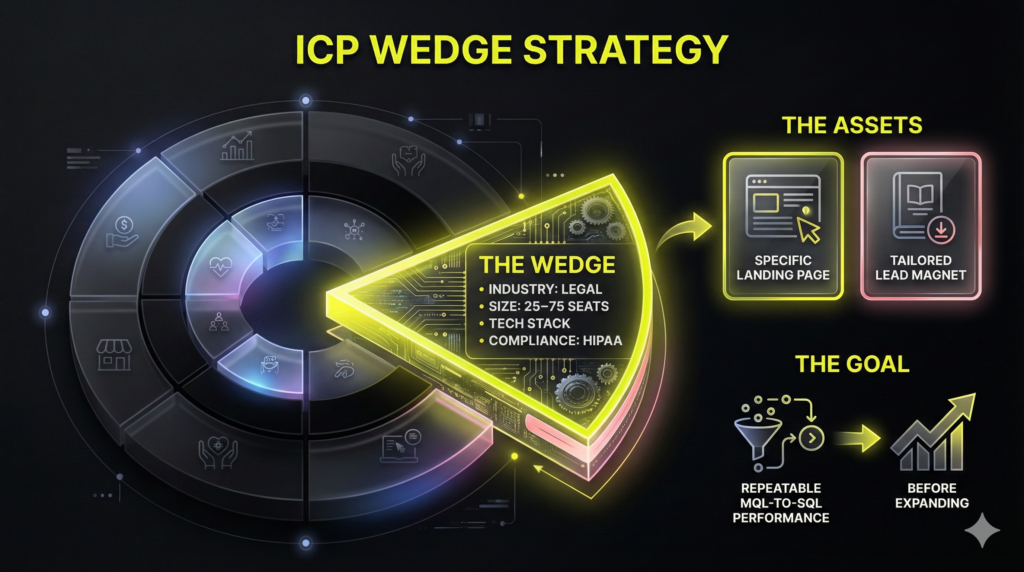
Define your Ideal Customer Profile (ICP) based on operational dimensions you can actually target:
* **Industry:** The vertical you know best (e.g., legal, manufacturing, finance).
* **Size Band:** Specific employee counts or revenue levels (e.g., 25–75 seats).
* **Tech Stack:** Specific systems or platforms they currently use or need to adopt.
* **Compliance Exposure:** Required regulatory adherence (HIPAA, CMMC, SOC 2, etc.).
* **Geography:** Your physical service radius for rapid response.
To gain immediate traction, select one narrow ICP *wedge*: one primary vertical plus a key buyer persona (e.g., Law Firms, 25–50 seats, targeting the Managing Partner).
Once the wedge is selected, build the minimum viable marketing assets immediately: a specific landing page centered on measurable outcomes and proof points for that niche, and a tailored lead magnet (e.g., Compliance Readiness Assessment or Security Checklist).
**Guardrail:** Do not add a second ICP until you demonstrate repeatable, profitable MQL→SQL performance in the first. Focus reduces waste and sharpens relevance, accelerating lead generation.
## 3. Productize Your Services to Eliminate Buyer Risk and Friction
Even after defining your ICP, qualified prospects often stall because managed services are sold as complex, custom projects. This introduces high perceived risk, scope confusion, and pricing friction. To improve **sales cycle efficiency**, apply **productization**—making the service easy to explain and even easier to buy.
Execute this **productization checklist** to move clients from proposal to contract quickly:
* **Name the Offer:** Avoid generic “Managed IT.” Use outcome-driven names (e.g., “Legal Compliance Shield,” “CMMC Readiness Package”).
* **Tier Pricing:** Structure service into three tiers (Good, Better, Best) with explicit inclusions and exclusions, eliminating “Option Paralysis.”
* **Define the Trigger:** Integrate a clear “why now” component. Use external pressures—like compliance deadlines, rising ransomware exposure, or insurance requirements—to create urgency.
Before scaling lead generation spend, ensure these minimum proof assets are built for your specific ICP:
* One detailed case study with before/after metrics.
* At least three testimonials or reviews aligned with the offer’s outcome.
* A one-page scope and onboarding timeline.
This structured approach ensures **predictable growth**. Packaged offers lower buyer anxiety, streamline delivery, and translate directly into verifiable **gross margin predictability**, which appeals deeply to ownership and investors.
4. Design the Website as a Conversion Engine: High-Converting Landing Pages
The most common error sabotaging marketing ROI is sending high-intent, targeted traffic to a generic homepage. Your homepage is a brochure; your **high-converting landing page** is the foundation of your revenue system. When running paid campaigns or leveraging high-value content, the destination must be hyper-focused on solving the specific pain point of your target Ideal Customer Profile (ICP). To ensure high conversion rates support your pipeline model, the page must eliminate buyer friction and anxiety.
The anatomy of a winning page, tailored to the specific ICP wedge (Section 2), includes:
* **Clarity on Offer:** Immediately state who the solution is for (e.g., “Law Firms 25-75 Seats”), the measurable business outcome, and the specific risk reduced (e.g., guaranteed regulatory compliance).
* **Process & Proof:** Detail the scope of work using high-value bullets (what’s included, implementation timeline, and the first call agenda). Integrate logos, three short testimonials, or a vertical-specific case study snippet for immediate authority.
* **Primary CTA:** Feature one clear, non-generic call to action, such as “Book Compliance Assessment” or “Request Fixed-Price Quote.”
For **predictable growth** and scaling, technical tracking is non-negotiable. This requires meticulous setup: call tracking, form tracking, proper UTMs on all inbound links, and tracking a ‘Thank You Page View’ event in your CRM. This technical infrastructure allows you to measure ad spend efficiency down to the keyword level, proving the ROI of every tactic in your **MSP Marketing Playbook**. Finally, the page must meet basic speed and mobile responsiveness requirements, as slow load times instantly kill conversions.
5. Systematize Content Velocity: The Flagship Asset Repurposing Playbook
Defining your Ideal Customer Profile (ICP) is insufficient if you cannot feed that niche with consistent, high-value content. Since MSPs cannot afford a dedicated writer for every vertical, generic content is often the default, which dilutes your message. The solution lies in maximum efficiency: implementing a structured, repeatable **flagship asset repurposing** system. This system delivers essential personalization without ballooning headcount. The core play: create one definitive asset per month (e.g., a 20-minute compliance webinar or CMMC whitepaper) tied directly to the ICP’s top pain point.
The Content Force Multiplier
Repurposing is the engine of content velocity. Enforce this strict workflow for every flagship asset to maximize reach and drive qualified Marketing Qualified Leads (MQLs):
* **Short-Form Video:** Extract 3–8 high-impact, 60-second clips for LinkedIn and social distribution.
* **Written Content:** Deconstruct core findings into one long-form blog post (for SEO) and 6–12 tailored LinkedIn posts.
* **Email Nurture:** Transform the content into a 3-email sequence targeting a specific buyer persona.
Tactical AI integration provides the 2026 edge. AI does not write the flagship asset—your team provides the strategic insight and technical validation—but it drastically speeds up distribution. Use AI for drafting initial outlines, automatically cutting video clips, generating variant hooks by persona, and summarizing executive briefs. The human role remains crucial: validating technical claims and injecting the differentiated Point-of-View (POV) that defines your firm.
For predictable growth, track attribution rigorously. Monitor the asset’s influence from content piece to landing page to MQL source. This confirms which assets drive closed business, informing topics for the next 30-day kickstart cycle within the **MSP Marketing Playbook**. This flow eliminates content bottlenecks and establishes market authority at scale.
6. Building Your Compounding Asset: Modern MSP SEO Strategy
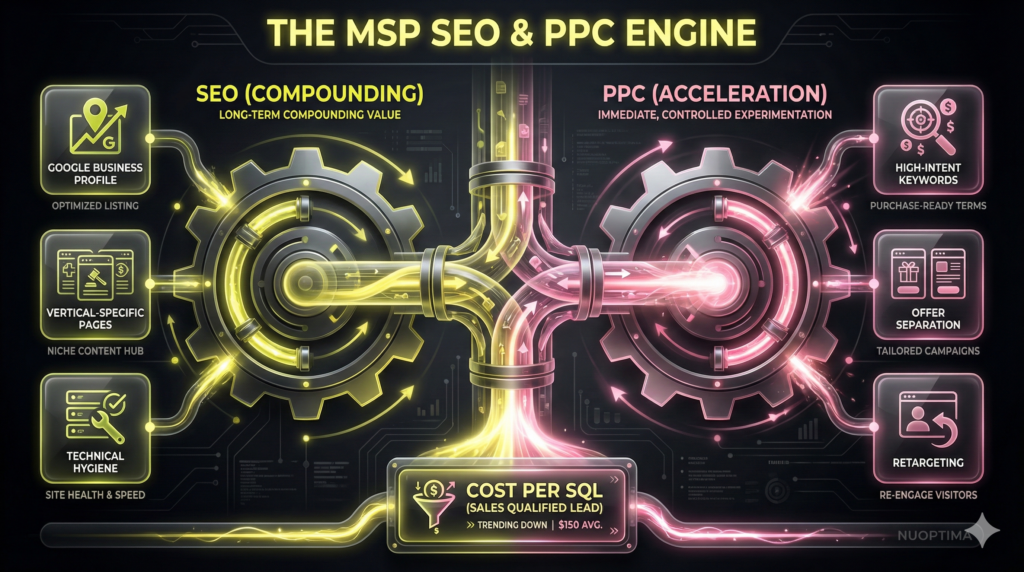
PPC delivers immediate phone calls, but **MSP SEO** builds predictable traffic and long-term enterprise value. SEO is a durable asset that feeds high-intent traffic to your conversion pages (Section 4). Unlike paid media, where leads halt when the budget is paused, organic search traffic compounds, lowering your blended client acquisition cost.
For 2026, successful MSP SEO moves beyond generic keyword rankings; it must be intensely localized and niche-focused. The mechanics that generate qualified MQLs are precise:
* **Hyper-Local Authority:** Aggressively optimize your **Google Business Profile**, focusing on review velocity and consistency to dominate local 3-pack results.
* **Vertical-Specific Pages:** Dedicate site sections to your niche (e.g., “MSP for Finance”). Support these pages with FAQs addressing critical regulatory concerns, risk, and sector downtime costs.
* **Targeted Service Area Pages:** Build local landing pages only for areas where you can physically sell or dispatch services. Focus on deliverability within a restricted footprint.
* **Technical Hygiene:** Ensure perfect crawlability, site speed, and mobile responsiveness; technical flaws directly impact authority and conversion rates.
Content strategy must answer critical buyer questions—not sell features. Write about compliance failures, complex insurance requirements, and the true cost of security downtime to establish expertise.
Measure outcomes, not efforts. The core KPI set is Impressions → Clicks → Conversions (MQLs). If you cannot connect organic traffic to a sales-qualified lead, the ranking is a vanity metric and must be ignored.
7. Launching a Controlled-Experiment PPC Engine (Cost per SQL)
While SEO builds long-term durability, Paid Per Click (PPC) is the lever for immediate acceleration and controlled experimentation. The PPC engine requires strict prerequisites before launch: a **clear, productized offer** (Section 3), a dedicated **high-converting landing page** (Section 4), and robust **conversion tracking** integrated with your CRM. If you cannot track an MQL’s journey to a Closed Won deal, the budget must be halted immediately.
PPC Structure for High-Intent Lead Flow
Prioritize intent over volume. Avoid generic terms like “IT support” (unless hyper-local), focusing on these precise elements:
* **Keyword Clusters:** Target 3–5 high-intent phrases that signal immediate need (e.g., “CMMC compliance consultant,” “HIPAA risk assessment service”).
* **Offer Separation:** Create entirely separate campaigns for each major offer or vertical (e.g., Managed Security vs. Cloud Migration).
* **Retargeting:** Dedicate budget to retargeting site visitors or recent webinar attendees already familiar with your brand.
Lead Quality Guardrails
The objective is acquiring **SQLs**, not cheap clicks. Control lead quality using strict negative keywords and on-form qualification steps:
* **Exclusion Lists:** Ruthlessly exclude bad geography, job seekers, consumer IT terms, and irrelevant industry searches.
* **Form Qualification:** Use qualifying questions on landing page forms to filter prospects who do not meet your ICP’s size band or industry criteria.
Leadership requires accountability. Core demanded metrics are: Cost Per Lead (CPL), Marketing Qualified Lead (MQL) rate, Sales Qualified Lead (SQL) rate, and the definitive metric: **Cost per SQL**. The common failure mode is optimizing for low Cost Per Click (CPC) or vanity traffic, instead of prioritizing qualified meetings and clear pipeline ROI.
8. Systematize LinkedIn: An ABM-Lite Approach for Scaling Relationships
MSP deals are relationship-driven, but traditional networking is not scalable. Many MSPs treat LinkedIn as either a passive branding exercise or a cold spam channel—neither delivers measurable opportunities. To maximize this platform within your **MSP Marketing Playbook**, reframe it as a disciplined, Account-Based Marketing (ABM) execution layer designed to build authority and relationships with Ideal Customer Profile (ICP) accounts at scale.
This ABM-lite approach demands precision. Based on your defined vertical and size wedge, create a “Dream 50–100” list of named target companies. Next, map the 3–5 key buying roles within those firms (e.g., Owner, COO, Finance Leader, IT Manager).
Design your weekly rhythm to nurture these targets with specific content velocity:
* **Content Mix:** Publish 2 Point-of-View (POV) posts, 1 proof post (testimonial or case study snippet), and 1 educational short video. Content must remain non-technical and outcome-led.
* **Outreach Sequence:** Execute a lightweight, value-first sequence: connection request → value-add message referencing a pain point or recent post → low-friction invite to an assessment or specialized webinar.
Crucially, measure success not by vanity impressions or likes, but by the ultimate metric: **meetings booked from named accounts**. This structured deployment transforms LinkedIn from a time sink into a predictable source of qualified sales conversations.
9. Implement the Minimum Viable Nurture System and Lead Scoring
Predictable growth in MSP marketing is found in the nurture phase. If Marketing Qualified Leads (MQLs) fail to convert into opportunities, the budget is wasted on short-term acquisition, not a long-term engine. Deploying a minimum viable nurture system stabilizes conversion rates and stops the funnel from leaking.
Your first step is deploying the minimum viable nurture system, which stabilizes your conversion rates and stops the funnel from leaking.
The Essential Nurture Structure
The minimum required structure must include:
1. **New Lead Education Sequence (7–10 Touches):** Mandatory for every new MQL. Its purpose is education, not selling—establish expertise by aligning content with the ICP’s pain points (Section 2) and positioning productized services (Section 3) as the natural solution.
2. **Re-engagement Sequence:** A short (3–5 touches over six months) sequence designed to re-engage stalled opportunities or cold leads who failed the initial education phase.
3. **Value-Dense Newsletter:** Only send this if it provides genuine market insight (e.g., security or compliance updates), avoiding internal company news.
Lead Scoring for Velocity
Nurture must integrate with **lead scoring** to route only high-intent prospects to sales, ensuring focus and speed.
Assign scores based on clear intent actions: visiting the pricing page, viewing the ‘Book a Demo,’ or attending a webinar. Leads hitting a high-intent threshold must route to sales for follow-up in under five minutes.
This framework requires **marketing automation** integrated with your CRM, utilizing clean lifecycle stages to track MQLs through nurture to Closed Won status. Avoid the common mistake of spammy promotional emails; focus instead on delivering educational value aligned with the buyer’s context.
10. Systematize Trust Assets: Referrals, Reviews, and Co-Marketing
Trust is the constraint in B2B service acquisition. While technical acumen is essential, the **MSP Marketing Playbook** requires a system that delivers third-party validation on schedule. Lack of verifiable social proof is the biggest friction point slowing pipeline velocity; you must turn the competitor’s primary advantage—referrals and reviews—into your predictable assets.
To guarantee a constant flow of trust signals, implement and measure these three core systems:
* **The Referral Engine:** Make the ask mandatory and systematic. Ask at high-probability moments: post-QBR, immediately post-onboarding, or following a successful high-stakes incident resolution. Make the process low-friction by using a dedicated referral link or a one-click email template for easy introductions.
* **The Review Velocity System:** Set a monthly target for new Google or niche industry reviews. Do not let these assets sit on an archive page; publish client testimonials and case study summaries directly onto relevant service and vertical landing pages.
* **Partner Co-Marketing:** Select 2–3 strategic, non-competitive vendors (security, cloud, or LOB app specialists) aligned with your ICP. Run joint webinars or co-brand essential assets, such as a “Compliance Checklist” or a “Risk Mitigation Guide.” This extends your reach and borrows instant credibility.
The ultimate KPI for this system is twofold: measurable **referral lead volume** and the associated **close rate**. Referrals and partner leads possess a dramatically higher close rate, providing the predictable pipeline quality that feeds your revenue model.
11. Execute the Minimum Viable GTM Plan for High-Margin Services
Attempting to launch multiple specialized services simultaneously is the common error that destroys marketing budgets, guaranteeing resource dispersion and fragmented messaging. To capture the margin available in complex services (Managed Security, AI Readiness, compliance), commit to launching only *one* high-margin wedge at a time: launch, learn, then scale. This focused Go-to-Market (**GTM**) requires a minimum viable marketing set engineered to drive qualified Sales Qualified Leads (SQLs):
The GTM Minimum Set
* **Offer Structure:** Clear tiers, defined deliverables, and a low-friction 30–60 day pilot or assessment.
* **Marketing Assets:** One educational webinar (focus on risk/outcomes), one targeted case study, and one simplified sales one-pager.
* **Distribution:** A named-account list (25–50 targets) for an ABM-lite approach, supported by specific LinkedIn follow-up.
Maximize conversions by designing a three-stage funnel:
* **Top-of-Funnel (TOFU):** Educational content focused intensely on the risk, compliance failure points, and the “why now” urgency for your Ideal Customer Profile (ICP).
* **Middle-of-Funnel (MOFU):** A productized pilot or assessment that provides tangible value and clear next steps.
* **Bottom-of-Funnel (BOFU):** A proposal tied directly to the assessment report, complete with a defined onboarding timeline.
Crucially, measure this initiative not by traffic or impressions, but by its contribution to **predictable growth**. The core KPI is attaching measurable revenue and expansion revenue (**LTV** goals) to the launched service. This targeted approach minimizes risk, ensures high-quality lead flow, and validates your ability to sell complex services before scaling. (239 words)
The 90-Day Execution Schedule for Predictable MSP Growth
The preceding 11 strategies provide the blueprint for growth. Predictable results require sequencing, not just tactics. Leaders need an operating system with clear ownership, milestones, and verifiable outcomes. Use this 90-day **Execution Schedule** to transition from marketing theory to a measurable, board-ready pipeline.
Prerequisites: Stabilizing the Launch Pad
Before initiating or scaling marketing spend, stabilize the funnel with three non-negotiable foundations:
* **ICP and Offer Definition:** Choose one focused Ideal Customer Profile (ICP) wedge and structure the associated **Productized Offers** (Sections 2 and 3).
* **Pipeline Model Finalized:** Model and approve conversion rates (Visit to MQL to SQL). Define the precise monthly targets required to hit revenue goals (Section 1).
* **Tracking Infrastructure:** Ensure CRM lifecycle stages, call tracking, and UTM standards are functional. Track the entire MQL to Closed journey (Sections 4 and 7).
Phase 1 (Days 1–30): Foundation and First Asset
The goal is to establish the fully tracked conversion path and produce the flagship asset for content velocity.
* **Finalize Infrastructure:** **Configure all CRM fields** and conversion events (MQL forms, Book Demo) for airtight tracking.
* **Build Your Conversion Engine:** **Design and publish 1 hyper-focused landing page** aligned with the ICP wedge and productized offer (Section 4). Feature one clear Call-to-Action (CTA).
* **Produce the Flagship Asset:** **Write and record one definitive educational webinar** or whitepaper (e.g., a Compliance Checklist for Law Firms). Tie it directly to the ICP’s top pain point.
* **Outcome:** A validated, tracked system that turns anonymous traffic into measurable MQLs, providing the first core piece of authority content.
Phase 2 (Days 31–60): Distribution, Nurture, and Trust
Leverage the new asset and stabilize conversion rates using automation and social proof.
* **Systematize Content Velocity:** **Execute the repurposing playbook** (Section 5). Deconstruct the flagship asset into 6 to 8 LinkedIn posts, 3 to 4 short videos, and one long-form blog post.
* **Launch Minimum Viable Nurture:** **Deploy the 7-touch New Lead Education Sequence** (Section 9). Implement basic lead scoring aligned with intent signals (e.g., pricing page views).
* **Activate Trust Assets:** **Launch the Review Velocity System** (Section 10). Set a mandatory monthly target for Google or niche reviews. Optimize your **Google Business Profile** for local SEO authority.
* **Outcome:** Automated MQL education, consistent LinkedIn brand presence, and measurable trust signals yielding higher conversion rates.
Phase 3 (Days 61–90): Controlled Experimentation and Validation
Use small, controlled paid budgets to test unit economics before scaling.
* **Launch Controlled PPC:** **Execute a small, high-intent PPC test** (Section 7). Focus exclusively on Cost per SQL, using precise, negative-keyword heavy targeting for the ICP.
* **Deploy ABM-Lite:** **Begin outreach to the “Dream 50” named account list** on LinkedIn (Section 8). Use repurposed content as the primary value driver.
* **Weekly KPI Review:** Conduct mandatory leadership reviews using a single scorecard. Track CPL, MQL to SQL Rate, Meetings Set (target versus actual), and **Cost per SQL**.
* **Outcome:** Verifiable unit economics from paid channels, validated messaging, and clear data identifying channels that deliver profitable SQLs.
The Quarterly Cadence for Leadership
This initial 90-day plan must transition into a continuous, repeatable operational rhythm to sustain predictable growth.
| Quarter | Focus Objective | Primary Execution | KPI Measurement Focus |
| :— | :— | :— | :— |
| **Q1** | **Foundation and Validation** | Establish pipeline model, launch one vertical wedge, validate one repeatable lead source (SEO or PPC). | MQL Volume, Cost per SQL, Close Rate. |
| **Q2** | **Scaling Efficiency** | Double down on 1 or 2 channels that proved **SQL efficiency** in Q1. Allocate resources only to proven channels. | Channel ROI, SQL Volume, Pipeline Velocity. |
| **Q3** | **Vertical Depth and Partnerships** | Launch the second minimum viable GTM (Section 11) for a high-margin service. Integrate 1 or 2 **Partner Co-Marketing** plays. | Expansion MRR, Partner Lead Volume, Close Rate on Complex Services. |
| **Q4** | **Expansion and Retention** | Offer expansion into a related, high-margin service (e.g., MSSP or compliance). Focus content on client retention and expansion stories. | Client Lifetime Value (LTV), Churn Reduction, Revenue from Existing Clients. |
**Final Deliverable:** By the end of Q1, leadership must receive a **One-Page Scorecard**. This essential document tracks target MRR versus actual MRR, summarizes learnings (which channels failed, which succeeded), and defines the resource bets for the next quarter. This report ensures marketing is viewed as a predictable, science-backed revenue engine and forces accountability.
الأسئلة الشائعة
The timeline depends heavily on the channel. Immediate results typically come from highly targeted Paid Per Click (PPC) campaigns focused on high-intent keywords, yielding MQLs within 30–60 days. Organic channels like **MSP SEO** and content marketing (authority-building) are long-term assets that begin showing pipeline impact around the 90-day mark and compound thereafter. True **predictable growth** is achieved when you stabilize conversion rates within the first 90-day execution cycle, as detailed in the schedule above.
A reasonable starting budget should be anchored to testing cycles, not just a monthly lump sum. Allocate sufficient funds to run a minimum of 4–6 weeks of controlled PPC experiments for your core Ideal Customer Profile (ICP), ensuring you generate enough data to calculate a reliable **Cost per SQL** (Sales Qualified Lead). If you cannot afford to test a channel adequately to prove profitable unit economics, postpone that tactic. Budgeting is an investment required to establish predictable outcomes, not an expense to avoid.
You must track a minimal KPI set that ties marketing effort directly to revenue. The core metrics are Cost Per Lead (CPL), the MQL to SQL conversion rate, and your blended Client Acquisition Cost (CAC) compared against the projected Lifetime Value (LTV) of a client. For investors and leadership, distill this into a **One-Page Scorecard** that compares target MRR versus actual MRR, breaks down the **Cost per SQL** by channel, and outlines the resource allocation strategy for the next quarter.
MSPs should use AI to maximize content velocity and personalization at scale. Use AI tools for drafting outlines, generating variant hooks by persona, and automatically repurposing flagship content (Section 5). However, the human role must be preserved for strategic validation: ensuring all technical claims are accurate, injecting your firm’s differentiated Point-of-View (POV), and maintaining strict brand security governance. AI is an engine for speed; human expertise is the source of authority.
The decision should be based on your capacity to consistently ship high-quality assets and run rigorous measurement. For most growing MSPs, the ideal strategy is a hybrid model. Keep core strategic functions internal, such as defining the Ideal Customer Profile (ICP) and the productized offers. Outsource the high-velocity production and distribution tasks—like SEO execution, paid media management, or content repurposing—to specialist partners who can guarantee reliable output and deliver results predictably.