The core challenge for managed service providers is not visibility, but credibility. High-intent B2B buyers skip entertainment and perform deep technical due diligence; your accounts must function as measurable trust signals. Chasing virality drains RevOps and accelerates the Technical Authority Gap. The goal for effective Social Media for MSP is not volume, but authority: you must become the obvious safe choice. This repeatable social selling MSP playbook ensures demand nurturing and supports complex sales conversations. Here are the eight levers for building consistent visibility and driving revenue outcomes.
1. Establish the Strategic Foundation: The Authority Triangle
If your social media output is generic or inconsistent, you actively signal that your MSP is a commodity to high-intent buyers and potential acquirers. Specialized growth demands codified positioning.
To bridge the “Technical Authority Gap,” deploy the Authority Triangle. This framework ensures every post contributes to predictable revenue outcomes by establishing differentiation across three elements:
- ICP (Ideal Customer Profile): Pinpoint your niche, moving beyond size/industry to include specific trigger moments: compliance deadlines, CISO transitions, or M&A activity.
- Offer (Core Outcomes): Strip away jargon. Focus on 1–2 measurable results: “guaranteed compliance readiness,” “reduced downtime risk,” or “predictable OpEx.”
- POV (Point of View): Define your contrarian, earned belief. This intellectual hook separates you. (Example: “Security is operations, not compliance,” or “The cloud is only as reliable as your RevOps.”)
Quick Execution for Social Media for MSP
Translate the strategy into immediate action. Refine your social bio: pair a 1-sentence outcome statement with three proof points (certifications, partnerships, or SLAs). Establish three permanent content pillars that map to your ICP’s fears (risk), goals (growth), and constraints (budget). This focused clarity drives M&A readiness and accelerated valuation. (203 words)
2. Execute a LinkedIn-First Posture for B2B Authority
Channel sprawl—launching accounts everywhere and achieving zero momentum—is the most common social media failure for MSPs. This dilutes positioning. The platform decision rule for B2B MSPs and MSSPs is non-negotiable: prioritize where economic buyers and talent reside. Your primary focus must be LinkedIn, the hub where C-suite decision-makers perform due diligence and validate your authority.
The Platform Discipline Checklist
Inactive social profiles signal neglect and actively reduce trust during buyer due diligence. Only launch channels you can sustain with weekly activity.
- Primary Channel (100% Focus): LinkedIn (Economic buyers, talent acquisition, partner ecosystem).
- Secondary Channel (Select One): Choose a platform based on a measurable goal (e.g., YouTube for durable educational content; X for competitive commentary; Facebook for localized culture).
Ensure your LinkedIn presence achieves Minimum Viable Profile status immediately. Maintain a consistent logo/banner, clear service categories, region served, and a high-value CTA (Book a Consult or Download a Security Checklist). Crucially, pin one high-authority asset (case study or “What to Ask an MSP” guide) immediately. This focused, LinkedIn-first strategy transforms your profile into a measurable revenue asset aligned with modern B2B buying behavior.
3. Codify Your Expertise: The Three-Pillar Content Cadence
Generic Social Media for MSP content, like “5 Tips to Improve Your Wi-Fi,” commoditizes expertise and attracts low-LTV clients. To command high-ticket contracts and maximize enterprise valuation, your content must function as continuous, undeniable evidence of deep technical authority and M&A Readiness.
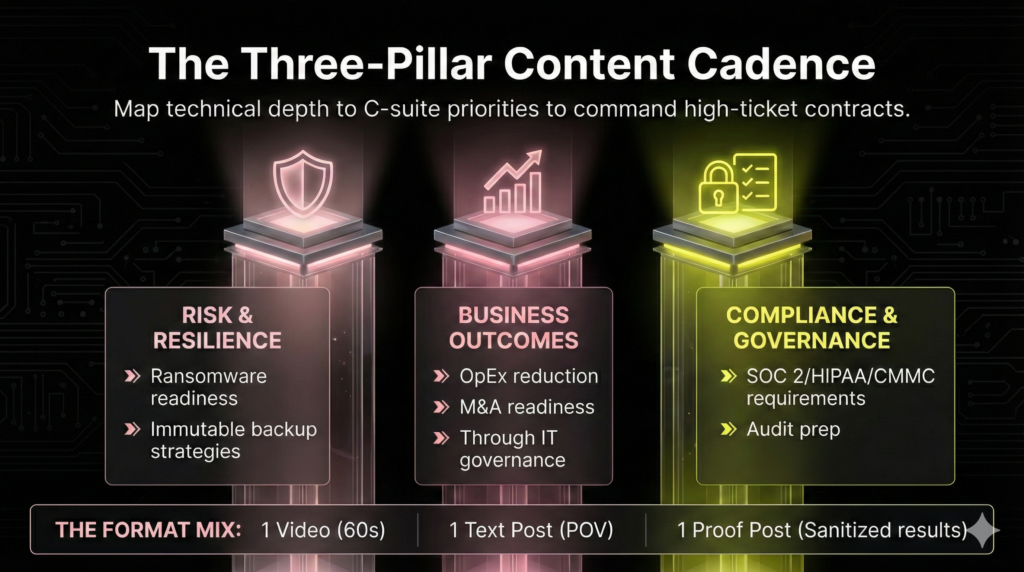
Establish a revolving three-pillar content cadence that consistently maps your technical depth to C-suite priorities:
- Risk & Resilience: Discuss complex downside protection: ransomware readiness, advanced incident learnings, and immutable backup strategies. This proves the MSP can handle enterprise-level operational disruption.
- Business Outcomes: Focus on quantifiable growth: OpEx reduction via automation, optimizing onboarding processes, and accelerating M&A readiness through IT governance cleanup.
- Compliance & Governance: Address the non-negotiables: demystifying SOC 2/HIPAA/CMMC requirements, audit preparation, and detailed policy hygiene necessary for predictable regulation adherence.
Structure your week simply: deploy Video content for MSPs, such as one 60-second video explaining a core concept; one text post offering a strong POV with actionable steps; and one proof post featuring sanitized client results (e.g., “99.99% uptime achieved” or “audit passed in 4 weeks”). Anchor all content with proof hooks. Utilize specific process signals (QBRs, vCIO cadence, runbooks) and measurable outcomes to ensure your authority is undeniable, signaling competence beyond technical features. (177 words)
4. Implement Operational Discipline: The Batching Cadence
Erratic posting accelerates content fatigue, damages authority, and signals instability—undermining the predictability required for M&A readiness. Consistency is not creative; it is an operational discipline that transforms your Social Media for MSP into a lightweight production line, solving the chaos of last-minute content creation.
To maintain the Three-Pillar Content Cadence without resource drain, adopt a strict batching rhythm. The minimum effective dose for scaling MSPs is three LinkedIn posts per week over a 90-day learning cycle, paired with 15 minutes daily dedicated to targeted engagement (commenting and DM triage).
The workflow must be weekly:
- Batch Day: Dedicate 60–90 minutes weekly to draft all three posts and record one short (60-second) educational video.
- Schedule: Use a centralized platform to schedule content 2–4 weeks ahead. This builds the necessary 14-day buffer, preventing vacations or critical incident response from breaking your authority streak.
The scheduling tool is an operational necessity for RevOps. It must provide scheduling, a content library, basic analytics, and crucial access controls. Prioritize features that allow monitoring mentions and routing inbound messages directly to the sales owner, ensuring social leads become a predictable pipeline input aligned with clear revenue outcomes. (179 words)
5. Deploy Low-Friction Nurture Offers for Pipeline Conversion
If your content engine is running, the risk is converting high-effort thought leadership into vanity metrics. Chasing broad engagement does not deliver revenue outcomes. The goal of Social Media for MSP is not awareness, but low-friction conversion moving interested parties directly into the CRM for nurturing.
Replace the immediate, hard pitch (“Book a Demo”) with two to three valuable nurture offers that appeal to the high-intent buyer. These are specific, consumable resources: an IT Budgeting Template for SMBs, a Security Readiness Checklist, or a Compliance Quick Audit guide.
Execution must be simple and non-intrusive. Every few posts, use a soft CTA: “Comment ‘CHECKLIST’ and I’ll send it directly.” This method provides an instantaneous, measurable pipeline input. When a prospect comments, route the response to a simple follow-up sequence: Resource delivery → Immediate, specific question → Optional, low-pressure call.
Crucially, design your landing pages not for volume, but for the qualification guardrail. Optimize the form to capture key firmographic data (vertical, size, role) for sales prioritization, ensuring the team only pursues high-LTV conversations. This RevOps approach turns social interaction into a quantifiable asset.
6. Accelerate Demand with Hypothesis-Driven Paid Social
If you are waiting 18 months for organic SEO to mature, or terrified of burning budget boosting random posts, you have correctly identified the paid social paradox. Unstructured spending drains the RevOps engine, and relying on organic reach is too slow for M&A readiness. The solution: treat paid social not as awareness, but as a hypothesis-driven testing engine focused exclusively on low-funnel qualification.
Start with one tight hypothesis: “CFOs in 20–200 employee healthcare firms will convert on a ransomware readiness checklist.”
Minimal setup validates intent: one proven nurture offer, one dedicated landing page, and one hyper-specific audience (industry, size, job titles). Run two creatives maximum following MSP AdWords management best practices: one naming the pain and outcome, and a second validating credibility.
Success metrics must move beyond vanity: prioritize Cost per Qualified Lead (CPQL), landing page conversion rate, and booked call rate. Implement a strict scale rule: only increase spend after you demonstrate the leads are high-quality, high-LTV meetings that match your ICP. This discipline ensures paid social accelerates, rather than jeopardizes, your predictable revenue outcomes. (178 words)
7. Activate Employee Advocacy with Compliance Guardrails
The company page is not the authority engine; your people are. For MSPs, however, unlocking team distribution often risks client confidentiality or compliance breaches. Many founders block posting, keeping Social Media for MSP impact low and stuck in the company page’s algorithmic penalty box. To mitigate risk and activate predictable social distribution, formalize the necessary guardrails. This is an essential component of M&A Readiness.
Set Rules of Engagement and Deploy Assets
Provide your team with a clear binary list of “Allowed” topics (educational tips, public industry commentary, culture) and “Not Allowed” topics (client PII, sensitive configurations, incident details).
Lower the friction to participation by providing plug-and-play posting assets. Give 2–3 willing team members 10 pre-approved educational tips, three simple visual templates, and five story starters. A lightweight cadence (one post per week) is dramatically better than forcing high volume.
Institute a strategic engagement play: when a team member posts, ensure three internal colleagues comment thoughtfully within the first 60 minutes. This internal reinforcement is a technical signal to the LinkedIn algorithm, accelerating team authority and predictable revenue outcomes.
8. Codify the Crisis Posture: Protecting Valuation During Incidents
Weeks of building Technical Authority are undone by panic-posting; crisis chaos erodes trust faster than technical failure, jeopardizing M&A Readiness. Your Social Media for MSP must operate under a codified response framework designed to minimize reputational erosion. This is not a PR function; it is a critical RevOps policy.
Establish the crisis posture before the event: designate a single approval authority for all public messaging and a clear triage owner for inbound DMs and mentions. Legal/compliance escalation must be instant.
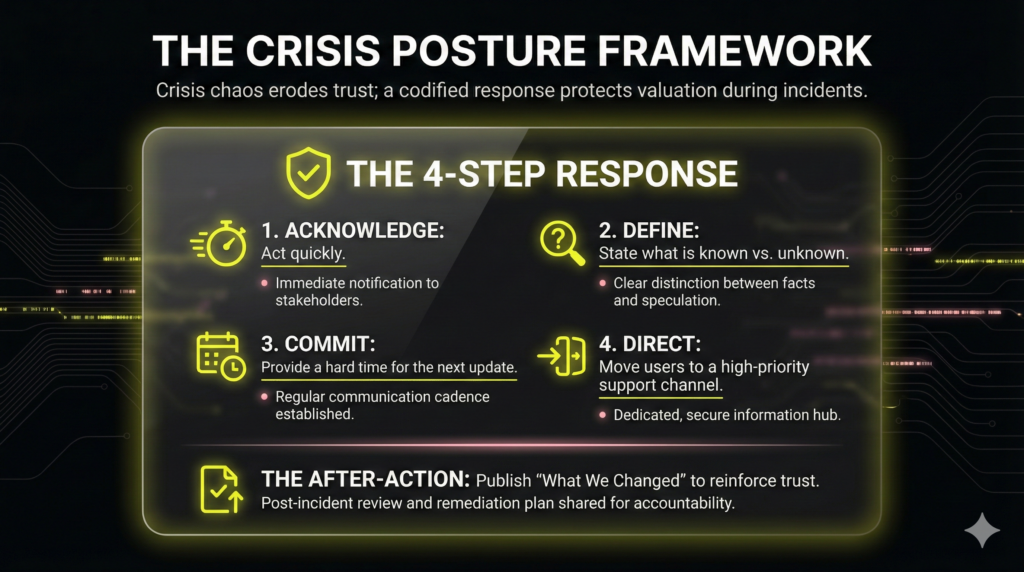
The response framework is disciplined:
- Acknowledge the incident quickly.
- State only what is known and what remains unknown.
- Provide a hard time for the next update.
- Direct clients to a dedicated, high-priority support channel.
For reputation ops, never debate public commentary. Respond calmly, move the conversation to private channels, and document the resolution internally. Once resolved, leverage the event strategically: publish sanitized after-action content detailing “What We Changed.” This demonstrates continuous improvement, reinforcing trust, and transforming a liability into a proof point for predictable revenue outcomes.
FAQ
The definitive first priority for any B2B MSP or MSSP is LinkedIn. This is where economic buyers and C-suite decision-makers perform due diligence, validate your expertise, and seek trusted advisors. Treat your LinkedIn Company Page and key employee profiles as measurable revenue assets, pinning high-authority assets like compliance guides or case studies. Only consider adding a secondary channel (like YouTube for durable video content) once a consistent, weekly cadence on LinkedIn is firmly established.
Prioritize consistency over intensity. For scaling MSPs, the minimum effective dose is posting three times per week, sustained over a 90-day learning cycle. Irregular posting or long gaps actively erode the technical authority you are working to build. A predictable batching cadence ensures you maintain the required visibility without resource chaos, signaling stability and operational discipline to potential high-LTV clients.
Focus on repurposing and the Three-Pillar Content Cadence (Risk, Outcomes, Compliance). If time is constrained, take one complex idea from a technical blog post or internal runbook and break it into three separate 60-second video or text posts. This transforms high-effort assets into bite-sized, proof-heavy content. The goal is providing undeniable evidence of competence, not generating entertainment.
Outsource the production and scheduling tasks, but never the strategy or technical authority. Strategy, including defining the ICP, unique POV, and revenue outcomes, must remain in-house under Fractional RevOps oversight. Outsourcing content creation requires strict guardrails and an internal approval process to ensure the voice accurately reflects your technical depth and protects client confidentiality, a key component of M&A Readiness.
Social media success is measured by low-friction conversion, not likes. Integrate attribution tools, ensuring all downloadable offers and CTAs use unique UTM parameters. Track pipeline inputs such as resource downloads, direct message replies (DMs), and, most critically, Cost per Qualified Lead (CPQL). Social media is generating true leads when you can correlate platform activity directly to high-LTV conversations captured within your CRM.
Maintain a codified crisis posture: Respond quickly, acknowledge the comment calmly, and immediately move the conversation to private channels (DM or support ticket). Never debate technical or security issues publicly. For sensitive security topics, route the comment to a designated, pre-approved escalation path within minutes. This disciplined approach protects reputational capital and ensures the perceived stability of your MSP brand.