The most critical decision facing MSP leaders is not which SEO strategy to adopt, but who has the bandwidth to execute it. The simple cost analysis that previously drove the choice between in house SEO vs outsourcing is obsolete. Modern visibility success hinges entirely on reliable execution capacity, not just strategy. Because AI search rewards consistent, structured, and high-quality content, sustained rankings demand significant operational resources and credibility building. We break down the true costs and strategic purpose of the four common models: in-house staff, fractional consultants, full agencies, and hybrid structures.
1. Defining Measurable SEO Outcomes: Beyond Vanity Metrics
The evaluation of in house SEO vs outsourcing hinges on one factor: defining success beyond vanity metrics. Most MSP executives fail at SEO because they misdiagnose success, tracking generic high-volume traffic instead of measurable business outcomes.
The Qualified Pipeline Scorecard
SEO execution must drive results that integrate directly into the sales pipeline. For Managed Service Providers, success means qualified pipeline outcomes, necessitating a pivot away from general volume (traffic, generic non-brand impressions) toward high-intent conversion points:
- Demos and Assessments: Tracking the first point of serious contact initiated directly from organic search is paramount.
- Consult Calls: Optimization efforts must focus on specific pages designed to transition high-intent visitors into sales conversations.
- Sales-Assisted Pages: Content must cover the entire buying journey (cost, comparison, compliance needs), ensuring comprehensive coverage of service, vertical, and proof pages to accelerate decision-making.
Why the Metrics Must Change in 2026
The AI and Large Language Model (LLM) revolution demands SEO compete not just for blue links, but for the position of cited source and expert quoted in generative search results. This pressure requires deep topical coverage and verifiable real-world proof.
To establish authority and win in this environment, success requires evidence of:
- Trust Signals (E-E-A-T): Requires baseline technical health, a clean technical backlog, and deep, specialized content that validates expertise, experience, authority, and trustworthiness.
- Citation Growth: Success includes an increasing velocity of digital PR and high-authority mentions, proving brand recognition as an industry leader.
An informed resourcing decision requires evaluating staffing models against this two-part scorecard:
Inputs (Execution Velocity)
- Content Throughput (Volume and Quality)
- Technical Backlog Throughput
- Link Velocity / Digital PR
Outputs (Business Impact)
- Non-Brand Impressions (relevant to core offerings)
- Qualified Leads
- Sales-Assisted Page Conversions
- Citation and Mention Growth
If you want a detailed framework, request an MSP-specific SEO/AI search scorecard template from NUOPTIMA.
2. The Illusion of the Solo SEO Hire: Why the “Unicorn” Doesn’t Scale
Hiring one person to solve the deep, competitive challenges of MSP visibility sets the individual and your budget up for failure. The myth of the “SEO unicorn”—the single individual who can flawlessly handle strategy, content creation, technical implementation, and digital PR—is the primary reason why many firms conclude that SEO “doesn’t work.”
What You Get When You Hire a Single SEO
In competitive B2B markets, a single hire rarely delivers the execution velocity required. What you acquire is typically a strategist and project manager who delivers:
- Strategy and roadmapping
- Basic on-page optimization (keyword implementation, metadata writing)
- Stakeholder wrangling (convincing IT management or development teams to prioritize tasks)
However, the skill gaps inherent to a single role immediately stall the essential inputs required for growth:
| Missing Essential Execution Capacity | Impact on MSP Growth |
|---|---|
| Technical Implementation | Slows Technical Backlog Throughput. Tasks sit in development queue for months. |
| Content Production | Low Content Throughput. One person cannot produce the deep topical expertise necessary for AI search. |
| Link Acquisition/Digital PR | Zero Citation Growth. Essential for building authority and E-E-A-T. |
The Hidden Cost of Dependencies
This capacity deficit creates internal dependencies that quickly translate into hidden costs. The SEO must borrow expensive time from billable employees: developers halt client work for technical fixes, and Subject Matter Experts (SMEs) must write the deep compliance or vertical content the SEO cannot produce.
This is fundamentally an opportunity cost problem. SEO requires consistent, high-volume inputs to compound. When execution is throttled by internal resource constraints, the entire process slows down, delaying profitable outcomes and undermining the argument for in-house SEO vs outsourcing.
Making the Solo Hire Work
The solo-hire model functions only if the MSP already possesses strong, dedicated resources: dedicated writers, allocated developer time, and established brand positioning. In this ideal scenario, the SEO acts as the coordinator and priority setter, maximizing the output of existing internal teams.
If choosing this path, define success by shipped work, not recommendations. The first 90 days must adhere to a rigid “ship list” of immediately implementable quick wins. Crucially, budget for fractional contractor support to handle high-velocity tasks—like link building or specialized technical remediation—allowing the core strategist to focus purely on strategic execution.
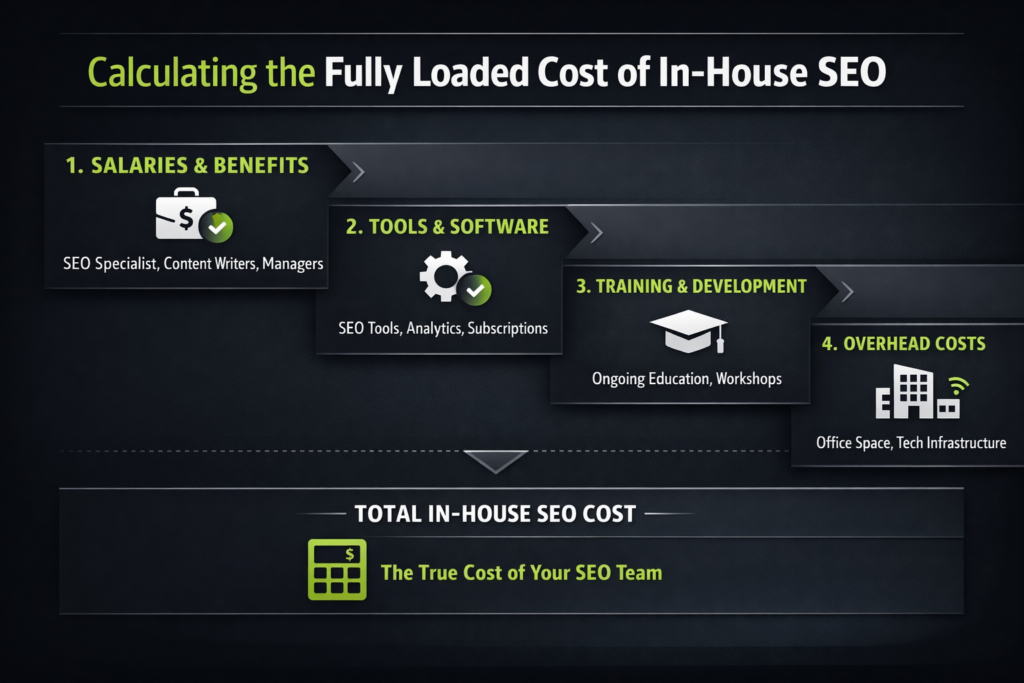
3. The Minimum Viable Stack: Calculating the Fully Loaded Cost of In-House SEO
To achieve the execution velocity of a dedicated agency, bringing SEO in-house requires replicating a multi-faceted team stack. This minimum viable structure delivers the technical, content, and authority inputs required for modern AI search environments. It moves beyond the “solo unicorn” fantasy, demanding simultaneous commitment to several dedicated functions.
The Agency-Equivalent In-House Stack
To build genuine authority and meet the demands of enterprise search, your team must include these five dedicated functions, designed not to rely on borrowed time from developers or Subject Matter Experts (SMEs):
- SEO Strategist/Lead: Owns the roadmap, manages prioritization, and translates business goals into measurable organic initiatives.
- Content Production: Drives the research, drafting, and editing of high-volume, deep topical content (requiring 1–3 writers plus an editor or SME).
- Technical SEO Owner: Works directly with development teams to own audits, site architecture, template optimization, schema implementation, and crawl/indexation health.
- Authority Building Specialist: Executes link outreach, digital PR, link acquisition and citation growth—the fundamental tasks needed to establish E-E-A-T.
- Analytics/Reporting Lead: Maintains dashboards, ensures proper attribution, manages call tracking hygiene, and connects organic performance directly to pipeline outcomes.
The Forgotten Components of Fully Loaded Costs
A critical error when comparing in-house SEO vs outsourcing is failing to calculate the fully loaded costs of personnel, which often double the simple salary figure.
- Human Capital Overhead: Account for health benefits, payroll taxes, retirement contributions, and the costs associated with recruiting and training. Losing an in-house expert can halt execution for six months due to churn and ramp time.
- Tools and Licenses: Unlike an agency that amortizes costs, an in-house team needs its own enterprise licenses for SEO suites (Ahrefs, SEMrush), specialized rank tracking, content optimization, and reporting platforms. These licensing costs can easily exceed $1,500 per month per strategist.
When In-House is Justified
The internal path is only strategically viable under specific, high-resource conditions:
- High Internal Dependencies: Your organization is complex, with heavy regulatory or compliance requirements where deep, constant internal dependency (like specialized security integration) is critical and ownership trumps speed.
- Long-Term Funding: You can commit to fully funding the minimum viable stack for 12 or more months before expecting compounding, revenue-generating results.
If your organization cannot commit to this full, multi-role stack, you are not choosing “in-house SEO.” You are intentionally choosing partial SEO, guaranteeing low execution velocity and slow, non-linear returns.
4. The Fractional SEO Consultant: Strategy, Oversight, Not Execution
A common, expensive mistake when evaluating in-house SEO vs outsourcing is treating a fractional consultant like a full-service agency. The fractional SEO lead provides high-leverage strategic guidance, not repeatable execution. Expecting them to write content or build links consistently results in powerful advice that never ships, halting organic growth and wasting resources.
What the Fractional Lead Delivers
The fractional lead operates as senior leadership, translating overarching business goals into a structured organic roadmap and bridging internal strategic gaps through:
- Strategy and Prioritization: Building the 12-month roadmap, conducting deep technical and topical audits, and defining the specific order of operations.
- Stakeholder Alignment: Managing the political landscape across the CEO/CMO, marketing, and development/IT teams, ensuring consensus on KPIs, ownership, and resource allocation.
- Vendor Management: Acting as an internal guardian to oversee the work of any external agency you hire later, protecting the MSP from poor reporting or generalized fluff services.
The Capacity Gap
Crucially, a consultant is focused on decision-making, not execution inputs. They are not structurally built to provide the inputs required for authority building or massive topical coverage.
Unless specifically scoped for additional contract support, consultants typically do not deliver:
- Consistent, high-volume content production (thousands of words per month).
- Ongoing link outreach, citation growth, or digital PR at scale.
- The actual technical fixes deployed in code.
Structuring the High-Leverage Engagement
This model is ideal for MSPs with existing content writers, developers, and marketing ops staff who lack senior direction. To ensure the consultation doesn’t become “advice that never ships,” structure the engagement by tying scope to tangible outcomes and requiring accountability.
Require the consultant to ensure:
- A Weekly Shipped-Work Log: Success is defined by what the team publishes, fixes, or completes, driven by consultant prioritization—not just their meeting schedule.
- Backlog Closure Metrics: Tie payment or renewal to closing the technical backlog, completing critical pipeline pages, and prioritizing specific high-intent keywords.
When executed well, the fractional leader provides the strategic rigor needed to transform internal resources into a high-performing execution team, maximizing your internal velocity. For most MSPs, however, this guidance only highlights the immediate need for a dedicated production arm—the next critical decision in the in-house SEO vs outsourcing debate. (294 words)
5. The Full-Service Agency: Buying Capacity and Predictable Execution
The outsourcing model offers immediate execution velocity, bypassing the long recruiting cycle, software licensing costs, and the capacity gaps of solo internal hires. For competitive MSPs, an agency delivers both strategy and continuous production concurrently, which is the core advantage in the in house SEO vs outsourcing debate.
What an Agency Must Deliver (Beyond “Recommendations”)
A legitimate SEO partner must drive pipeline growth and satisfy the modern AI search environment. If an agency only delivers strategy and spreadsheets, it is merely a high-priced fractional consultant.
Expect a full-service agency to own execution across the following pillars:
- Strategy & Content Production: Developing the topical authority map, producing comprehensive briefs, writing, editing, and managing the publishing cadence.
- Technical Remediation: Running continuous technical audits, providing clear implementation guidance, and generating ready-to-use development tickets or executing fixes directly.
- Authority Building (Digital PR): Consistent link acquisition, citation growth, and relationship-driven outreach—the critical components needed to establish E-E-A-T.
- Pipeline Reporting: Connecting visibility gains (rankings, AI citations) directly to measurable business outcomes (calls, form fills, qualified demos).
The Cost Efficiency of Outsourcing
Agencies provide superior ROI by amortizing significant overhead costs, including the tool stack and salaries. You gain instant access to a multi-role team—technical SEO, writers, and strategists—for the cost of one or two mid-level hires, delivering speed and specialization without the massive recruitment and training ramp time.
De-Risking the Agency Choice
MSP leaders must vet agencies rigorously to mitigate the objective risks of less control and communication failures. De-risk your choice by:
- Demanding a 90-Day Plan: Require a plan tied to specific deliverables (e.g., 12 content pieces, 10 links, technical audit completion) and a firm shipping cadence.
- Verifying Case Studies: Ask for client results and verify success using third-party tools (Ahrefs, SEMrush) to ensure performance is real, not inflated.
If you want an MSP-focused SEO + AI search partner, NUOPTIMA can provide the plan, production, Generative Engine Optimization (GEO), off-page SEO and reporting—without you building a full internal department. Learn our Cortavo MSP, Microminder and Eden Data case studies.
6. The Tactical Hybrid Structure: Maximizing Velocity Without Sacrificing Control
When a full in-house team is too costly and a full agency lacks control, the tactical hybrid structure resolves the in-house SEO vs outsourcing tension. It delivers agency velocity while retaining internal control over brand voice and client intimacy.
The Hybrid Principle: Truth In, Scale Out
The simplest rule for the hybrid model is to keep the “truth” in-house and outsource “scale and specialization.”
- Internal (The Truth): Core knowledge that cannot be delegated: Subject Matter Expert (SME) interviews, case study validation, final content approvals, Ideal Customer Profile (ICP) knowledge, and vertical compliance expertise (e.g., HIPAA, CMMC).
- External (Scale + Specialization): High-volume, repeatable tasks requiring deep technical expertise: technical SEO audits, link outreach/digital PR sprints, content velocity (research/drafting), and specialized analytical reporting.
A Practical MSP Hybrid Org Chart
This structure keeps internal headcount lean while buying immediate, multi-role execution capacity.
- Internal Core: A Marketing Lead/CMO who owns strategy and budget, plus one Content Owner/SME Coordinator who translates internal expertise into external briefs.
- External Pod: A dedicated agency or contractors acting as the execution arm (Strategist, Technical SEO specialist, Content Writer/Editor, and Link/Outreach team).
If internal leadership is thin, a fractional SEO lead can act as the ‘orchestrator’ between the CMO and the external pod, focusing the agency on closing the technical backlog and hitting qualified pipeline KPIs.
Defining Ownership (RACI)
Clarity prevents delays; the RACI model ensures every task moves forward efficiently:
- Responsible (The Doers): The external agency content and technical teams.
- Accountable (The Buck Stops Here): The internal Marketing Lead/CMO.
- Consulted (SMEs/Experts): Internal billable staff providing validation and input.
- Informed (Leadership): Executives who need monthly KPI reviews and sales pipeline reports.
This model is superior for MSPs, leveraging your busiest asset: SMEs. Brief interviews yield high-quality input, allowing the outsourced team to handle drafting, optimization, and publishing. This protects compliance and brand while delivering the consistent throughput necessary to win in modern search.
7. Operationalizing the Decision: Governance and Your 90-Day Scorecard
Selecting the right model is only the first step; the greater risk is poor governance. Without strict controls on budget segmentation, data ownership, and project management, even the best team will fail. Success hinges entirely on how effectively you measure, manage, and scale the SEO relationship.
Budgeting Like an Operator
Avoid simple retainers. Budgeting must match your specific bottleneck, breaking scope into tiered execution needs to maximize leverage:
- Content Tier: High-volume topical production. Ideal if technical health is strong but authority is thin.
- Technical Tier: Dedicated to clearing the technical backlog, site speed, and indexation health.
- Authority Tier: Focused on digital PR, link acquisition, and citation growth to establish E-E-A-T.
- Full-Service: Maximum budget, blending all three for deep competitive challenges.
If your MSP needs to establish vertical expertise and trust, invest heavily in the Content and Authority tiers, bypassing basic keyword list generation.
Tooling and Data Ownership
Data sovereignty is non-negotiable. Contracts must include transition clauses ensuring the MSP retains 100% ownership of:
- Platform Access: Primary access to GA4 and Google Search Console (GSC).
- Asset Files: All content drafts, editorial calendars, link outreach lists, and landing page templates.
- Handoff Timeline: A defined clause detailing the export process and knowledge transfer if the vendor relationship terminates.
Project Management Integration
All work must live in a single source of truth (Jira/Asana). Clearly define who triages the backlog and approves priorities. Require weekly PM updates focused strictly on shipped deliverables and resulting business KPIs, avoiding reports based only on activity.
The 90-Day Scorecard
Move beyond vanity reporting by tying success to shipped deliverables and qualified leads, not just rank increases. Use this concrete 90-day evaluation plan:
| Phase | Goal | Decision Rule at Day 90 |
|---|---|---|
| Weeks 1–2 (Baseline) | Establish traffic/lead benchmarks; complete core technical audit. | Did the team deliver the audit and baselines? |
| Weeks 3–6 (Quick Wins) | Deploy all high-impact, low-effort fixes; ship 4–6 high-intent pipeline pages. | Was the technical backlog reduced by 25%? |
| Weeks 7–12 (Compounding Assets) | Launch 6–8 deep authority content pieces; secure initial links/citations. | Did the velocity targets hit? Are qualified lead metrics moving positively? |
At day 90, make a strategic decision: scale the scope, adjust focus (e.g., technical to content), or change the model. This structured approach ensures optimization and accountability.
Operationalizing Your MSP SEO Strategy: The 90-Day Execution Plan
Selecting the right capacity model (in-house, fractional, or agency) is only the first step. Most MSP SEO failures result from operational drift: unclear key performance indicators (KPIs), poor backlog discipline, and inconsistent shipping cadences. This 90-day execution schedule provides the specific structure required to turn strategy into predictable business outcomes, regardless of the staffing model you choose.
Prerequisites: Define the Baseline
Before Day 1, define the necessary inputs and ensure data hygiene:
- Define Core Identity: Pinpoint your Ideal Customer Profile (ICP). Confirm your top five service lines and target geographies or verticals.
- Confirm Tracking Hygiene: Ensure all tracking basics are functional: calls, form fills, and initial CRM attribution. Connect organic traffic directly to qualified pipeline leads.
- Decide Operating Cadence: Lock in a project management platform (e.g., Jira, Asana). Commit to a review schedule: weekly shipping commitments and a monthly business review (MBR).
Days 1–30: Baseline and Technical Triage
Establish technical health and set content authority targets during the first month.
- Execute Core Audits: Complete a full technical audit. Prioritize indexation, crawl health, and site speed, using findings to generate the technical backlog.
- Inventory Priority Pages: Audit existing “money pages” (service, vertical, and location assets). Identify immediate optimization targets.
- Map the Content Gap: Develop a content gap map covering the MSP buyer journey (Awareness to Vendor Shortlist). Define the topics required to establish topical authority in your niche.
Days 31–60: Prove Early Wins and Ship Velocity
Deliver tangible quick wins during this phase to demonstrate momentum and justify investment.
- Upgrade Pipeline Assets: Ship 2–4 critical “money page” upgrades (service, vertical, or location pages). Fully optimize these assets with internal linking.
- Publish Support Content: Produce and ship 2–6 high-intent support assets (FAQs, comparison articles, refreshed case studies, or pricing breakdowns).
- Initiate Authority Building: Launch the authority tier. Generate Digital PR pitch angles, compile partner ecosystem mentions, and begin targeted link outreach.
Days 61–90: Lock-In and Scale Capacity
Dedicate the final 30 days to locking repeatable processes and making the strategic decision to scale.
- Build Repeatable Content Ops: Formalize content production. Build brief templates, lock the schedule for Subject Matter Expert (SME) interviews, and set quality assurance (QA) requirements.
- Lock the Q2 Roadmap: Based on early wins and capacity constraints, finalize the content, technical, and authority roadmaps for the next three months.
- Capacity Decision Point: Determine capacity needs. Decide whether to hire an editor, commit dedicated developer time, or expand the scope of your agency partner to meet velocity demands.
If your organization requires a dedicated strategic partner to run this 90-day execution plan end-to-end (delivering the content, technical remediation, and authority building required to win AI search visibility), NUOPTIMA can implement this roadmap with clear deliverables and pipeline reporting.
FAQ
Not when accounting for fully loaded costs. An agency amortizes enterprise software, training, and specialized salaries (technical, content, outreach). An in-house team requires funding the minimum viable stack—typically the cost of 3-5 roles—plus $1,500+ monthly in tools. If you cannot afford the full stack, the partial in-house investment yields slow, non-linear returns compared to the immediate, specialized execution capacity of an agency.
No. A fractional consultant provides strategic direction, prioritization, and internal alignment; they do not provide continuous execution velocity. Consultants are ideal for strategy oversight but lack the capacity to write high-volume content, implement technical fixes, or drive scale link acquisition. For execution, they require a production arm (internal staff or an outsourced agency) to ship the work.
Early indicators often appear around the 90-day mark, showing improvements in technical health, indexing, and high-intent keyword ranking. However, durable, compounding results that impact the qualified pipeline and revenue typically take 6 to 12 months. Velocity in fixing the technical backlog and publishing deep authority content accelerates this timeline.
Demand clarity on deliverables, not just activities. Ask for a 90-day execution roadmap tied to specific outputs (e.g., number of links, content pieces shipped, technical backlog closure). Verify communication cadence, asset ownership (must be 100% client-owned), and review the exit terms to ensure a smooth transition should the partnership end.
The MSP must retain 100% direct ownership and primary access to all digital assets, including Google Search Console (GSC), GA4 accounts, and all content drafts and editorial calendars. While an agency may manage or operate these tools, the client should never allow a third party to “hold” these accounts hostage. Data sovereignty is non-negotiable and essential for a smooth transition.
If you want an MSP-specific execution plan outlining required roles, fully loaded costs, and a measurable 90-day pipeline roadmap, NUOPTIMA can provide a scoped consultation.