The Technical Authority Gap is the fundamental friction in scaling MSP services. Wasting 3–4 calls educating prospects stalls pipeline velocity and jeopardizes M&A readiness. You must engineer out this sales friction. Video content for MSP is the fastest way to translate technical competence into demonstrable trust and accelerate conversion. This strategy focuses purely on revenue outcomes, not vanity views, detailing six proven formats to pre-qualify every prospect. We start with the essential asset that lifts every channel: the Explainer Video.
1. The 60-Second Conversion Asset: Explainer Video
MSPs cripple pipeline velocity when sales calls start with explaining the process. The Explainer Video executes that crucial digital handshake, shrinking time-to-conversion and boosting M&A readiness by establishing baseline trust before the demo.
This concise, 60–120 second video content for MSPs lives on high-value pages (homepage, Managed IT, Cybersecurity/MDR). Its function is to immediately translate complex technical capabilities into quantifiable business outcomes—downtime avoidance, predictable spend, and compliance readiness—closing the Technical Authority Gap before a meeting is booked.
How to Build a Pipeline-Ready Explainer Video
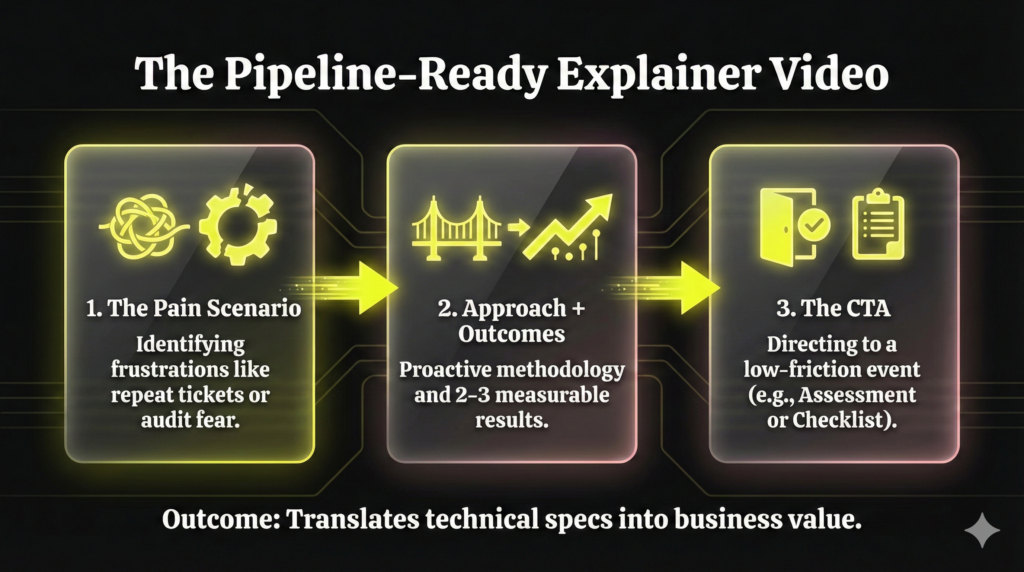
Execution must be lean, focused entirely on the outcome, not the specific tools or technology stack. A hyper-focused script requires three critical beats to move the needle:
- The Pain Scenario: Name a specific frustration your ideal client is experiencing (e.g., “The pain of repeat tickets” or “The fear of a failed compliance audit”).
- Your Approach + Outcomes: Detail your unique methodology (e.g., “What proactive actually means”) and promise 2–3 measurable results (e.g., risk reduction, guaranteed uptime).
- The CTA: A direct call to action, usually driving toward a specific low-friction conversion event (e.g., “Book a 15-minute assessment” or “Download our compliance readiness checklist”).
Whether delivered by a talking head or motion graphics, this asset must immediately address the client’s primary fear: risk exposure. This ensures every booked demo is already focused on measurable ROI and strategic partnership, not feature parity.
2. Short-Form Video: The Repeatable Attention Engine
The objective of video content for MSP in this format is repeatable, low-cost attention designed to accelerate pipeline velocity. Unlike evergreen explainers, these 15–60 second clips, optimized for Reels and LinkedIn, serve as daily distribution tools to build pure awareness and technical authority. Each segment must answer one question, debunk one myth, or demonstrate one quick security check. This format targets high-intent micro-moments.
Engineered Hooks for Technical Authority
The video structure is non-negotiable: immediately address the user’s operational anxiety to establish instant credibility. Leverage hook templates proven to capture C-suite attention:
- “If you use Microsoft 365, check this setting for account takeover prevention…”
- “One sign your team is bypassing your MFA policy…”
- “This common ‘backup’ strategy fails under real-life ransomware pressure because…”
These direct hooks cut through noise and quickly bridge the Technical Authority Gap, positioning the MSP as a trusted, knowledgeable advisor.
Maximizing Bottom-Funnel Intent
Optimize these assets for clear conversion mapping, not just vanity views. The video’s title text overlay must explicitly state the plain-English query the prospect is searching for (e.g., HIPAA Compliance Checklist 2024). Crucially, utilize hyper-focused hashtags combining the industry, problem, and region (e.g., #FinTechCompliance #DallasMSSP). Ensure captions are on by default and limit the CTA to one directive.
Content should focus on trust-building topics—phishing examples, device hygiene, incident-response readiness, or compliance ‘gotchas’—not fear mongering. Every video must map to a specific conversion event, serving as a core pillar of your social selling strategy. Link the content directly to your Security Readiness Checklist or a 15-minute risk review. This methodology transforms high-volume distribution into a predictable lead engine, critical for maximizing enterprise valuation and M&A readiness.
3. Prove Operational Maturity: The Technical Workflow Demo
MSPs possess world-class internal processes, yet these proprietary workflows remain invisible to prospects. This forces sales teams to waste valuable pipeline velocity proving fundamental competence. The Technical Workflow Demo provides a massive competitive advantage: leveraging short, 2–6 minute screen recordings to document specific, auditable processes. This is due diligence in advance, instantly establishing operational maturity.
These assets must focus on revealing high-value procedures, transforming vague promises into concrete technical process proof. Consider demonstrating: “What our monthly executive summary actually shows,” “How we triage a suspicious login,” or “The step-by-step path a ticket takes from intake to resolution.” These videos confirm the quality of your back office—a critical requirement for maximizing enterprise valuation and M&A readiness.
To keep these trust-building tools client-safe, always use a demo tenant and sanitized data; real client names, domains, and IPs are non-negotiable red flags. Production quality should prioritize clear audio and visual focus (zooms, cursor highlights) over cinematic value.
Place these powerful pieces of video content for MSP on dedicated service pages or use them as follow-up attachments during the proposal phase. They eliminate the need for long explanations, allowing the live demo to focus exclusively on strategic fit and ROI.
4. Personalized Sales Video: Unsticking Stalled Deals
The primary drain on pipeline velocity is the stalled deal—the “ghosting” that vanishes into silence. Such sales friction is unacceptable when maximizing enterprise valuation. Personalized video acts as a strategic pattern interrupt, forcing high-leverage engagement in the MSP sales cycle.
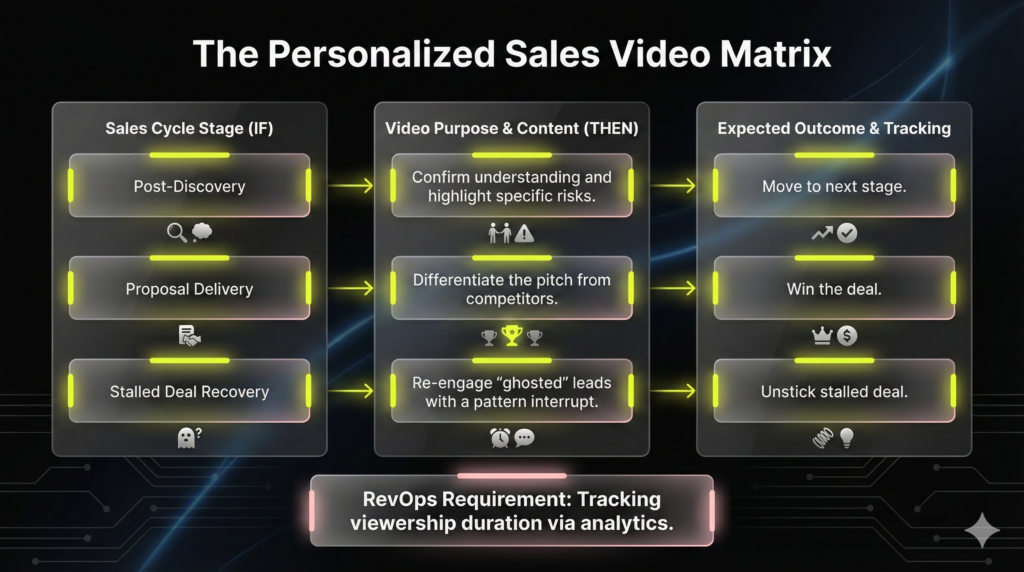
Highest ROI videos are deployed at high-leverage junctures: following first discovery (to confirm understanding), sending the official proposal (to differentiate the pitch), or recovering deals stalled post-discovery. Success requires context-specificity and strict time-boxing, kept under two minutes.
The script requires three critical elements: a specific observation (e.g., “Here are the three risks I saw in your backup strategy”), a concise recommendation of the next step (e.g., “Here is how we’d phase onboarding”), and a single, unambiguous calendar link CTA.
For MSPs focused on RevOps rigor, tooling is paramount: the platform must provide robust viewer analytics. Tracking precise viewership duration is non-negotiable. This data allows sales teams to align follow-up timing to specific watched/not-watched behavior, ensuring every touchpoint is strategic and data-driven, never speculative.
Integrating personalized video into the sales motion accelerates conversion, transforming manual BDR tasks into an auditable, high-conversion machine essential for M&A readiness.
5. The Video Case Study: Investor-Grade Proof and Bottom-Funnel Intent
Prospects distrust marketing claims for high-value contracts; they rely on peer evidence. The video case study is your most potent bottom-funnel proof, transforming technical success into investor-grade evidence that justifies premium pricing and accelerates enterprise valuation.
Maximize asset utility by choosing a story with a clear, quantifiable before-and-after. Avoid generic praise; prioritize clients who experienced reduced downtime, successfully avoided or recovered from a ransomware incident, or passed a critical compliance audit.
Structuring Trust and Utility
The client interview should follow a strict, easy-to-record three-part structure:
- The Problem: What specific, painful operational deficit did they have before contacting you?
- The Choice: Why did they choose your MSP over a competitor?
- The Measurable Result: Detail 1–2 metrics (e.g., “99.99% uptime restored,” “reduced audit preparation time by 60%”).
Engineer the asset for multi-channel usage. Utilize video content for MSP by cutting down clips: 15–30 second quote clips for daily LinkedIn posts or Shorts; 60–90 second segments for relevant service pages; and the 3–5 minute full story for YouTube or proposal follow-ups.
Crucially, include trust-building details: the client’s industry, company size bracket, and the high-level solution implemented. This rigor transforms a testimonial into due diligence, enabling decision-makers to justify the investment. Always conclude with a clear CTA, prompting immediate next steps like “Book a readiness review” or “Download the full case study PDF.”
6. The Operational Blueprint Video: Reducing Client Switching Risk
High-value conversions stall on the prospect’s fear of transition. Objections like “Will this disrupt operations?” and “How fast are tickets handled?” lose deals to perceived switching risk. The solution is the Operational Blueprint Video, a set of 2–4 hyper-focused videos that make your delivery model visible and auditable.
This strategic content acts as a visual trust checklist, proving operational maturity and strengthening M&A readiness by documenting predictable, scalable RevOps.
The Trust Checklist: What to Visualize
This asset eliminates sales friction by preemptively answering due diligence questions. Key elements include:
- Onboarding Timeline: Visually detail the Day 1 through Day 90 process, clarifying client and MSP responsibilities, access requirements, and change management procedures.
- Support and Escalation Model: Demonstrate exactly how tickets are triaged, who owns resolution, and how after-hours security issues escalate.
- Value Confirmation: Show what the client receives monthly (e.g., a sample QBR agenda or executive summary walk-through) to prove ongoing value.
Deploy these videos on your proposal page, in post-discovery follow-ups, or within the onboarding sequence. Revealing internal excellence directly answers all major objections—eliminating ambiguity, accelerating pipeline velocity, and validating your premium price point.
How to Operationalize Video Content for MSPs: A 30-Day Execution Schedule
Transitioning video from an aspiration to predictable pipeline velocity requires a defined operating system. Use this four-week schedule to build technical authority and strengthen M&A readiness through repeatable output.
The 4-Week Video OS Blueprint
Week 1: Strategy and Asset Mapping. Define the three mandatory video assets that service the revenue funnel: one Explainer Video (conversion), three Short-Form Clips (reach), and one Video Case Study (trust/bottom-funnel intent). This validates critical conversion pathways.
Week 2: Minimal Production Configuration. Build the foundational setup. Prioritize professional-grade audio first, followed by lighting and camera. Standardize a single editing approach and template (branded intro/outro, lower-thirds) to ensure brand control and repeatable output.
Week 3: Batch Production Workflow. Implement the repeatable process essential for maximizing scale. Schedule batch scripting (30 minutes), batch recording (60–90 minutes)und batch editing (1–2 hours) for high-volume content. This conserves internal bandwidth and avoids technical debt.
Week 4: Distribution and Repurposing Protocol. Enforce the 1:3–6 repurposing rule: one long asset must yield 3–6 short cutdowns. Publish all assets on YouTube und embed high-intent assets on corresponding service pages to maximize conversions. Reuse cutdowns within email sequences and client proposals (reference Section 4 for full RevOps integration).
Strategic Investment Paths
Base your execution decision on internal bandwidth versus desired speed. Choose one of three paths: DIY (lowest cash, highest time commitment), Freelancer (mid-cost, moderate speed), or a Template/Vendor Pack (highest cash, fastest deployment). Evaluate the choice based on critical factors: required speed, internal bandwidth, brand control requirements, and compliance risk appetite.
FAQ
Video duration must correlate directly with the prospect’s stage in the conversion funnel. For top-of-funnel reach (Short-Form/Reels), target 15–60 seconds. Explainer Videos for awareness and trust should be 60–120 seconds. Bottom-funnel assets, such as Workflow Demos and Video Case Studies, require 2–6 minutes to provide necessary operational proof. Always prioritize clear communication over duration; one video should execute one specific job.
To establish technical authority, professional sound is non-negotiable. Prioritize investing in a high-quality USB microphone and clean, consistent lighting setup before upgrading the camera. Ensure you record in a quiet environment with a stable frame, and always utilize automatic captions. Credibility is built on clear communication, not cinematic production value, so focus on sound and lighting clarity.
Every channel serves a distinct strategic purpose. Use YouTube for evergreen search visibility and for hosting assets that will be embedded on your website and service pages. Leverage LinkedIn for B2B distribution and lead generation, especially for Short-Form content (Reels/Shorts) designed for daily awareness. Avoid creating net-new content for every channel; enforce a repurposing protocol to maximize pipeline velocity.
Focus on measurable revenue outcomes, not views or likes. Track the conversion rate uplift on service pages where explainer videos are embedded. Monitor the change in proposal close rate when Personalized Sales Videos or Workflow Demos are included in the process. Crucially, use viewer analytics from personalized videos to align sales follow-up timing, treating viewership data as a high-intent signal for RevOps execution.
Your decision should be based on maximizing enterprise valuation through repeatable processes. Choose DIY if internal bandwidth is high and speed is low. Hire a skilled freelancer for rapid deployment of high-value assets (like Case Studies) where brand control is paramount. Consider a template vendor for standardized Short-Form content creation to minimize internal time commitment and establish a predictable content OS (See the Strategic Investment Paths section above).