The era of chasing page 1 traffic is over. Modern B2B growth requires an AI SEO strategy focused on answer-engine visibility and brand citations rather than just clicks. As LLMs build vendor shortlists, your brand loses click volume but gains invisible influence.
At nuoptima.com, we bridge this technical authority gap. This framework provides a roadmap for comparison pages, expert content, trust signals, and attribution to ensure you remain the primary cited authority.
Key Takeaways
- Modern B2B AI SEO measures Share of Model (AI share of voice), citation presence, and brand attribution in comparison prompts rather than raw page-one traffic.
- Treat your website as a structured retrieval database, using TL;DR summaries, Q&A blocks, definitions, and comparison tables so LLMs can extract and cite your claims.
- Comparison pages (category vs competitor, best category for ICP, competitor alternatives) capture high-intent buyers and give AI engines the structured data they need for shortlists.
- RAG systems weight third-party evidence over your own domain, so off-site mentions, YouTube transcripts, and niche citations are as important as on-site optimization.
1. Owning the Share of Model in AI-First Search
Traditional lead magnets fail because buyers no longer visit your site to evaluate technical expertise. Prospects now use complex, situational prompts like Find a SOC2-compliant MSSP for a mid-market law firm. LLMs synthesize your content into summaries, often satisfying the query without a click.
This shift moves pipeline creation inside the answer engine. To compete, you must optimize for new visibility KPIs:
- Share of Model (AI Share of Voice)
- Citation presence in category and problem queries
- Brand attribution in comparison prompts
Success is no longer measured by raw traffic but by your footprint in model responses.
Treat your website as a structured retrieval database. Make key technical claims easy for AI to extract, validate, and attribute to your brand. A mature AI SEO strategy ensures your firm remains the primary cited authority during the pre-click consideration phase. This prevents teams from over-indexing on legacy rankings and aligns marketing to actual pipeline impact.
## 2. Building Comparison Pages for High-Intent AI Retrieval
LLMs like ChatGPT and Perplexity prioritize structured data to categorize pros, cons, and use cases. Vague marketing copy fails in AI search because it lacks the logical framework models need to provide authoritative recommendations. High-density comparison pages bridge the technical authority gap by delivering this structured differentiation.
Capture high-intent buyers by publishing targeted B2B templates:
- {Your Category} vs {Competitor}
- Best {Category} for {Specific ICP}
- {Competitor} alternatives for {Constraint: Compliance, Budget, Region}
These assets serve as bottom-funnel organic equity that answers what should we buy? directly. This approach builds investor-ready revenue data for PE-backed firms by creating a scalable engine for predictable leads.
To increase retrieval rates, use clear tables detailing features, SLAs, and compliance integrations. Replace long-form narratives with concise Q&A blocks and an explicit Who this is for/not for section. This structure provides the granular data LLMs require to cite your firm as the logical choice for complex technical requirements and compliance-heavy sales cycles.

3. Beyond Commodity SEO: Creating High-Fidelity Source Content
The bar for B2B authority has shifted. If your content mirrors a model’s average output, LLMs won’t cite it and prospects won’t trust it. Generic advice is a zero-ROI liability. To bridge the technical authority gap, your AI SEO strategy must prioritize unique, high-fidelity, expert-led assets as source material for answer engines.
Real expert content requires operational depth that models cannot simulate. Move beyond theory by publishing verifiable assets:
- SOC2 compliance decision trees and checklists
- Annotated security workflow teardowns
- Step-by-step configuration guides
These specific data points provide the high-density signal that LLMs prioritize during retrieval.
Embed B2B proof points focusing on security, risk reduction, and outcomes like time-to-value. For PE-backed MSPs, this operational specificity drives EBITDA growth by transforming your site into an investor-grade knowledge hub. This prevents wasted spend on commodity AI text and builds assets that enterprise buyers treat as essential decision-support material.
4. Codifying Trust for AI Citation and M&A Readiness
Technical accuracy alone cannot earn an AI citation. If an LLM cannot verify your identity, it will not risk citing you as a primary source. This technical authority gap is a critical liability for MSPs targeting enterprise buyers. Trust is now a fundamental technical requirement for a modern AI SEO strategy.
Prioritize deep authorship through detailed About pages, leadership bios, and transparent editorial standards. High-value trust signals include security certifications, awards, partner badges, and client logos with project context. Direct contactability and clear expertise prove your insights are human-led rather than hallucinated.
Trust must be machine-readable to be effective. Implement rigorous Organization and Person schema with consistent entity naming across all directories to remove ambiguity. This reduces perceived risk for buyers and ensures answer engines cite your brand over better-known rivals. These optimizations build the organic equity necessary to maximize enterprise valuation during M&A scrutiny.
5. Engineering Content for AI Extraction and Retrieval
Enhance your AI SEO strategy by shifting from narrative readability to technical extractability. While humans appreciate stories, LLMs prioritize structured data to synthesize vendor shortlists. To bridge the technical authority gap, treat every page as a retrieval-friendly database designed for easy data harvesting.
Incorporate components that simplify machine extraction to ensure your content is the primary citation for AI engines. Use structured on-page elements including:
- TL;DR summaries and direct answers under question headings.
- Clear definitions and numbered implementation steps.
- Tables for feature comparisons and procurement checklists.
- Implementation timelines and risk/controls mapping.
Prioritize these updates on high-value assets like comparison pages, pricing/packaging, implementation docs, and security explainer documents. This turns existing pages into decision artifacts that LLMs can confidently cite even as search clicks decline. Codifying technical expertise into modular formats builds the organic equity necessary to dominate the consideration phase, ensure M&A readiness, and maximize enterprise valuation.
6. Hardening the Technical Floor for Machine Retrieval
MSPs with elite technical whitepapers often fail to appear in AI-driven shortlists because of technical accessibility rather than insight quality. If an LLM cannot parse data trapped behind JavaScript-only rendering or restrictive robots.txt settings, your authority effectively does not exist. Ensure your core value propositions remain accessible in clean HTML to support a high-performance AI SEO strategy.
Implement structured data to provide consistent context, allowing models to treat your site as a validated database. Use and validate implementation quality for schema types including:
- Organization and Article
- FAQ and HowTo
- Product or Service
Ensure media visibility by adding transcripts to webinars and descriptive alt text to images. This prevents technical knowledge from being trapped in non-text formats and ensures your investments remain retrievable for citations. By eliminating these technical blockers, you transform your website into a machine-readable asset ready for M&A due diligence or enterprise scaling.
7. Scaling Influence via Off-Site Mentions and RAG Validation
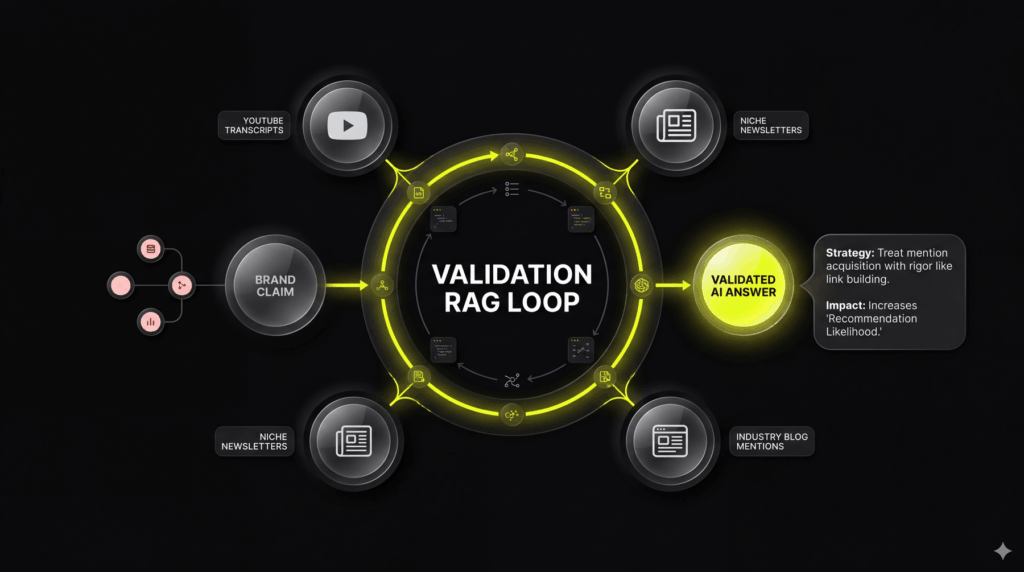
Retrieval-Augmented Generation (RAG) systems prioritize external evidence over your own domain. AI models verify brand claims against high-trust third-party data to determine recommendation likelihood. In technical B2B sectors, a mention on a reputable industry blog often carries more weight than marketing copy. This reduces over-reliance on domain ranking and increases the probability of being recommended in AI answers.
Implement these high-leverage moves for external validation:
- Publish YouTube videos with clean, keyword-rich transcripts.
- Transform technical webinars into indexed landing pages to capture intent.
- Secure citations from niche creators and specialized newsletters.
Treat mention acquisition with the same operational rigor as link building. Build target lists, use outreach scripts, and utilize partner ecosystems to acquire signals. This AI SEO strategy builds the organic equity necessary for LLMs to validate your brand. Off-site citations effectively bridge the technical authority gap in generative search.
8. Source Your Prompts Where Intent is Real
Stop guessing which technical topics resonate. Most MSPs fail the Technical Authority Gap because their content ignores real sales room questions. Your AI SEO strategy must pivot from generic volume keywords to pipeline reality. B2B prompts are inherently longer and more contextual.
Use your CRM to identify high-intent signals from:
- Sales calls and demo notes
- Support tickets and onboarding chats
- Procurement and security questionnaires
Identify repeated objections like SOC2 mapping, data residency, or MDR vs. MSSP. These are your content requirements. Build pages that answer them directly to navigate complex buyer journeys.
For every prompt cluster, define:
- Target Page: Comparison guides, expert deep-dives, or case studies.
- Proof Required: SOC2 reports or verifiable technical data.
- Next Step: Strategic consultation CTA.
This strategic alignment builds organic equity. It ensures your firm is the primary citation in AI-search while accelerating the path toward an investor-grade exit.
9. Measuring GEO Impact and Attribution for CMO Buy-In
CMOs struggle to fund channels that lack traditional clicks. The technical authority gap is often widened by invisible AI influence that standard analytics fail to capture. To secure investment, you must quantify visibility within the generative layer of the funnel.
Build prompt sets covering your category, specific technical problems, and competitor comparisons. Run these across target LLMs to log citations and calculate your AI Share of Voice (SOV). This data establishes the performance baseline for your AI SEO strategy.
Connect these insights to revenue by adding How did you hear about us? fields to capture self-reported AI influence. Segment results by deal stage and ICP to prove bottom-funnel impact. Monthly reporting must highlight:
- AI SOV trends and top cited pages
- Competitor visibility gaps
- Prompts correlating with sales-qualified conversations
This approach transforms abstract citations into a fundable, investor-grade revenue engine. It creates a defensible attribution model that solves the invisible channel problem and makes AI-visibility investment measurable.
10. Mitigating Factual Risk Through Content Governance
Unvetted AI drafts create a generic sameness that kills brand authority and blocks citations from generative engines. For MSPs, factual inaccuracies represent a significant brand risk, producing thin content that fails to convert high-intent decision-makers.
Protect B2B trust by implementing a minimum viable governance system. Every asset requires mandatory human SME sign-off to verify technical claims and log primary sources. For key money pages, maintain a quarterly refresh cadence to ensure data remains current for M&A-grade scrutiny and technical due diligence.
Position AI as a high-speed accelerator rather than an autonomous author. Use it to generate initial outlines, repurpose technical transcripts, and extract FAQs from sales calls. These raw outputs must be refined by experts into publish-grade organic equity.
This AI SEO strategy enables teams to scale production while protecting the trust signals that drive AI citations. By bridging the Technical Authority Gap, you ensure your content earns the trust of both LLMs and enterprise CISOs.
30-Day Execution Roadmap: Building Your AI SEO Strategy
This roadmap transforms your AI SEO strategy into an operational execution plan. It is built specifically for B2B SaaS, MSP, and MSSP leadership teams with a functioning CRM and an established content program. Focus on building organic equity rather than temporary traffic spikes.
Program Ownership and Prerequisites
Assign cross-functional owners to ensure technical accuracy and attribution. An effective strategy requires coordination between marketing and operations.
- SEO Lead: Manage overall program strategy and ICP prompt engineering.
- RevOps: Oversee CRM integration and citation attribution.
- SME: Validate all technical data, security claims, and comparison accuracy.
- Content: Produce high-fidelity, retrieval-ready assets that models can parse.
Week 1: Baseline Research and Measurement Setup
Move from assumptions to data by defining your Prompt Universe. This provides the foundation for all future optimizations.
- Define ICP Prompt Categories: Map prompts across four specific buckets: category terms, competitor alternatives, compliance-specific queries, and technical implementation prompts.
- Create AI SOV Baseline: Audit brand mentions across ChatGPT, Perplexity, Claude, and Gemini. Log current citations and identify the top sources currently cited by these models.
- Identify Money Pages: Select three to five existing comparison or service pages that drive the highest pipeline value for immediate optimization.
Deliverable: AI Share of Voice (SOV) Baseline Report and prioritized content backlog.
Week 2: Build Comparison Pages and Retrieval Formatting
LLMs prioritize logical, structured data over generic marketing copy. This week focuses on making your high-intent pages machine-readable.
- Ship Comparison Assets: Publish two to three comparison and alternatives pages. Include side-by-side tables, explicit pricing logic, and clear who this is for sections.
- Implement Retrieval Blocks: Add TL;DR summaries to the top of every long-form article. Convert technical sections into Q&A blocks to improve the likelihood of direct answer extraction.
- Format Quote-Ready Data: Present security and compliance claims in short, punchy statements that an LLM can easily extract and cite.
Deliverable: Three published or optimized high-intent comparison pages.
Week 3: Trust Signals and Technical Floor Hardening
If an AI model cannot verify your identity or expertise, it will favor better-known competitors. Focus on entity clarity and technical validation.
- Update Author and Editorial Profiles: Build detailed Author pages and a transparent Editorial Policy. Link every content asset to a verified expert with a searchable professional footprint.
- Standardize Entity Naming: Audit your name, address, and phone (NAP) data across all templates. Ensure consistent naming to help models uniquely identify your brand.
- Validate Core Schema: Implement Organization, Person, and FAQ schema. Ensure all transcripts for technical webinars are accessible to search crawlers.
Deliverable: A fully validated technical environment with zero crawl blockers for LLM parsers.
Week 4: Mention Acquisition and Executive Reporting
AI models use external data to validate their recommendations. This final week focuses on distribution and communicating ROI to leadership.
- Launch Feeder Source Plays: Publish two technical YouTube transcripts as indexed blog posts. Finalize a target list of 15 partner sites for mention acquisition outreach.
- Finalize Attribution: Ensure CRM fields are set to capture AI-driven intent.
- Publish Executive GEO Report: Present the first month’s results to the C-suite. Highlight AI SOV movement, specific citations gained, and pages currently driving citations.
Deliverable: The first Executive GEO Report and a Month 2 distribution backlog.
How NUOPTIMA Can Help
Building a defensible AI SEO strategy in the MSP and Cybersecurity space requires technical depth and strategic oversight. At nuoptima.com, we specialize in bridging the technical authority gap for high-growth B2B firms. We combine RevOps-grade attribution with GEO-first content to ensure your brand is the primary recommendation in the era of answer engines. Contact nuoptima.com today to secure your AI Share of Voice and maximize your enterprise valuation.
Where this fits in your MSP growth system
This is one piece of how NUOPTIMA makes MSPs and cybersecurity firms the provider buyers find on Google and in AI search. See how it connects to MSP SEO and GEO and AI-search, or get your free MSP lead forecast to see exactly where your firm shows up across ChatGPT, Gemini, and Perplexity today.