Your IT company website is a revenue system, not a brochure. Most IT firms struggle with a technical authority gap where rising traffic fails to produce qualified meetings. This 9-part checklist connects technical SEO with investor-grade conversion pathways. Using NUOPTIMA’s founder-to-founder approach, we ensure your site dominates both traditional search and generative AI engines. We begin with the critical non-negotiables: can Google crawl, render, and establish the trust required to build a sustainable sales pipeline?
Key Takeaways
- An IT company website is a revenue system, not a brochure, and most firms have a technical authority gap where rising traffic fails to produce qualified meetings.
- Start by removing indexation blocks: check Google Search Console coverage, confirm robots.txt and meta tags allow access to conversion pages, and keep only canonical 200-status URLs in the sitemap.
- Target Core Web Vitals at the 75th percentile: LCP 2.5 seconds or under, INP 200 milliseconds or under, and CLS 0.1 or under, prioritizing field data over lab scores.
- Give every page one primary intent-based CTA, surface institutional trust signals like SOC 2 and HIPAA badges, and deploy Organization, Service, LocalBusiness, and FAQPage schema.
- Measure success by booked-meeting rates and response time rather than raw impressions, and run weekly, monthly, and post-release monitoring to catch regressions early.
1. Eliminate Indexation Blocks on High-Intent Revenue Pages
Invisible revenue pages result from technical plumbing issues rather than content quality. When Google fails to index services or case studies, your technical authority remains hidden from high-intent decision-makers. This effectively blocks your most profitable revenue outcomes.
Audit your IT company website to ensure it is not unintentionally self-sabotaging:
- Review Google Search Console (GSC) for coverage and indexing errors.
- Confirm robots.txt and meta noindex tags allow conversion page access.
- Ensure the XML sitemap contains only canonical, 200-status URLs.
Verify status by running a service page through GSC’s URL Inspection tool. If we fix only indexation and Core Web Vitals, most IT company website profiles see immediate crawl efficiency gains.
2. Optimize Performance to Close the Technical Authority Gap
Slow or jittery pages bleed conversions before your CTA loads. On an IT company website, speed is a proxy for technical competence. To satisfy time-poor buyers and Google SEO requirements, target these 75th-percentile benchmarks:
- LCP (≤ 2.5s): Optimize oversized hero images.
- INP (≤ 200ms): Minimize heavy third-party chat or tag scripts.
- CLS (≤ 0.1): Prevent layout shifts from late-loading badges.
Audit your site using PageSpeed Insights and the GSC Core Web Vitals report. Prioritize field data over lab wins to ensure prospects reach your value proposition instead of bouncing due to friction.
3. Architect Your Site for Conversion with Intent-Based CTAs
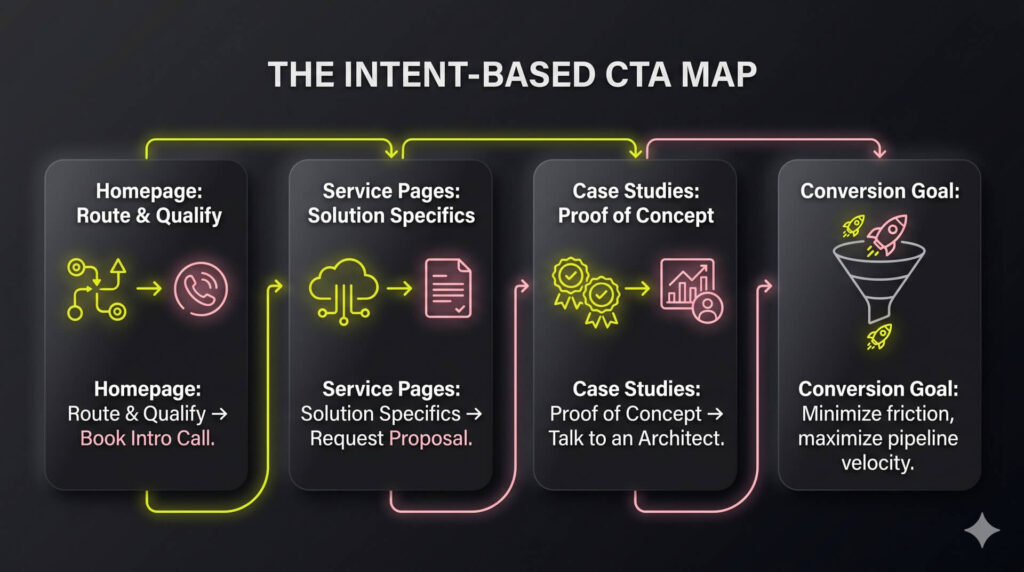
An IT company website must eliminate the friction between reading and reaching out. If visitors consume technical content but exit without booking, the UX fails to dictate the next step. Every page requires a single primary action.
Define clear goals by page type:
Homepage: Qualify and route via Book Intro Call.
- Service Pages: Request a Proposal or Get a Quote.
- Case Studies: Talk to an Architect to showcase outcomes.
Place primary CTAs above the fold and repeat them contextually. Remove competing buttons to minimize friction. Offer micro-CTAs like a 30-day M&A Readiness Audit to capture investor-grade intent.
4. Deploy Advanced Schema for Machine-Readability
Search engines often fail to connect your brand to specific technical expertise. This Technical Authority Gap is where an IT company website loses visibility to AI answer engines. To dominate Generative Engine Optimization, your data must be structured for machine-level ingestion and validation.
Prioritize these schema types:
- Organization & LocalBusiness: Clarify your entity and regional footprint.
- Service: Map core offerings to dedicated revenue pages.
- FAQPage: Mark up pricing, onboarding, and compliance to remove buying friction.
Audit implementation using Google’s Rich Results Test to ensure parity between markup and visible content. Validated markup ensures your brand becomes the primary citation when LLMs recommend providers to high-intent executives.
5. Build an Indexable Proof Layer with Strategic Case Studies
Enterprise buyers demand proof before signing high-value contracts. Successes trapped in PDFs or gated forms stop Google from indexing outcome-driven relevance, widening the technical authority gap on your IT company website.
Transform case studies into indexable assets using HTML-first architecture to capture high-intent queries. This strategy increases qualified inbound leads by proving technical competence. Structure every story to demonstrate:
- Problem: Specific business risks.
- Solution: Technical implementation.
- Results: Hard metrics signaling M&A readiness.
Connect case studies to service pages via unique metadata and internal links. Audit your site for orphaned or noindexed stories. Convert trust into revenue with a contextual CTA: Talk to us about a similar environment.
6. Surface Institutional Trust to Accelerate Vendor Risk Management
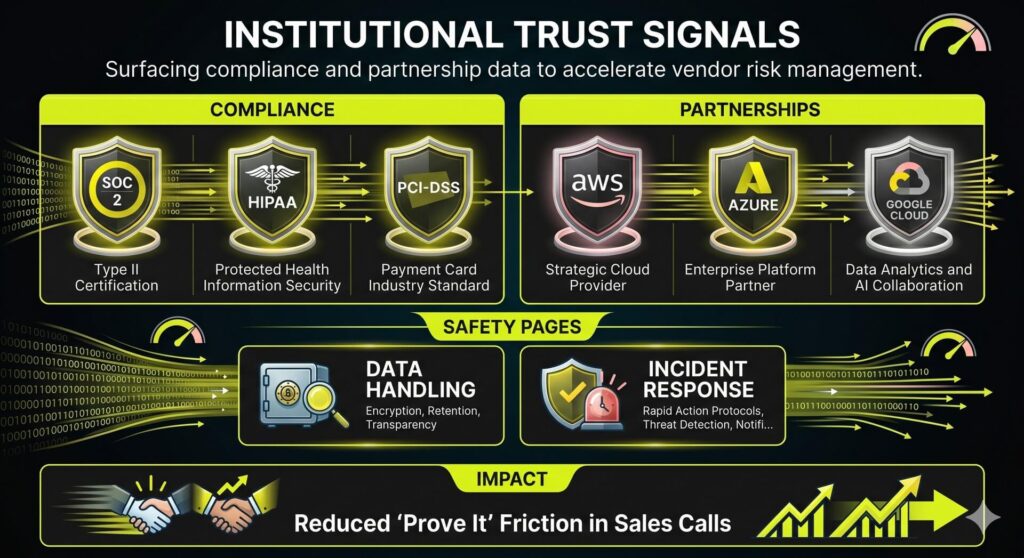
Enterprise buyers bounce from an IT company website when providers look generic rather than enterprise-safe. Since mid-market leaders perform vendor risk management immediately, you must surface institutional trust to survive their scrutiny.
Place compliance badges like SOC 2 or HIPAA and partner logos from Microsoft or AWS on service and contact pages. Build dedicated pages for security practices, data handling, and incident response. Use fixed image dimensions for these badges to prevent CLS layout shifts.
Surfacing these elements removes prove it friction on sales calls and accelerates time-to-close. This transparency reduces perceived risk and builds organic equity, making qualified prospects more likely to book a meeting.
7. Segment High-Intent Pages to Mirror Buyer Categories
High impressions with low conversion on your IT company website signal a category mismatch. Generic pages alienate specialized buyers seeking specific proof. Segmenting by sub-category ensures prospects recognize your relevance within five seconds, aligning your digital presence with buyer intent.
- MSP: Focus on uptime, predictable costs, and vCIO strategy.
- MSSP: Prioritize threat detection, compliance, and SOC reporting.
- IT Consulting/Dev: Showcase technical depth and delivery methodology.
Assign one keyword theme per page and link to relevant case studies. Tailor trust signals like SLAs and certifications to specific pain points to bridge the technical authority gap, driving revenue outcomes and M&A readiness.
8. Engineer Your Lead Path for Immediate Pipeline Velocity
Leads decay within minutes without follow-up. Treat your IT company website as a high-velocity pipeline input rather than a static form to prevent inquiries from leaking.
Audit your lead path to ensure:
- Form fields map to CRM data (vertical, budget, service interest).
- Routing rules and SLAs dictate instant ownership.
- Auto-confirmations include direct calendar booking.
Prioritize speed-to-lead with instant email or SMS triggers. Measure success by booked-meeting rates and response time rather than raw submissions. This creates the investor-grade attribution required to maximize valuation and M&A readiness.
9. Protect Revenue Outcomes with Continuous Technical Monitoring
Technical regressions often stay silent until they impact the bottom line. Many firms only notice broken forms or indexing blocks after the sales pipeline stalls. To scale, replace reactive fixes with an investor-grade monitoring stack.
Maintain technical authority with this audit rhythm:
- Weekly: Review GSC for indexing anomalies and impression drops.
- Monthly: Audit Core Web Vitals and landing page speeds.
- Post-Release: Verify that key pages index, render, and convert.
Proactive monitoring eliminates what changed? fire drills. It preserves the organic equity of your IT company website, ensuring clean attribution and M&A readiness.
FAQ
A comprehensive technical audit for an IT company website covers crawlability, indexing, and site architecture. We specifically analyze Google Search Console for coverage errors, robots.txt restrictions, and XML sitemap health. Beyond plumbing, the audit assesses Core Web Vitals for speed and structured data for AI-readiness. Finally, we evaluate internal linking to ensure high-value service pages are not orphaned and receive proper link equity. See Section 1 and 2 for details.
Core Web Vitals are a confirmed Google ranking signal, but their primary value lies in reducing user friction. On an IT company website, performance benchmarks like Largest Contentful Paint (LCP) serve as evidence of your technical expertise. Improving these metrics directly lowers bounce rates and keeps high-intent prospects on your site longer. Focus on high-traffic pages like your homepage and flagship service offerings first to maximize the impact on your sales pipeline.
While Google’s algorithms remain consistent across sectors, the buying behavior for IT services is unique. Prospects prioritize trust, compliance (SOC2/HIPAA), and proven outcomes over generic information. Consequently, SEO for IT firms must focus heavily on bottom-funnel intent. Specialized niche pages, such as those targeting MSSP or MSP verticals, frequently outperform broad IT services terms because they address specific buyer requirements and compliance-driven pain points that generic pages miss.
Start with Organization and Service schema to clarify your business identity and specific technical offerings for search engines. These are essential for bridging the technical authority gap and dominating generative AI engines. If your business serves a specific region, implement LocalBusiness schema next. Finally, use FAQPage markup on pages addressing pricing or compliance to win real estate in People Also Ask boxes and provide clear citations for AI answer engines.
Prioritize fixes that directly impact revenue outcomes. Start by resolving cannot be indexed errors in Search Console to ensure your revenue-generating content is visible. Once visibility is secured, optimize your conversion architecture and CTA placement to capture existing intent. Performance improvements and schema enhancements should follow. Always track the impact of these changes through booked meetings and pipeline growth rather than impressions to ensure you are building institutional equity.
Where this fits in your MSP growth system
This is one piece of how NUOPTIMA makes MSPs and cybersecurity firms the provider buyers find on Google and in AI search. See how it connects to cybersecurity SEO and MSP SEO, or get your free MSP lead forecast to see exactly where your firm shows up across ChatGPT, Gemini, and Perplexity today.