Client demands for speed and robust security are increasing, but price resistance is crushing the traditional MSP operating model. AI is not a new RMM feature; it is the fundamental shift required to secure your long-term margins and maximize enterprise valuation when selling your MSP. AI redefines service delivery, risk profile, pricing, and go-to-market motions. This guide to AI for MSPs presents 10 ways AI is reshaping MSPs, showing exactly how to position your firm for predictable MRR and M&A readiness. We start with the most measurable win: preventing incidents before they generate a single ticket.
Key Takeaways
- AI reshapes MSPs across ten levers: predictive operations, AI-driven service desk, automated MDR, alert correlation, a RAG-based knowledge base, compliance reporting, AI governance, QBR advisory, client communication portals, and outcome-based productization.
- Predictive operations replace static threshold alerts with anomaly detection, cutting Mean Time to Resolution by remediating issues before clients experience an outage.
- An AI-driven service desk classifies and summarizes tickets and suggests step-by-step fixes, raising the L1 resolution rate and lowering cost per ticket while converting tribal knowledge into a documented asset.
- Pricing on per-user or per-device rates lets efficiency gains flow back to clients, so MSPs should productize outcomes (for example Zero-Trust Identity Hardening or Compliance-Ready IT) to protect gross margin.
- Every lever is tied to investor-ready KPIs because measurable, repeatable AI delivery is what raises enterprise valuation and M&A readiness.
Predictive operations is an MSP monitoring model that uses AI anomaly detection on logs, metrics, and event data to flag early-warning signals and remediate failures before they generate a ticket or client outage.
1. Achieve Predictive Operations: Move Beyond Threshold-Based Monitoring
Static thresholds are a reactive liability, ensuring your firm generates noise that crushes gross margin. If technicians are perpetually fighting P1 incidents and after-hours escalations, you cannot achieve the cost predictability necessary for maximizing enterprise valuation.
The transition to predictive operations shifts monitoring from simple threshold alerts to intelligent anomaly detection. AI models analyze logs, metrics, and event data for early-warning signals that indicate imminent failure. This proactive approach immediately reduces your Mean Time to Resolution (MTTR) by enabling remediation before clients experience an outage.
To implement this, centralize telemetry from your RMM, firewalls, and key application signals. Start small: focus on high-frequency failure modes (e.g., disk errors, backup failures) to build healthy baselines. The results are immediate: reduced SLA breaches, fewer service credits, and a dramatic decrease in costly after-hours ticket volume. This frees technical talent to focus on billable projects, significantly boosting margin.
KPIs to Track:
- Reduction in P1 incidents.
- Improvement in MTTR.
- Reduction in after-hours ticket volume.
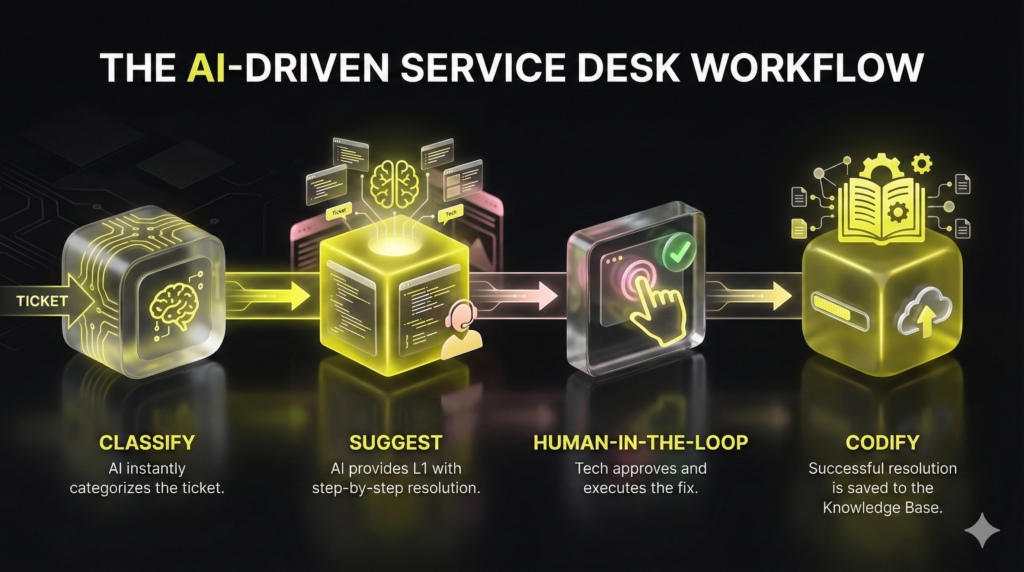
2. Implement the AI-Driven Service Desk: Operationalizing Tribal Knowledge
Tribal knowledge limits L1 efficiency, leading to slow resolution times and high escalation rates that crush gross margin. Every senior engineer touch on a routine ticket drains resources better spent on billable strategic projects, a common efficiency leak that often leads to corporate ownership pitfalls during scaling.
The solution is transforming your PSA into an AI-driven service desk, an "assistive workflow" that acts as a capacity multiplier for junior teams. AI instantly classifies the ticket, summarizes the issue, and provides the L1 technician with a suggested, step-by-step resolution derived from historical patterns.
Focus on top repetitive categories (MFA issues, password resets, VPN access) for near-instant resolution:
- Implement Human-in-the-Loop (HITL): The L1 technician approves the AI’s suggested fix.
- Codify Resolution: That successful action is immediately captured and structured into the Knowledge Base (KB), converting tribal knowledge into a scalable, institutional asset.
This process yields a higher L1 resolution rate, dramatically reducing the cost per ticket and creating an auditably predictable service engine, critical for M&A due diligence.
KPIs to Track:
- L1 resolution rate
- Escalation rate
- Cost per ticket
- Time-to-first-response (TTFR)
3. Transition to Automated MDR: Response as a Predictable Revenue Outcome
For firms positioning as MSSPs, an uncontained alert is a liability, not a service. Managed Detection and Response (MDR) shifts security from static alerts to intelligent, behavior-based detection and cross-tool correlation. AI aggregates signals from your full telemetry stack (EDR, M365, Identity) to identify true threats instantly, drastically reducing dwell time. This predictable security outcome is a critical differentiator to help you compare and maximize MSP acquisition offers and enables high-margin SOC service upsells.
To operationalize the shift:
- Map Telemetry: Define minimum viable log coverage across your full stack.
- Engineer Containment: Build 3 to 5 foundational containment playbooks (e.g., isolate endpoint, revoke session tokens, reset credentials) with explicit human approval gates.
This systematic approach proves security delivery at scale, replacing the need for linear analyst hiring. Track these investor-ready KPIs: time-to-detect, time-to-contain, and the true false-positive rate. This is the measurable difference between a basic MSP and a high-value MSSP.
4. Eliminate Alert Fatigue: Prioritize Threats by EBITDA Impact
Alert fatigue is a direct EBITDA leak. When senior security staff spend hours triaging duplicate notifications across multiple consoles, high-value time is pulled from strategic, billable work, eroding gross margin. This systemic noise must be engineered out of your operations.
The solution is AI-driven alert correlation and prioritization. This capability moves beyond simple thresholding by automatically linking related events, across RMM, network, endpoint, and cloud, into a single, actionable incident. This correlation eliminates context switching and creates a defensible operational advantage by cutting the mean time spent triaging.
To realize this gain, embed financial logic into prioritization rules. Define "business-impact" weighting (VIP users, critical revenue applications, or regulated compliance systems) so the AI’s urgency score aligns directly with your SLA commitments. Crucially, require the AI to provide explainability: why the specific correlated incident is urgent and what evidence triggered it.
KPIs to Track:
- Alert-to-ticket ratio
- Duplicate ticket rate
- Mean time spent triaging per incident (MTST)
5. Standardize Service Quality: The AI-Powered MSP Knowledge Base
Static wikis and reliance on key staff memories are an unquantified liability, severely impacting operational predictability and M&A readiness. This systemic risk must be eliminated to maximize enterprise valuation.
AI transforms the MSP knowledge base from a passive archive into an active operating system, converting SOPs and sanitized ticket resolutions into a dynamic, institutional asset. This allows junior techs to instantly summarize complex environments and execute "how we do X for client Y" without senior staff intervention.
The operational shift demands a controlled approach: implement Retrieval-Augmented Generation (RAG). This architecture ensures the AI retrieves approved, vetted data from your specific, controlled knowledge base, eliminating reliance on unverified general responses. This standardization minimizes service variation, speeds onboarding, and guarantees consistently high service quality across the team.
KPIs to Track:
- Time-to-onboard new technicians
- Internal question deflection rate
- Time-to-prepare change management plans
6. Automate Investor-Grade Compliance Reporting and Audit Prep
Manual compliance evidence gathering is a non-billable drag on margin, making it impossible to scale high-value service lines (SOC 2, CMMC). For an MSP focusing on M&A readiness, this operational gap reduces enterprise valuation.
AI closes this gap by transforming raw telemetry (logs, config files, policies) into structured, defensible compliance reporting narratives, minimizing linear human review. This productizes compliance services and dramatically reduces delivery cost.
To implement this strategic advantage, you must:
- Standardize Control Libraries: Define "good" per vertical (HIPAA, CMMC) and map those controls to specific, standardized output templates.
- Automate Recurring Reports: Use AI to generate scheduled evidence packages for patch compliance, MFA adoption, admin privilege reviews, and verifiable backup test outcomes.
To ensure scalability and audit predictability, track these KPIs relentlessly: hours per monthly compliance report and audit prep cycle time. This proves to investors your firm delivers predictable revenue outcomes, not endless manual labor.
7. Operationalize AI Governance: De-Risking Automation for M&A Readiness
Integrating AI introduces a critical operational risk: unmanaged data leakage and non-compliant output. For firms maximizing enterprise valuation ahead of M&A, neglecting AI governance is a brand-destroying liability savvy PE investors will flag.
This requires shifting from passive AI usage to active risk management, establishing explicit guardrails for data handling, model access, and verifiable audit logs.
De-risk automation scaling by defining clear policies, including:
- Data Control: Specify what client data can and cannot enter public Large Language Models (LLMs).
- Approval Gates: Embed requirements in SOWs that mandate human approval for all high-impact remediation or client configuration changes assisted by AI.
This structured governance avoids catastrophic incidents, proving the firm is the safe choice for sophisticated clientele.
KPIs to Track:
- Policy compliance rate (internal tool usage).
- Number of AI-assisted actions requiring human approval logs.
- Near-miss incidents identified by governance checks.
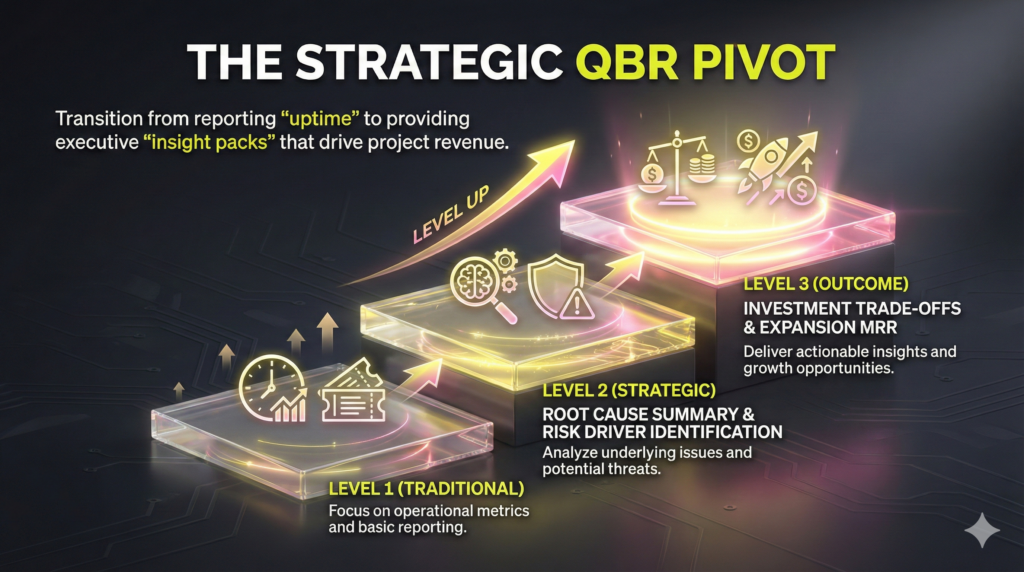
8. Automate Strategic Advisory: Transform the QBR into a Project Engine
If your Quarterly Business Reviews (QBRs) still revolve around uptime statistics and completed tickets, they are failing to drive expansion MRR or justify premium pricing. AI automates the pivot to strategic advisory, summarizing fleet health and recurring risk drivers into executive narratives that quantify business risk and strengthen client retention.
To act, engineer a monthly “insight pack” summarizing top incidents, recurring root causes, and security posture deltas. Critically, these insights must be translated into actionable investment trade-offs: "Enforce MFA now to mitigate $X annual risk," or "Replace the legacy server to eliminate $Y in recurring maintenance cost." This process establishes a predictable strategic layer, essential for maximizing enterprise valuation.
KPIs to Track:
- QBR adoption rate.
- Project attach rate.
- Client retention.
- Expansion MRR from advisory services.
9. Enable Frictionless Client Communication: The AI-Driven Portal
Consumer AI sets the service benchmark: clients expect instant answers, making the wait for an email status update feel like debilitating friction. This perception of “black box IT” is a core driver of low CSAT and high churn risk. AI transforms external service delivery by automating communication, freeing high-cost technicians from manual status updates. This enables critical ticket deflection and elevates service predictability, essential for enterprise valuation.
How to Act:
- Deploy a Client-Facing Assistant: Implement a secured chatbot linked only to approved institutional knowledge: the service catalog, FAQs, official status page, and core SLA terms.
- Automate Incident Comms: Use AI to draft clear, concise incident updates and postmortems (with human review). This dramatically increases the speed and clarity of communication, improving time-to-update during outages.
This proactive approach minimizes contact volume and proves operational transparency. Quantify the ROI by tracking your ticket deflection rate, CSAT/NPS, and reduction in churn signals.
10. Productize AI Outcomes: Protect Gross Margin and Enterprise Valuation
AI guarantees the commoditization of your effort. If pricing remains anchored to per-user or per-device rates, efficiency gains flow directly back to the client, crushing your gross margin. The strategic shift demands you productize outcomes instead.
MSPs must pivot from managing devices to managing intelligence and measurable business outcomes. This shift creates differentiated IP, insulates margins from tool commoditization, and maximizes enterprise valuation via repeatable, profitable systems, not headcount.
Define 2 to 3 outcome bundles. Replace generic "Managed Security" with focused offerings like Zero-Trust Identity Hardening or Compliance-Ready IT. Anchor pricing to value delivered: risk reduced, hours eliminated, or guaranteed uptime.
This focus ensures higher MRR, tracked by investor-ready KPIs: gross margin by package and expansion revenue. Audit tooling and data streams now to build these defensible packages.
Which Services MSPs Can Productize With AI
The fastest way to turn AI from a cost into a margin is to sell it as a named, outcome-priced service, not a background efficiency. Clients rarely pay for the fact that your service desk got faster. They will pay for a bundle that names the risk it removes and the outcome it guarantees. Below are neutral service categories MSPs are packaging in 2026, described by outcome rather than by any single tool or vendor.
- AI Security-as-a-Service: a managed detection-and-response bundle where AI correlates telemetry and drives containment playbooks, sold on time-to-contain and dwell-time reduction rather than seats.
- AI-Assisted Help Desk SLA: a tiered support offer that guarantees faster L1 resolution because AI triage and a retrieval-backed knowledge base carry the routine load, priced on resolution speed and coverage.
- Compliance Reporting-as-a-Service: recurring, AI-generated evidence packages for frameworks like SOC 2, HIPAA, or CMMC, sold as a fixed monthly deliverable instead of billable audit-prep hours.
- AI-Powered vCIO Advisory: a quarterly insight pack that translates fleet health and risk into named investment trade-offs, attached to premium advisory pricing.
- Zero-Trust Identity Hardening: an outcome bundle around identity, MFA, and access governance, anchored to risk reduced rather than devices managed.
Pick two or three of these, write explicit inclusions and exclusions, and anchor the price to the outcome. For the mechanics of moving off per-device rates without losing deals, see how to price MSP services around value instead of headcount. To turn AI into a named, resellable practice line, see our MSP AI advisory service.