
Your best quarter came from one conference and two referrals you cannot repeat. When the CFO asks what drives the next four quarters, there is no answer. Hiring sales reps adds fixed overhead before demand is proven.
The third lever is a compounding demand engine. By structuring your proof for Google and AI search shortlists, this MSP marketing strategy reduces founder dependency. This framework provides revenue-stage decisions and a finance-grade scorecard to prove payback to your CFO.
Start with Item 1: define the engine you are building.
Key Takeaways
- Generic "managed IT" positioning is the single fastest way to inflate cost per lead; a narrow vertical ICP wedge is the fix.
- GEO (Generative Engine Optimization) is a board-level metric: track shortlist inclusion across ChatGPT, Gemini, and Perplexity, not just Google rankings.
- The minimum authority stack is four pages, not a blog calendar: wedge landing page, comparison pages, proof pages, and buyer enablement.
- Match marketing channel investment to operational maturity; scaling spend before delivery capacity is ready causes churn that kills the payback model.
- Cortavo ran this governance model with NUOPTIMA and reached $1,000,000+ in MQL pipeline by December 2025, with 4x more AI citations than the closest competitor.
An MSP marketing strategy is the system a managed service provider uses to turn search visibility, proof assets, and budget into a predictable sales pipeline. It defines who you target, which marketing channels you fund at each revenue stage, and the metrics that prove payback to your CFO.
If you need the fundamentals first, start with what MSP marketing is. This guide assumes them and covers strategy and governance.
1. Escape the Two-Lever Growth Trap
Most MSP owners scale using two risky growth paths. The first is referrals, which are highly qualified but entirely out of your control. The second is adding sales headcount, which forces you to pay expensive salaries before demand is proven.
A mature MSP marketing strategy introduces a third option: a compounding demand engine. This digital infrastructure sits underneath your referral network, making your firm findable and pre-trusted before the first discovery call. It secures your spot on the shortlist when prospects query Google or AI search, making future sales hires safer.
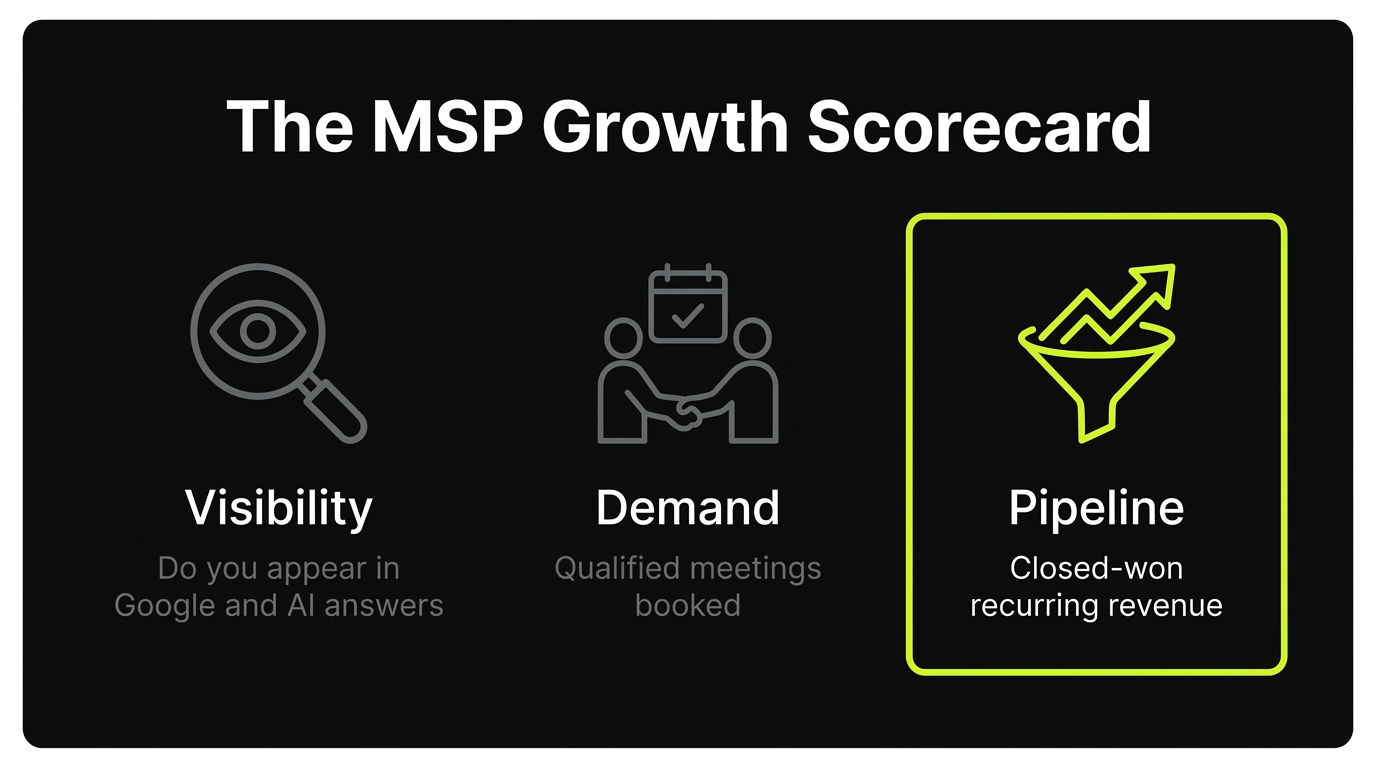
At the board level, this engine is accountable for pipeline, not vanity traffic. Its performance is measured strictly on qualified meetings, shortlist visibility, and sales-cycle compression.
To run this as a governed growth engine rather than random activity, assign a dedicated owner and establish a weekly tracking cadence, just like any IT delivery function. Start with a baseline visibility test. Score your firm against 10 critical buyer queries and 10 high-value target accounts to see if you exist in Google and AI search answers.
2. Why MSP Marketing Needs Its Own Playbook
Generic B2B marketing advice fails MSPs for structural reasons, not execution reasons. Three market dynamics change the math:
- Commodity density: Tens of thousands of MSPs compete in the US market with near-identical service catalogs. A prospect comparing five providers reads the same promises everywhere: proactive monitoring, help desk, cybersecurity. Differentiation has to come from your wedge and your proof, not from adjectives.
- Technical buyers vet you silently: In 2026, the IT director shortlisting providers reads your security posture page, checks your compliance claims, and asks ChatGPT or Perplexity who serves their vertical, all before a first call. Thin public proof means silent elimination.
- Long sales cycles compound acquisition cost: A managed services deal routinely takes a quarter or longer from first touch to signature. Every added month of cycle time raises customer acquisition cost and pushes payback further out, which is why nurture assets and shortlist presence matter more here than in transactional B2B categories.
The recurring-revenue model cuts both ways. One signed logo is worth years of monthly recurring revenue, so an engine that adds even two qualified deals per quarter changes the P&L. The same model punishes overreach: a burst of poorly fitted logos strains delivery and churns out, taking the payback math with it.
That asymmetry is why this guide treats marketing as capital allocation with decision gates rather than a list of tactics. If your current plan cannot survive a CFO's payback question, it is not a strategy yet.
3. Define a Focused ICP Wedge to Avoid Commodity Messaging
Marketing your MSP as generic "managed IT" inflates your cost per lead and tanks close rates. Buyers read generic messaging as an interchangeable commodity, forcing you to compete on price. A focused ICP wedge solves this, making outbound, SEO, and AI visibility cheaper and more effective. This wedge defines your market across four components:
- Vertical: Healthcare, legal, finance, manufacturing, or professional services
- Company size band: 25 to 200 seats
- Geo constraint: Metro region or multi-location pattern
- Marketable moment: Compliance deadline, ransomware wave, merger, new CIO, or insurance change
Your decision output is one positioning sentence you can defend in a board meeting: "We provide HIPAA-compliant IT support for 50-to-200-seat medical practices in Chicago navigating cybersecurity insurance audits."
To defend this position, you must hold three credibility assets: a vertical case study, verifiable compliance capability, and a regional response-time SLA.
If you cannot name the wedge, you are buying expensive randomness.
4. Secure Shortlist Presence in AI Search Answers
Buyers now disqualify your MSP before they ever fill out a contact form. Instead of clicking blue links, they ask ChatGPT, Gemini, Claude, and Perplexity who to trust. Generative Engine Optimization (GEO) is the new layer on top of traditional SEO that secures this defensible first-mover advantage.
To the board, GEO represents a measurable visibility score. It tracks answer presence, citation share, query-level visibility, and shortlist inclusion. Your 90-day goal is to move from "not mentioned" to "consistently recommended" for a defined market wedge.
To win trust from AI models, you must establish three signals:
- Clear service entities: Exactly what you do, who you serve, and where you operate.
- Proof assets: Case studies, compliance pages, and third-party citations.
- Off-site signals: Digital PR, authoritative directories, and consistent brand mentions.
Run a diagnostic by testing 10 wedge queries across major AI models. Record which competitors appear and what proof the systems cite. If your firm is invisible, run the board-ready growth diagnostic at nuoptima.com to map your citation gaps.
5. Build the Minimum Authority Stack to De-Risk the Buyer's Decision
No prospect signs a $3,000 monthly recurring revenue agreement after reading one blog post. In managed IT, buyers only move when they feel operational risk is controlled.
To scale a $5M to $15M MSP, bypass high-volume blogging. Instead, build a high-proof authority stack on a foundation of technical SEO consisting of four specific assets. Each must either get you shortlisted or increase close rates on referred and outbound deals:
- Wedge landing page: Details your target vertical, specific operational outcomes, and concrete proof.
- Comparison pages: Evaluates MSP versus in-house versus co-managed IT, contrasting your model against common alternatives.
- Proof pages: Houses case studies, security posture details, and verified compliance capabilities.
- Buyer enablement: Explains pricing structures, transition frameworks, and onboarding timelines.
This stack directly drives your pipeline. The wedge page lifts MQL-to-SQL conversion, comparison and proof assets increase win rates, and enablement tools shorten sales cycles. Credibility is your product; generic AI content destroys it. Only human-validated proof converts skeptical buyers.
6. Align Your Marketing Engine with Operational Maturity
Your marketing system must match delivery capacity and sales maturity. An uncontrolled pipeline causes service bottlenecks, delivery strain, and client churn. Build a sustainable demand engine by matching your channel investments to three distinct operational stages.
- $5M to $8M: Clarify your vertical wedge, resolve basic search findability (start with local SEO for MSPs), establish proof assets, and run one controlled channel test.
- $8M to $12M: Scale the working channel, formalize attribution with a proper CRM and pipeline buildout, build a vertical authority hub, and tighten lead qualification.
- $12M to $15M: Defend category position, expand into adjacent sub-verticals, and invest in digital PR to protect AI search visibility.
Govern this progression at the board level with three standard outputs: a one-page positioning guide, a scorecard linking search visibility to pipeline economics, and an operational capacity check to ensure your service team can absorb new logos without churn risk.
This staged model reduces downside for your finance partner. It ties marketing budget directly to operational readiness, preventing the mid-six-figure marketing experiments that fail to generate contracted revenue.
Operational maturity increasingly includes AI maturity. An MSP that scores its sales calls automatically and drafts proposals from transcripts spends senior time on clients, not paperwork; our MSP AI advisory builds that capability before the demand engine scales past it.
7. Where the Budget Goes: The MSP Marketing Channel Mix
Marketing channels are a sequence, not a menu. Each line below earns budget only after the one before it has attribution in place. Fund them in this order and hold every channel to the stop rules in Item 8.
- SEO and GEO (fund first, never pause): Search equity is the one line that compounds. The wedge pages and proof assets from Item 5 anchor both classic rankings and AI shortlist presence, and every other channel converts better once a skeptical buyer can find your proof.
- Content marketing (proof production, not publishing volume): The authority stack is your content marketing program. Budget it by proof gaps closed per quarter, not posts per week. One vertical case study outperforms twelve generic blog posts for shortlist inclusion.
- Email marketing and nurture (the pipeline you already own): With sales cycles running a quarter or longer, a monthly wedge-specific briefing keeps your firm on the shortlist between evaluation windows. Measure reply-sourced meetings, not open rates.
Those three lines build the compounding base. The next three capture demand against it:
- Paid search (capture, on a stopwatch): Google Ads on high-intent wedge terms buys visibility while search equity matures. Size it as a budget-controlled test with a 60 to 90 day learning window and a hard cost-per-lead ceiling. Once it is stable, the same structure extends to Microsoft Advertising through Bing ads for MSPs.
- Outbound and LinkedIn (aimed by the wedge): Lead generation sequences work when the list is your ICP wedge and the message cites vertical proof. Generic spray improves reply rates only for your spam folder placement. Pair the outbound list with founder-led LinkedIn content so target accounts recognise your name before the first touch.
- Referrals and partnerships (formalize your founding channel): Referrals remain the highest-close-rate source. The engine's job is to remove your dependence on their timing, not to replace them. Put partner introductions on the same scorecard as every other channel.
Allocation follows the revenue stages from Item 6: at $5M to $8M, concentrate on search equity and proof plus one capture test; at $8M to $12M, add nurture and scale the proven capture channel; at $12M to $15M, layer digital PR to defend citation share. The mix shifts as you scale. The stop rules do not.
8. Govern Marketing as a Capital Allocation Decision
Marketing is not a creative project. To your finance partner, your MSP marketing strategy must run as a disciplined capital allocation decision.
Boardroom math requires tracking unit economics. Start with cost-per-lead (CPL) ranges per channel, apply MQL-to-SQL conversion rates, and factor in close-rate assumptions to calculate customer acquisition cost (CAC). Finally, convert CAC into clear payback metrics: months of MRR and gross-profit payback.
Compare this digital infrastructure to human capital. A compounding demand engine costs less than a senior sales hire. While a new salesperson is a high fixed cost requiring immediate lead flow to be productive, search equity compounds in value over time.
To protect margins, enforce two strict stop rules:
- No scaling spend without attribution: Do not increase budgets without a verified pipeline source.
- No scaling without modeled payback: Every channel requires a modeled payback scenario and a 60 to 90 day learning plan.
The final output is a one-page unit-economic model your finance partner can confidently own.
How to Execute Your MSP Marketing Strategy: The Board Governance Layer
This section covers governance cadence and stage-gated channel sequencing, the decisions a CFO or board sponsor reviews each quarter. The week-by-week tactical build (asset calendars, campaign briefs, content sprints) belongs in a dedicated execution plan. Most strategy guides stop at a channel list; they skip stage-gated sequencing and closed-loop attribution math, which means finance partners cannot model payback or set decision gates. That gap is what this section closes.
Complete three prerequisites before increasing your marketing spend.
Step 1: Secure Your Operational Prerequisites
Do not commit major capital to broad campaigns until you execute these three foundational actions:
- Draft one ICP wedge statement. Write a single, highly specific positioning sentence that targets a narrow, profitable market niche.
- Run a baseline visibility test. Document your firm's current presence across Google and AI search engines like ChatGPT and Perplexity.
- Configure basic pipeline attribution. Set up a dedicated lead-source field in your CRM and establish UTM tracking parameters to trace exact pipeline origins.
Step 2: Days 1 to 15 (Diagnose and Baseline)
Establish your quantitative starting point and map where competitors are winning market share:
- Conduct a shortlist visibility audit. Query 10 high-intent wedge terms across major search engines and generative AI models to record your initial answer presence.
- Map the competitive proof gap. Document the precise case studies, technical certifications, and third-party claims your competitors publish that your firm currently lacks.
- Select your first five authority assets. Identify five high-proof documents that directly address these competitive gaps.
Step 3: Days 16 to 45 (Build and Publish Compounding Assets)
Publish technical proof to establish search equity and build domain authority:
- Publish your foundational assets. Launch one wedge-specific landing page, two written proof assets, and one head-to-head competitor comparison page.
- Build your internal link architecture. Connect these new assets to your primary SEO directory page to pass domain authority.
- Deploy your citation and PR plan. Standardize your directory listings to maintain citation hygiene and secure targeted mentions in niche trade publications.
Step 4: Days 46 to 90 (Capture Demand and Prove Economics)
Activate immediate capture motions and monitor conversion efficiency to prove viability:
- Add one demand capture motion. Deploy a targeted outbound sequence or a highly specific paid search campaign. Size this strictly as a budget-controlled test, not a long-term resource commitment.
- Execute weekly pipeline reviews. Track qualified meeting volume, lead quality, conversion rates, and sales objections during your team meetings.
- Update your AI visibility scorecard. Run the initial 10 baseline queries again to verify early query-level visibility improvements.
Step 5: Establish the Governance Scorecard
Report on operational progress and financial performance using a two-tier cadence.
- Review weekly metrics. Track qualified meetings booked, total pipeline created, and opportunity advancement through sales stages.
- Calculate monthly metrics. Estimate your customer acquisition cost (CAC), forecast gross-profit payback periods, measure changes in AI shortlist visibility, and track creative asset production throughput.
Proof: What a Governed Strategy Delivers in Practice
Cortavo, a managed IT provider, ran this exact governance model with NUOPTIMA. The strategy prioritised GEO signals alongside traditional SEO, tracking shortlist inclusion across ChatGPT, Gemini, and Perplexity as a board-level visibility metric. The result: 4x more AI citations than the closest competitor for tracked terms, with AI Search sessions surpassing every other month of the year by mid-December. That visibility fed a $1,000,000+ MQL pipeline by December 2025, a number the CFO could read directly from attribution, not infer from traffic. By month twelve the engine reached $403,330 in contracted sales value at a 4.6x return. See the Cortavo case study for the full breakdown.
The lesson for the board: citation share and shortlist inclusion are lagging indicators of content proof quality, and leading indicators of pipeline. When you govern them on a monthly scorecard, you get a signal before pipeline moves, not after.
Step 6: Enforce Your Boardroom Decision Gates
Review the pilot data at day 90 to determine your next capital allocation step:
- The scale path. If your gross-profit payback model trends inside your target threshold and AI visibility scores improve, scale your budget deliberately.
- The pivot path. If results lag, do not increase your budget. Tighten your wedge statement, address unaddressed proof gaps, or audit your service response data before adding more capital.
To verify where your firm stands before launching your 90-day pilot, request a customized, diagnostic-led visibility teardown at nuoptima.com.