
Your finance partner just killed the budget because the proposal said “awareness.” A MSP marketing plan built on gross-profit payback, a 90-day proof window, and a stage-gate exit clause speaks their language. While you need a believable growth engine beyond referrals, your finance partner requires strict downside risk controls and milestone-based cancellation terms. This plan is the execution layer of a broader MSP marketing strategy; here we turn that governance model into a week-by-week build. This blueprint delivers a week-by-week rollout, a toolkit of operational materials, and a simple payback model to satisfy both buyers in your boardroom.
Start with economics, because it determines everything else.
Key Takeaways
- Frame every marketing budget as a gross-profit payback model: one $3,000 MRR logo at 55% margin generates $1,650/month, making payback calculable in weeks, not years.
- A one-sentence vertical wedge is the prerequisite for every other step; without it, Google and AI engines misclassify your MSP and cost-per-lead rises.
- The 90-day window is a proof-of-model milestone, not a revenue promise; leading indicators (shortlist visibility, qualified meetings) must move before scaling spend.
- A stage-gate exit clause at days 14, 30, 60, and 90 protects your finance partner and makes the contract signable.
- NUOPTIMA ran this exact plan for Cortavo: $210,000+ contracted value and $1,000,000+ MQL pipeline by December 2025.
An MSP marketing plan is the document that turns strategy into scheduled, budgeted work: which campaigns run, who owns them, what they cost, and which numbers prove payback. The 90-day version stage-gates that spend, so finance can scale or cancel on evidence instead of faith.
1. Frame Marketing Through a Gross-Profit Payback Model
To secure a budget for this program, you must treat marketing as a capital allocation problem. Your finance partner cares about cash payback, not search traffic. Frame the plan using a simple boardroom-ready model.
Inputs:
- Target account MRR
- Gross margin percentage
- Expected logo retention (months)
- Monthly marketing investment
The outputs are your gross-profit payback months and break-even retained logos.
For example, if one new logo is worth $3,000 MRR at a 55 percent gross margin, it generates $1,650 in monthly gross profit. If your monthly marketing spend is $10,000, one logo covers 16.5 percent of that cost.
Real-world payback looks like this: NUOPTIMA’s engagement with Cortavo, a managed IT provider, produced $210,000+ in contracted value and $1,000,000+ in MQL pipeline by December 2025 from a combined organic and AI-search program. The running return dipped below 1x in the early months and crossed breakeven for good in December 2025. See the Cortavo case study for the full breakdown.
Your finance partner will require two gate checks. Can operations absorb these new logos without hurting client retention or NPS? What happens if zero logos close in 90 days, and which leading indicators must still improve?
Address this skepticism by seeking approval for a 90-day proof-of-model milestone set. You are not trying to get rich in 30 days. Use this period to prove leading indicators, like search visibility and qualified pipeline, before scaling spend.
2. Pass the One-Sentence Positioning Test
Before building your commercial roadmap, you must pass a brutal positioning test. Trying to serve everyone kills your conversion rate and causes Google and AI search engines to misclassify your MSP. If a human prospect cannot repeat your core focus in one sentence, machine engines will never shortlist you.
Test your current positioning against this simple template:
“We help [vertical] in [region] reduce [risk] with [managed service wedge].”
Ground each bracket in a real ideal client profile before you wordsmith: one vertical you already serve well, a seat-size band you can support, a geography your team can cover, and a buying trigger you can time campaigns to. The MSP marketing strategy guide covers how to pick that wedge; this plan assumes you have one.
You must lead with a narrow wedge offer rather than your entire service catalog. Proven wedges include a security baseline and roadmap, compliance readiness, or co-managed IT for multi-site operations.
This tight positioning satisfies both buyer stakeholders in the sales cycle:
- The Founder: Gets a memorable, referable story that builds regional brand equity.
- The Finance Partner: Gains high-LTV contracts with lower churn, systematically filtering out unprofitable break-fix work.
This single commercial decision dictates every landing page, asset, and case study you must build over the next 90 days. Lock this wedge before starting your organic SEO or generative engine campaigns.
3. Build a Finance-Approved Marketing Scoreboard
Most MSP growth strategies fail because they rely on vanity metrics that finance partners instantly discount. To secure boardroom trust, establish a non-negotiable scoreboard tracking three critical operational tiers:
- Visibility: Google and AI shortlist presence for 10 to 20 specific vertical queries.
- Demand: Form fills, inbound calls, and booked qualified meetings.
- Pipeline: Sales-qualified opportunities, total pipeline value, and closed-won MRR.
Keep your tracking infrastructure simple. Use one unified naming convention for campaigns and landing pages, and map CRM pipeline stages directly to your actual sales process. Enforce a strict lead-source rule: if attribution is unknown, record it as unknown. Never allow your team to fake attribution to justify spend.
Before high-value contracts close, get your finance partner to accept 90-day leading indicators. Track rising conversion rates on key proof assets, more branded search, and increased impressions on vertical-specific service pages. The final output is a one-page weekly dashboard designed for your operations meeting. This simple sheet creates a shared language that treats marketing like a controlled system and proves true gross-profit payback.
4. Deploy a Verified Proof Pack and Marketing Toolkit
Accelerate sales cycles and defend margins by deploying pre-built conversion assets. This proof pack makes warm referrals close faster and cold outreach feel familiar. It is the critical conversion layer that competitors skip.
Your conversion toolkit should include:
- The Proof Pack: A case study template, security posture overview, onboarding outline, "Month 1" expectations sheet, and an "Us vs. Internal IT" comparison.
- Lead Generation Assets: A three-touch cold email sequence, a voicemail script, and a one-page "drop-by" flyer.
- QBR Deck: An account review structure that tees up upsell opportunities and reduces churn risk.
We build these assets through a 30-minute subject matter expert interview to avoid draining your engineering hours. NUOPTIMA drafts the copy, you review, and we claim-check every metric. All performance claims must be contractually verified. Never promise 24/7 support in your marketing materials unless your service level agreements strictly guarantee it.
5. Target High-Intent Pages and Measure AI Shortlist Visibility
Treat search engine optimization as pipeline infrastructure, not a traffic game. A modern demand engine ignores generic blogging to focus on compounding demand capture, ensuring you are findable before a referral even happens.
Keep your 90-day scope limited to three high-intent pages:
- One core service page tied to your wedge offer.
- One vertical page, such as healthcare or legal.
- One regional page to capture local search intent.
Pair these with two trust-building conversion assets: a buyer selection guide and a transparent pricing explainer.
Claim and complete your Google Business Profile in the same sprint. For many MSP buyers the local map pack is the first shortlist they ever see, and it costs nothing but an afternoon.
Next, make AI visibility tangible. Build a query list of high-intent terms like "best MSP for [vertical] in [city]" and "SOC 2 ready MSP." Score your presence weekly: verify if you are named, which competitors appear, and if your brand description is accurate.
To build this deeper content architecture, use our content architecture guide as your next step.
6. Launch Two Clean, Finance-Friendly Meeting-Generation Plays
Avoid multi-channel sprawl by running two tightly controlled experiments. This finance-friendly tactic generates near-term meeting volume while your SEO engine ramps, avoiding unproven 12-month brand spend.
Campaign A captures high-intent search. Direct Google Ads or retargeting traffic to decision-intent pages with a single CTA: "book a fit call" or "request an assessment." Tie this to a specific vertical segment, such as healthcare, backed by a case study proof pack.
Campaign B is an outbound assist. Build a highly targeted list by vertical and region, matching each target to a specific case study proof pack. Deploy a tight toolkit: a three-email sequence and a physical drop-by sheet.
Measure success strictly on sales pipeline. Track cost per qualified meeting and cost per opportunity created, ignoring vanity clicks.
This division of labor keeps execution clean:
- Owner approves positioning and vertical proof.
- Agency builds landing pages, assets, and tracking.
- Sales runs the qualified booking calls.
7. Put a 90-Day Stage-Gate and Exit Structure in Your Contract
Many MSP owners carry scar tissue from agencies that promised pipeline but delivered excuses. Avoid this by structuring your pipeline system as a finance-signable, milestone-based operating agreement.
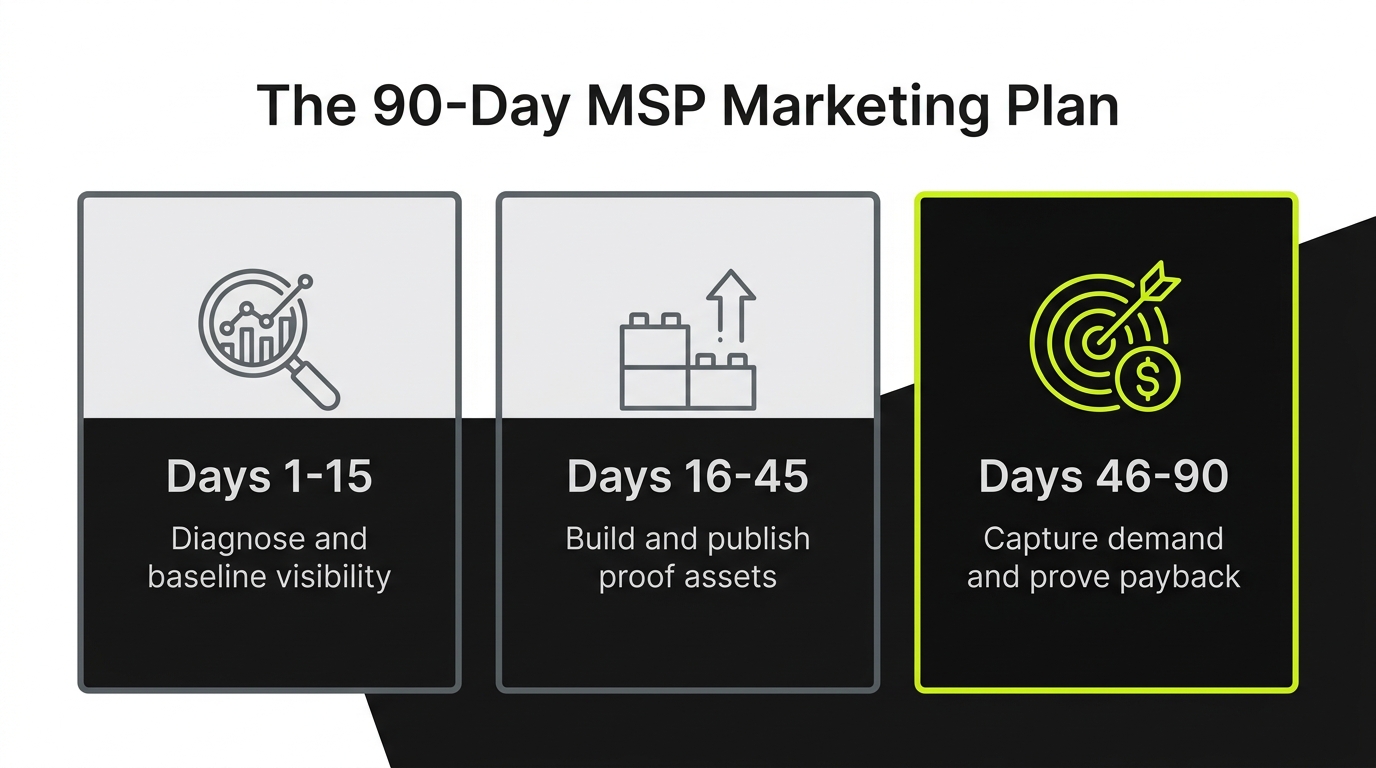
- Day 14: Measurement stack and positioning locked.
- Day 30: Proof pack v1 and first demand-capture pages live.
- Day 60: First shortlist visibility improvements and campaign data.
- Day 90: Pipeline review and scale decision.
Tie cancellation terms to performance. If deliverables are missed, exit the agreement. If deliverables ship but leading indicators do not move, downshift scope. If indicators move but pipeline lags, extend with a defined hypothesis to isolate friction.
At day 90, run a payback checkpoint. Recompute your payback model using real pipeline conversion rates instead of assumptions.
To book a payback model review or get the 90-day payback calculator, visit nuoptima.com.
How to Execute the 90-Day MSP Marketing Plan
Execute this 90-day system with strict operational discipline. Use the pre-built downloadable kit to run the system without draining engineering hours.
Most MSP marketing guides list tactics; few give you the week-by-week calendar and the payback math to take to your finance partner. This is that plan.
Step 1: Download the Execution Assets
Download the resource kit to eliminate setup friction. This package includes three distinct execution tools:
- The 90-Day Calendar: Follow the week-by-week roadmap with specific deliverables.
- The Payback Calculator: Model your gross profit payback, calculate break-even logos, and stress-test your downside scenario.
- The Marketing Swipe File: Deploy ready-to-use email templates, a drop-by flyer, a strategic QBR outline, and a high-intent landing page wireframe.
Review the comprehensive MSP content marketing guide to build the deep, verticalized content architecture that powers this framework.
Step 2: Run the 60-Minute Weekly Routine
Operate this system as a founder in exactly 60 minutes per week. Maintain this pace using a strict, two-part operational rhythm.
First, dedicate 30 minutes to the weekly review:
- Check Visibility Scores: Audit your Google and AI shortlist presence for 10 vertical-specific queries.
- Track Pipeline: Measure inbound meetings booked and active pipeline value created.
- Verify Deliverables: Confirm that the weekly outputs match the 90-day calendar milestones.
Second, execute a 30-minute approval workflow. Have subject matter experts provide raw technical inputs. Review and approve the final drafts when they return to your desk.
Step 3: Lock Financial Assumptions and Measure Progress
Instruct your finance partner to evaluate this program against clear operational milestones.
- Measure Day 30 Progress: Confirm tracking infrastructure is verified and wedge-offer landing pages are live.
- Measure Day 60 Progress: Verify initial AI visibility scores are improving and outbound campaigns are generating qualified meetings.
Lock four non-negotiable financial assumptions before launching: gross margin, average client retention, operational capacity, and sales cycle length.
Step 4: De-risk Execution with a Done-for-You Diagnostic
Skip the setup friction and accelerate your results by letting our team handle the diagnostic work. Go to nuoptima.com to book a payback model review and get the 90-day payback calculator. Before you plan, run an MSP revenue diagnostic to identify where your funnel is leaking. And if the plan surfaces manual bottlenecks, like unreviewed sales calls or proposals that take days, our AI advisory for MSPs automates them so the 90-day plan does not stall on capacity.