Reliance on unpredictable referrals is no longer a viable growth strategy. Intense competition and private equity scrutiny demand predictable pipelines built on measurable unit economics and repeatable plays, not random tactics. This MSP Marketing Playbook delivers that board-ready predictability, detailing exactly what to do, in what order, and how to measure ROI. It specifically addresses the technical and strategic structural gaps most other marketing guides miss. To build this predictable growth engine, we start by reverse-engineering your revenue targets into a robust pipeline model.
An MSP marketing playbook is a set of repeatable plays that reverse-engineers your revenue target into monthly MQL, SQL, and meeting goals, then runs the same sequence, ICP wedge, productized offer, content, paid, nurture, every quarter so growth is predictable rather than referral-dependent. It is the execution manual, not the architecture diagram.
Key Takeaways
- Predictable MSP growth starts with a pipeline model that reverse-engineers your annual revenue target into required monthly MQLs, SQLs, and meetings.
- If you cannot track the full MQL to SQL to closed journey in one reliable CRM, you cannot scale predictably, so fix tracking before spending on channels.
- Pick one narrow ICP wedge, a single vertical plus a key buyer persona, and do not add a second until the first shows repeatable, profitable performance.
- Productize services into Good, Better, Best tiers with clear inclusions, a defined buying trigger, and proof assets like one case study and three testimonials.
- The 90-day plan runs Q1 foundation, Q2 scaling proven channels, Q3 high-margin GTM launch, and Q4 retention, ending with a one-page leadership scorecard.
1. Reverse-Engineer Your Revenue Goals with a Pipeline Model
When owners or investors question marketing spend, the defense often focuses on disconnected tactics ("We need more LinkedIn ads" or "better SEO"). This fails because it treats marketing like an artrather than a science, a common red flag when vetting M&A advisors for your firm's future sale. To secure budget and achieve predictable growth, you must first define the pipeline mathematics. Your strategy must begin with a quantitative model that converts the annual revenue target into concrete monthly lead goals. This pipeline model makes every marketing activity accountable to a clear financial outcome, effectively serving as a core component of your MSP acquisitions playbook.
Building this model requires five critical inputs:
- Target Net-New MRR: The total monthly recurring revenue (MRR) the business needs to secure this year.
- Average MRR per Client: The typical monthly value of a new managed services contract.
- Close Rate (SQL - Closed): The percentage of sales-qualified opportunities that sign a deal.
- Meeting Rate (MQL - SQL): The rate at which marketing-qualified leads convert into sales meetings.
- Conversion Rate (Visit - Lead): The rate at which anonymous website traffic becomes a known contact (MQL).
The model's output is a set of mandatory monthly targets for MQLs, SQLs, and meetings. These figures dictate your channel mix and resource allocation, ensuring every tactic feeds a measurable revenue requirement.
The core measurement rule for this MSP Marketing Playbook is scale-limiting: If you cannot track the full MQL-SQL-Closed journey within a single, reliable CRM, you cannot scale predictably. Start with conservative conversion ranges, then tighten these assumptions every 30 days based on verifiable CRM data.
2. Define and Attack Your Ideal Customer Profile (ICP) Wedge
The generic promise, "We provide IT support for anyone", is the single greatest destroyer of MSP Marketing Playbook budgets. This unfocused approach dilutes messaging, wastes ad spend, and plummets conversion rates. To achieve predictable growth, precision is required.
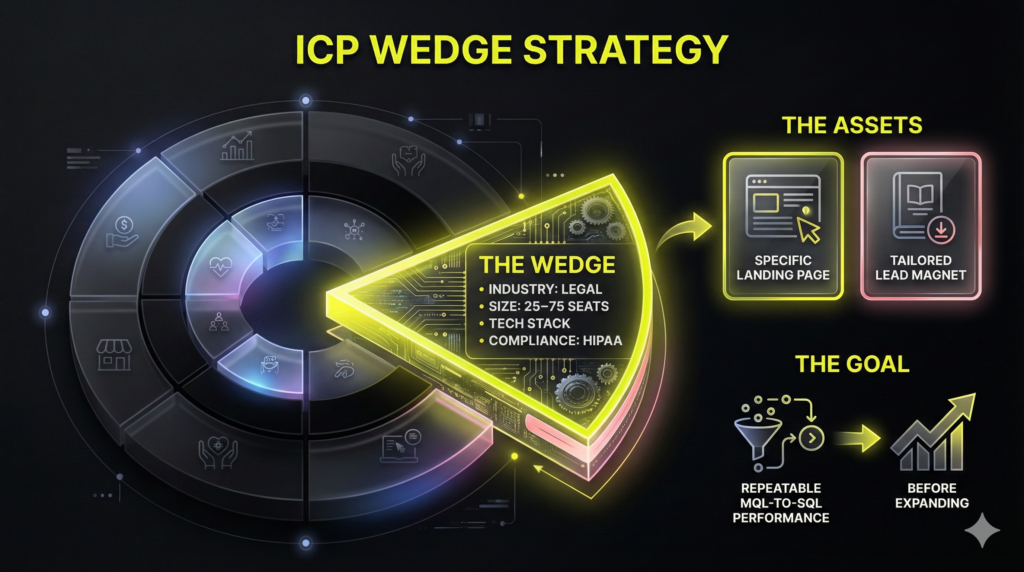
Define your Ideal Customer Profile (ICP) based on operational dimensions you can actually target:
- Industry: The vertical you know best (e.g., legal, manufacturing, finance).
- Size Band: Specific employee counts or revenue levels (e.g., 25-75 seats).
- Tech Stack: Specific systems or platforms they currently use or need to adopt.
- Compliance Exposure: Required regulatory adherence (HIPAA, CMMC, SOC 2, etc.).
- Geography: Your physical service radius for rapid response.
To gain immediate traction, select one narrow ICP wedge: one primary vertical plus a key buyer persona (e.g., Law Firms, 25-50 seats, targeting the Managing Partner).
Once the wedge is selected, build the minimum viable marketing assets immediately: a specific landing page centered on measurable outcomes and proof points for that niche, and a tailored lead magnet (e.g., Compliance Readiness Assessment or Security Checklist).
Guardrail: Do not add a second ICP until you demonstrate repeatable, profitable MQL-SQL performance in the first. Focus reduces waste and sharpens relevance, accelerating lead generation.
3. Productize Your Services to Eliminate Buyer Risk and Friction
Even after defining your ICP, qualified prospects often stall because managed services are sold as complex, custom projects. This introduces high perceived risk, scope confusion, and pricing friction. To improve sales cycle efficiency, apply productization, making the service easy to explain and even easier to buy.
Execute this productization checklist:
- Name the Offer: Use outcome-driven names instead of generic "Managed IT".
- Tier Pricing: Three tiers (Good, Better, Best) with explicit inclusions and exclusions.
- Define the Trigger: A clear "why now" using compliance deadlines, security risk, or insurance pressure.
Before scaling lead generation spend, ensure these proof assets exist:
- One detailed case study with before and after metrics.
- At least three testimonials aligned with the offer outcome.
- A one-page scope and onboarding timeline.
This structured approach lowers buyer anxiety, streamlines delivery, and translates directly into predictable gross margins. When you align your services with the client's long-term exit strategy, showing how disciplined IT compliance lifts firm value the way an MSP valuation is actually assessed, you transform from a vendor into a strategic partner.
4. Design the Website as a Conversion Engine
Sending high-intent traffic to a generic homepage is the most common ROI killer, which is why MSP website design built around a single offer beats a brochure site. Your homepage is a brochure. Your high-converting landing page is a revenue asset.
- Clarity on Offer: Who it is for, the outcome, and the risk reduced.
- Process and Proof: Scope, timeline, testimonials, and case study snippets.
- Primary CTA: One clear action such as "Book Compliance Assessment".
Technical tracking is mandatory: call tracking, form tracking, UTMs, and CRM event tracking. Speed and mobile responsiveness are non-negotiable.
5. Systematize Content Velocity
MSPs win by efficiency. Create one flagship asset per month tied to a core ICP pain point, then repurpose aggressively.
The Content Force Multiplier
- Short-Form Video: 3-8 clips for LinkedIn.
- Written Content: One long-form blog and 6-12 LinkedIn posts.
- Email Nurture: One 3-email persona-specific sequence.
AI accelerates distribution, not strategy. Humans validate expertise and inject POV. Track attribution end to end to identify assets that drive revenue.
6. Building Your Compounding Asset: Modern MSP SEO Strategy
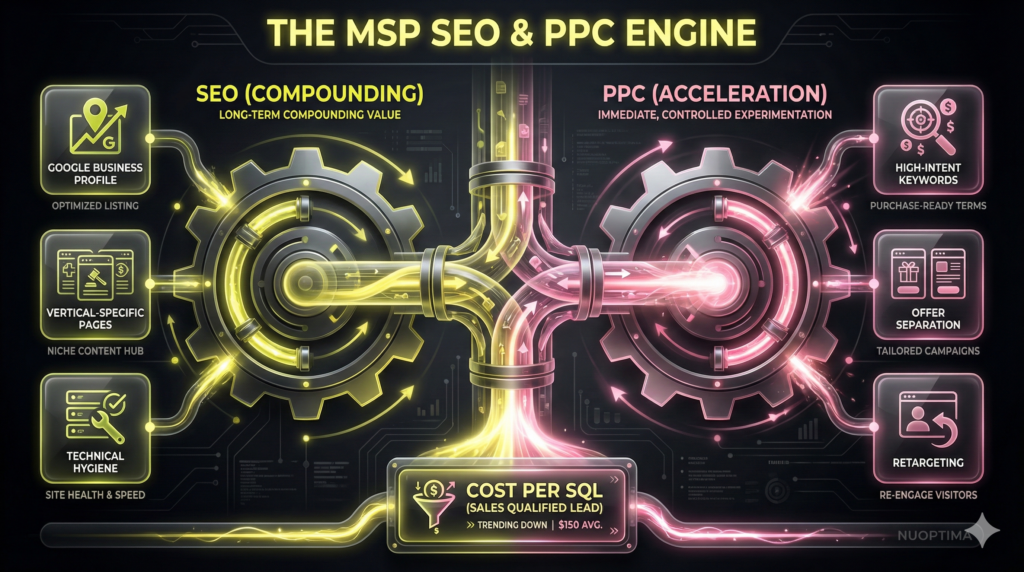
SEO builds durable traffic and enterprise value. For MSPs, success requires hyper-local and vertical-specific execution.
- Hyper-Local Authority: Optimize Google Business Profile and review velocity.
- Vertical Pages: Niche service pages with regulatory FAQs.
- Service Area Pages: Only where you can physically deliver.
- Technical Hygiene: Speed, crawlability, and mobile UX.
Measure impressions, clicks, and conversions. Rankings without MQLs are vanity metrics.
7. Launching a Controlled-Experiment PPC Engine
PPC accelerates growth when structure and tracking are in place. The goal is Cost per SQL, not cheap clicks.
PPC Structure
- 3-5 high-intent keyword clusters.
- Separate campaigns per offer or vertical.
- Dedicated retargeting spend.
Lead Quality Guardrails
- Strict negative keywords.
- On-form qualification aligned with ICP.
8. Systematize LinkedIn: ABM-Lite
LinkedIn becomes predictable when treated as an ABM execution layer. Build a Dream 50-100 list and map buying roles.
- 2 POV posts weekly.
- 1 proof post.
- 1 educational short video.
Measure meetings booked from named accounts, not likes or impressions.
9. Implement the Minimum Viable Nurture System
The Essential Nurture Structure
- 7-10 touch new lead education sequence.
- 3-5 touch re-engagement sequence.
- Value-dense newsletter only.
Lead Scoring
Score intent actions and route high-intent leads to sales within five minutes.
10. Systematize Trust Assets
- Referral Engine: Ask at high-probability moments.
- Review Velocity: Monthly review targets.
- Partner Co-Marketing: Joint webinars and assets.
11. Execute the Minimum Viable GTM Plan
Launch one high-margin service at a time with a focused GTM motion.
- Clear offer tiers and pilot.
- One webinar, one case study, one sales one-pager.
- ABM-lite distribution.
12. Model Unit Economics Before You Scale a Single Channel
A play only earns more budget when its unit economics clear a threshold you set in advance. The pipeline model from play one tells you how many meetings you need. Unit economics tell you which channel is allowed to fund them. Before you scale Google Ads, LinkedIn, or a webinar series, model the cost to acquire one signed client and the value that client returns over the life of the contract.
Build the calculation from numbers already sitting in your CRM, not industry averages:
- Customer acquisition cost (CAC): fully loaded channel spend plus management fees, divided by clients signed from that channel.
- Lifetime value (LTV): average MRR per client multiplied by expected contract months and gross margin, not raw revenue.
- Payback period: how many months of that client's margin it takes to recover CAC. A managed-services contract that pays back inside the first year is a channel you can scale with confidence.
- Cost per SQL by channel: the leading indicator you can read in week three, long before a deal closes.
Set a rule before spending: any channel whose payback runs longer than roughly a year, or whose LTV fails to clear CAC by a healthy multiple, gets fixed or cut, never scaled on hope. Recheck these figures every 30 days as real closed-won data replaces your starting assumptions. This is the discipline a private-equity acquirer looks for when they audit a marketing function in 2026, and it is what separates a defensible spend from marketing theater.
13. Enforce Hard MQL and SQL Definitions So Sales Stops Ignoring Leads
If sales ignores the leads marketing sends, you do not have a volume problem, you have a definition problem. Predictable pipeline breaks the moment marketing and sales disagree on what a real lead is. The fix is a written, non-negotiable set of lifecycle stages every team member routes against.
- Inquiry: any raw contact form fill or newsletter signup, no fit check yet.
- MQL: an account that matches your ICP wedge firmographics and has engaged with high-intent content such as a compliance assessment or pricing page.
- SQL: a prospect with a live trigger, a compliance deadline, a breach, an expiring contract, who is ready for a sales conversation now.
- Qualified meeting: a booked discovery call with an actual decision-maker, the metric your pipeline model actually counts.
Attach a response-time SLA to the definition: every SQL gets a first sales touch within minutes, not days, because speed to lead is one of the few free conversion levers an MSP owns. Then track how each stage converts to the next. When a stage leaks, you know exactly which play to fix rather than blaming the channel. This qualification layer is what turns the plays above into the board-ready predictability the pipeline model promised, and it feeds the one-page scorecard leadership reviews at the end of every quarter.
The 90-Day Execution Schedule
| Quarter | Focus Objective | Primary Execution | KPI Focus |
|---|---|---|---|
| Q1 | Foundation and Validation | Pipeline model, first vertical wedge | MQLs, Cost per SQL |
| Q2 | Scaling Efficiency | Double down on proven channels | Channel ROI, SQL volume |
| Q3 | Vertical Depth | Launch high-margin GTM | Expansion MRR |
| Q4 | Expansion and Retention | Upsell and retention content | LTV, churn reduction |
Final Deliverable
By the end of Q1, leadership must receive a One-Page Scorecard. This essential document tracks target MRR versus actual MRR, summarizes learnings (which channels failed, which succeeded), and defines the resource bets for the next quarter. This report ensures marketing is viewed as a predictable, science-backed revenue engine and forces accountability. If you want the structural view behind these plays, how the levers fit together as one demand engine, see the MSP marketing blueprint; this playbook is how you run it week to week.