
If your next client does not come from a referral, do you actually know where they will come from? Most founders are trapped between unpredictable word-of-mouth and rented ad traffic. To scale, you need a compounding demand engine. This modern system uses owned attention, proof, and distribution to build enterprise value.
This MSP marketing blueprint lays out 10 concrete levers to dominate the 2026 market using GEO and AI-search positioning, structured as a demand engine rather than a list of tactics.
Key Takeaways
- MSPs that rely on referrals for 80%+ of pipeline are one lost relationship away from a revenue gap; a compounding demand engine is the fix.
- Generative Engine Optimization (GEO) is the highest-leverage channel for 2026: AI answer engines like ChatGPT and Perplexity now shortlist vendors before prospects ever visit a website.
- Niche targeting by vertical and firmographic band directly lowers cost per lead and raises close rates; generic "managed IT" positioning commoditises your firm.
- A structured 90-day sprint covering demand capture, trust assets, and compounding authority is the minimum viable path to predictable pipeline.
- NUOPTIMA ran this exact system for Cortavo and produced $1,000,000+ in MQL pipeline and $210,000+ in contracted value by December 2025.
An MSP marketing blueprint is the structured demand-generation system a managed service provider uses to convert referral dependency into a compounding pipeline, mapping levers across positioning, GEO, local search, paid, and RevOps into one measurable engine. It is the architecture, not the week-by-week task list.
This is not a theory. NUOPTIMA ran this exact play for Cortavo, a managed IT provider: a combined organic and AI-search engine that produced over $1,000,000 in MQL pipeline and $210,000+ in contracted value by December 2025, with 4x more AI citations than the closest competitor for tracked terms, and $403,330 in contracted sales value at a 4.6x return by month twelve. Read the full Cortavo case study for the breakdown.
1. Engineer a Predictable Demand System
Many technical founders get trapped in a frustrating "we tried marketing" loop because they treat growth as a series of ad-hoc campaigns. True demand generation is an engineered system that systematically manufactures trust and market demand, eliminating keyman dependency and making pipeline growth predictable.
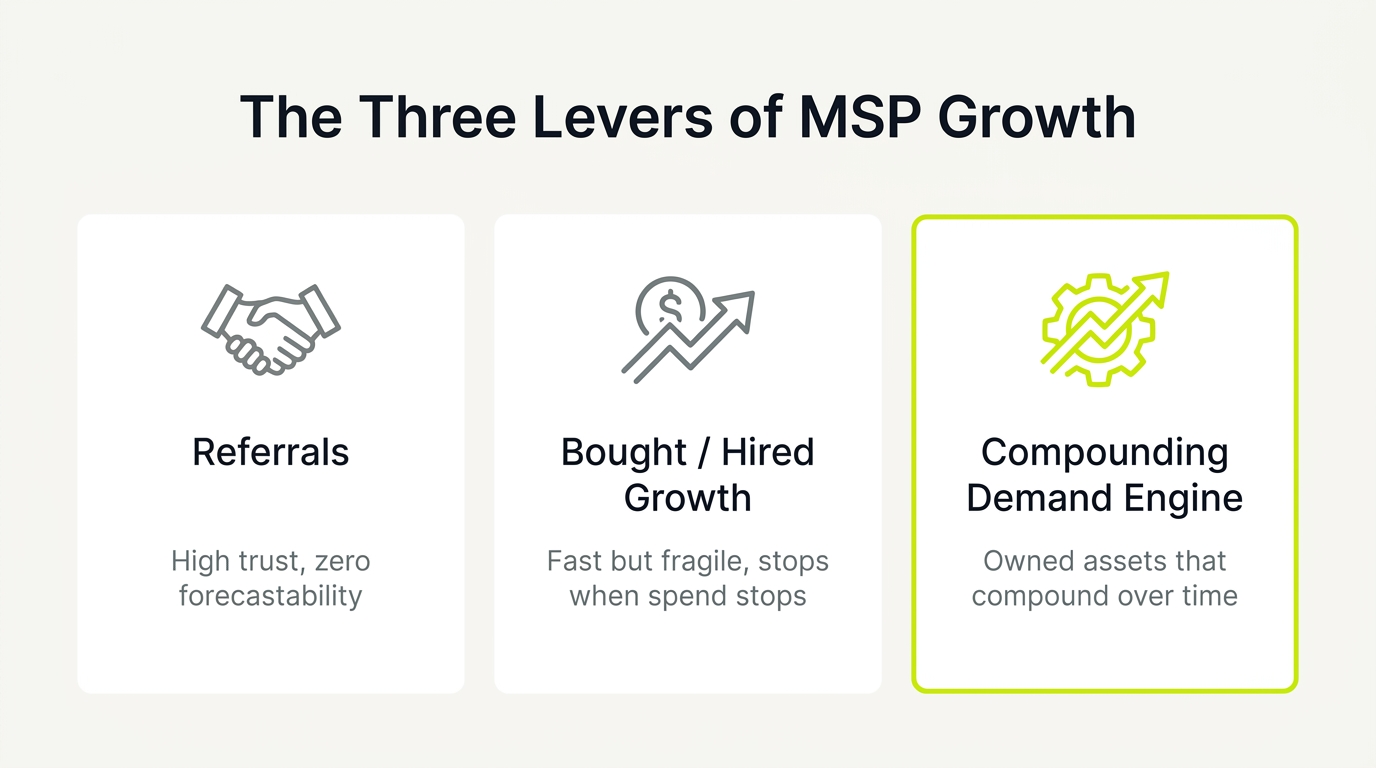
This architecture operates through three distinct levers:
- Referrals: High-conversion but fundamentally uncontrolled and erratic.
- Bought or Hired Growth: Fragile, expensive outbound agencies and paid ads that stop producing when spending ends.
- Compounding Demand Engines: Owned digital assets, including localized case studies, GEO citations, and webinar recordings that build organic equity.
To scale, leadership must track metrics that reflect actual MSP operational reality. Instead of monitoring vanity website clicks, focus on qualified meetings booked, sales cycle length, CAC-to-LTV ratios, and the percentage of pipeline sourced independent of referrals. This framework shifts your firm from reactive pipeline building to predictable, investor-ready enterprise valuation.
2. Dominate AI Answer Engines with Generative Engine Optimization
By 2026, prospects will bypass page-one Google links entirely. Instead, high-intent B2B decision-makers ask AI answer engines like Perplexity and SearchGPT who to hire. The winner of this shift is the brand the model cites and summarizes. For vertical IT firms, this makes Generative Engine Optimization (GEO) the ultimate pipeline multiplier.
LLMs prioritize risk reduction and objective trust signals over clever slogans. To secure these recommendations, you must pivot your strategy to target how machines crawl data. This defensible 2026 strategy prevents your firm from losing critical mindshare to AI-curated competitive recommendations.
Build a citation-ready digital footprint with this action checklist:
- Authority Pages: Publish clear service definitions, compliance frameworks (SOC2/HIPAA), FAQs, and regional outcomes.
- Citable Assets: Build structured case studies, comparisons, and technical checklists that LLMs can easily quote.
- Structured Schema: Deploy clean backend code so models accurately attribute your firm as the local authority.
3. Escape Commoditization with Niche Targeting and Outcome Messaging
If your website lists the same tech stack as regional competitors, you are a commodity. To differentiate, your positioning must target a specific vertical and firmographic band within your physical operating radius. Choose an ideal customer profile (ICP), such as compliance-heavy healthcare or financial firms with 20 to 75 employees, where you can prove deep domain fluency.
Intercept these prospects during high-intent trigger events. Focus your outbound campaigns on "why now" moments like compliance shifts, M&A activity, leadership transitions, active cyber breaches, or internal IT team overload.
Then, translate technical features into clear business outcomes. Stop pitching "24/7 monitoring" and start selling risk mitigation, hours saved, and stronger compliance confidence.
- Audit-Ready Compliance: Target SOC 2 or HIPAA readiness, often in under 90 days.
- Reduced Downtime: Deploy proactive patching that prevents critical outages to keep your workforce productive.
- Faster Onboarding: Configure and ship fully secured, compliant user devices in under 24 hours.
4. De-Risk the Switch with High-Impact, Frictionless Offers
Why do prospects stay with terrible IT providers? It is rarely the price. The real barrier is transition anxiety: the fear of migration downtime and operational disruption.
Generic offers fail because they ignore this pain point. Pitching another "free IT assessment" does nothing to soothe the fear of transition risk. To win these buyers, you must shift the migration risk from their shoulders to yours with a high-impact, low-friction lead magnet:
- The Zero-Downtime Guarantee: A structured onboarding plan backed by a financial commitment to credit their first month if migration causes unscheduled downtime.
- The Onboarding Credit: A financial offset covering the cost of their internal team’s time during the handoff.
- Co-Managed Augmentation Plan: A risk-free pilot program that supports, rather than replaces, their current internal IT lead.
By proactively neutralizing migration pain, you transform your hook from a generic sales pitch into a strategic risk-reduction asset.
5. Dominate Local Search to Capture High-Intent Regional Demand
For geographically constrained MSPs, local authority is the shortest path to compounding demand. High-intent prospects seeking fast on-site support or regional compliance expertise look directly to the Google map-pack. Map-pack visibility and client reviews are critical conversion levers, not branding fluff.
To turn local search into a predictable trust advantage, your local playbook must combine search engine authority with vertical proof. Implement this execution checklist to dominate your territory:
- Optimize Google Business Profile: Tighten primary and secondary categories, and explicitly list your specialized vertical compliance services.
- Build Consistent Citations: Ensure your name, address, and phone number (NAP) are identical across all local business directories.
- Run a Systematic Review Engine: Set an operational milestone of 30+ detailed, five-star client reviews to build trust, then maintain a monthly cadence.
Owning your immediate territory creates a local trust advantage that improves search rankings and close rates, creating a defensible lead engine.
6. De-Risk Paid Acquisition with Upfront Unit Economics
Launching Google Ads campaigns without modeling unit economics upfront is a fast way to burn capital. Many technical MSP founders abandon paid acquisition prematurely because they underestimate the actual cost of capturing high-intent B2B search traffic.
To establish a finance-grade decision framework, start with realistic benchmarks. The Google Ads cost per lead (CPL) for qualified IT opportunities spans $100 to $1,000+ depending on market and intent. In highly competitive metropolitan areas, expect an average CPL of $600 to $1,000 for verified enterprise decision-makers.
Structure your budget as two distinct line items: direct ad spend and professional management fees. Underfunded campaigns routinely stall because they lack the necessary conversion data for Google's algorithms to optimize. To cross this threshold, commit to a starting ad spend floor of $3,500 to $5,000 per month. Forcing this LTV/CAC math upfront prevents wasted capital and ensures your paid acquisition aligns with long-term client contract value.
7. Capture High-Attention Pipeline with Low-Cost Webinars
How much time does a prospect spend reading a blog post? Usually under a minute. In contrast, a structured webinar commands 20 to 30 minutes of undivided attention, a rare commodity today. By focusing on urgent, self-qualifying topics like Microsoft Copilot integrations, CMMC compliance updates, or ransomware incident readiness, you instantly filter for high-intent buyers.
This strategy solves a critical growth bottleneck. It provides a repeatable tactic to generate qualified sales conversations without relying on passive referrals or producing massive volumes of daily content.
You only need a minimal-stack play to execute:
- A simple registration landing page.
- Targeted promotion via Meta Ads, which often deliver a lower cost-per-lead than LinkedIn.
- A structured follow-up sequence that treats both registrants and no-shows as long-term nurture assets.
Post-event, package the recording into bite-sized video clips for social proof. Finally, convert the transcript into structured text to feed your SEO and GEO engines.
8. Reactivate Lost Deals to Drastically Slash Acquisition Costs
Instead of waiting for net-new demand, create immediate pipeline opportunities using assets your MSP already owns: your CRM history. Reactivation is the most underutilized growth lever. Past prospects already know your brand, meaning you do not need to rebuild trust. Your only job now is to change the timing, adjust the offer, and remove friction.
To unlock this value, deploy a structured 4 to 6 week multi-touch cadence:
- Segment by loss reason: Group old opportunities by why they walked away, such as choosing a competitor or keeping internal IT.
- Remove switching friction: Send a differentiated offer, like a transitional onboarding credit, to directly ease their transition anxiety.
- Coordinate the touchpoints: Combine targeted email sequences, physical direct mail, LinkedIn engagement, and direct sales outreach.
- Measure performance: Track close rates and customer acquisition cost (CAC) with the same rigor as any paid advertising campaign.
9. Plug Website Leaks by Manufacturing Trust and Simplifying Conversion Pathways
Many MSP websites silently leak demand, wasting budget on traffic that never converts. The fastest path to ROI is not buying more traffic, but fixing your conversion rate through trust manufacturing and clear buyer pathways.
To stop these leaks, deploy critical trust assets across your core pages:
- Clear "Who We Help" Statement: Instantly self-qualifies ideal prospects.
- Short Owner or Team Video: Humanizes your technical brand and builds rapport.
- Visible Guarantees: Minimizes the perceived risk of switching IT providers.
- Proven Outcomes: Showcases partner logos, testimonials, and before-and-after metrics.
Next, optimize your conversion mechanics. Direct campaign traffic to dedicated landing pages rather than a generic homepage, routing visitors toward a single primary CTA like a consultation. For non-ready buyers, build a lightweight nurture path using email sequences and retargeting ads. To build these high-converting pathways, read our MSP content marketing growth guide.
10. Align Sales and Marketing with RevOps and Rigid Lead Definitions
If your sales team ignores incoming website submissions, you do not have a lead volume problem. You have a definition problem.
Without standardized pipeline stages, your marketing budget is wasted on "marketing theater" and inconsistent follow-ups. RevOps converts chaotic team activity into predictable revenue outcomes by enforcing rigid, non-negotiable lifecycle stages:
- Inquiry: A basic contact form submission or newsletter signup.
- MQL: An account matching your target firmographics that engaged with high-intent content.
- SQL: A prospect actively seeking to resolve an IT compliance vulnerability.
- Qualified Meeting: A confirmed sales discovery call booked with a decision-maker.
Set a strict response-time service-level agreement (SLA) requiring sales to contact every SQL within fifteen minutes.
Finally, build a minimal attribution framework tracking lead source, stage progression, and closed-won revenue. This reporting discipline provides the data needed to scale what works and decide whether to fund SEO/GEO, paid search, or webinars next quarter.
The 90-Day MSP Marketing Sprint: Pipeline Stabilization to Scaled Distribution
To execute effectively without falling into the trap of random acts of marketing, focus exclusively on three tracks: Demand Capture, Trust and Conversion, and Compounding Authority. Avoid trying to execute everything at once. Use this structured 12-week sequence to build a high-yield revenue engine. Once the architecture is set, the MSP marketing playbook of plays to run covers the repeatable execution week to week.
Weeks 1 to 2: Stabilize Your Near-Term Pipeline
Secure immediate revenue wins and plug active conversion leaks.
- Export and Reactivate: Pull historical CRM data of lost deals. Launch a multi-touch reactivation sequence using a low-friction, risk-reduction offer.
- Optimize Your Homepage: Eliminate vague technical jargon. Add clear outcomes, client proof, and a single, high-converting call to action.
- Enforce RevOps Basics: Define clear lead stages and establish a strict 15-minute response-time service level agreement (SLA) for incoming inquiries.
- Schedule a Strategic Review: Before scaling your budget, invite a strategic review at nuoptima.com to identify structural gaps in your CRM and funnel.
Weeks 3 to 6: Build Your Compounding Assets
With your core conversion path secure, construct marketing assets that build long-term organic equity.
- Lock in Your Focus: Select one specific vertical ideal customer profile (ICP) and pair it with a single, high-value offer.
- Create GEO Foundations: Publish two citation-ready authority pages addressing specific compliance frameworks to feed AI search engines.
- Dominate Local Search: Claim and refresh your Google Business Profile. Implement an automated process to secure weekly five-star client reviews.
Weeks 7 to 12: Scale Distribution
Expand your reach only after verifying your core funnel conversion rates.
- Launch a Targeted Webinar: Host a live session on an urgent compliance or security trigger topic. Use lower-cost paid social ads to drive registrations.
- Evaluate Paid Search: Deploy Google Ads only if you can commit to a $3,500 monthly budget floor and have all conversion plumbing verified.
- Track Pipeline, Not Traffic: Establish a monthly reporting cadence focused strictly on opportunities, customer acquisition costs, and closed-won contract value.