
Referrals still close, but stalling around $7M reveals a hard ceiling where pipeline remains lumpy and founder-dependent. True MSP growth requires shifting from a delivery focus to a demand and positioning strategy. Escape velocity comes from engineered demand for shortlist visibility in Google and AI answers, plus verticalization to support premium pricing and a higher multiple. Here are eight plays and a 90-day plan for you and your finance partner to measure. Start with a valuation-focused growth diagnostic at nuoptima.com.
Key Takeaways
- MSPs stall at roughly $7M ARR when pipeline is still founder-dependent and referral-driven. Escaping that ceiling requires an engineered demand system, not more hustle.
- Verticalization is the single highest-leverage positioning move: owning one niche improves close rates, supports premium pricing, and raises your valuation multiple.
- Track five boardroom metrics monthly (gross margin, EBITDA, net revenue retention, sales capacity, founder-sourced revenue %). Without this baseline, growth constraints stay invisible.
- A 60% gross margin floor on managed services is non-negotiable; custom pricing sheets and legacy break-fix accounts silently erode it.
- Buyers underwrite transferable systems, not founder hustle. De-risk key-person dependency before you want to sell or raise.
Predictable MSP growth is the shift from founder-dependent referral pipeline to an engineered demand engine that generates shortlist visibility in Google and AI search, supports recurring-revenue packaging, and produces transferable enterprise value independent of the owner's network.
1. Standardize Your Boardroom Scorecard
Corporate buyers underwrite predictable systems, not founder hustle. If your pipeline relies on your personal network, your valuation suffers. To build an acquirable business, you must track five core metrics on a single sheet: gross margin on managed services, EBITDA, net revenue retention, sales capacity, and the percentage of founder-sourced revenue.
Without this baseline, the growth-ceiling pattern is predictable: when relationships and referrals slow, the entire sales forecast breaks because you lack an engineered pipeline. You can rebuild a client's network overnight, but your own pipeline still runs on whoever you bumped into last quarter.
This scorecard provides a practical monthly baseline for you and your finance partner. It stops random, expensive marketing projects by identifying the binding constraint capping your valuation. Marketing is finally judged on pipeline and gross-profit payback, not useless click reports.
2. Own a Vertical Beachhead First
Generalist messaging compresses margins because buyers view IT services as an interchangeable commodity. Trying to serve everyone skyrockets CAC and collapses your pricing power, stalling your positioning.
The believer minority strategy requires verticalization. Choose your beachhead niche based on five criteria:
- High average deal size
- Strict regulatory compliance or operational urgency
- A repeatable technology stack
- Referenceable local clients
- Strong prospect density in your geographic region
Define a clear category statement detailing who you serve, the operational outcome you own, and your verified proof. For example: "We secure regional healthcare clinics with zero regulatory downtime, backed by a documented SOC 2 track record." This defensible position improves close rates, supports premium pricing, and builds a specialized service provider that commands much higher valuation multiples from future buyers.
3. Engineer a Compounding Demand Stack
Demand engineering means being found, trusted, and shortlisted before a buyer ever books an introductory call. This system replaces unpredictable, referral-only growth with an owned inbound engine that improves pipeline forecastability, reduces founder dependency, and supports closing existing relationships.
To build a compounding pipeline for predictable demand, you must deploy a minimum viable demand stack that converts skeptical technical buyers:
- Vertical landing pages addressing industry compliance
- Direct competitor comparison pages
- Clear "who we are for" positioning
- Technical proof assets that reduce perceived risk
Rather than tracking vanity traffic, measure your query-level shortlist visibility in Google and AI answers across a fixed set of high-value buyer questions. If ChatGPT cannot find and cite your technical proof when a regional CFO asks for specialized IT support, your firm remains invisible.
4. Standardize Pricing Packages to Protect Service Margins
Every custom pricing sheet designed to win a difficult deal is a service margin waiting to die. To protect your bottom line, shift packaging from labor hours to clear outcomes. Define exactly what you prevent, what you guarantee operationally, and what you exclude.
Simplify your commercial offering into three predictable models:
- Core IT
- Compliance-heavy
- Co-managed support
Only offer co-managed support if your delivery team can handle the shared workflow without operational chaos. This clear menu allows a buyer's CFO to compare value easily without stalling the sales cycle.
Finally, establish strict margin guardrails, maintaining a 60% gross margin floor on all managed services. Topline revenue built on custom operational snowflakes drags down your valuation. True scale requires predictable, repeatable margins that compound.
5. Run a Controlled Conversion Program for Legacy Accounts
Legacy break-fix accounts should fund your transition to recurring revenue, not drain your delivery margins. To free up capacity for expansion, run a controlled conversion program rather than taking a moral stance.
First, segment accounts using five metrics to identify who to retain:
- Gross margin
- Ticket volume
- Roadmap receptiveness
- Security posture
- Referral value
For the viable accounts, introduce a standard managed agreement. Frame the upgrade around business risk, explaining how unmanaged environments expose both companies to liability. Offer a single, non-negotiable service tier, and set a strict 90-day deadline to sign or transition.
If they refuse, execute a clean offboarding plan. Deliver their documentation, suggest three alternative local providers, and enforce the termination date. Graceful offboarding stops your team from subsidizing unscalable, low-margin work, freeing engineers to support your high-value contracted clients.
6. Map Channel Partners to Multiply Pipeline Trust
Partner channels build a compounding pipeline source that does not rely on cold outbound or founder networking. This ecosystem rewards credible specialists who make partners look good and reduce implementation risk.
To build this engine, map three distinct channel sources:
- Platform and software vendor ecosystems
- Local professional partners, including CPA, legal, and insurance firms
- Adjacent IT service firms
Do not ask these partners for warm introductions. Instead, give them a high-value co-sell asset, like a vertical security checklist, a shortlist guide, or a migration plan they can pass directly to their clients.
The strict execution rule is that channels compound only after your positioning is exceptionally narrow. If you look like a generic provider, partners will not risk their client relationships. Clear specialization protects your margin and drives compounding pipeline.
7. Build a Repeatable Sales Pathway to De-Risk Decisions
Sales does not scale by hiring alone. Predictable revenue scales when you turn technical expertise into a repeatable decision pathway designed for both the champion and their cautious finance partner. This structured sales process improves close rates and sales-cycle predictability while reducing the founder's dependency to personally close every deal.
To build a repeatable pipeline, implement a three-part sales system:
- Strict Qualification: Disqualify poor-fit prospects quickly on seat count, urgency, compliance requirements, and their decision structure before wasting engineering resources.
- The Proof Stack: Deploy case studies, your verified security posture, and an explicit onboarding plan showing exactly what happens in the first 30 days.
- The Finance Partner Layer: Speak directly to the board. Frame the decision around gross-profit payback rather than vanity customer acquisition costs, and present the downside case to de-risk the investment.
8. Position for Enterprise Value and Transferable Revenue
Future buyers do not underwrite founder hustle. They underwrite transferable systems. To maximize enterprise value, you must translate your topline revenue growth into buyer logic. This means securing:
- Multi-year contract quality
- Low customer concentration risk
- Net revenue retention through documented delivery
The largest drag on your valuation multiple is key-person risk. If your pipeline halts when you stop selling, your firm is a high-risk lifestyle business. De-risk this transition by building a visible demand engine, standardizing technical onboarding, and developing a capable leadership bench.
Vertical authority acts as your ultimate defensibility. Specialized MSPs command premium multiples because they are harder to displace than generalist competitors, even at identical EBITDA. When your revenue is predictable, documented, and independent of your daily involvement, your business becomes highly acquirable.
The Predictable MSP Growth Equation
Predictable growth is arithmetic, not ambition. Every play in this guide feeds one of two inputs, and holding them both above their thresholds is what lets you forecast next year's recurring revenue instead of hoping for it. The equation an acquirer underwrites is simple: next-year MRR equals current MRR times net revenue retention, plus new MRR from your engineered demand engine, minus churn. Break it into the three levers you actually control:
- Net revenue retention (the base): Expansion inside your book, driven by the standardized packages in section 4 and the co-managed upgrades in section 5. Net revenue retention above 100% means the base grows before you win a single new logo, which is the closest thing to compounding an MSP has.
- New MRR (the engine): Output of the demand stack in section 3 and the repeatable sales pathway in section 7. Because it is engineered rather than referral-sourced, you can forecast it from pipeline coverage instead of guessing from last quarter's introductions.
- Churn and margin (the leak): The 60% gross-margin floor and the legacy-account conversion program in section 5 keep the leak small enough that growth actually reaches EBITDA.
Plug your own numbers into that equation each month on the boardroom scorecard from section 1, and the binding constraint becomes obvious: a weak base points to retention work, a weak engine points to demand and sales, a fast leak points to pricing and offboarding. This is how NUOPTIMA framed the Cortavo build, and by 2026 that discipline is what separates a forecastable MSP from a founder-dependent one. The 90-day plan below sequences the plays against the revenue stage where each lever moves the equation most.
How to Build a Predictable MSP Growth Engine in 90 Days: Revenue-Stage Milestones
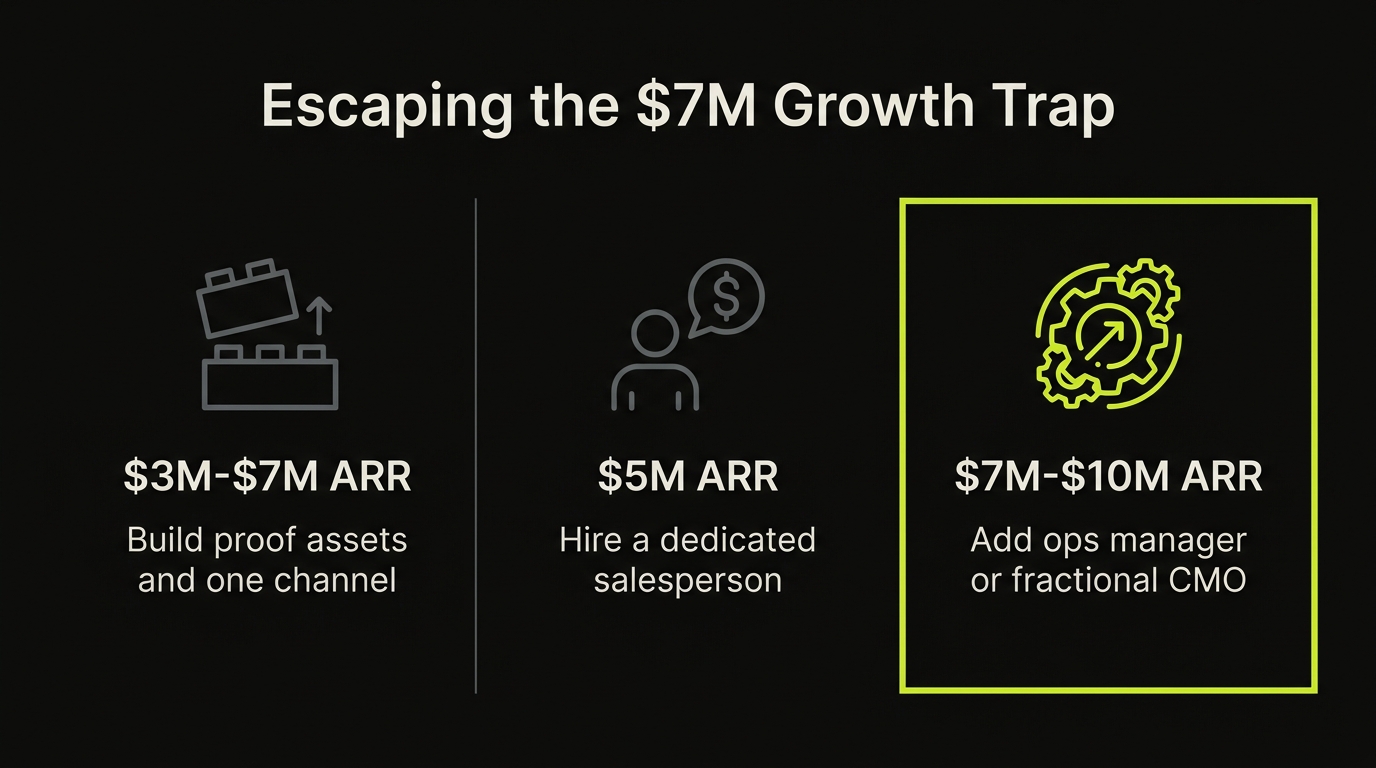
Most "MSP growth" guides measure endpoint counts or stay deliberately vague; they do not tell owners what to do differently at $3M ARR versus $7M ARR, or when to make the hire that changes the org's shape. This roadmap maps each action to the revenue stage where it has the highest leverage and to the org-design move that follows, because those decisions directly set your valuation multiple. Use it to turn positioning plays into a repeatable, stage-appropriate client acquisition system.
Weeks 1 to 2: Baseline Metrics and Narrow the Focus (Applies at Every ARR Band)
- Run the valuation-grade diagnostic. Audit your gross margins, EBITDA, and customer acquisition costs to establish your financial floor.
- Select your vertical beachhead. Write your strict category statement. Define the compliance requirements, target seat size, and geographic boundary for this niche.
Weeks 3 to 6: Construct the Visibility and Proof Layer (Critical at $3M to $7M ARR)
- Deploy your core search assets. Publish or fix your vertical landing pages, your "who we serve" page, your proof assets, and 5 to 10 buyer-intent search pages.
- Establish a shortlist visibility test set. Test 10 high-value buyer queries inside Google and leading generative AI engines. Record your baseline presence to measure search visibility changes over time.
Weeks 7 to 10: Protect Margins and Standardize the Pathway (Breakpoint: Hire a Dedicated Salesperson at ~$5M ARR)
- Align packaging and pricing. Standardize your pricing model and run a break-fix conversion segmentation analysis to upgrade or offboard low-margin contracts.
- Install qualification rules and the sales proof stack. Implement strict criteria for inbound leads and arm your sales team with 30-day onboarding plans and technical case studies. You will see a shorter sales cycle as a result.
Weeks 11 to 13: Launch Partner Channels and Evaluate Payback (Breakpoint: Add Ops Manager or Fractional CMO at ~$7M to $10M ARR)
- Initiate co-sell motions. Partner with 1 to 2 platform vendors or local professional services firms to launch co-sell campaigns.
- Audit your progress. Review qualified meetings, conversion rates, gross-profit payback trajectory, and your shortlist visibility delta.
To secure an external perspective on this process, request a tailored valuation-focused growth diagnostic at nuoptima.com.
This sequencing is not theoretical. Cortavo, a managed IT provider, had strong delivery but was stuck on founder-led referrals and needed a demand engine that worked independent of the owner's network. NUOPTIMA built Cortavo a combined organic and AI-search demand engine that generated over $1,000,000 in MQL pipeline and $210,000+ in contracted value by December 2025 without any additional founder networking, growing to $403,330 in contracted sales value at a 4.6x return by month twelve. Contracted value grew independent of referrals, which is precisely the proof a buyer or growth-equity partner needs to assign a higher multiple. Read the full Cortavo case study to see the stage-by-stage build.
Compare alternative options by reading our analysis at nuoptima.com/best-MSP-marketing-agencies as a starting point.