Map-pack visibility captures need help now local intent for IT support, cybersecurity, and managed services. Most firms treat their Google Business Profile MSP as a static checklist, but it is a strategic asset-building system for revenue outcomes. We prioritize qualified calls and booked assessments over vanity views. These 10 specific optimizations build the prominence and trust required to convert local leads, starting with relevance through categories and proximity via location setup.
A Google Business Profile is the free Google listing that puts an MSP in the local Map Pack when nearby businesses search for IT support, cybersecurity, or managed services. For an MSP it is worth the effort: local buyers often look for IT help on Google before they ever reach a website, and a well-run profile turns that search into qualified calls and booked assessments.
Key Takeaways
- Treat your Google Business Profile as a revenue system that drives qualified calls and booked assessments, not a static checklist optimized for profile views.
- Set one primary category that matches your core revenue driver (typically Managed IT Services) plus two to four secondary categories like Computer Security Service or Cloud Computing Service.
- Remote-first MSPs should configure the profile as a Service Area Business and hide the address; faking a physical location with virtual offices risks permanent suspension.
- Trigger review requests at milestone moments (project closures, resolved incidents, completed onboarding) and ask for outcome-based reviews covering uptime, responsiveness, and security posture.
- Track attribution with UTM-tagged URLs, call tracking, and geo-grid rank trackers so map visibility ties directly to CRM entries rather than vanity metrics.
1. Optimize Your Category Hierarchy for Search Eligibility
Relevance starts with categorization. Google treats your primary category as the definitive signal for search intent, determining your ranking eligibility. To maximize your Google Business Profile MSP performance, select a single primary category matching your core revenue driver, typically Managed IT Services. This focus prevents your profile from ranking for misaligned, low-intent queries.
Add two to four secondary categories like Computer Security Service or Cloud Computing Service to widen coverage. Pair this with the query themes from your managed IT services SEO plan so your categories match how local buyers actually search. Map these choices to core offers like cybersecurity or data recovery to capture specific prospect needs. Validate your strategy by auditing top-three Map Pack competitors for missed category opportunities. Use our [GBP Category & Competitor Intent Snapshot] to align your profile with local market demand.
2. Secure Your Proximity Strategy: Service Area vs. Physical Address
Address visibility is a compliance lever, not a cosmetic choice. If clients do not visit your location, configure your Google Business Profile MSP as a Service Area Business (SAB) and hide the address. Only show a physical location if it is legitimate, staffed, and accessible per Google guidelines. Virtual office shortcuts risk permanent suspension and destroy organic equity.
A massive service area will not expand reach because proximity still centers on your verification point. Instead of address games, remote-first MSPs win through prominence:
- Consolidate high-intent client reviews.
- Publish localized technical content.
- Secure consistent NAP citations.
This builds the authority required for M&A readiness without risking a local search blackout.
3. Systemize Reputation with Outcome-Based Reviews
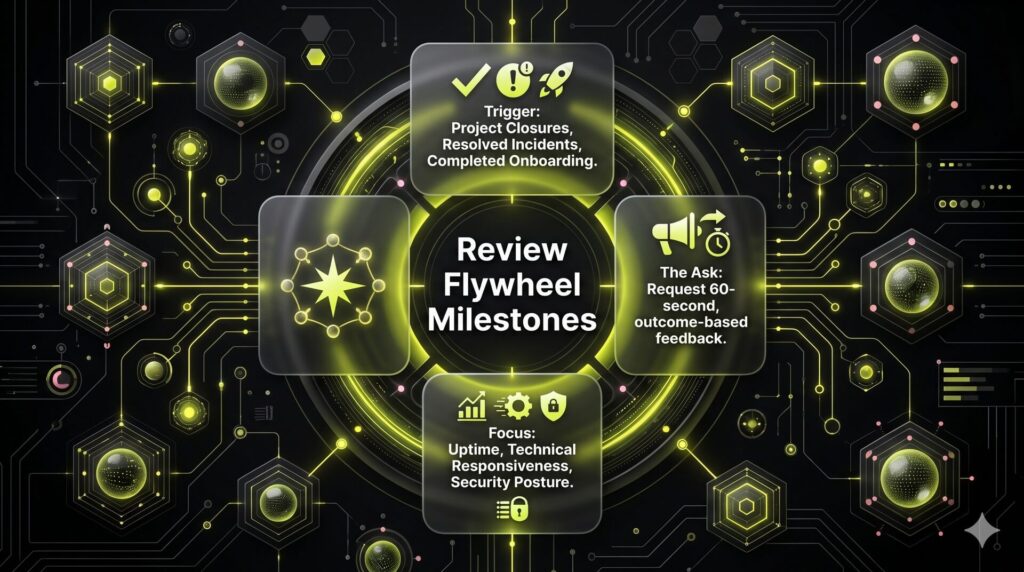
Time-poor decision-makers are the bottleneck for your Google Business Profile prominence. Transition from random asks to triggered requests during milestone moments like project closures, resolved incidents, or completed onboarding. When value is tangible, response rates increase. Use a one-click link and concise subject line to minimize friction.
Request a 60-second, outcomes-based review instead of generic praise. Ask clients to highlight:
- Uptime and reliability
- Technical responsiveness
- Security posture
Maintain hygiene by responding to every review professionally. Avoid mentioning sensitive technical data or PHI. Build a review flywheel with templates and SOPs that convert satisfaction into local authority, the same discipline that underpins ongoing MSP reputation management.
4. Transform Your GBP Into a High-Intent Landing Page
Treat your services as a high-intent landing page to filter out unqualified leads. List 8 - 15 services using buyer-centric language instead of technical jargon. Focus on core offerings:
- Managed IT support
- Cybersecurity assessments
- Backup & DR
- M365 management
- Compliance support
Use GBP Products to package bottom-funnel offers like a Security Posture Assessment or Ransomware Readiness Audit. Each card requires a clear CTA and fit signals. Stating target industries, minimum seat counts, or response SLAs reduces sales friction. This strategy increases conversions from qualified decision-makers while filtering out tire-kickers that waste technical sales time.
5. Align Your Website to Reinforce Local Trust Signals
NAP inconsistency creates a technical authority gap that weakens local ranking signals. Google requires absolute parity across your website footer, contact pages, and key directories to solidify your organic equity. Consistent name, address, and phone data is a foundation of any local SEO for MSPs program, and your profile only ranks as high as those signals let it.
Verify consistency across:
- Website footer and contact pages.
- Major industry directories.
- Your Google Business Profile (GBP).
Your website must signal local intent to capture bottom-funnel demand. Refine your homepage H1 to reflect your Primary Service + City and embed a live map on your location page to reinforce entity authority. If your local pages are not converting, run an IT company website SEO audit to find the gaps before you scale posts and reviews. Match the specific wording in your Google Business Profile MSP to your service pages to ensure relevance and improve conversion.
Avoid claiming broad regions without local reviews or citations to back the claim. Vague language without proof suppresses visibility and signals low technical authority.
6. Build Authority with a High-Intent Posting Strategy
An inactive Google Business Profile MSP signals a lack of operational maturity to sophisticated buyers. To establish credibility in cybersecurity-forward markets, commit to a weekly posting cadence for 12 weeks. This consistent activity signals that your firm is active and attentive to regional market shifts.
Focus on these high-conversion post types:
- Security Alerts: Address local threats and offer a free assessment.
- Project Wins: Before-and-after outcomes using non-sensitive technical data.
- Community Proof: Highlight regional sponsorships, events, and partnerships.
- Direct Offers: Feature response-time guarantees or onboarding promos.
Every update must utilize a singular BOFU CTA. Direct prospects to call, book, or visit a relevant service page. This focused structure eliminates decision friction and drives measurable lead conversion from the profile.
7. Use Authentic Media to Close the Technical Authority Gap
Stock photos signal a generic IT shop rather than a local partner. B2B buyers require visual evidence of your physical operations before booking an assessment. To bridge the Technical Authority Gap, replace stock imagery with:
- Team photos and office workspaces.
- Branded equipment and community involvement.
- Anonymized in the field moments.
Prioritize visuals that anchor your Google Business Profile MSP presence by featuring local landmarks or identifiable on-site work. Consistency matters more than volume spikes. Upload a small monthly batch to maintain ranking and engagement signals. For an immediate win, refresh your logo and cover photo today, then add five original images this week.
8. Pre-empt Friction with Strategic Q&A and Messaging
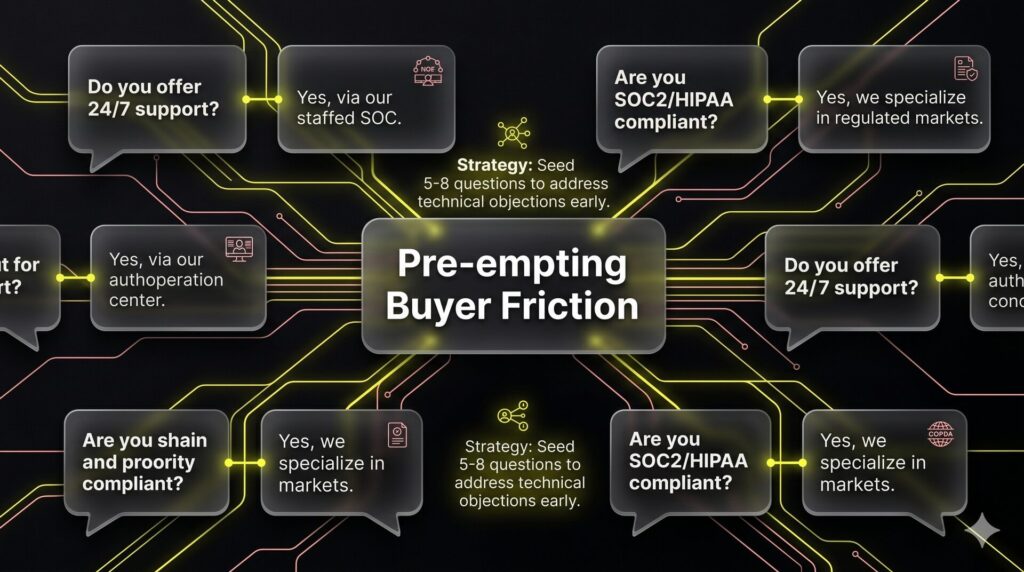
Your Google Business Profile is often the first sales conversation an MSP has with a prospect. Seed the Q&A section proactively with 5 to 8 questions to address high-intent concerns. Provide plain-language answers and always include a logical next step:
- 24/7 support availability
- Compliance expertise (SOC2/HIPAA)
- Typical onboarding timelines
- Response time guarantees
Enable GBP messaging only if your team can respond rapidly via set ownership, hours, and escalation rules. Treat every reply as a mini-qualification by asking about company size, current setup, and urgency. Never discuss sensitive client details publicly. Move detailed scoping to a booked call to protect data and reinforce your authority.
9. Weaponize GBP Spam Fighting to Reclaim Local Market Share
In competitive metros, outranking rivals often requires removing non-compliant listings. Purging spam is a strategic lever to reclaim Map Pack visibility and protect your organic equity.
When to Take Action
Target competitors using:
- Fake addresses (residential or unstaffed virtual offices)
- Keyword-stuffed names (e.g., MSP Cloud Security Houston)
- Listings lacking legitimate local staffing or signage
### Reporting Workflow
Gather proof like Street View screenshots showing signage absence or website-location mismatches. Start with Suggest an edit in Google Maps. Escalate persistent violators via the Business Redressal Complaint Form. Report only clear policy breaches to maintain professional integrity and avoid blowback.
10. Track Attribution to Turn Visibility into Revenue
Vanity metrics like profile views often mask stagnant pipeline growth. To transform your Google Business Profile MSP into a revenue asset, bridge the gap between map impressions and CRM entries. Execute monthly audits focusing on:
- High-intent search queries
- Website click-through rates
- Review velocity and recency
Utilize geo-grid rank trackers to visualize where your technical authority converts in specific neighborhoods. For better attribution, implement UTM-tagged URLs and dedicated call tracking. This ensures every qualified meeting is correctly attributed within your RevOps stack. Iterate on categories and service posts using conversion data rather than guesswork.
Book a Local Intent to Pipeline Attribution Audit.
To see how these metrics tie into a broader growth strategy, read the MSP marketing strategy guide.