Local SEO for MSP is a controllable revenue asset built on trust, not thin city-page spam. You provide world-class IT, but locally you are invisible: when prospects search for IT support in your city, Google favors shops with three reviews over your enterprise team.
NUOPTIMA builds organic equity for technical firms. Visit nuoptima.com for a local and GEO audit. These eight levers capture Map Pack visibility. It starts with your Google Business Profile.
Key Takeaways
- Set Managed Service Provider as your primary Google Business Profile category, keeping secondary categories limited to tightly relevant fields like Computer Security Service and IT Consultant.
- If you lack staff onsite, register as a Service Area Business and hide your address. Using virtual or coworking addresses frequently triggers permanent profile suspensions.
- Build a lean site structure with one central /locations hub and individual pages only for priority cities, which prevents keyword cannibalization and doorway page penalties.
- Engineer reviews by triggering requests right after ticket closure and prompting customers to name the service type, outcome, and geography for SEO weight.
- Deploy LocalBusiness and Service schema with accurate areaServed properties that match your Google Business Profile, giving AI answer engines machine-readable proof of where you operate.
Local SEO for MSPs is the practice of building Map Pack and local search visibility for managed service providers through an optimized Google Business Profile, consistent citations, revenue-linked city pages, and structured data, rather than thin city-page spam.
1. Optimize Your Google Business Profile for Categorical Authority
You cannot rank in the Map Pack if Google cannot confidently classify your firm. Treat your Google Business Profile (GBP) as a dynamic revenue engine rather than a static map pin. Incomplete or miscategorized profiles remain invisible to high-intent decision-makers searching for local SEO for MSP results.
Select Managed Service Provider as your primary category anchor. Keep secondary categories limited to tightly relevant fields:
- Computer Security Service
- Data Recovery Service
- IT Consultant
Diluting your profile with irrelevant categories confuses the ranking algorithm and weakens categorical relevance. Fill every field that influences trust, including hours, appointment links, and service attributes. Only select attributes that are demonstrably true to maintain profile integrity and algorithmic confidence. For the field-by-field GBP walkthrough, see our Google Business Profile playbook for MSPs.
Align GBP service descriptions with the technical language on your website. Mismatched terminology creates friction that hinders visibility for bottom-funnel queries. Eliminate stock photography. Upload high-resolution images of your operations center, team, and work context to bridge the Technical Authority Gap before a prospect clicks your site.
Never keyword-stuff your business name. This triggers manual reviews and harms long-term organic equity. A clean, optimized profile ensures your firm is the definitive recommendation when a local enterprise searches for managed IT services. This strategy maximizes relevance for managed IT services + city and related queries.
2. Transform Your Profile Into a High-Intent Conversion Engine
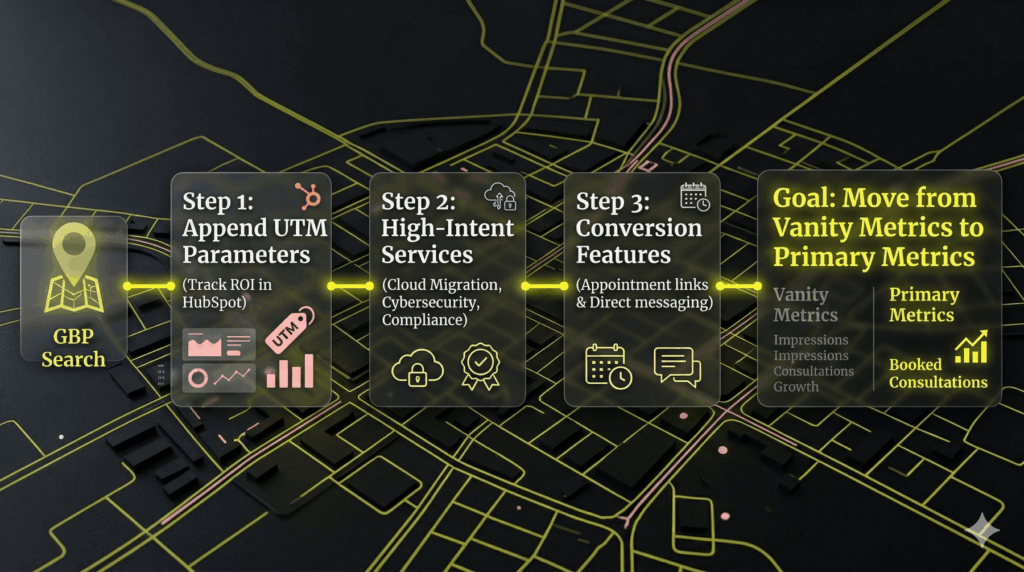
Most MSPs treat their Google Business Profile (GBP) as a simple citation. Winners treat it as a high-intent landing page with measurable attribution. High impression counts are vanity metrics if you cannot track qualified calls or source-specific leads. Append UTM parameters (e.g., `?utm_source=gbp&utm_medium=organic`) to your profile links to ensure HubSpot accurately reflects the ROI of your local SEO for MSP strategy.
Protect engineering resources by using a dedicated tracking line or screened number to filter low-value spam. Enable conversion features like appointment links and direct messaging only if you can guarantee an immediate response SLA. Route traffic to a dedicated consultation page rather than a generic homepage to maintain high-intent momentum.
Structure your Services list as a decision-maker checklist to signal technical authority. Use high-intent service categories:
- Managed IT & Cloud Migration
- Microsoft 365 Security Audits
- Cybersecurity & Compliance Support
Regularly publish GBP Posts featuring local proof, such as case snippets from regional clients or community involvement. Define one primary conversion metric, such as a booked consultation or a qualified discovery call, and review it monthly. This shift converts your GBP from a passive visibility asset into a controlled lead capture mechanism that builds organic equity.
3. Navigate the Office Address vs. Service Area Business (SAB) Framework
MSPs often aim to dominate multi-city Map Packs without maintaining physical desks in every location. Using virtual offices or coworking addresses is a high-risk shortcut that frequently triggers permanent profile suspensions. Google now utilizes AI-driven verification to target non-staffed locations. A suspended Google Business Profile (GBP) is a direct hit to your brand’s enterprise valuation and M&A readiness.
Follow this policy-aware framework to protect your local SEO for MSP:
- Legitimate Staffed Office: Display the address publicly if you have staff onsite.
- Home Office or Remote Hub: Register as a Service Area Business (SAB) and hide your physical address.
This configuration bridges the Technical Authority Gap. It proves you are a legitimate operator rather than a lead-generation ghost.
Keep your SAB service area geographically realistic. Claiming an entire state when your onsite response time is four hours creates trust gaps with prospects and algorithms. Align your territory with proof signals on your website:
- Case studies referencing specific ZIP codes.
- Local testimonials from regional hubs.
- Project-specific references in target counties.
Ensure the sales process can support the radius you claim. Avoid creating multiple profiles for markets where you lack a real presence. Inconsistent Name, Address, and Phone (NAP) data across listings creates algorithmic friction that undermines visibility. Build your strategy on policy-compliant data to turn local search into sustainable organic equity.
4. Build Revenue-Linked Local Pages (Not Index Bloat)
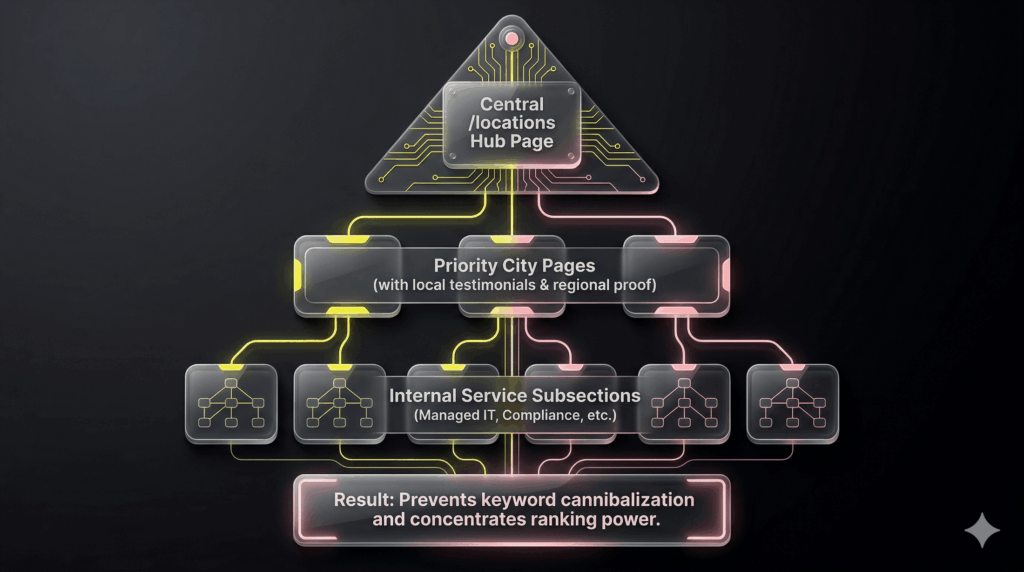
Stop treating local SEO as a volume game. Many MSPs flood their index with near-identical city pages to catch IT support + city traffic, creating technical debt and triggering doorway page penalties. To build lasting organic equity, prioritize a high-intent architecture that helps buyers choose you in their specific market.
Implement a lean site structure:
- A central `/locations` hub page.
- Individual pages for priority cities where you genuinely want clients.
- Internal service subsections instead of separate service × city pages.
This consolidation prevents keyword cannibalization across adjacent territories while concentrating authority into revenue-driving assets. Forcing search engines to choose between multiple near-identical pages for neighboring suburbs dilutes your ranking power.
A high-density city page must bridge the Technical Authority Gap with regional proof. Include testimonials from local clients, recognizable regional references, and state-specific compliance notes. Address Buyer FAQs directly, focusing on onsite response times, local coverage, and regional industry specialties.
Integrate these pages into your primary navigation and link them from relevant service pages. Replace generic Contact Us buttons with high-intent conversion blocks like Get Pricing Range or Book a Local Network Assessment. This scalable architecture ensures your firm remains the primary recommendation for managed IT services + city queries without polluting your index with spam.
5. Engineer a Compounding Review Engine
Most MSPs operate with a social proof deficit. You might possess superior technical skills but only five reviews while a competitor has 80. This gap creates friction for high-intent leads and lowers your M&A readiness. Transition from passive hoping to an engineered system that builds organic equity.
Capture peak delight moments to maximize review velocity:
- Trigger requests immediately after ticket closure or positive CSAT surveys.
- Embed frictionless direct links or QR codes in technician email signatures.
- Implement a two-step automated reminder sequence.
Generic praise lacks SEO weight. Prompt customers to include three specific data points to reinforce relevance:
- Service Type: Mention cybersecurity, Microsoft 365, or cloud migration.
- Outcome: Highlight results like reduced downtime or improved remote access.
- Geography: Reference your city or region to anchor local authority.
Maintain response discipline by replying to every review. Professional responses to negative feedback signal operational maturity to prospects and potential buyers. Avoid buying reviews or offering conditional incentives tied to five-star ratings. These high-risk tactics jeopardize your profile and long-term enterprise valuation.
A high-velocity, keyword-rich profile ensures you dominate the Local Pack and generative engine citations. This technical authority directly increases conversion and builds the relevance signals required to move rankings for local SEO for MSP keywords.
Secure Third-Party Validation through Citations and Associations
Fragmented digital data creates a Technical Authority Gap that prevents Google and buyers from reconciling your MSP’s identity. If your firm’s digital presence lacks third-party validation, search engines cannot verify your legitimacy or physical location. This reconciliation is essential for appearing in the Map Pack and building trust with skeptical C-suite decision-makers.
Local SEO for MSPs depends on absolute Name, Address, and Phone (NAP) consistency across the web. Discrepancies in suite numbers or phone extensions create algorithmic friction that dilutes your authority. Prioritize accuracy on high-authority platforms over a high volume of low-quality listings:
- Major search engines (Google Business Profile, Bing, Apple Maps)
- Industry-relevant directories and IT services marketplaces
- Local Chamber of Commerce and business associations
Secure high-value trust signals by leveraging your existing ecosystem. Placements on partner pages for vendors like Microsoft or Cisco confirm your technical tier. Participating in local cybersecurity meetups or regional business groups provides hyper-local mentions that AI search engines use to validate your firm during due diligence.
Avoid pitfalls like duplicate listings or uncoordinated tracking numbers that break your data trail. A unified citation profile increases entity confidence and secures your position for generative search citations. This strategy transforms technical expertise into a verified, investor-grade authority that increases long-term enterprise valuation.

7. Leverage Structured Data for Machine-Readable Authority
Search engines often struggle to identify exactly who you are and where you operate. This technical ambiguity creates a visibility ceiling for high-intent queries. Structured data (Schema) solves this by converting website text into machine-readable facts. It bridges the technical authority gap, clarifying your entity for both Google Maps and AI answer engines.
Deploy LocalBusiness schema on your homepage and location pages to anchor your Name, Address, and Phone (NAP) data. Include specific geo-coordinates and operating hours to eliminate algorithmic doubt regarding your physical presence. This foundation is essential for appearing in the Map Pack and building investor-grade organic equity.
Implement Service schema on your key service pages:
- Managed IT Services
- Cybersecurity and Compliance
- Cloud Migration
Use the `provider` and `areaServed` properties to link expertise to your geography. Differentiating service types prevents your brand from appearing as a generic blob and captures niche intent for high-margin contracts.
Focus implementation on your two highest-revenue services and primary office. Your `areaServed` markup must align perfectly with your Google Business Profile and on-page claims. Avoid marking up services you do not truly deliver. Inconsistent data triggers trust filters that harm local SEO for MSP, while precise markup builds the organic equity required for M&A readiness and AI-driven answer engines.
8. Build High-Authority Local Backlinks Through Proof Assets
A ranking plateau often occurs when an MSP lacks the hyper-local digital signals used to verify market leadership. While competitors scale thin city pages, true authority stems from building community roots that are difficult for rivals to replicate. Bridging this gap requires creating link-worthy assets that local organizations, schools, and business journals proactively cite.
Shift from generic SEO tactics to developing one or two high-utility proof assets:
- Cybersecurity Workshops: Host regional events for non-profits or local SMBs.
- STEM Scholarships: Partner with local colleges to create a recurring citation source.
- Incident Response Checklists: Build specific guides for local compliance requirements.
Sponsor community organizations only when they provide a direct, high-authority link. Pitch local business journals with data-driven angles, such as regional breach trends or compliance shifts. Avoid low-quality directory links and irrelevant guest posts, as these dilute technical authority and provide zero SEO ROI.
Direct these high-value links toward your priority city pages or a local authority hub. For the full editorial backlink playbook, work through our MSP link building strategy. This targeted distribution anchors your expertise to specific geographies, strengthening your local SEO for MSP results. By prioritizing proof over spam, you improve Map Pack competitiveness and build the organic equity necessary for investor-grade M&A readiness. This strategy ensures your market position is backed by verifiable digital signals.