High rankings mean nothing if your pipeline consists of low-value noise. Many firms struggle with managed IT services SEO because their pages target generic intent instead of enterprise-grade procurement needs. To bridge the technical authority gap, you must dominate search engines and AI answer engines. These 9 tactical levers align RevOps to capture buyer-intent queries across industry and compliance niches. Start with the keyword map designed to prevent wasted content at scale.
Key Takeaways
- Managed IT services SEO works only when pages target enterprise procurement intent, not generic education, so you capture buyers ready to hire rather than low-value research traffic.
- Build a 4-dimensional keyword matrix across service, industry, compliance, and location, mapping one primary query per URL to prevent cannibalization and wasted content.
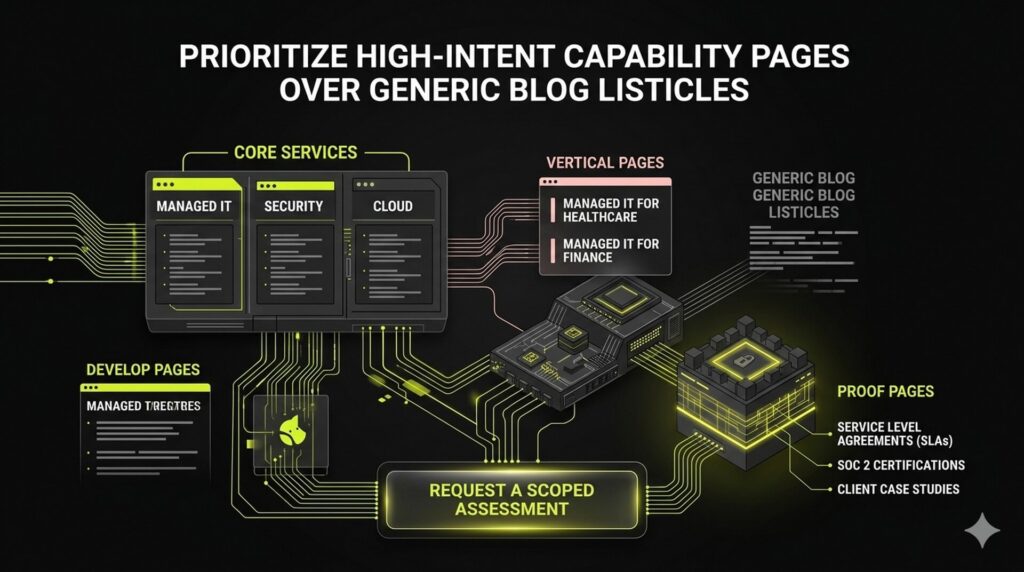
- Prioritize high-intent money pages (core services, vertical landing pages, and proof pages like SLAs and SOC 2) over blogs, and replace generic 'Contact Us' with 'Request a Scoped Assessment'.
- Disambiguate intent so you attract IT directors, not marketing managers seeking managed SEO, using clarity statements, snippet optimization, and FAQ schema.
- Tie organic equity to revenue by connecting Google Search Console, GA4, and your CRM, then reporting pipeline generated per keyword cluster rather than raw traffic.
Managed IT services SEO is search optimization that targets enterprise buyer-intent and procurement queries across service, industry, compliance, and location dimensions so an MSP captures high-value pipeline from both Google and AI answer engines.
1. Build a 4-Dimensional Keyword Matrix
High traffic often masks a lack of procurement intent. This disconnect occurs when managed IT services SEO focuses on general education instead of high-intent selection. To capture enterprise value, you must eliminate ambiguity by mapping every keyword cluster to a specific owner page and conversion path.
Construct a 4-dimensional map using these pillars:
- Service: Co-managed IT, MDR/SOC, vCIO, or backup/DR.
- Industry: Healthcare, finance, manufacturing, or legal.
- Compliance: CMMC, HIPAA, SOC 2, or NIST 800-171.
- Location: City/state/region or national + vertical.
The output artifact is a page-to-keyword matrix. This assigns one primary query plus close variants per URL to prevent keyword cannibalization and wasted content production.
Prioritize selection terms like provider, outsourced, or company. Use GSC queries, sales call notes, and helpdesk ticket language to identify the exact terms decision-makers use. This ensures every page targets a buyer ready to hire, not just research.
2. Prioritize High-Intent Service Money Pages
Most MSP blogs are digital graveyards that attract researchers instead of buyers. Enterprise decision-makers rarely convert on generic listicles; they require procurement-ready capability statements that bridge the technical authority gap. For high-performance managed IT services SEO, service pages are your highest-leverage assets.
Maintain a minimum viable money-page set:
- Core services: Managed IT, Security, Cloud, and Compliance.
- Vertical pages: Niche landing pages (e.g., Managed IT for Healthcare).
- Proof pages: SLAs, SOC 2 certifications, and case studies.
On-page anatomy must map to buyer evaluation. Include clear scopes, deliverables, and who it’s for / who it’s not for sections to qualify traffic and protect margins. Integrate trust blocks like leadership bios and partner logos to establish institutional-grade credibility.
Eliminate orphaned thought leadership by funneling internal links from technical clusters into these conversion hubs. Replace generic Contact Us buttons with a Request a Scoped Assessment CTA. This signals the operational maturity required by C-suite stakeholders and Private Equity partners.
3. Capture Mature Buyers with Co-managed IT Funnels
Targeting co-managed intent signals a mature prospect with an existing IT budget and a professional buying committee. This strategy avoids the high competition of generic managed IT services SEO while attracting mid-market leads looking to augment rather than replace their staff.
Focus content on high-intent queries:
- Co-managed IT services and co-managed helpdesk
- IT staff augmentation vs MSP
- Hybrid IT support model
Enterprise buyers require operational transparency. Your service pages must include:
- A responsibilities matrix defining ownership boundaries between teams.
- Operational details on escalation paths, SLAs, shared tooling, and security boundaries.
- Range-based pricing bands and procurement-friendly packaging.
Build supporting cluster pages comparing co-managed vs fully managed models and vertical-specific applications for healthcare, finance, or manufacturing. Replace generic lead forms with a Co-managed Readiness Workshop. This discovery session reduces sales friction and signals the technical maturity required to support complex, mid-market environments.
4. Engineering Trust with Compliance Pillars
Forty percent of organizations fail initial SOC 2 audits due to undocumented operational processes. In high-stakes managed IT services SEO, compliance keywords function as trust engineering assets for CISOs at a crisis point. Ranking for CMMC 2.0 or HIPAA requires deep-dive pillars that address M&A readiness and enterprise valuation. Build one authoritative pillar per regulatory arena to bridge the technical authority gap.
Cluster page types to mirror the audit lifecycle:
- Implementation guides (controls, checklists, and timelines).
- Audit prep (evidence collection and POA&M themes).
- Common failure modes (root causes of audit findings).
Enhance E-E-A-T signals by citing credentialed authors, anonymized case studies, and downloadable templates. Use scannable H2s, clear definitions, and technical tables to position your firm as the primary citation in AI answer engines. This structured format helps LLMs identify your expertise as a definitive answer for regulated buyers. Book a compliance gap assessment to identify hidden risks before your next filing.

5. Disambiguate Intent to Filter Pipeline Noise
The managed services search landscape is heavily polluted by intent overlap. Many MSPs accidentally attract marketing managers seeking managed SEO instead of IT directors looking for infrastructure support. This technical authority gap wastes resources on irrelevant leads. To protect your margins, you must execute deliberate disambiguation.
Implement defensive SEO tactics to ensure Google and AI answer engines understand your specific offering.
- Add a clarity statement near the page header defining your focus on IT and cybersecurity.
- De-optimize collateral that ranks for marketing keywords, or create a distinct Managed SEO page if you sell it.
- Route commercial IT queries to service pages and educational queries to technical clusters.
Control your SERP presence through precise snippet optimization. Rewrite title tags and meta descriptions to explicitly include Managed IT or MSP. Use FAQ schema to pre-qualify traffic by asking if you provide IT or marketing services. These moves ensure your rankings convert into investor-grade revenue rather than pipeline noise.
6. Scale Geographically Without Deindexing Risks
Google deindexes over 60% of near-identical location pages within enterprise domains. For scaling MSPs, expansion must not compromise technical authority or trigger duplicate content penalties. Choose between a local-first model using Google Business Profiles (GBP) with city pages or a national model utilizing vertical pages with territory proof.
Avoid the thin content trap by ensuring every location page includes unique proof and regional constraints:
- Local team bios and on-site response SLAs.
- Regional case studies and partner ecosystems.
- Specific data residency and regulatory compliance like Saudi Arabia’s PDPL.
Eliminate dead-end pages by linking location hubs directly to service and vertical pages. Maintain operational control via templates with mandatory unique fields and strict QA rules. Align on-site service naming with GBP categories to prioritize local SEO. This Glocal strategy ensures your firm remains the primary citation for regional stakeholders while maintaining M&A readiness and enterprise-grade stability.
7. Harden Technical Trust as a Search Signal
Prospects won’t trust you to manage cloud infrastructure if your website triggers 404 errors or loads slowly. In managed IT services SEO, technical reliability is a brand signal of operational maturity, not just a ranking factor. Technical debt suppresses rankings and erodes the trust needed for high-value contract conversions.
Audit trust hygiene by eliminating 404s, redirect chains, and bloated plugins. Protect crawl budgets by applying noindex tags to low-value archives or faceted URLs that dilute authority. Deploy structured Schema to ensure services are extractable for Google and AI answer engines:
- Organization and LocalBusiness
- Service and FAQ
- Breadcrumbs
Improve SERP readiness by using concise definitions and structured headings. This ensures your content is optimized for featured snippets and AI overviews during complex procurement queries.
Enterprise MSPs should establish governance standards for schema and page components. Documenting these rules allows teams to publish safely while maintaining the technical integrity required for investor-grade search performance.
8. Build Authority Through Trusted Ecosystem Backlinks
Enterprise procurement teams verify technical authority through the vendors and associations they already trust. To dominate managed IT services SEO, your backlink profile must mirror enterprise due diligence. Prioritize placements in technology partner directories, vertical industry associations, and conference sponsorship pages. Collaborating on webinars with credible co-hosts further signals stability to search engines and C-suite stakeholders.
High-utility assets earn these citations naturally. Technical researchers cite tools that solve immediate operational problems, such as:
- Incident response playbooks
- Compliance checklists
- Vertical benchmark studies
- ROI calculators
Avoid low-quality link packages. These shortcuts create reputational risks that jeopardize M&A readiness and investor-grade valuation. Every authority asset should use hub linking to pass equity to primary money pages. This structure transforms technical expertise into measurable pipeline momentum.
Competitor Intent Report: Identify exactly where rivals are winning authority signals and bridge your technical authority gap today.
9. Tie Organic Equity to Revenue Outcomes
Enterprise managed IT services SEO fails during Private Equity reviews when it lacks revenue attribution. Without pipeline data, your program is viewed as a cost center rather than an asset building organic equity. Bridging this gap requires a unified stack: Google Search Console for demand, GA4 for engagement, and HubSpot or Salesforce for lifecycle tracking. This alignment transforms vanity metrics into investor-grade data.
Eliminate ambiguity by replacing generic buttons with high-intent conversion actions. Effective options include:
- Security consults
- Assessment requests
- Co-managed workshops
Measure performance using KPIs that matter to operators, such as share of voice on buyer-intent clusters, conversion rate by page type, and pipeline generated per cluster. Boost results with CRO quick wins like placing technical proof above the fold and reducing form friction.
M&A Readiness Audit: Frame your organic presence as a valuation multiplier. Optimize your RevOps to ensure every lead is attributed to revenue outcomes.
FAQ
Technical optimizations and rewriting high-intent money pages often deliver quick wins within the first 90 days. However, building the technical authority required to dominate competitive cybersecurity or co-managed clusters typically takes 6 to 12 months. Focus on leading indicators, such as rank movement for buyer-intent clusters, before expecting closed revenue. Consistent authority building ensures you capture prospects early in the procurement lifecycle while maintaining a steady flow of high-value leads.
Your priority should align with your specific go-to-market strategy. Territory-based sales teams benefit most from local SEO and Google Business Profile optimization to capture regional market share. Conversely, firms specializing in niches like HIPAA or CMMC compliance should prioritize national vertical SEO to attract high-margin contracts regardless of geography. Enterprise MSPs often require multi-region governance to balance a strong local presence with national authority in specialized vertical markets.
The most valuable keywords prioritize selection and procurement over general education. Examples include managed security services provider, co-managed IT support, and DR and BCP services. Vertical-specific terms like cybersecurity for fintech or SOC 2 compliance audit often yield the highest ROI by attracting mature buyers. Long-tail queries consistently outperform generic head terms because they target specific operational pain points. See the section on building a 4-dimensional keyword matrix for a full breakdown.
AI is a powerful tool for initial drafting and templating, but it should never be used for unreviewed publishing. Enterprise IT and compliance content require mandatory SME review to maintain technical accuracy and credibility. To satisfy Google E-E-A-T requirements, AI-assisted pages must be bolstered with unique evidence, including anonymized case studies, professional credentials, and proprietary checklists. This approach ensures your content bridges the technical authority gap effectively without risking your search rankings.
Stop traffic theater by connecting Google Search Console and GA4 data directly to your CRM stages. Report performance by keyword cluster and page type, distinguishing between high-intent money pages and supporting technical content. This level of full-funnel attribution allows you to track a keyword from the initial search to a closed-won contract. Measuring success via pipeline revenue rather than raw click volume aligns your marketing efforts with actual revenue outcomes and investor-grade growth.
Turn your SEO into a revenue engine with NUOPTIMA.
Where this fits in your MSP growth system
This is one piece of how NUOPTIMA makes MSPs and cybersecurity firms the provider buyers find on Google and in AI search. See how it connects to MSP SEO and GEO and AI-search, or get your free MSP lead forecast to see exactly where your firm shows up across ChatGPT, Gemini, and Perplexity today.