
Your MSP valuation is not a random industry multiple; it starts with a verified valuation range for your size and profile. Enterprise value is simply a multiple applied to normalized earnings, adjusted for risk and transferability.
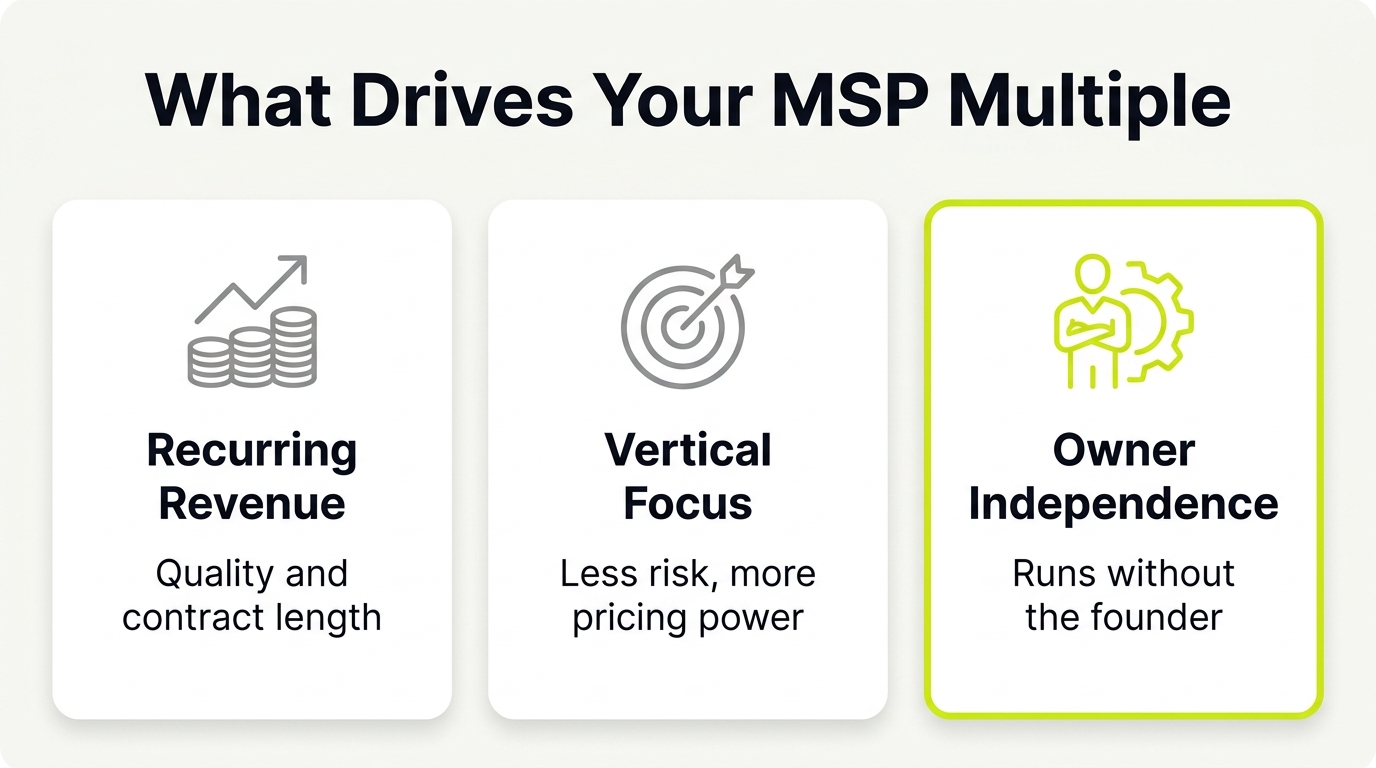
Specialists with verticalization, high-quality recurring revenue, and a compounding demand engine look less risky, securing higher multiples and cash at close over earn-outs.
Here are the ten operational drivers that move your multiple, alongside a clear execution plan.
Key Takeaways
- MSP valuation is a multiple applied to normalized earnings, adjusted for risk and transferability -- specialization, recurring revenue quality, and a repeatable demand engine are the three levers that move it most.
- Month-to-month agreements labeled as MRR depress your multiple because buyers underwrite certainty, not labels; re-papering top accounts onto 1 to 3 year terms with auto-renewals is the fastest contract fix.
- Owner-operators must run both SDE (adds back full owner compensation) and Adjusted EBITDA (re-staffs the founder at market rates) schedules to avoid valuation whiplash during diligence.
- Customer concentration above 15 percent of revenue for a single client shifts transaction terms from cash at close to earn-outs; diluting that exposure before going to market protects your payout.
- Shortlist visibility in Google and AI search engines is now a quantifiable diligence signal: buyers search before calling, so query-level presence proves demand durability.
MSP valuation is the estimated enterprise value of a managed service provider, calculated by multiplying normalized earnings (SDE or Adjusted EBITDA) by an industry multiple that scales with revenue quality, recurring-revenue mix, customer concentration risk, operational transferability, and growth durability.
1. Position Your Vertical Focus as a Financial Moat
Buyers do not pay premium multiples for generic IT support. Specialization directly lifts your multiple by reducing perceived competition and proving pricing power. This makes your cash flows look highly durable in buyer underwriting.
Acquirers look for a clear ICP with repeated wins in sectors like:
- Healthcare clinics
- Law firms
- Financial services
You must match the vertical's specific risk profile with proof assets covering compliance and security.
To act fast, select one vertical wedge. Build a dedicated offer page and three proof artifacts: a case study, a risk checklist, and a tailored onboarding plan.
2. Structure Contracts for Certainty, Not Just Recurring Labels
Do not confuse recurring billing with contract predictability. Buyers underwrite certainty, not labels. A month-to-month agreement labeled as MRR does not protect against transitional churn risk, directly depressing your multiple.
To secure premium multiples, audit your contract quality against what acquirers actually value:
- Duration: Shift top accounts to written 1 to 3 year terms.
- Mechanics: Require auto-renewals with 60 to 90 days written notice.
- Escalation: Embed automatic annual price escalators of 3 to 5 percent to protect margins.
Presenting a clean MRR schedule mapping clients, terms, and renewal dates proves your revenue is secure long after transition.
3. De-risk Your MSP Valuation by Building a Predictable Acquisition Engine
If growth relies on personal relationships, buyers see key-person risk that discounts your MSP valuation. A repeatable acquisition channel protects your multiple by reducing founder dependency and making future pipeline believable during diligence.
Real predictability requires query-level shortlist visibility in Google and AI answers because buyers ask machines before contacting sales. This builds a measurable pipeline model from search intent to retained logo.
NUOPTIMA’s engagement with Cortavo, a managed IT provider, produced $210,000+ in contracted value and $1,000,000+ in MQL pipeline by December 2025, with 4x more AI citations than the nearest competitor. That demand-engine visibility directly supported their valuation story in buyer conversations.
To test your positioning, search 10 key buyer queries in Google and ChatGPT to score:
- Whether you appear
- Which competitors do
- What proof is cited
For a valuation and multiple teardown, visit nuoptima.com or read our guide to the best MSP marketing agencies.
4. Run Both SDE and EBITDA Schedules to Prevent Diligence Surprises
Many MSP owners suffer valuation whiplash when buyers replace founder labor with market salaries, collapsing the earnings base. This happens when founders confuse Seller’s Discretionary Earnings (SDE) with Adjusted EBITDA.
Owner-operated MSPs use SDE, which adds back the owner’s total compensation. Mid-market MSPs use Adjusted EBITDA, where the founder's role is re-staffed at market rates. In diligence, buyers aggressively normalize compensation, remove one-time items, and validate add-backs to expose inflated EBITDA.
Prepare both SDE and Adjusted EBITDA schedules early. Documenting these adjustments yourself ensures you control your earnings narrative, preventing the buyer’s Quality of Earnings provider from rewriting your numbers.
5. Prove Margin Stability to Reduce Buyer Risk Underwriting
Buyers look past top-line revenue to ask one fundamental risk question: are your operating margins repeatable and defensible post-sale? To secure a premium multiple, present a clean service gross margin completely isolated from low-margin hardware and product resale. Buyers underwrite EBITDA margin stability, so document a clear 24-month trend explaining historical spikes or dips.
For an immediate valuation lift, run a cost-to-serve audit to isolate your bottom-decile accounts by contribution margin. Protect your earnings base and recover engineering capacity before entering diligence by taking action on these contracts:
- Reprice them to market rates
- Re-scope the deliverables
- Exit the relationship entirely
6. Align Your Revenue Mix with Buyer Valuation Formulas
Acquirers do not value all revenue streams equally. Buyers heavily discount hardware resale and projects because they are unpredictable, transactional, and low-margin. To maximize your multiple, you must prove your revenue quality by making recurring, core managed services your primary financial engine.
If you perform project work, package those one-off deployments into repeatable, recurring service offerings.
Take two immediate steps before entering diligence:
- Segment your ledger: Split financial reporting into contracted managed services, recurring add-ons, projects, and product resale.
- Standardize one-offs: Build an operational plan to migrate legacy, one-off revenue into structured, recurring modules.
7. Neutralize Customer Concentration to Secure Cash at Close
Buyers discount your multiple if a single client exit can collapse your EBITDA during a transition. Whale concentration shifts transaction terms from cash at close to aggressive earn-outs.
Acquirers measure your net revenue retention trend alongside your top-10 concentration. While vertical focus is healthy, single-client dependence is a primary deal risk.
To secure favorable terms, build a top-client risk plan with:
- Executive sponsors
- Clear roadmaps
- Regular QBRs
- Contract upgrades
Set a target to dilute single-client exposure below 15 percent of total revenue before launching your market process.
8. Embed Operational Maturity to Prove Transferability
If delivery stalls when you step away, buyers see a high-risk lifestyle business. Lower key-person risk directly translates to a higher exit multiple and more cash at close.
Acquirers discount static Google Docs. They look for SOPs embedded into ticketing workflows, managed by named owners for:
- Sales and operations
- Service delivery
- Financial reporting
To protect your MSP valuation, take two actions:
- Integrate onboarding, escalations, and QBRs inside your ticketing workflow.
- Run a 60-day "owner out of the loop" test and document KPIs.
This turns founder-led execution into a transferable operating system that buyers can scale. An AI-native operation compounds the same story: documented, automated revenue processes read as transferable infrastructure, and a productized AI service line adds recurring revenue a buyer can price.
9. Secure Your Terms by Neutralizing Buyer Downside Risk
A single unmapped liability clause or unresolved security gap can instantly turn your cash at close into a multi-year escrow holdback. Buyers underwrite the worst-case scenario. One cyber incident, one client lawsuit, or one weak contract clause can wipe out their projected returns and suppress your enterprise value.
To prevent buyers from demanding larger earn-outs, compile a one-page risk pack containing:
- Security and backup posture summaries, incident history, and remediation evidence.
- Standard MSA terms, SLAs, and limitation of liability clauses.
- Current insurance summaries.
Fix obvious contract inconsistencies before diligence starts. Neutralizing these non-financial risks removes the buyer's justification for discounting your terms.
10. Build Your Data Room Early to Control the Transaction Pace
Diligence is where premium multiples die. Disorganization allows buyers to renegotiate around uncertainty and push value into contingent payments. Preparing your data room early eliminates diligence friction, forcing buyers to compete on price.
Before speaking to buyers, compile your data room:
- Financials: Monthly P&Ls, balance sheets, AR aging, revenue by client, and margin by service line.
- Documentation: Add-back documentation and a KPI pack tracking MRR, churn, and margin trends.
Pair this with a one-page deal narrative to defend your MSP valuation and prevent the last-minute scrambles that weaken negotiating power.
Turn Cybersecurity into a Value Multiplier, Not Just a Risk Control
A mature security stack lifts your multiple twice: it removes a diligence discount and it proves you sell higher-margin, stickier services buyers want to scale. Section 9 shows how a clean security posture stops buyers from pushing cash into escrow. The upside is the other half of the story. Providers that package security as a productized line, not an afterthought bundled into the base fee, present a revenue mix acquirers pay up for because it raises switching costs and expands margin.
Position security as a value driver before you go to market:
- Productize it: Break out managed detection, backup and recovery, and compliance support as named, separately priced services so the recurring, high-margin portion of your revenue is visible in the ledger rather than buried.
- Attach it to a framework: Map your controls to a recognized standard such as CIS or NIST so a buyer can underwrite your posture in hours rather than weeks.
- Prove demand: Show attach rates and expansion revenue from security add-ons across your base, because expansion inside existing accounts is the cheapest growth an acquirer can model.
By 2026 most mid-market buyers screen out MSPs with weak security economics, so this is table stakes for a premium outcome. If you want the sales motion behind a productized offer, our guide on how to sell cyber security shows how to price and pitch it.
Run a Competitive Sale Process to Create Buyer Tension
A single unsolicited offer almost always underpays; competition is what moves the final number. The same normalized earnings can clear at very different terms depending on whether one buyer knows they are the only bidder or several buyers know they are not. Owners who negotiate with one acquirer hand that acquirer control of the price and the pace.
Create tension without turning the sale into a fire drill:
- Build a buyer set: Approach a curated list of strategic acquirers, platforms, and private equity backed consolidators in parallel rather than one at a time.
- Run a timeline: Set indicative-offer and diligence deadlines so bidders move on your schedule, which keeps momentum and prevents any one party from stalling the deal.
- Use an intermediary: An experienced advisor or broker runs the outreach, protects your anonymity early, and keeps you focused on delivery while the process runs. Screen them carefully first with our guide to vetting MSP M&A advisors.
A structured process, backed by the data room in Section 10, is what converts a strong asset into a strong price.
How to Execute Your MSP Valuation Improvement Plan
Shift your transaction positioning from "we believe our business is worth X" to "here is why our risk is lower and earnings are higher." This 90-day sequence provides a finance-friendly framework to improve your MSP valuation without relying solely on risky topline growth.
Weeks 1-2: Financial Reporting and Earnings Cleanup
- Produce SDE and adjusted EBITDA schedules to prevent compensation disputes during quality of earnings audits.
- Map gross margin by service line to isolate high-performing contracts from one-off project revenue.
- Document your top-10 client concentration ratio to measure customer risk.
Weeks 3-5: Revenue Quality Upgrades
- Audit all active MSAs and SLAs to confirm baseline parameters.
- Re-paper top accounts to secure written 1-to-3-year terms with auto-renewals.
- Embed 3% to 5% annual price escalators and enforce strict scope controls to stabilize recurring margins.
Weeks 6-8: Process Transferability Upgrades
- Operationalize three critical SOPs inside your ticketing workflows to reduce key-person dependency.
- Assign clear process owners for sales, delivery, and reporting.
- Run a 30-day owner-reduction test to prove operations continue without founder intervention.
Weeks 9-12: Shortlist Visibility and Demand Proof
- Run a 10-query visibility test in Google and AI engines to score your search presence.
- Publish one vertical authority page and two proof assets targeting your niche.
- Assess your valuation and pipeline gap at [nuoptima.com](https://www.nuoptima.com) for an external teardown, or read about the best MSP marketing agencies for context.
Executing this sequence delivers improved cash flow quality, lower perceived risk, and a cleaner diligence package that supports better terms.