
Knowing how to sell cyber security starts with a truth: CISOs do not buy features. They buy reduced operational and financial downside from partners they trust.
This playbook details 9 practical moves to shorten cycles and handle objections without dropping prices. Learn how technical authority and AI-search visibility slash perceived risk before the first call.
We begin with positioning, then move to proof, packaging, and closing.
Key Takeaways
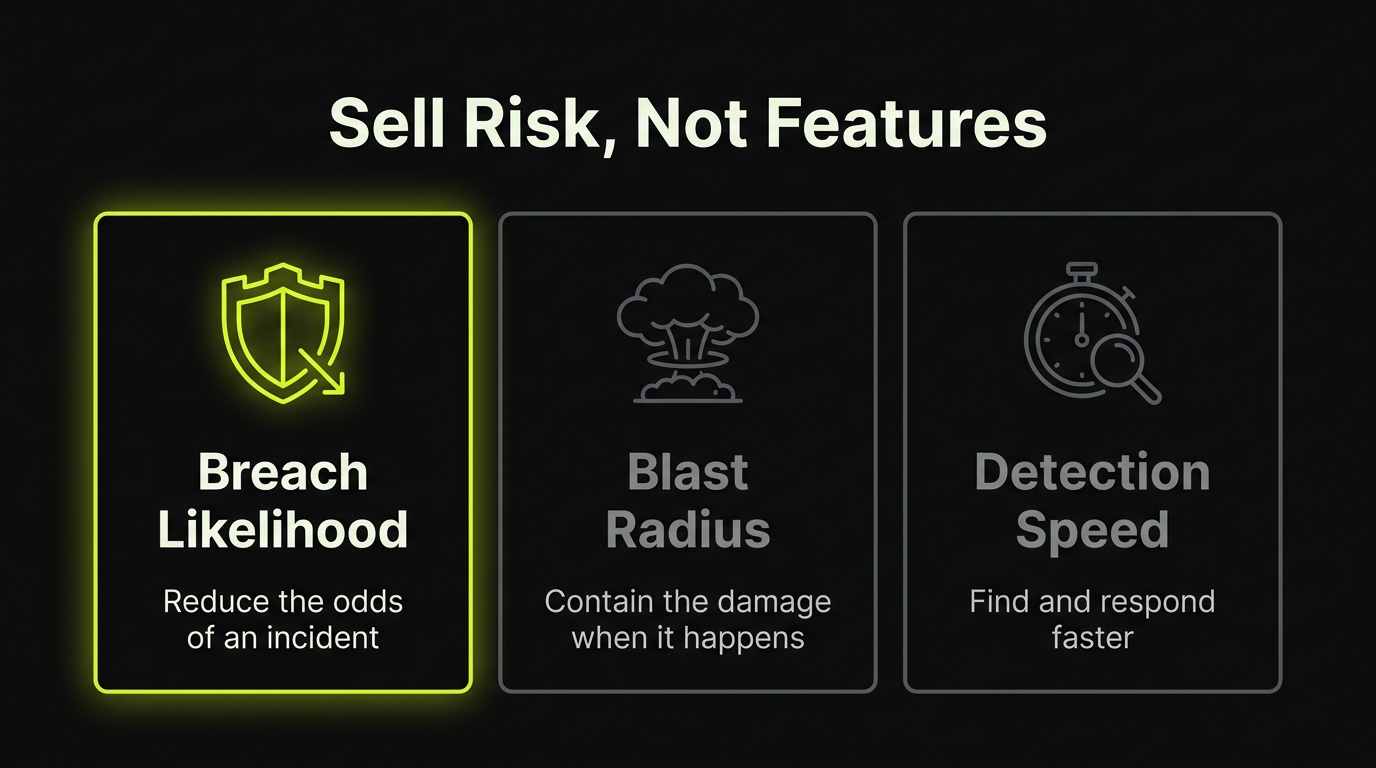
- CISOs buy reduced operational and financial downside, not features. Reframe every pitch around breach likelihood, blast radius, and detection speed.
- Multi-thread every deal: give technical buyers an operational controls narrative and CFOs/legal a financial risk and compliance narrative to prevent late-stage stalls.
- Package your offering into three outcome-based tiers (Monitoring, 24/7 Response, Strategic Governance) rather than tool bundles to protect gross margins.
- A non-intrusive external risk snapshot. Three to five prioritized findings. Builds trust faster than any pitch deck and converts cold prospects into active pipeline.
- Publish technical authority assets (MDR onboarding timeline, MSSP selection guide, proof library) so buyers can complete due diligence before your first call; thin digital proof kills deals silently.
Cybersecurity sales is the process of converting technical risk controls into board-defensible business outcomes, positioning the seller as the accountable execution partner who reduces breach likelihood, blast radius, and recovery time.
1. Reframe the Conversation Around Governance and Loss Magnitude
Security sales stall when you pitch features to CISOs who need board-level defensibility. Executive buyers do not buy software; they buy incident prevention and reasonable, documented decisions.
To build a winning security sales motion, translate your technical scope into three business outcomes:
- Reduced breach likelihood
- Minimized blast radius
- Faster detection and response
Give the buyer an executive-ready narrative they can defend. Establish risk-demarcation early with a single statement: "You own the strategic risk of business interruption, while we own the execution of the technical controls that mitigate it."
Then, define exactly what changes in the first 90 days:
- Controls: We deploy baseline defenses to block primary threat vectors.
- Visibility: We map and eliminate blind spots across your digital environment.
- Response: We establish response readiness to limit downside loss magnitude.
2. Map Stakeholders to Align Technical Controls with Business Risk
Late-stage cybersecurity deals usually stall because a CFO or legal counsel blocks a technical proposal they do not understand. Winning cyber deals requires a multi-threaded sales motion that addresses both technical buyers and commercial decision-makers.
Map your stakeholders early to split your narrative and prevent buying friction. A CISO wants:
- Operational control and tool integration
- Response capability and vendor credibility
Meanwhile, the CFO and risk owners require:
- Loss exposure and predictable costs
- Contract terms and audit readiness
Build two distinct tracks. Give technical buyers a "security leader" version focused on operational controls and incident response metrics. Give business buyers a "risk owner" version focused on financial downtime, insurance claims, compliance governance, and measurable risk reduction. This prevents late-stage pipeline stalls and procurement-driven price cuts.
3. Offer a Low-Friction Security Snapshot to Accelerate Trust
To accelerate trust, replace generic fear with prospect-specific proof. CISOs are exhausted by aggressive pitches that demand immediate, deep network access. Instead, offer a safe value exchange: a non-intrusive external scan and a clean executive posture snapshot.
Deliver these findings like a security leader, not a marketer. Present three to five prioritized issues. For each finding, detail:
- Why it matters: The underlying technical reality.
- Likely impact: The financial or operational business risk.
- Next step: A localized pilot, deep dive, or scoped assessment.
This low-friction approach proves technical competence without requiring a full engineering engagement. It creates immediate, buyer-specific urgency and converts cold prospects into active pipeline without resorting to generic scare tactics.
4. Package Clear, Defensible Tiers to Neutralize Tool Fatigue
When prospects compare your security proposal to a single software license, you have a packaging problem, not a pricing problem. Closing more cyber deals requires positioning your MSSP as the accountable layer that reduces tool fatigue. Package your offering into three outcome-based tiers:
- Tier 1: Monitoring and Triage: Continuous threat detection and basic alert filtering.
- Tier 2: 24/7 Response: Active incident containment, remediation, and defined response hours.
- Tier 3: Strategic Governance: Board-ready risk reporting, compliance alignment, and ongoing advisory.
This sells an outcome and an operating model instead of a software bundle. Keep gross margins secure by making your scope defensible. Define precise inclusions like escalation pathways and reporting cadence, and explicitly exclude out-of-scope tasks like disaster recovery rebuilds to stop scope creep from silently destroying profitability.
5. Align Pricing Units to Cost Exposure to Protect Gross Margin
Compete purely on flat per-endpoint pricing and you invite silent delivery risk. True mastery of security pricing requires units aligned directly to your actual cost exposure.
Establish a per-endpoint base for workstations, then isolate high-cost variables. Charge separately for:
- Servers
- High-volume log ingestion
- Specialized compliance reporting
- Incident response retainers
Build a hard margin floor your sales team cannot discount past. Calculate this floor by combining direct tooling costs with realistic analyst time assumptions. Benchmarks are only sanity checks, not pricing strategies.
If a competitor undercuts your floor, let them take the deal. Underpriced security contracts lead to cutting corners on monitoring, creating systemic delivery risks that ultimately expose both the client and your firm to catastrophic failure.
6. Build a Minimum Viable Cybersecurity Business Plan to Operationalize Your Sales Motion
A repeatable delivery plan, not just a pitch narrative, is what separates firms that close from those that stall. This operational blueprint helps you deliver on your sales promises.
Every plan must define these operational foundations:
- ICP and Wedge Offer: Target a specific niche with a low-friction entry point, like an email security assessment.
- Delivery and Coverage: Choose between partnering with a 24/7 white-label MSSP or building an expensive in-house SOC.
- Lean Tooling and Staffing: Use automated detection tools before hiring tier-two analysts.
The boardroom layer protects your margins. Target a 65% to 75% gross margin, and calculate the exact endpoint count needed to break even. Finally, address capacity constraints. If closing three new logos in 30 days breaks your onboarding team, your delivery engine is unscalable.
7. Deploy Buyer-Safe Scripts to Neutralize Cybersecurity Objections
Arguing with a skeptical prospect creates resistance. Pivot the conversation to business defensibility without sounding alarmist. Use these peer-to-peer scripts to turn friction into collaborative next steps.
Objection: "We have cyber insurance."
- Response: "Understood. Insurance is a critical backstop. What technical controls and incident response partners does your carrier require to keep that policy valid? Our service reduces breach likelihood and helps you meet those strict policy conditions so payouts are never disputed."
Objection: "We are too small," "We have EDR," or "No budget."
- Response: "Tools and policies do not manage downtime; operations do. If an incident occurs, how will we defend this security posture to your board? Let us run a quick governance workshop or a limited risk snapshot to verify your actual exposure."
8. Publish High-Intent Trust Assets to Defeat the Silent Deal Killer
Buyers research your security practice long before they reply to your sales team. If your digital proof is thin, the deal dies silently.
To prevent this leakage, publish three technical-authority assets that rank in Google and train AI search models:
- How We Run MDR in 90 Days: Detail your onboarding timeline, tooling integrations, and milestones to remove transition anxiety.
- MSSP Selection Guide: Give buyers precise questions to ask when comparing providers, establishing your firm as the objective standard.
- Proof Library: Share redacted incident reports, clear SLAs, and response workflows.
Structuring your expertise openly, like Eden Data does with compliance, proves your operational discipline. This self-serve diligence reduces perceived vendor risk, converting anonymous researchers into qualified pipeline.
9. Sell Security as a Risk-and-Adversary Lifecycle, Not an IT Support Contract
Knowing how to sell cyber security starts with separating it from IT support. Generic IT support sells uptime and reliability. Security sells defense against active adversaries and governance gaps. Because you fight human threats instead of broken printers, your scope must be much tighter.
Avoid overpromising by starting with a "small promise" pilot. Secure a single vector first, like email ingress or identity access, using explicit success criteria. Once proven, expand contract value with:
- An incident response retainer
- Governance reporting
- Compliance support
Finally, secure retention during the initial sale. Establish a strict cadence of quarterly risk reviews and executive reporting. This structure gives your buyer the exact progress data they need to justify the cybersecurity budget to their board.
CISOs buy from vendors they can defend to the board. Your primary job is to reduce perceived vendor risk before the initial meeting. Before building assets, select one specific ICP and one core offer tier from your business plan. This focus establishes technical authority and AI-search visibility, reducing sales friction far more effectively than high-volume demand-generation tactics.
Step 1: Map the AI and Google Landscape (Days 1 to 15)
Select 10 high-intent buyer queries split between CISO and CFO concerns. Record which competitors appear in Google and generative AI answers to establish your baseline visibility score.
Step 2: Publish 3 Core Authority Pages (Days 16 to 45)
Publish three deep-dive pages that answer these queries. Include technical proof, clear operational scope, and exclusion parameters to build pre-meeting trust.
Step 3: Build 2 High-Value Sales Assets (Days 46 to 60)
Create a one-page risk snapshot template and a "what to ask an MSSP" checklist. These assets help buyers evaluate competing vendors objectively.
Step 4: Inject Third-Party Credibility Signals (Days 61 to 75)
Secure profiles, partner citations, and digital PR. This external footprint feeds the large language models that recommend your brand.
Step 5: Integrate Assets into Your Sales Motion (Days 76 to 90)
Send the risk snapshot in early-stage cold outreach sequences. Deliver the checklist during late-stage procurement to expose competitor vulnerabilities.
To build technical authority and optimize your search presence, get expert help from qualified cyber security seo agencies or run a cyber demand and AI-visibility diagnostic at nuoptima.com.