Scaling a security pipeline requires more than generic lead generation. Skeptical CISO buyers ignore marketing jargon and demand technical depth. To bridge the Technical Authority Gap and convert long sales cycles, your cybersecurity marketing agency must demonstrate compliance literacy and trust signals rather than vanity traffic. This guide provides eight criteria to evaluate potential partners and a practical 90-day rollout plan focused on revenue outcomes. For a partner built for growth, start at nuoptima.com.

Key Takeaways
- Skeptical CISO buyers ignore marketing jargon and demand technical depth, so vet a cybersecurity marketing agency on proof tied to pipeline and closed-won revenue, not impressions.
- Require a Subject Matter Expert (SME) workflow: a real reviewer, a brief-to-review process, and technical artifacts like incident response checklists or architecture POVs.
- Turn compliance into a demand-gen engine by mapping content to SOC2, HIPAA, or CMMC and running event-triggered campaigns around audit seasons and vendor due diligence.
- Treat marketing as a RevOps function with CRM governance, shared MQL/SQL/SAO definitions, and multi-touch attribution instead of last-click or GA4 traffic charts.
- Outbound timelines: qualified meetings in 30 to 60 days, while inbound SEO and GEO take 6 to 12 months to compound, so judge the first 90 days on opportunity creation and pipeline value.
A cybersecurity marketing agency is a partner that builds a security firm's pipeline through technically credible content, compliance-driven demand generation, and RevOps measurement tied to revenue, not vanity traffic.
1. Prioritize Proof Over Proposals: The Trust Checklist
In cybersecurity marketing, traffic without conversion is a liability. Agencies often promise growth but deliver top-of-funnel noise that never reaches the pipeline. This creates a Technical Authority Gap where expertise fails to translate into CISO trust. Treat proof as the primary gating factor to avoid paying for activity that does not move the needle.
Use this trust checklist during sales calls to vet a potential cybersecurity marketing agency:
- Verifiable Case Studies: Demand data tied to pipeline and closed-won revenue rather than impressions.
- Direct References: Speak with clients managing similar deal sizes and 6 to 12-month sales cycles.
- SLA Definitions: Establish clear criteria for MQLs, SQLs, and meeting quality before signing.
Watch for red flags like anonymous logos, vague results, or ignoring sales-cycle length. Avoid any agency claiming they can market anyone because security requires vertical expertise, not generalist tactics. A credible partner demonstrates exactly how they track pipeline outcomes within your HubSpot or Salesforce CRM.
2. Demand Technical Depth: The SME System Audit
Security buyers use a fluff detector to identify content from generalist copywriters. Generic articles fail to challenge the status quo and create noise that CISOs ignore. This prevents ranking for high-intent queries and destroys the trust required for long sales cycles.
Validate an agency by conducting a Subject Matter Expert (SME) system audit. Ask these questions to evaluate technical depth:
- Who is the SME and how is their time structured?
- What does the review workflow look like from brief to SME review?
- Can they show technical artifacts like incident response checklists or architecture POVs?
High-value output requires evidence-led claims aligned with threat models or NIST control language. A major red flag is any agency claiming writers can learn anything without a formal SME workflow. If they cannot provide examples beyond blog introductions, they will fail to bridge the Technical Authority Gap.
Before signing, request a sample outline and SME review plan as a pre-sales artifact.
3. Leverage Compliance as a Demand-Gen Engine
Stop treating compliance as a footnote in your sales deck. Passive marketing misses the Crisis Moment when a failed audit or board review drives enterprise security spend. Generic campaigns fail to capture the high-intent triggers that force a CISO’s hand.
A sophisticated cybersecurity marketing agency transforms these triggers into demand-generation levers. They map technical frameworks to buyer questions by connecting controls to failure points and remediation paths. Instead of broad awareness, they execute event-triggered campaigns tied to audit seasons, vendor due diligence, or new regulatory mandates.
Your agency partner must deliver:
- Framework Alignment: Mapping content directly to SOC2, HIPAA, or CMMC requirements.
- Tactical Lead Magnets: Readiness mini-audits, control gap checklists, or policy packs.
- Governance Rigor: Strict QA for regulated verticals and professional management of disclaimers.
Avoid agencies using compliance terms as keywords without deep NIST or CIS framework knowledge. Without technical depth, content becomes a liability rather than a trust signal.
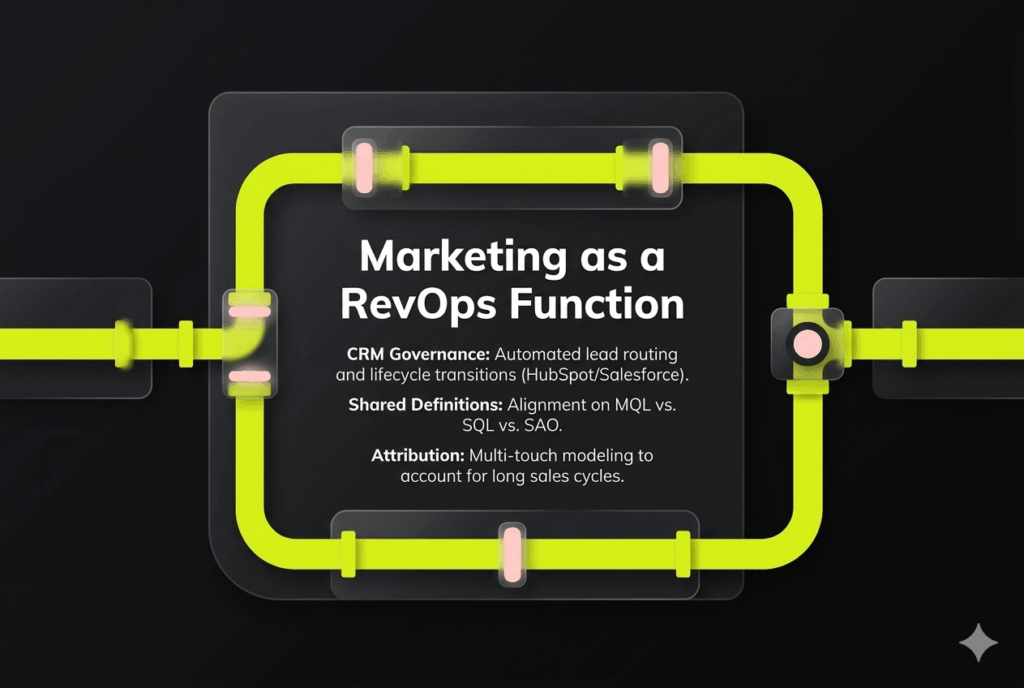
4. Audit the RevOps Framework: From Leads to ARR
Stop paying for leads that sales immediately disqualifies. This misalignment creates marketing busywork disconnected from opportunities, ARR, and CAC payback. For PE-backed MSSPs, valuation depends on predictable pipeline, not vanity metrics. Hire a cybersecurity marketing agency that treats marketing as a Revenue Operations (RevOps) function.
A sophisticated partner must own the CRM lifecycle. Evaluate their RevOps framework against these requirements:
- CRM Governance: Experience in HubSpot or Salesforce hygiene, including lead routing and automated lifecycle stage transitions.
- Shared Definitions: Standardized criteria for MQLs, SQLs, and SAOs that align with your internal sales process.
- Attribution Modeling: A multi-touch approach that accounts for long sales cycles and avoids the false certainty of last-click attribution.
Request reporting that ties a specific keyword or conversion asset to a booked meeting and a closed-won deal. Red flags include agencies providing only GA4 traffic charts or those lacking lifecycle stage governance and sales alignment.
At NUOPTIMA, we act as your Fractional CMO and RevOps engine. We integrate SEO, GEO, and performance ads into one system that scales pipeline and increases enterprise value.
5. Future-Proof Inbound: Auditing for GEO and Technical Authority
Modern CISOs self-educate using LLMs like Perplexity and SearchGPT that prioritize cited authority over keyword density. If your cybersecurity marketing agency ignores Generative Engine Optimization (GEO), your inbound pipeline is shrinking. Buyers use AI-assisted research to filter providers, meaning you must be the primary citation for technical queries. High-value agencies bridge the Technical Authority Gap to win both traditional search and AI answer engines.
Evaluate potential partners based on these technical content pillars:
- Bottom-Funnel Intent: Topic strategies built around high-value queries like MDR, MSSP, vCISO, and compliance-as-a-service.
- Evidence Assets: Data-rich technical explainers, architecture teardowns, and comparison pages that serve as proof of expertise.
- GEO Fundamentals: Use of structured data, entity clarity, and citation-ready architecture that AI models prioritize when recommending service providers.
The conversion layer must transform readers into prospects through architecture reviews or specialized workshops. Red flags include high-volume blog quotas lacking decision-stage pages or rigorous technical QA. Chasing broad awareness keywords creates vanity metrics while ignoring the bottom-funnel intent that drives enterprise-grade contracts.
6. Secure the Pipeline: A Credibility-First Outbound Framework
Outbound is necessary for pipeline growth, but security buyers punish spam. An elite cybersecurity marketing agency replaces spray-and-pray volume with a credibility-focused framework that produces predictable, high-intent meetings without damaging your brand.
A high-performing partner builds outreach on three pillars:
- Granular ICPs: Target account lists segmented by industry, compliance needs (SOC2/CMMC), and security maturity.
- Technical Messaging: Points rooted in specific risks like audit failure, ransomware downtime, or vendor due diligence hurdles.
- Multi-Channel Sequences: A coordinated cadence of email, LinkedIn, calling, and retargeting, sequenced, rather than random.
Protect sales time with a strict pre-qualification policy. Prospects must demonstrate budget and urgency before booking a calendar slot. This ensures every discovery call has a path to ARR and helps bridge the Technical Authority Gap.
Red Flags: Avoid agencies that lack technical deliverability setups (SPF/DKIM), refuse to define meeting quality, or prioritize raw lead volume over revenue outcomes.
7. Beyond Clicks: Engineering a High-Intent Paid Strategy
Paid media accelerates growth but punishes weak messaging. Without tight guardrails, performance marketing becomes an expensive black hole attracting low-intent clicks or students instead of buyers. Demand granular segmentation that distinguishes between CISOs, IT Directors, and compliance owners. Generic ads fail because they lack the technical nuance required to build trust with skeptical security professionals.
Effective agencies move beyond the Book a Demo trap for cold traffic. Instead, lead with technical value through:
- Security workshops or mini-audits
- Risk assessments
- Compliance gap analyses
Retargeting must mirror the long cybersecurity sales cycle by sequencing prospects from technical content to case studies and formal assessments.
Measure success via pipeline attribution rather than vanity clicks. Establish a clear 90-day timeline:
- Day 30: Consistent lead flow
- Day 60: Verified qualified meetings
- Day 90: Attributed pipeline value
Watch for red flags like stagnant landing pages, absent negative keyword lists, or a lack of CRM integration. Integrate paid spend with SEO and GEO to build organic equity rather than renting traffic indefinitely.
8. Optimize for Conversion: Bridging the Credibility Gap
Cybersecurity firms often face a traffic but no meetings bottleneck. You spend on SEO and ads, yet high-intent visitors leave without converting. Security buyers are professional skeptics who prioritize self-education. To bridge the Technical Authority Gap, your cybersecurity marketing agency must transform your site into a silent salesperson that resolves objections before the first call.
- Evaluation-ready pages: Service breakdowns, vertical use cases, and how we operate transparency.
- High-value mini-offers: Technical assessments or readiness checklists that provide immediate utility to skeptics.
- Friction removal: Qualification questions paired with direct calendar routing to capture intent instantly.
Incorporate trust elements like security posture statements, certifications, and responsible disclosure policies. Avoid pretty redesigns that ignore funnel logic. A major red flag is a site with no CTA beyond Contact Us. Without low-friction next steps, researchers never become prospects.
How to Build a 90-Day Cybersecurity Pipeline Engine
Many partnerships with a cybersecurity marketing agency fail because they lack technical guardrails and clear definitions. In a market defined by long sales cycles and professional skepticism, a generic marketing plan is a liability. You must implement an operational roadmap that bridges the Technical Authority Gap and aligns your Revenue Operations with the way CISOs actually buy. Use this 90-day schedule to transform your marketing from a cost center into a predictable revenue driver.
Week 0: Pre-Launch Alignment and Asset Collection
Establish your strategic foundation before signing a contract or launching a campaign. Use this period to eliminate ambiguity between sales and marketing teams.
- Define your ICP and Primary Offers: Narrow your focus to high-intent services. These include Managed Detection and Response (MDR), vCISO services, compliance-as-a-service, or incident response retainers.
- Standardize Lead Definitions: Agree on specific criteria for Marketing Qualified Leads (MQL), Sales Qualified Leads (SQL), and Sales Accepted Opportunities (SAO). Define exactly what constitutes a high-quality meeting to prevent future friction.
- Audit Your Proof Assets: Gather existing case studies, customer quotes, and your security posture statement. These serve as essential trust signals.
- Map Partner Ecosystems: Identify relevant partner pages and certifications. This results in a clear map of your external authority signals.
Days 1 to 30: The Foundation Sprint
Focus on the technical infrastructure of your revenue engine. Without clean data and a technical narrative, scaling efforts lead to wasted spend.
- Execute CRM and Lifecycle Cleanup: Audit your HubSpot or Salesforce instance. Implement automated lead routing and establish a baseline for full-funnel attribution.
- Conduct a Messaging Workshop: Document specific pain points and regulatory triggers. Clearly differentiate between service-based and SaaS-based narratives to ensure your value proposition is precise.
- Build Conversion Assets: Create high-utility tools such as a compliance mini-audit or a security risk assessment.
- Deploy Decision-Stage Landing Pages: Engineer primary service pages for conversion using technical depth. You will see higher engagement from informed buyers who value expertise over fluff.
Days 31 to 60: The Demand Build Phase
Shift your focus to capturing existing intent and building technical authority across search and AI engines.
- Launch SEO and GEO Campaigns: Publish technical content and decision-stage pages optimized for Generative Engine Optimization. This ensures your brand is a primary citation when CISOs use AI-assisted research tools.
- Initiate the Outbound Pilot: Deploy a multi-channel cadence targeting a tight account list. Use a pre-qualification script to protect sales time.
- Layer in Retargeting: Use paid social and search to stay visible to prospects who have engaged with your technical content. This keeps your agency top-of-mind during long evaluation periods.
Days 61 to 90: Scale with Control
Double down on high-performing channels and institutionalize the feedback loop between sales and marketing.
- Analyze Opportunity Data: Identify which channels create actual revenue opportunities rather than just raw meeting volume. Reallocate your budget to the highest-performing segments.
- Develop Vertical-Specific Pages: Build dedicated content for highly regulated sectors like healthcare, finance, or manufacturing.
- Launch Compliance Trigger Campaigns: Execute targeted outreach tied to specific audit seasons or new regulatory mandates.
- Establish the Pipeline Council: Hold monthly meetings between Marketing, Sales, and RevOps to review data. This ensures all departments remain aligned on pipeline growth.
Where this fits in your MSP growth system
This is one piece of how NUOPTIMA makes MSPs and cybersecurity firms the provider buyers find on Google and in AI search. See how it connects to cybersecurity SEO and MSP SEO, or get your free MSP lead forecast to see exactly where your firm shows up across ChatGPT, Gemini, and Perplexity today.