Your MSP possesses world-class technical depth, yet your website likely reads like a generic brochure that fails to book meetings. Most firms treat cloud computing marketing as a vanity exercise instead of an education engine that scales enterprise valuation. NUOPTIMA bridges this Technical Authority Gap by aligning SEO, GEO, and RevOps with pipeline outcomes. These strategic plays transform technical capability into measurable M&A readiness. We first correct the positioning mistake poisoning your keyword intent.
Key Takeaways
- Cloud computing marketing covers two distinct activities: selling managed cloud services to clients and using cloud infrastructure to run your own marketing operations, and conflating them causes intent mismatch.
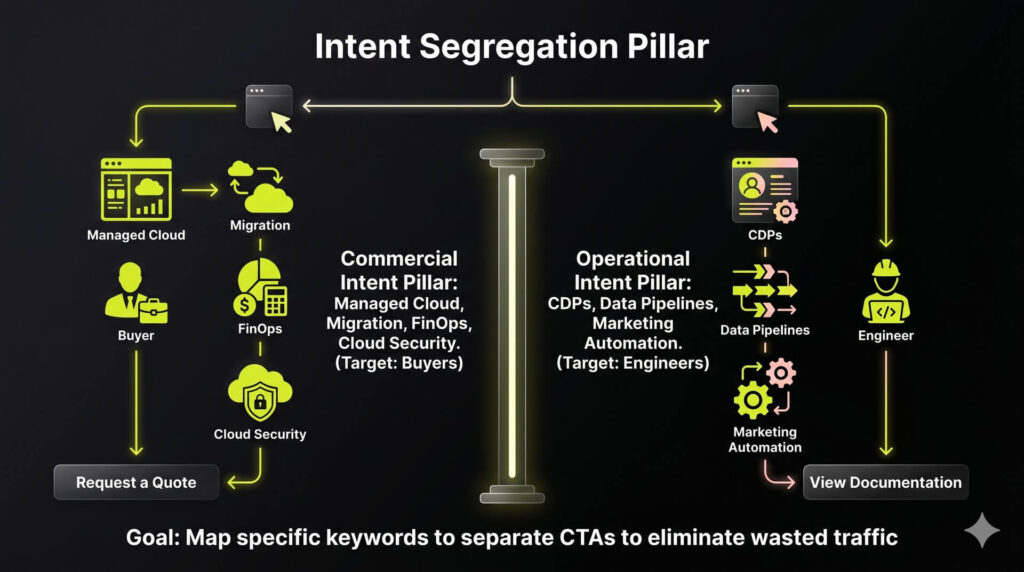
- Separate commercial intent (managed cloud, migration, FinOps, security) from operational intent (CDPs, data pipelines, automation) using distinct pillar pages, navigation menus, and URL paths.
- Map content to the buyer's risk sequence (awareness, consideration, decision, post-click) with one CTA per stage, and track stage-to-stage conversion rather than keyword rankings.
- Productize technical expertise into indexable Authority Assets like reference architectures, migration checklists, and security explainers that prove competence before the first sales call.
- Focus on investor-ready KPIs such as qualified conversion rate, SQL rate, speed-to-lead, pipeline velocity, and CAC payback rather than general website traffic.
Cloud computing marketing is the practice of marketing managed cloud services to prospective clients while also using cloud-native infrastructure to power your own marketing operations.
1. Segregate Service Intent from Operational Infrastructure
Intent mismatch occurs when you attract technical researchers instead of high-intent buyers. To capture bottom-funnel interest, define two distinct content pillars:
- Commercial Intent: Selling managed cloud, migration, FinOps, and cloud security.
- Operational Intent: Building CDPs, data pipelines, and marketing automation architecture.
Execution requires separate pillar pages, navigation menus, and URL paths to prevent search engines from confusing professional services with tutorials. For each pillar, feature three elements above the fold:
- Target audience identification (who it’s for).
- Quantifiable business outcomes (e.g., 30% reduction in cloud spend).
- Empirical proof of success and technical authority.
Stop tracking sessions as a primary metric. Monitor qualified form-fill rates and assisted pipeline generated per pillar. This data-driven approach bridges the Technical Authority Gap and ensures SEO efforts build organic equity. By mapping specific keywords to separate CTAs, you stop wasting resources on traffic that will never become leads.
2. Align Your Content Funnel with the Buyer’s Risk Sequence
Most MSPs lose qualified leads by forcing Book a Call CTAs before prospects understand their risk profile. This friction widens the Technical Authority Gap and stalls the sales cycle. High-performance cloud computing marketing mirrors the buyer’s inquiry sequence: risk, options, proof, implementation, and vendor selection. Matching depth to readiness ensures content functions as a valuation-building asset.
Map your content to these four funnel stages:
- Awareness: Address what is and why now regarding hybrid cloud security and cost predictability.
- Consideration: Compare approaches like lift-and-shift versus modernization or build versus buy.
- Decision: Detail provider evaluation, managed services, and cloud compliance proof.
- Post-click: Provide validation through case studies and a firm assessment offer.
Deploy one CTA per stage to ensure progression. Offer a webinar for awareness, a checklist for consideration, and a discovery call for the decision phase. Track stage-to-stage conversion, measuring how many downloads turn into meetings, rather than keyword rankings. This converts informational traffic into a controlled path toward meetings while building Investor-Ready revenue data.
3. Productize Technical Expertise into High-Authority Assets
MSPs often struggle with the Technical Authority Gap because their expertise remains hidden behind daily service delivery. To bridge this, transform your intellectual property into indexable Authority Assets that prove competence before the first sales call. Effective cloud computing marketing productizes technical knowledge to de-risk the buying decision for high-intent decision-makers.
Build authority quickly by publishing these specific asset types:
- Reference Architecture: Visualizes what you deploy and why it is secure.
- Migration Readiness Checklist: Maps technical inputs, dependencies, and deployment risks.
- Security Controls Explainer: Details PII handling, IAM, and encryption protocols.
Each asset requires an indexable landing page to capture bottom-funnel cloud computing marketing intent and a downloadable version for lead capture. Translate technical specifications into plain-English business outcomes like audit readiness, uptime, and cost control. Track success through backlink volume and sales enablement usage via HubSpot. These assets build the organic equity required to increase enterprise valuation and M&A readiness.
4. Structure Service Pages as Outcome Engines
Most MSP pages fail by prioritizing technical manuals over solutions, widening the Technical Authority Gap. Effective cloud computing marketing targets decision-maker anxieties instead of technical specifications. Your page anatomy must pivot from inputs to measurable outputs.
Use headlines addressing financial or operational pain points:
- Eliminate Cloud Spend Variance
- Pass Security Audits 30% Faster
- Achieve 100% Regulatory Compliance
Follow this with a dual-track narrative that pairs technical scope with business impact.
Insert proof blocks to mitigate risk. Include a case snippet with a metric, such as reduced cloud waste by 22% in 60 days. Address objections regarding vendor lock-in or downtime directly within the service narrative.
Remove CTA clutter to improve lead quality. Direct traffic to one Cloud Demand and Readiness Assessment to capture high-intent SQLs. This prioritizes conversion and builds the investor-grade revenue data required for M&A readiness.
5. Weaponize Compliance to Shorten the Sales Cycle
Sales cycles often stall for weeks while legal teams interrogate data handling. This trust tax exists when marketing fails to pre-emptively solve compliance objections. To bridge the Technical Authority Gap, treat compliance as a strategic differentiator rather than a back-office chore.
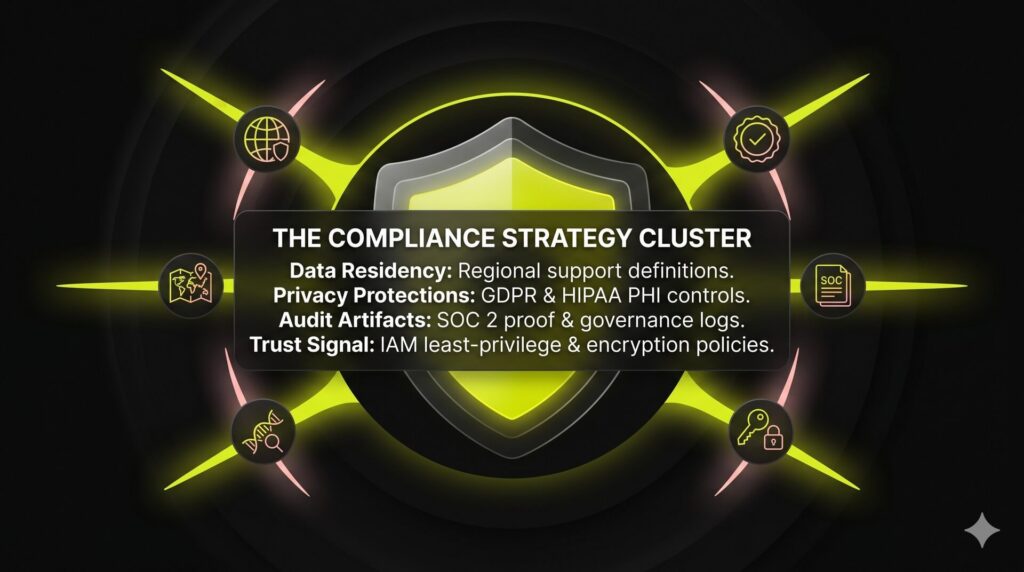
Build a Compliance & Data Handling content cluster to capture high-intent regulatory searches. This cluster should explicitly define your stances on:
- Data residency by region (what you support vs. what you won’t promise).
- GDPR, UK GDPR, and HIPAA/PHI protection.
- Concrete PII/PHI controls within cloud computing marketing stacks like CDPs and CRMs.
Display page-level trust signals including IAM least privilege, encryption, logging, and retention policies. List available audit artifacts like SOC 2 to prove governance before the discovery call. This demonstrates the operational maturity required for investor-grade scrutiny and maximized enterprise valuation.
Convert this traffic with a targeted CTA: Security + Data Governance review for your marketing stack. Track success through rankings on compliance-intent keywords and assisted conversions. This strategy captures prospects under regulatory pressure and significantly reduces friction in the sales cycle.
6. Engineer High-Conversion Automation with Institutional Guardrails
Many MSPs lose leads to manual response lag. Success requires automating the transition from form-fill to CRM to bridge the Technical Authority Gap. While n8n-style platforms handle basic triggers, advanced cloud computing marketing leverages serverless orchestration for agentic workflows following a strict sequence:
- Form submission and CRM logging
- Real-time enrichment via Apollo
- Routing based on revenue potential
Maintain investor-ready data integrity with institutional guardrails. Implement least-privilege tokens for API access and limit automation to approved data sources. Human oversight remains mandatory for outbound claims to protect brand trust. Control operational costs by utilizing:
- Caching
- Monitoring
- Strict API limits
Focus on two primary KPIs: speed-to-lead and follow-up SLA compliance. These patterns increase lead-to-meeting conversions by operationalizing fast, personalized follow-ups with controlled risk.
7. Operationalize Attribution to Satisfy CFO Skepticism
Your CFO likely views cloud computing marketing as a speculative expense rather than a predictable revenue engine. To bridge the Technical Authority Gap, replace vanity metrics with institutional-grade attribution that connects content directly to unit economics. Success requires a measurement model that tracks the full journey from source and landing page to meeting, SQL, and closed-won revenue.
Operationalizing this model requires specific governance:
- Standardized UTMs, lifecycle stages, and lead scoring within your CRM.
- Direct mapping of keyword to page to offer to eliminate attribution ambiguity.
- A monthly ship, move, or kill review to prune low-performing assets and scale winners.
Focus on two critical KPIs: pipeline generated per topic cluster and your CAC payback period. This transparency transforms marketing from an opaque cost center into a high-yield organic equity asset. By anchoring your cloud computing marketing in revenue outcomes, you ensure growth is investor-ready and prepared for rigorous M&A scrutiny.
FAQ
It encompasses two distinct activities: marketing managed cloud services to prospective clients and using cloud infrastructure to power your own marketing operations. Selling services focuses on cloud migration, FinOps, and security. In contrast, operational marketing utilizes cloud-native stacks like CDPs for advanced data management. Conflating these leads to intent mismatch, attracting technical researchers rather than enterprise buyers. Clear separation ensures your content speaks to high-intent decision-makers while protecting your technical authority.
Early signals like keyword movement often appear within 3 to 6 months, but a measurable impact on the sales pipeline usually takes 6 to 12 months of consistent execution. This timeline accounts for the time needed to build technical authority and index high-value assets. Unlike paid ads, SEO provides a compounding return on investment. Over time, these assets create organic equity that lowers your customer acquisition costs and significantly improves your firm’s overall enterprise valuation.
Your decision hinges on your internal technical resources and desired time-to-value. Enterprise suites provide a unified ecosystem but often come with significant vendor lock-in and complex licensing. A custom, cloud-native stack offers maximum flexibility and data sovereignty but demands more engineering oversight and maintenance. Most scaling MSPs benefit from a hybrid strategy: maintaining a robust core CRM like HubSpot while building specialized, cloud-native automation for proprietary data workflows or industry-specific compliance needs.
It is safe only if you implement institutional-grade guardrails including least-privilege tokens, controlled context windows, and comprehensive audit logging. Trust is the primary currency in B2B IT, and a data mishap can be legally and commercially fatal to your brand. Ensure that AI agents never have autonomous outbound authority without human review. By formalizing these security protocols, you turn a potential liability into a strategic advantage that demonstrates your operational maturity to high-intent prospects.
Prioritize qualified conversion rate, SQL rate, speed-to-lead, and pipeline velocity. These specific metrics directly correlate with revenue growth and M&A readiness. General website traffic is a secondary indicator; it only matters if it converts into high-intent meetings. Track CAC payback periods and full-funnel attribution to prove marketing’s impact to stakeholders. Focusing on these investor-ready KPIs ensures your marketing is viewed as a predictable revenue engine rather than an opaque operational expense.
Where this fits in your MSP growth system
This is one piece of how NUOPTIMA makes MSPs and cybersecurity firms the provider buyers find on Google and in AI search. See how it connects to cybersecurity SEO and MSP SEO, or get your free MSP lead forecast to see exactly where your firm shows up across ChatGPT, Gemini, and Perplexity today.