
A prospect in your city types "best managed IT provider" into ChatGPT. Three firms appear by name. Yours is not one of them. That moment is what managed service provider (MSP) marketing exists to fix.
MSP marketing is the system that makes your firm findable, credible and chosen before the first sales call. This guide gives you a definition you can paste into a board memo, the channels that make up the work, what a sensible budget looks like, what has changed in 2026 with artificial intelligence (AI) search, and how to measure whether any of it pays back.
It is written for MSP owners and leadership teams who have grown on referrals and now want a pipeline they can forecast. If you already have a funded plan and need to sequence it quarter by quarter, the MSP marketing strategy guide covers stage-gated budgets and governance in more depth.
Last reviewed September 2026.
Key Takeaways
- MSP marketing is a demand system, not a blog calendar. Its job is to get your firm shortlisted on Google and in AI assistants before a buyer ever calls.
- Referrals and bought growth both hit a ceiling. A compounding demand engine is the lever that builds enterprise value and removes founder dependency.
- Marketing owns positioning and visibility. Sales owns qualification and close. Blurring that handoff raises acquisition cost and lowers win rates.
- In 2026, AI search visibility is part of the shortlist. Buyers ask ChatGPT, Gemini and Perplexity who to hire, and those tools draw on the same proof your website should already carry.
- Set the budget by working backward from new-client targets and acceptable acquisition cost, not from a generic percentage of revenue.
MSP Marketing at a Glance
| Question | Short answer |
|---|---|
| What it is | The system an MSP uses to attract, educate and convert business buyers who need outsourced information technology (IT) |
| Who it targets | Owners, operations leaders and IT decision makers at small and mid-sized businesses in a defined vertical and region |
| Core channels | Search engine optimization, AI search, local search, paid search, content, email, outbound, social, referrals and partners |
| What changed in 2026 | AI assistants now name vendors directly, so structured proof and consistent entity data matter as much as rankings |
| How to set budget | From new-client targets and acceptable customer acquisition cost, then tested against a percentage-of-revenue sanity check |
| How to measure | Qualified meetings, proposals, closed-won contracts and payback period, tracked by source in your customer relationship management (CRM) system |
1. The MSP Marketing Meaning
What is MSP marketing? It is the system a managed service provider uses to become visible in search and AI assistants, then attract, educate and convert qualified business buyers who need outsourced IT.
It differs from most marketing because you sell multi-year recurring contracts built on trust, not one-off projects. Switching providers carries real operational risk for the buyer: downtime, lost access, a messy handover. So buyers want strong proof before they add you to a shortlist, and the sales cycle often runs a quarter or longer.
In plain English, the goal is simple. When a business in your region asks Google or an AI tool who to hire for managed IT, your firm is one of the names that comes back, and your website gives them enough evidence to book a call.
This matters because a pipeline you can forecast, instead of referrals you cannot, is what protects margins and supports a higher valuation when you eventually sell.
2. What MSP Marketing Is Not
Many MSP owners write marketing off as a money pit because they tried random tactics and called it strategy. Three patterns show up again and again:
- A blog calendar with no clear positioning. Generic posts on "5 cybersecurity tips" that could sit on any of a thousand MSP sites.
- Traffic reports with no link to pipeline. Sessions and impressions go up while booked meetings stay flat.
- Vendor product copy pasted onto your services. Your firewall vendor's feature list does not explain why a 60-person law firm should pick you.
These fail for two reasons. Technical decision makers spot generic, outsourced content quickly. And in a trust-driven sale, weak proof breaks the funnel before the first call. Marketing that works is a connected system where each piece feeds the next.
3. The Three Levers of MSP Growth
Most scaling MSPs stall on two levers. To build a pipeline you can forecast, you need all three:
- Lever 1, referrals: High trust and high close rates, but you cannot forecast them or turn up the volume when you need to.
- Lever 2, bought growth: Hiring sales headcount or acquiring smaller competitors. Both work, and both are capital-intensive.
- Lever 3, a compounding demand engine: Search visibility, AI search presence, proof content and demand capture that keep producing leads after the work is done.
The third lever turns marketing into a measurable asset rather than a line of spend. It reduces how much new business depends on the founder's network, and it means a qualified buyer can shortlist your MSP without already knowing you.
4. MSP Marketing vs MSP Sales: The Handoff
A compounding pipeline needs a clear line between creating demand and closing deals.
What is MSP sales? It is the consultative process of turning qualified interest into recurring contracts through technical discovery, risk assessment and scoped proposals.
- Marketing owns: positioning, visibility, lead capture, nurturing and the assets sales uses.
- Sales owns: qualification, technical discovery, risk review, proposal and close.
Map the funnel in one line: marketing qualified lead (MQL) to sales qualified lead (SQL) to scoped proposal to signed contract. Agree in writing what makes a lead an MQL, and how fast sales follows up. When sales and marketing disagree on the ideal client profile (ICP), customer acquisition cost (CAC) rises and close rates drop.
5. Marketing Inside the MSP Channel Ecosystem
The MSP channel is the network of technology vendors, distributors and service providers that delivers IT outcomes to end users. Vendors build products and partner programs, distributors handle scale and supply, and you package the pieces into outcomes while owning the client relationship.
That structure can feed your marketing. Partner badges transfer credibility, many vendor programs offer market development funds for co-marketing, and pairing a recognized platform with your local expertise gives a skeptical prospect two reasons to trust you. Guard your positioning, though. The vendor's narrative is about their product. Yours has to be about the client's risk and outcomes.
6. The Minimum Viable Growth System
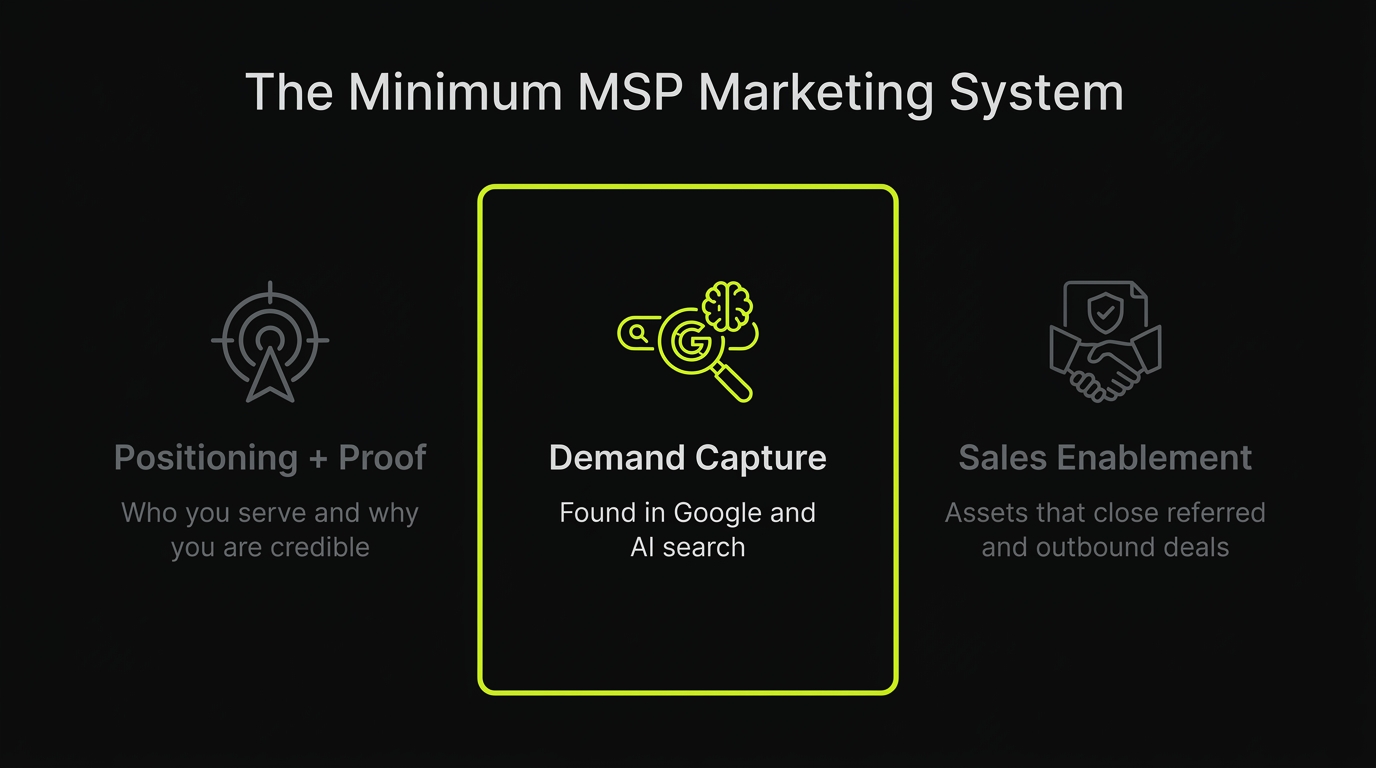
You can check your pipeline readiness in two minutes. A growth system that works beyond referrals has six parts:
- Positioning: Who you serve, where you operate, and the specific operational risk you reduce.
- Offer clarity: Clear service tiers and a low-friction first step, such as a network assessment or security review.
- Proof assets: Case studies, client reviews and verified certifications.
- Demand capture: Visibility in Google, Google Maps and AI assistants for the searches your buyers actually run.
- Sales enablement: Selection guides, comparison pages and an onboarding map that answers "what happens if we switch?"
- Measurement: Cost per lead (CPL), CAC and gross-profit payback, tracked by source.
If one part is missing, lead generation gets expensive or fragile. Strong ads pointed at a website with no proof burn budget. Strong proof with no demand capture sits unread.
7. The Core MSP Marketing Channels
Every MSP marketing plan draws from the same set of channels. Here is what each one does and when it tends to fit.
| Channel | What it does | Speed to first results | Fits best when |
|---|---|---|---|
| Search engine optimization (SEO) | Ranks service, vertical and location pages on Google | Slow, compounds over months | You want inbound demand that keeps paying back |
| Generative engine optimization (GEO) | Gets your firm named in ChatGPT, Gemini and Perplexity answers | Slow to medium | Buyers in your market research with AI tools |
| Local search | Wins the map pack and "near me" searches through your Google Business Profile | Medium | You sell within a defined metro area |
| Paid search | Buys placement on high-intent searches | Fast | You need pipeline while organic builds |
| Outbound | Cold email and LinkedIn outreach to a defined list | Fast | Your ICP is narrow and you have vertical proof |
| Content and email | Proof assets and nurture across a long sales cycle | Medium | Deals take a quarter or more to close |
| Social media | Keeps the founder and team visible, mostly on LinkedIn | Medium | Buyers already know your people |
| Referrals and partners | Structures introductions from clients, vendors and peers | Varies | You have happy clients and vendor relationships |
A few notes on how each channel behaves for an MSP specifically:
- SEO: For most MSPs this is local and intent-driven, not a volume game. One strong page per service, per vertical and per city you serve beats fifty generic posts. SEO for MSPs covers the page structure in detail.
- GEO: AI assistants build their answers from sources they trust: your site, review platforms, directories and third-party mentions. Consistent facts about who you serve and where, repeated across those sources, is what earns a mention. See generative engine optimization services.
- Local search: A complete Google Business Profile with the right primary category, real photos and a steady flow of reviews is often the cheapest lead source an MSP has. More in local SEO for MSPs.
- Paid search and advertising: Pay-per-click (PPC) campaigns on terms like "managed IT services [city]" can produce calls within weeks. Tight geographic targeting, negative keywords that filter out job seekers and consumers, and a landing page per service keep the cost per lead sane. The wider paid layer, including LinkedIn and Meta, is laid out on paid ads for MSPs.
- Outbound: Works when aimed at a narrow list with a relevant reason to talk, such as a compliance deadline in that vertical. Cold email outreach for MSPs covers list building and deliverability.
- Content marketing: The content that moves MSP deals is specific: case studies with numbers, pricing explainers, "what switching providers looks like" guides and comparison pages. Thought-leadership posts help less than most owners expect.
- Social media: LinkedIn is where business buyers see you. Posts from the founder and engineers about real client problems tend to outperform company page updates.
Digital marketing for MSPs is simply these channels run online and measured together. Which to fund first is a budget decision, covered next.
8. How Much Should an MSP Spend on Marketing?
The most common benchmark is a percentage of revenue. Gartner's 2026 survey of chief marketing officers (CMOs), the CMO Spend Survey, put average marketing budgets at 7.8% of company revenue, barely up from 7.7% in 2025. Treat that as a loose sanity check only: the survey's respondents were mostly companies with over $1 billion in revenue, not regional MSPs.
A better method works backward from the clients you want:
- Set the new-client target. Say six new managed services clients this year.
- Work out what a client is worth. A client at $3,000 monthly recurring revenue (MRR) and 50% gross margin produces $18,000 of gross profit a year.
- Pick a payback period. With a 12-month gross-profit payback as your rule (a planning choice, not an industry standard), you can spend up to $18,000 to win that client.
- Multiply. Six clients at up to $18,000 each gives a ceiling of $108,000 across marketing and sales for the year.
Then split it by stage. An MSP with no inbound engine usually funds positioning, the website and proof assets first, then adds one fast channel (paid search or outbound) for near-term pipeline, and one compounding channel (SEO and GEO) that takes longer to pay back. Adding a third or fourth channel before the first two produce qualified meetings spreads the budget too thin to learn anything.
9. Building an MSP Marketing Plan
A workable plan fits on one page:
- Pick one ICP. One vertical, one size band, one region to start.
- Write the offer. What you do for that buyer, the risk you remove, and the first step.
- Fix the proof. At least one case study and a reviews process before you spend on traffic.
- Choose two channels. One fast, one compounding, using the budget math above.
- Set the scorecard. Qualified meetings and proposals per month by source, reviewed monthly.
The MSP marketing strategy guide covers the quarter-by-quarter version of this plan.
10. What Works in 2026: Getting Shortlisted by AI Search
If your MSP is missing from AI recommendations, you can lose the deal before anyone visits your site. Shortlist visibility now has two halves. Traditional SEO ranks your pages on Google. AI search visibility gets your firm named when a buyer asks an assistant for recommendations.
Test where you stand today. Run ten prompts in ChatGPT, Gemini and Perplexity that match how your buyers ask, for example:
- "best managed IT for healthcare in Chicago"
- "top MSP near me for a 50-person accounting firm"
- "managed IT for law firms in Denver"
Note which firms appear, how often, and which sources the tool cites. That tells you who the assistants trust and where your own gaps are.
To earn those mentions, make your site easy to read as a set of clear facts:
- Services: One page per service, stating what is included.
- Verticals: Pages for the industries you actually serve, with the compliance frameworks you support.
- Locations: The cities and regions you cover, consistent with your Google Business Profile.
- Proof: Named case studies, reviews and certifications that other sites can confirm.
Then make sure the same facts appear off your site, on review platforms, directories, vendor partner listings and local business associations. Assistants lean on sources they can cross-check.
11. Turning Trust into Proof Assets
Your credentials do not exist to Google or ChatGPT if they only live in your head. To get shortlisted, turn your reputation into five kinds of published proof:
- Case studies: Client outcomes with numbers, such as reduced downtime, audit passed, or tickets resolved faster.
- Reviews: A steady flow of Google reviews and ratings on platforms your buyers check.
- Service pages: Clear offers segmented by industry and geography.
- Team credentials: Leadership and engineer bios with certifications and specialties.
- Third-party mentions: Local press, association listings and partner pages that link back to you.
This proof does two jobs. Buyers use it to reduce risk, and AI systems use the same consistent facts to decide who to recommend.
12. How to Measure MSP Marketing
Run marketing like a capital investment and agree on three numbers with your leadership team:
- CPL: Channel spend divided by leads produced.
- CAC: Total marketing and sales spend to win one retained client.
- Payback period: Months of gross profit needed to recover CAC.
Measure the funnel in your CRM, not in your analytics dashboard. Every lead needs a source tag (organic search, AI referral, paid search, outbound, referral) that follows it to the signed contract. Then review, each month:
- Leads and MQLs by source
- Qualified meetings held
- Proposals sent and their value
- Closed-won contracts and their MRR
Traffic, impressions and rankings are leading indicators. They tell you whether a channel is warming up, but they are not results. In month one, ignore them and check that the tracking works.
Here is what source-level measurement looks like in practice. For Cortavo, a managed IT provider in the United States, an $88,500 investment in organic and AI search produced $403,330 in contracted sales over 12 months, from 8 new clients and 75 organic-sourced MQLs, all tagged at source in the client's CRM. Numbers like these only exist if the tagging is in place before the campaign starts.
Key MSP Marketing Terms
The vocabulary that shows up in every MSP marketing plan, scorecard and agency call:
- Lead: A person or company that has shown interest and left contact details.
- MQL: A lead that fits your ICP and has engaged enough for marketing to pass it to sales.
- SQL: A lead sales has vetted and accepted as a real opportunity.
- ICP: The vertical, company size and geography you serve best and market to on purpose.
- CPL: Channel spend divided by leads produced.
- CAC: Everything it costs to win one client, across marketing and sales.
- MRR: The recurring revenue a client contract brings in each month.
- Payback period: How many months of a client's gross profit it takes to recover their CAC.
- GEO: Work that gets your firm named and cited in AI assistant answers.
- Shortlist visibility: Whether your firm is named when a buyer asks Google or an AI assistant who to consider.
Do this next: Pick one vertical, publish one page with real proof for that buyer, run the ten-prompt AI search test, and pause the generic blogging.