Most MSPs do not need more leads. They need qualified opportunities they can close repeatedly. Pipeline predictability stems from high-intent capture and closing the technical authority gap rather than chasing random tactics. This playbook outlines organic MSP lead generation strategies including SEO, GEO, and vertical focus to build long-term equity. NUOPTIMA helps technical founders build these engines and establish market authority at nuoptima.com. Start with positioning. The wrong positioning makes every marketing channel prohibitively expensive.
Key Takeaways
- MSP pipeline predictability comes from high-intent capture and closing the technical authority gap, not from chasing more random leads or tactics.
- Vertical specialization is the fastest lever: pair one primary vertical with a compliance wedge (for example healthcare with HIPAA, or manufacturing with CMMC) and only pick a niche where you can publish a credible case study within 30 days.
- Build bottom-funnel pages (Service + Vertical + Location, compliance-led security, co-managed IT, switching guides) and make Book an Assessment your primary CTA.
- Use Generative Engine Optimization with entity signals and quotable blocks so answer engines like Perplexity and SearchGPT cite your firm when a CISO asks for a compliant provider.
- Respond to inbound leads within five minutes and track meeting-to-opportunity conversion rather than vanity metrics, since slow follow-up leaks expensive high-intent traffic.
MSP lead generation is the process of attracting businesses with specific IT and compliance pain points and converting them into qualified sales opportunities. A predictable engine combines vertical SEO, Generative Engine Optimization, referral channels, LinkedIn outreach, and a tightly scoped high-intent offer rather than a scatter of one-off tactics.
Narrow Your Vertical to Dominate High-Intent Search
Generic hero sections promising tailored IT solutions for all attract price-shoppers rather than decision-makers. Mid-market leads avoid generalists. They seek partners who understand their specific regulatory landscape and operational risks.
To execute, pair one primary vertical with a compliance wedge: healthcare with HIPAA or manufacturing with CMMC. Shift messaging from technical specs to Board-level outcomes like audit readiness, insurance posture, and uptime. Update your hero section and navigation to state your vertical plainly, replacing vague jargon with industry-specific language.
Strengthen authority with specific quality signals:
- Framework certifications (NIST, SOC2) and audit support.
- SLA-backed response times.
- A who we don’t serve section to filter bad-fit leads.
Avoid choosing a niche without existing proof. Only select a vertical where you can publish a credible case study within 30 days. Vertical specialization is the fastest lever for MSP lead generation strategies, building the technical authority required for premium margins and M&A-ready valuation.
Capture High-Intent Demand with Bottom-Funnel Pages
High traffic often masks a failing lead engine. Blogs attracting technical tutorial hunters yield zero qualified meetings, essentially building an audience for competitors instead of a sales pipeline. Shift focus to bottom-funnel assets that capture prospects during a transition or crisis.
Build localized, vertical-specific pages to dominate high-intent regional searches:
- Service + Vertical + Location (e.g., Managed IT for Law Firms in Austin)
- Compliance-led security (SOC 2, HIPAA, or CMMC support)
- Co-managed IT for internal teams seeking expert overflow
- Switching assets like Replace your MSP checklists or due diligence guides
Convert this traffic by making Book an Assessment your primary CTA, supported by a secondary checklist download. Include transparent pricing ranges to establish immediate trust and bridge the technical authority gap. Effective MSP lead generation strategies track form fills by page and meeting-to-opportunity rates rather than just raw rankings. This ensures marketing spend builds organic equity rather than top-of-funnel noise.
Build Case Studies as High-Stakes Decision Support Documents
Prospects cannot verify technical claims, forcing sales teams into weeks of trust building. To accelerate MSP lead generation strategies, transform case studies from marketing fluff into decision-support documents that eliminate risk for compliance-heavy buyers.
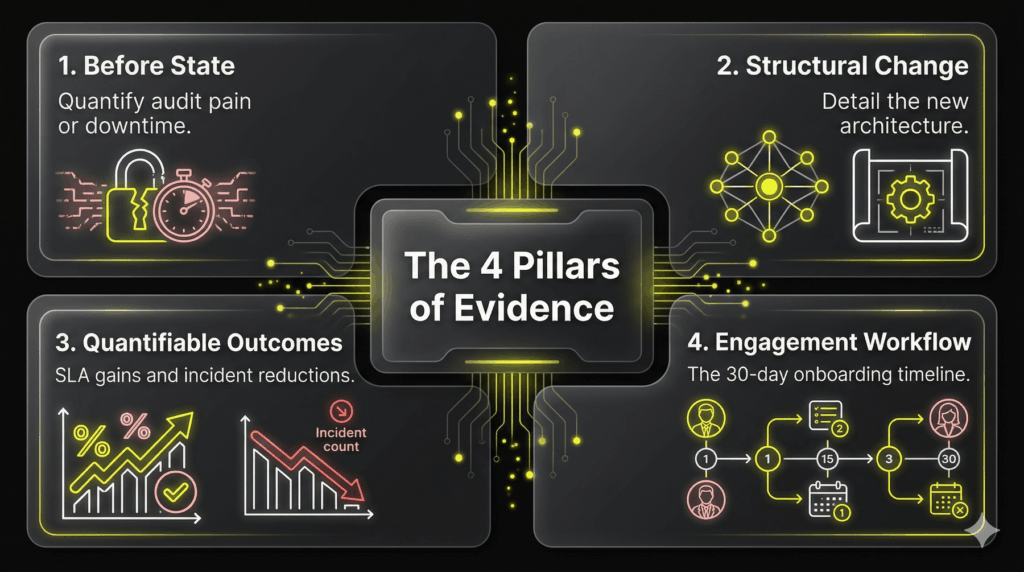
Effective narratives focus on architectural shifts rather than vendor logos. Structure each document around four pillars:
- Before State: Quantify audit pain, downtime, or tool sprawl.
- Structural Change: Detail process and architecture improvements.
- Quantifiable Outcomes: List SLA gains, incident reductions, or audit passes.
- Engagement Workflow: Outline the project timeline and stakeholders.
Link these assets from service pages, sales sequences, and proposals. Technical depth also feeds your GEO footprint, positioning your firm as a primary citation in AI search results. Avoid anonymous stories lacking specifics. If you must sanitize a client name, maintain enough technical rigor to validate your expertise and prove competence.
Use Generative Engine Optimization to Own AI Answer Engines
By 2026, high-intent MSP prospects increasingly bypass Google for answer engines like Perplexity and SearchGPT. If these models cannot cite your firm when a CISO asks for a specific compliant provider, you are effectively invisible. Traditional rankings no longer guarantee discovery.
Generative Engine Optimization (GEO) bridges this gap by transforming your site into a structured authority node. Effective MSP lead generation strategies must move beyond generic copy toward high-density entity signals and quotable blocks.
- Narrow Authority: Answer hyper-specific questions, such as CMMC compliance for regional manufacturers.
- Entity Signals: Explicitly list services, certifications, and technical frameworks like NIST or SOC2.
- Quotable Blocks: Create concise definitions and decision criteria that LLMs can easily cite.
Build credibility through expert quotes and original frameworks to close the technical authority gap. Avoid generic AI content farms. GEO rewards specificity and professional expertise over sheer volume.
Design a High-Intent Offer to Filter Tire-Kickers
Generic contact forms attract low-intent SMBs seeking price-shopper quotes. These inquiries drain engineering resources and suffer from low show rates. Replace broad Contact Us buttons with a tightly scoped, high-value assessment to qualify intent and protect your calendar.
A 60-minute Security and Compliance Snapshot delivering an executive summary within two working days is a proven model. Filter tire-kickers by charging a small fee credited back at signing or offering a charity donation if no value is found. This friction ensures you only speak with serious, high-intent buyers.
Deploy this via a dedicated landing page with an integrated calendar. Require three qualification data points:
- Industry vertical
- Seat count
- Compliance requirements (e.g., SOC2, HIPAA)
Automate routing so only prospects meeting your ICP thresholds can book a session, and map each booked assessment to a stage in your MSP sales funnel so marketing and sales measure the same pipeline. Ensure the audit scope remains narrow for fast, repeatable delivery. Proving technical authority upfront is one of the most effective MSP lead generation strategies for maximizing close rates.
Publish High-Stakes Authority Assets
Most content fails by educating technical peers rather than providing decision support for buyers. To refine your MSP lead generation strategies, move beyond surface-level explainers toward original frameworks that resolve specific executive anxieties. High-performing authority assets create trust by bridging the Technical Authority Gap between your technical expertise and the prospect's business outcomes.
Commit to one high-impact asset monthly. These playbooks or benchmarks should offer an original POV on vertical-specific compliance or risk. Effective formats include:
- Vertical CIO brief (2 to 4 pages) covering top risks, controls, and budget ranges.
- Vendor/tooling rationalization framework to reduce software sprawl.
- Switch MSP evaluation scorecard.
- Incident response readiness checklist.
Ensure these stay bottom-funnel by embedding CTAs for a specialized assessment. Use Who this is for/not for sections to qualify high-intent leads immediately. Repurpose each asset into one webinar, six LinkedIn posts, and three sales enablement emails to maximize market presence.
7. Build an Owned Audience to Decouple Growth from Outbound Pressure
LinkedIn reach is borrowed equity. Platform reliance leaves your pipeline vulnerable to algorithm shifts, providing engagement without a compounding distribution channel. To build a predictable asset, bridge the gap between rented social reach and owned CRM data to increase enterprise valuation.
High-performance MSP lead generation strategies prioritize a disciplined execution cadence. Connect with target ICPs daily by role and vertical, and post technical frameworks, such as cloud migration roadmaps or cybersecurity risk assessments, 2 to 3x weekly. Every activity should drive traffic to an owned asset, such as a monthly executive briefing or a SOC2 compliance checklist, to capture verified email addresses.
Nurture this list with a weekly value email and a monthly technical brief segmented by industry compliance requirements, run through a dedicated MSP email marketing system so segmentation and follow-up are automated rather than manual. Track reply rates and meeting-to-opportunity conversion rather than vanity metrics like follower counts. Avoid the common pitfall of generic posting without a direct offer or lead capture mechanism.
Institutionalize Referral Channels through Semi-Private Groups
Many MSP founders dismiss networking because it feels impossible to attribute. While you wait for perfect data, competitors close high-margin deals in dark social corners like vertical associations and private Slack communities. Treat these channels as a formal system for MSP lead generation strategies rather than a stroke of luck.
Build authority in specific environments where decision-makers gather:
- Vertical associations (Healthcare, Manufacturing, Finance)
- Private Slack or Discord communities for IT leaders
Enter these spaces with a wedge artifact like a breach post-mortem template or a CMMC audit readiness guide.
Capture interest via a QR code leading to a dedicated landing page. Follow the download with an automated email sequence tied directly to the artifact. Sponsoring events without a follow-up system or proof content is a common pitfall. This infrastructure turns high-trust introductions into a scalable revenue asset.
9. Deploy a Dream 100 Direct Mail Workflow
High-LTV MSP deals require precision. Digital channels are saturated with automated outreach, creating a Technical Authority Gap where your signal is lost. Direct mail serves as a pattern interrupt for MSP lead generation strategies, prioritizing differentiation over scale to reach decision-makers who ignore cold emails.
Build a Dream 100 list of accounts based on vertical, size, and technical posture. Send a monthly printed briefing containing:
- One industry-specific insight.
- One technical case study.
- One high-intent offer.
Follow up 48 hours later via LinkedIn or email, using a short cold outreach sequence built for MSPs so the printed briefing and the digital touch reinforce the same offer. Offer an editable version of a checklist mentioned in the briefing to initiate a soft conversion. Measure success by meetings booked and quarterly pipeline created rather than vanity metrics like open rates.
Avoid lumpy mail gadgets that lack relevance. Align physical outreach with compliance deadlines, upcoming audits, or board reporting cycles to ensure your firm is viewed as a strategic advisor rather than junk mail.
10. Automate Lead Response to Eliminate Pipeline Leakage
Many MSPs scale SEO and GEO but lose high-intent leads to unmonitored inboxes. A slow response signals technical incompetence and widens the Technical Authority Gap before a discovery call occurs. Without immediate follow-up, your MSP lead generation strategies suffer from a leaky bucket effect where expensive traffic fails to convert.
Bridge this gap with a minimum viable RevOps setup:
- Route form submissions to the CRM owner instantly.
- Embed a calendar link on the thank you page for immediate booking.
- Trigger an automated email within 5 minutes containing social proof and next steps.
- Set a firm SLA for the first human touch.
Use AI to summarize calls and draft follow-up notes to maintain momentum while keeping humans accountable for final outreach. Track metrics like speed-to-first-touch, show rates, and meeting-to-opportunity ratios to validate performance. Avoid tool sprawl by starting with one clean, governed workflow before layering in complex automation.
11. Avoid Low-Intent Marketing Shortcuts That Kill Domain Reputation
MSP founders often mistake high activity for a healthy pipeline. Sending thousands of automated LinkedIn messages feels productive until account restrictions and trust loss poison your growth. These shortcuts signal that you are a generalist commodity rather than a strategic partner to sophisticated IT buyers.
Avoid these volume-based tactics that damage domain authority and waste founder time:
- Buying generic lead lists with low intent and firmographic mismatches.
- Directing PPC traffic to a generic homepage rather than a qualified landing page.
- Publishing outsourced content that lacks technical depth and GEO relevance.
- Over-automating LinkedIn in ways that trigger spam filters and reputation loss.
Replace noise with a lean, high-intent stack to refine your MSP lead generation strategies. Focus on one vertical, one assessment offer, three proof assets, and a clean nurture system. Stop reporting on emails sent and start measuring qualified opportunities created.
How to Build a Predictable MSP Lead Generation Engine: A 90-Day Execution Plan
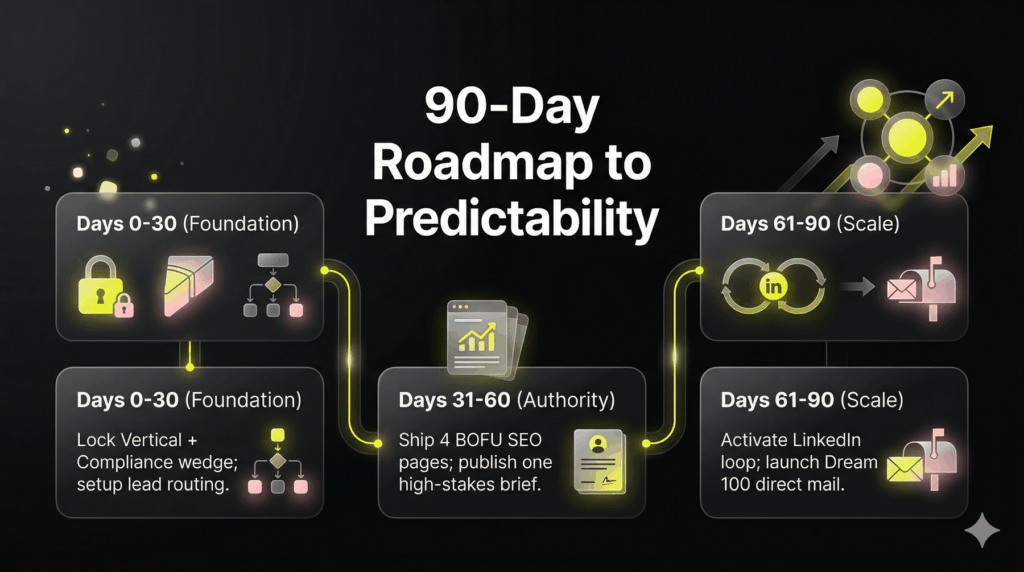
Managed service provider marketing usually fails due to random acts of promotion rather than a lack of ideas. Fragmented tactics like sporadic LinkedIn posts or disconnected webinars prevent the growth of organic equity and leave the pipeline empty. This 90-day roadmap transforms scattered MSP lead generation strategies into a sequenced operating plan. Follow this framework to close the technical authority gap and build an investor-grade revenue engine that increases enterprise valuation.
Week 0: Finalize the Strategic Foundation
Lock in your positioning before building any digital assets. This step prevents wasted spend on low-intent traffic and unqualified leads.
- Pick a vertical and compliance wedge. Select one primary industry and its specific regulatory framework, such as HIPAA for healthcare or CMMC for defense contractors.
- Define ICP thresholds. Set strict firmographic limits for your Ideal Customer Profile. Include minimum seat counts, annual revenue requirements, and specific geographic regions.
- Choose a single front-end offer. Define the exact scope of a 60-minute assessment. This ensures your initial touchpoint provides immediate utility to decision-makers.
Weeks 1 to 4: Build the Conversion Foundation
Your website must function as a 24/7 sales engineer. Focus on building assets that validate your expertise immediately to turn the site into a conversion-ready asset.
- Publish core messaging updates. Align your homepage and navigation tabs with your chosen vertical and compliance expertise.
- Update key service pages. Publish two specialized service pages and one deep vertical landing page to establish topical authority.
- Create proof assets. Build one high-stakes case study page and one dedicated assessment landing page.
- Set up lead routing. Configure speed-to-lead automation in your CRM. You will see higher conversion rates when inquiries receive a response in under five minutes.
Weeks 5 to 8: Capture High-Intent Search
Shift your focus to capturing prospects at the point of decision. This phase focuses on Generative Engine Optimization (GEO) to ensure AI models recommend your services.
- Ship four BOFU SEO pages. Target specific Service + Vertical + Location keywords to capture local bottom-funnel intent.
- Add internal links and CTAs. Connect new SEO pages to your assessment landing page to guide prospects directly into your sales funnel.
- Publish one authority asset. Create a vertical-specific brief and repurpose it into five LinkedIn posts and a targeted sales sequence.
Weeks 9 to 12: Distribution and Compounding
Scale your volume once the foundation converts traffic effectively.
- Activate the LinkedIn loop. Use your authority assets to drive followers into an owned email nurture sequence.
- Join one community channel. Establish a consistent presence in a vertical Slack group or a private professional association.
- Start Dream 100 outreach. Launch personalized direct mail and follow-up sequences for your top 100 target accounts if your lifetime value (LTV) supports higher acquisition costs.
The Weekly Scorecard for MSPs
Stop tracking vanity metrics like likes or impressions. Track these five data points every Friday to monitor the health of your revenue machine:
- Meetings booked from organic and direct sources.
- Meeting-to-opportunity conversion rate.
- Opportunity-to-close ratio.
- Total pipeline value created within the week.
- Average lead score of new inquiries.
Build Your Revenue Asset
Scaling a technical firm requires institutional-grade RevOps and a future-ready search strategy. If you want an AI-first SEO and GEO buildout that maximizes enterprise valuation, visit nuoptima.com to explore a growth partnership.