
A referral-led MSP can be healthy and still be entirely unforecastable. When growth relies on founder relationships, pipeline is lumpy.
To scale, you need a measurable MSP sales funnel that turns referrals into your baseline floor. At NUOPTIMA, we analyze pipeline economics through metrics your finance partner can underwrite, like stage conversion and cost per opportunity.
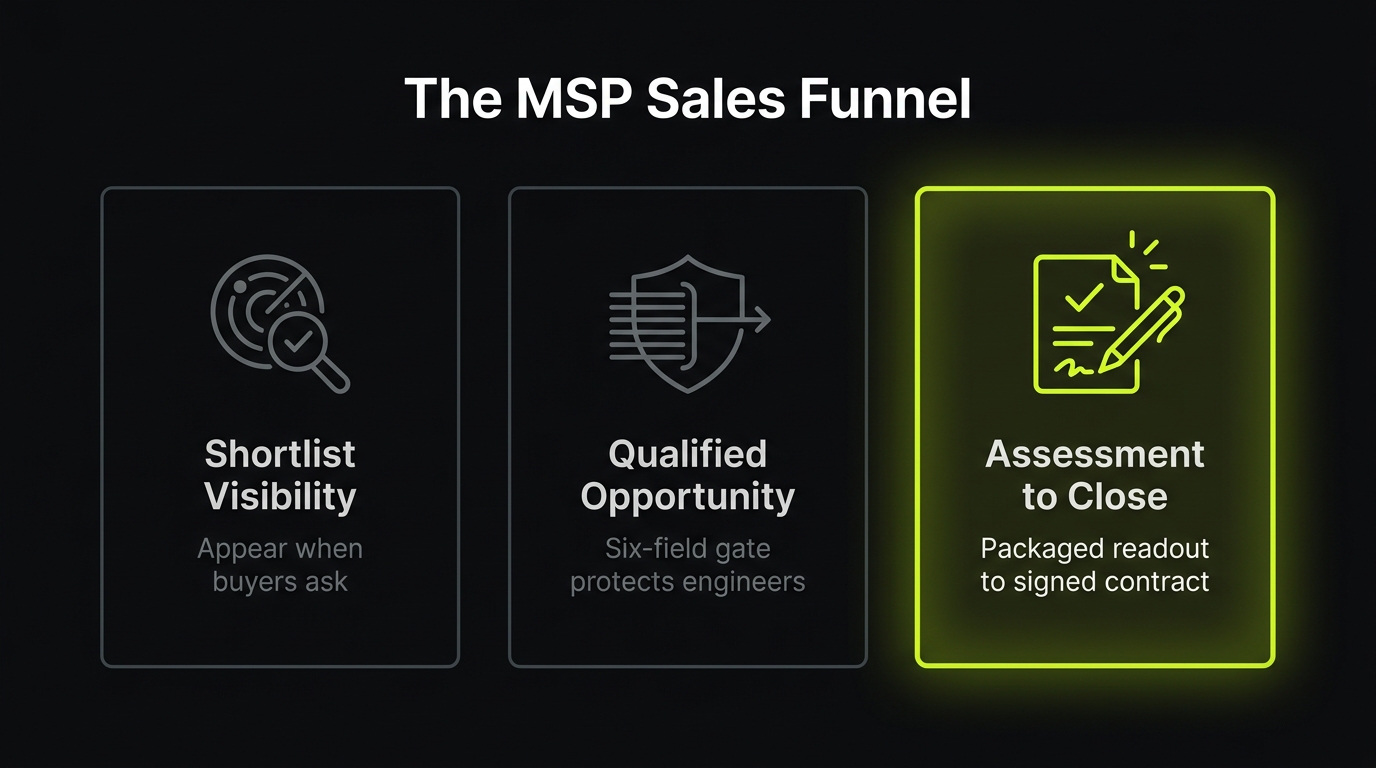
Start at the top: whether you show up when buyers ask Google and AI who to shortlist. That visibility layer is governed by your MSP marketing strategy; the funnel below converts it into contracted revenue.
Key Takeaways
- MSPs that lack query-level shortlist visibility lose deals before the first conversation because buyers rely on Google and AI to build their initial consideration set.
- Proof blocks targeting the two-buyer decision (technical founder and CFO) are what convert referrals into documented pipeline rather than letting them leak to better-positioned competitors.
- A six-field qualification gate and a structured discovery framework protect engineering time by disqualifying low-margin leads before they consume expensive technical resources.
- Funnel health is measured through four weekly metrics: stage volume, stage-to-stage conversion, cycle time, and cost per qualified opportunity.
An MSP sales funnel is a structured acquisition framework that tracks a prospective client from initial shortlist visibility through qualification, technical assessment, proposal, and close, accounting for the dual decision-making authority of a technical founder and a finance partner.
1. Audit Your Shortlist Visibility with a Query-Level Scorecard
You are losing deals you never knew existed. When a prospect asks ChatGPT or Google who to shortlist, and your name is missing, you stay invisible. To fix the top of your acquisition pipeline, stop tracking vanity impressions. Your real KPI is query-level presence: do you appear when buyers ask?
This week, run a 10-query shortlist test. Search Google and AI engines using queries combining:
- Your target vertical
- Your city
- Co-managed IT services
Record which competitors are named and what proof they cite. Then, build a simple visibility scorecard your CFO can read using these columns:
- Query and engine
- Appear (Y/N)
- Position or citation
- Next fix
This score makes your search presence tangible, stopping the hidden pipeline leak before a competitor gets the call.
2. Build Three Proof Blocks to Prevent Referral Leakage
Most MSP funnels fail because your champion cannot quickly explain your value to their finance or operations partners. Solve this two-buyer dynamic with a single positioning sentence that states exactly who you serve, backed by proof blocks that answer immediate risk questions.
Deploy these three proof blocks across your homepage, service pages, and proposals:
- Vertical Focus: Highlight deep sector-specific expertise and compliance capabilities.
- Risk Controls: Detail security frameworks, cyber insurance alignment, and contractual SLAs.
- Operational Maturity: Show a visual onboarding roadmap to prove your process is structured, not reactive.
Finally, add a brief "what changes, what stays stable" breakdown to de-risk the transition for the CFO. Explaining how daily operations migrate reduces switching fear, helping your champion sell your MSP internally and accelerating your pipeline.
3. Install a Six-Field Qualification Gate to Protect Engineering Time
Treating every lead as equal burns expensive technical hours on bad-fit opportunities. To protect your cost per opportunity and lift your lead-to-qualified-opportunity rate, add a lightweight qualification gate directly to your pipeline.
Replace generic contact forms with a structured, six-field pre-qualification form:
- Total seats
- Office locations
- Industry vertical
- Current IT setup (internal team or incumbent)
- Primary operational pain
- Target timeline
Then, apply automated routing rules based on account size. Smaller prospects (10 to 50 seats) route directly to speed-to-meeting booking. Mid-market or co-managed accounts (50 to 250 seats) receive risk and collaboration messaging designed to reduce internal IT defensiveness. This fast disqualification blocks low-margin noise before it drains your engineering and sales resources.
4. Convert Discovery Calls into Assessments by Eliminating the Audit Threat
Internal IT teams will stall your pipeline if they fear replacement. To increase your discovery-to-assessment conversion, do not treat the initial call as a technical audit. Treat it as a trust-building session that establishes a collaborative agenda.
De-risk the conversation early by stating: "We are not here to grade your team. We are here to map risk and options." This shift prevents assessment no-shows and internal IT pushback that kills qualified deals.
If discovery quality varies by rep, put an AI layer under it. A sales coaching bot that scores every recorded call against your framework, and against what actually closes, keeps the whole team running the same play; it is part of our AI advisory for MSP sales teams.
Use this copy-and-paste discovery skeleton:
- Outcomes: Document business goals for the next 12 months.
- Constraints: Identify compliance mandates, risk thresholds, and budget guardrails.
- Current Model: Map how internal staff and external vendors divide responsibilities.
- Next Step: Define what a valuable assessment looks like for their operations.
5. Package Your Assessments to Accelerate Proposals and Protect Margins
Assessments stall the demand engine when they feel like an open-ended intrusion. To protect gross margins, package the audit as a timeboxed, structured exercise. Your primary KPIs here are your assessment-to-proposal rate and time-to-proposal.
Limit engineering hours by keeping scope to a non-jargony checklist:
- Identity, access, and backup viability
- Endpoint hygiene and patching
- Network segmentation, vendor sprawl, and incident history
Do not deliver a dense technical dump. Hand the client a clean, four-column readout:
- Risk: The identified vulnerability.
- Impact: The business consequence.
- Recommended Control: The proposed solution.
- Effort Band: Low, medium, or high resource requirements.
This structured readout allows the CFO to evaluate financial tradeoffs instantly, converting a costly engineering step into a repeatable, high-converting sales stage.
6. Align Your Proposal Structure to the Two-Buyer Decision
Most MSP proposals lose because they read like a stack of tickets and tools. To accelerate your pipeline and lift proposal-to-close conversion, deliver a clean decision packet that addresses both the visionary founder and the cautious CFO. This makes the purchase legible to finance and safer for operations.
Structure the document around business outcomes and switching risk controls:
- Executive Summary: Map technical services directly to operational goals.
- Current-State Risks: Highlight vulnerabilities identified during your assessment.
- 90-Day Plan: Outline onboarding milestones and transition timelines to de-risk the migration.
- Governance Cadence: Define ongoing support and strategic review intervals.
Use a focused callout block to handle pricing upfront:
| CFO Pricing Guide | Details |
|---|---|
| Commercial Terms | Flat monthly recurring fee and one-time onboarding cost. |
| Price Drivers | Calculated strictly by active user seats and physical sites. |
| Scope Variables | Scales predictably with compliance scope or seat changes. |
7. Track In-Contract Prospects with a Future-Date Pipeline Nurture
Most mid-market prospects are locked into multi-year agreements. If you pitch outside their renewal window, you lose to the incumbent. To grow your pipeline, treat these accounts as pipeline inventory rather than dead leads. Your primary KPI is creating qualified future opportunities, stopping your funnel from dying at "no" when the real answer is "not yet."
Build a simple nurture track that delivers authority without sales pressure. Send a quarterly risk note, compliance updates, and a structured switching plan asset that reduces transition anxiety.
Track these critical triggers to time your outreach:
- Contract renewal dates
- Security incidents or regulatory changes
- Corporate mergers or acquisitions
- Leadership shifts, such as a new CFO or COO
- Internal IT department turnover
When these events occur, your firm is positioned to capture the transition and win the contract.
8. Engineer and Multiply Your Referrals with a Structured Kit
Referrals remain your highest-trust acquisition channel, but relying on happy accidents limits your acquisition system. Instead of awkward begging, treat introductions as an engineered system designed to increase referral volume and referral-to-opportunity conversion rates.
Install a standardized referral kit to make warm introductions friction-free:
- Target Profile: A one-page "who we help" sheet detailing your ideal client profile.
- Templates: Three copy-and-paste email templates for different introduction scenarios.
- Proof Assets: A vertical case story and a security posture summary.
Deploy this kit using a strict timing rule. Never ask at random. Only trigger the request immediately after a concrete win, such as a successful onboarding, a resolved critical incident, or a positive QBR outcome. This disciplined process creates a predictable pipeline and ensures referrals convert faster because your proof travels with the introduction.
Tie the Funnel to Monthly Recurring Revenue, Not Deal Count
A closed logo is a headline; recurring revenue is the number your acquirer underwrites. An MSP sales funnel that only counts wins hides the metric that sets your enterprise value: the monthly recurring revenue (MRR) each stage is expected to produce. Every qualified opportunity should carry an expected seat count and monthly fee before it reaches proposal, so pipeline is measured in contracted revenue rather than raw deal volume.
Layer these four economics metrics on top of the stage-conversion data you already track:
- Weighted pipeline MRR: Sum the expected monthly fee of every open opportunity, discounted by its stage-conversion probability, so a board can read forward revenue rather than a deal list.
- Blended acquisition cost: Divide marketing spend plus loaded sales time by new logos won, then compare it against first-year contract value to confirm the funnel pays back inside the gross-profit window.
- Net revenue retention: Track expansion from seat growth and add-on security or compliance services against churn, because retained and expanded MRR compounds far cheaper than net-new acquisition.
- Average contract length: Longer terms lift lifetime value and the multiple a buyer will pay, so weight multi-year proposals over month-to-month deals in your forecast.
Firms that report weighted MRR by stage in 2026 can forecast the next two quarters with the same confidence a SaaS operator brings to a subscription book. If you want the valuation logic behind these metrics, our MSP valuation guide shows how recurring revenue and retention drive the price a strategic buyer will pay.
How to Measure and Scale Your MSP Sales Funnel
To operationalize your pipeline for the boardroom, execute these four structured steps to evaluate pipeline investments objectively:
1. Build your minimum funnel spreadsheet. Define six clear stages: visibility, inquiries, qualified opportunities, assessment, proposal, and close.
2. Track key metrics weekly. Record volume, stage-to-stage conversion rates, and average cycle time for every stage to uncover friction points.
3. Calculate your true cost per opportunity. Use this mathematical formula to compare an active marketing program directly to a potential sales hire:
Cost per Opportunity = (Monthly Marketing Spend + Internal Time Cost Estimate) ÷ (Qualified Opportunities Created)
4. Apply the headcount decision rule. Only add fixed sales headcount when you can feed them qualified opportunities at an acceptable cost and clear gross-profit payback. Avoid premature hiring that adds fixed overhead to an empty pipeline.
Request a pipeline and shortlist-visibility teardown at [nuoptima.com](https://www.nuoptima.com) to diagnose where your funnel leaks and which stages cost you the most. If you are currently evaluating external growth partners to build this operational model, review our comparison of the best MSP marketing agencies to find the right growth partner.