Advanced SEO teams often treat programmatic SEO as a mere volume play. Most ship thousands of thin, doorway-style pages only to watch Google ignore them. Scalable organic revenue requires content infrastructure where structured data and automation build pages that deserve to rank. This engineered approach ensures high quality, supports AI citation visibility, and maintains strict crawl control. Here are the eight core components of a modern, revenue-first system from dataset to revenue tracking.
Programmatic SEO is a publishing system where a structured database, logic-driven templates, and generation rules create many pages at once, each mapped to a real query and built from genuine data. It differs from standard SEO, which hand-crafts individual pages around chosen keywords. The split that matters is engineered-from-data versus thin keyword permutations Google ignores.
Key Takeaways
- Programmatic SEO is a publishing system where a structured database, logic-driven templates, and generation rules create many pages at once, each mapped to a real query and built from genuine data.
- The split that matters is engineered-from-data pages versus thin keyword permutations that Google ignores, so every template must answer a real query with unique data a human would value.
- Build a data moat with enrichment signals like pricing bands, technical specs, and review summaries so pages stay non-duplicative and citation-worthy.
- Treat indexing as a gating metric: launch a 50 to 200 page pilot, and only scale once indexation clears 80% and engagement holds.
- Measure success by pipeline contribution per page type against paid CAC, and add GEO tracking for brand citations in ChatGPT, Gemini, and Perplexity.
Why it matters for MSPs and cybersecurity firms
- Service-plus-location and service-plus-industry combinations multiply fast for MSPs, and a template system covers them without thousands of hours.
- Done badly it triggers the "this looks fake / not actually local" fear that erodes the credibility referrals depend on.
- Structured pages with real data are also the cleanest fuel for AI engines that need verifiable facts to cite.
Our gate before a single page ships: every template must answer a real query with unique data a human would value, or it does not get built. That data-deserves-to-rank discipline is the same one behind our broader SEO programs.
1. Defining the pSEO Spec: Beyond Keyword Permutations
Programmatic SEO (pSEO) is a repeatable publishing system where a structured database, logic-driven templates, and generation rules create scalable organic assets. Unlike AI spinning or bulk city pages, high-value pSEO functions as content infrastructure designed for durability. Each page must serve as the definitive answer for a unique query cluster to survive both Google updates and LLM synthesis.
Advanced B2B teams should select a high-intent page type to anchor the system:
- Technical glossaries and definitions
- Integration and API directories
- Comparison hubs (e.g., “Alternative to X”)
- Vertical-specific use-case libraries
System validity depends on one rule: every row in your dataset must map to a distinct user intent. Mapping to keyword permutations creates thin content that search engines and AI engines ignore. Before development, align your team with a one-sentence pSEO spec: “We will build [number] [page type] that solve [user intent] to drive [conversion action].” This reframe ensures every automated page functions as a conversion-ready asset rather than a volume-based liability.
2. Architecting the Data Moat: Structured Assets for Defensible Search
Most programmatic projects fail because they mirror public data sources. This produces generic content that Google filters as duplicative and LLMs ignore as noise. To build a defensible moat, your dataset must serve as the definitive source of truth for your niche.
Successful pSEO requires data that is structured, scalable, and tied to entities users already search for. Use a practical dataset checklist including entity names, priority attributes, and a “last updated” field to signal freshness. This prevents thin content and protects crawl budgets by ensuring every page offers distinct value.
Defensibility comes through enrichment. Add unique signals like pricing bands, technical specs, availability, or review summaries to differentiate from competitors. These unique signals ensure your pages remain non-duplicative and citation-worthy after 2024 search updates.
Define a minimum viable schema before templating begins:
- Entity_Name (Primary Key)
- Category_Tags
- Unique_Value_Proposition
- Feature_Comparison_Points
- Proof_Points or Trust_Signals
- Last_Updated_Timestamp
This structure transforms raw data into content infrastructure that AI engines cite as a trusted authority.
3. Intent-First Templating: Engineering Value Without Variables
Low-quality programmatic pages resemble a mad-libs exercise where only a single keyword changes. This triggers quality classifiers and ensures LLMs ignore your brand. To scale effectively, templates must be intrinsically useful even if every variable is removed. This structural integrity is the primary defense against content-thinness penalties.
Architect pages using a modular anatomy that mirrors expert-level content:
- Direct answer block: Provide an immediate solution to the query in one or two sentences.
- Contextual overview: Explain why the specific entity or topic matters to the business.
- Decision criteria: Frameworks the reader uses to evaluate the data.
- Data-driven modules: Dynamic sections populated by unique dataset fields.
- Conditional FAQs: Logic-driven questions that vary based on category tags.
Enforce uniqueness with conditional sections that only render when specific data exists. Omit entire blocks for empty fields to prevent repetitive structures. Constrain dataset fields to force varied phrasing across rows. Finalize a static template outline for approval before development to ensure the content infrastructure supports revenue goals.
4. Architecting the Stack: pSEO as a Data Pipeline
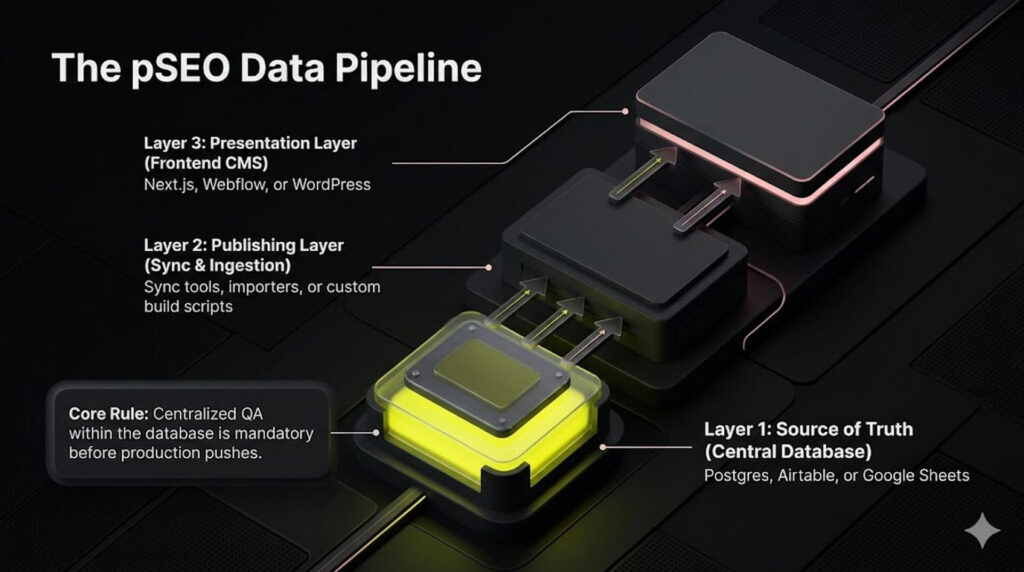
Programmatic SEO projects fail when technical plumbing cannot scale. High-performance stacks operate as three-layer data pipelines:
- Source of Truth: A central database like Postgres, Airtable, or Google Sheets.
- Publishing Layer: Sync tools, importers, or custom build scripts.
- Presentation Layer: The frontend CMS such as Next.js, WordPress, or Webflow.
Teams generally adopt one of two architectures. Dev-first teams prioritize performance using Next.js or Hugo paired with a database for static generation. Marketer-led teams favor no-code agility using Webflow or WordPress synced via tools like Whalesync. Evaluate these options against five criteria: scale, site speed, editorial control, QA complexity, and rollback safety.
For advanced teams, a resilient v1 stack utilizes Airtable as the source of truth and Webflow for presentation. This allows marketing to own the editorial layer while developers manage sync logic. Most failures occur during data ingestion, so centralized QA within the database is mandatory before production pushes. This modular blueprint prevents brittle workflows and ensures infrastructure stability as datasets expand.
5. Engineering Entity Authority: Structured Meaning at Scale
Programmatic SEO is not an HTML scaling exercise. It is the deployment of structured meaning at scale. To dominate AI Overviews and capture citations in LLMs like ChatGPT or Perplexity, content must prioritize entity authority over raw page volume. Every generated page should function as a data node designed for seamless engine extraction.
Build this infrastructure using a rigid taxonomy of breadcrumbs and consistent JSON-LD schema to identify page types immediately. Programmatically generate FAQ blocks only when your dataset provides genuine, unique answers. This prevents the generic noise that triggers retrieval failure and limits visibility in generative engines.
Schema + Entity Checklist
- Entity Declaration: Define the primary subject in the opening paragraph using declarative, extractable sentences.
- JSON-LD Integrity: Apply consistent schema (e.g., Service or Product) across the entire dataset.
- Relationship Mapping: Use hierarchical breadcrumbs to connect the entity to its parent category and related nodes.
- Extractable Attributes: List technical specs and comparisons in structured blocks for seamless LLM ingestion.
Without these signals, scaled pages underperform in rich results and fail the trust threshold for AI citation.
6. Architecting the Discovery Graph: Linking for Crawlers and AI
pSEO deployments often stagnate due to orphan factories where content sits in isolation. At scale, internal linking is your primary mechanism for crawl budget management, relevance distribution, and entity clustering. Without a systematic graph, pages remain invisible to both Google and LLM crawlers.
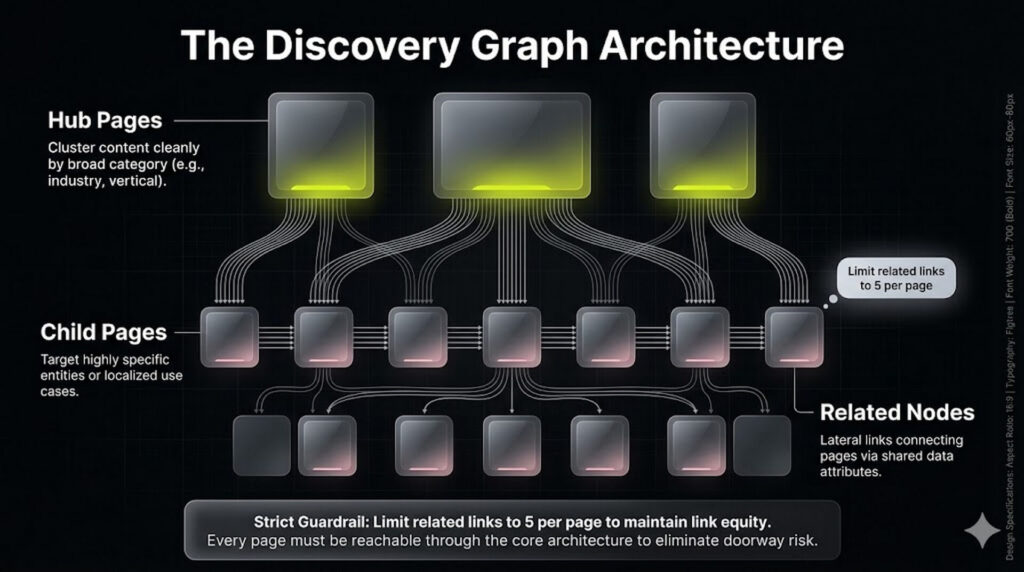
Implement a rigid discovery architecture to ensure visibility. Use category hub pages to funnel authority into child pages and breadcrumbs that reflect your taxonomy. Deploy related pages modules driven by shared dataset attributes, limiting each to five high-relevance links to maintain link equity.
Navigability is your core guardrail. If a page exists solely for search and remains unreachable through the primary interface, it creates a doorway risk. Every programmatic page must be discoverable through the site’s core architecture to be considered high-value.
The Linking Map:
- Hub Pages: Cluster content by category, such as industry or vertical.
- Child Pages: Target specific entities or localized use cases.
- Related Nodes: Lateral links based on shared data attributes.
This intentional graph ensures every page is discoverable, clusterable, and citation-ready for generative engines.
7. Scaling with Precision: The Gating Metric Protocol
Reckless deployment kills domain authority. Flooding an index with thousands of unproven pages triggers quality classifiers and risks sitewide “thin content” demotions. Treat indexing as a gating metric to protect your infrastructure. Publish a 50-page pilot to validate the funnel: crawl, index, rank, and convert.
Launch Checklist (QA Gates):
- Duplicate Detection: Use similarity scoring to ensure unique entity descriptions across the dataset.
- Content Thresholds: Enforce a minimum of three unique, logic-driven sections per page to exceed thin-content filters.
- Manual Sampling: Review 10% of top-intent pages and edge cases for data integrity.
Align rollout speed with domain authority growth. Prune clusters that fail to index within 30 days to prevent “crawled but not indexed” spirals and preserve crawl budget for high-performing pages.
The “Scale / Iterate / Prune” Decision Rule: If indexation is below 80% or engagement is zero after 45 days, iterate the template logic. Only scale to the next 500 pages once the pilot confirms search engine trust and commercial intent alignment.
8. Revenue-First Measurement: From Clicks to Pipeline Impact
High-volume pSEO is a strategic liability if it fails to convert or establish authority in the AI answer layer. Marketing leaders often prioritize traffic volume while ignoring CRM data. Revenue-first measurement requires connecting programmatic infrastructure directly to pipeline outcomes.
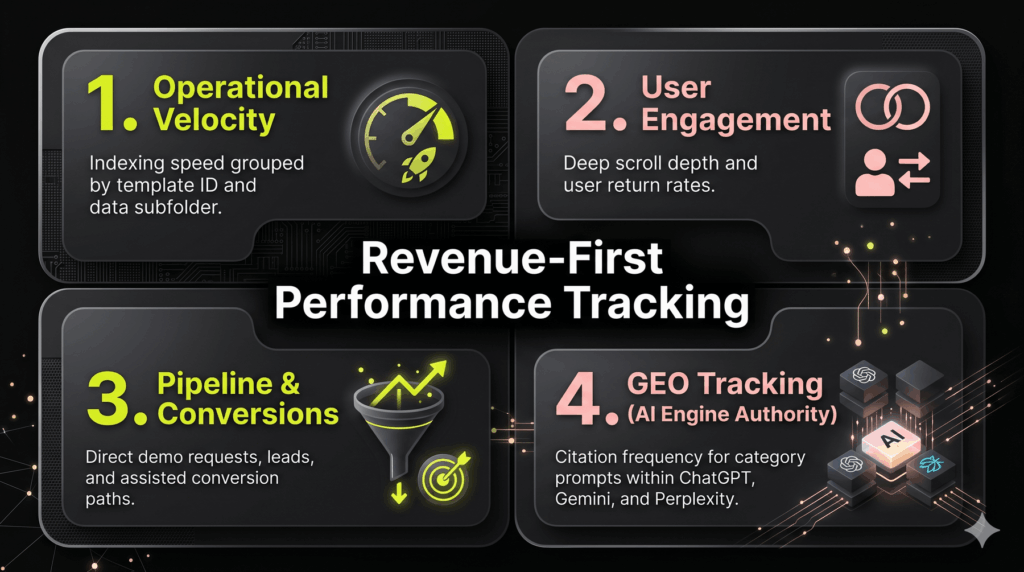
Effective tracking begins with segmentation. Group pSEO pages by template ID or subfolder in GA4 to isolate performance from editorial content. This deep separation is critical for a high-performance MSP SEO traffic strategy, allowing teams to identify exactly which automated folders fuel sales conversations. Monitor success through three critical layers:
- Indexing velocity by template and data category.
- Engagement signals including scroll depth and return rate.
- Conversion events (demos, leads) and assisted conversion paths.
Layer in GEO tracking to measure brand citations. Monitor how often your brand becomes the cited source for category prompts in ChatGPT, Gemini, and Perplexity. This validates that LLMs ingest and trust your technical architecture.
Leadership requires reporting focused on scalable unit economics. Highlight pipeline contribution per page type and compare it to paid CAC. Proving this efficiency transforms pSEO into a predictable, compounding revenue engine. Over time, calculating these page-level dynamics provides a direct roadmap for predictable IT services lead generation via MSP SEO campaigns.
How to Launch Your Programmatic SEO Infrastructure: A 14-Day Action Plan
Programmatic SEO (pSEO) usually fails when owned by “content” or “dev” teams in isolation. Success requires a shared specification and rigorous technical gates to prevent low-quality output. Use this time-boxed roadmap to transition from raw datasets to a live, citation-ready engine without falling into multi-quarter research loops.
Step 1: Lock Your pSEO Prerequisites
Establish these foundational elements before starting the clock. You cannot automate ambiguity without creating significant technical debt.
- Select one page type, such as comparison hubs or technical glossaries, to focus your initial pilot efforts.
- Commit to a dataset schema featuring at least five unique attributes to ensure entity authority and content defensibility.
- Define specific QA thresholds and template outlines to ensure every automated page meets high data density standards.
Step 2: The 90-Minute Planning Sprint
Assemble your SEO, development, and product owners for a single high-intensity session. By the end of this sprint, the team must sign off on a rigid execution specification.
- Define the specific query intent and the primary conversion action, such as a demo request or tool sign-up.
- Draft dataset fields and review 20 sample rows to verify field diversity. This ensures your templates have enough unique data to avoid search engine “thin content” flags.
- Approve the modular template structure, including specific content sections and conditional logic variables.
- Select the build architecture and assign project owners via a RACI matrix to guarantee accountability.
Step 3: The 2-Week MVP Sequence
Stop theorizing and start building. This phase focuses on technical validation and establishing an initial search presence.
Week 1: Build the Pipeline and Template
- Construct the technical connection between your primary data source and the site publishing layer.
- Generate 50 to 200 pilot pages to validate that all variables render correctly within the frontend design.
- Wire internal links and deploy JSON-LD schema to signal entity relationships and topical relevance to search crawlers.
Week 2: QA, Publish, and Monitor
- Audit the pilot batch for data integrity and logic errors before moving to a staged publish.
- Monitor indexing velocity via Google Search Console. You will see initial crawl signals and potential rendering warnings within 48 to 72 hours.
- Prune or fix template rules based on initial performance feedback before scaling the engine to your next 1,000 pages.
Executing a scalable search moat requires both technical precision and strategic foresight. For teams that want to dominate both traditional Google rankings and the AI answer layer, NUOPTIMA provides specialized GEO execution support to ensure your infrastructure is built for the future of search.
If you need expert execution support, Nuoptima specializes in building these AI-native search systems. Visit our GEO services page to learn how we help brands dominate the new search landscape.
Where this fits in your MSP growth system
This is one piece of how NUOPTIMA makes MSPs and cybersecurity firms the provider buyers find on Google and in AI search. See how it connects to MSP SEO and GEO and AI-search, or get your free MSP lead forecast to see exactly where your firm shows up across ChatGPT, Gemini, and Perplexity today.