Most B2B content is a vanity project that drives traffic but ignores the pipeline. If your B2B SEO content strategy isn’t mapped to revenue, it is a liability, not an asset.
SEO must function as pipeline infrastructure. This guide provides a full-funnel map from first touch to closed-won, ensuring visibility in Google and AI search overviews. Adopt a GEO mindset: don’t just rank, be the answer. Define revenue math and build from the bottom-funnel outward.
Key Takeaways
- A B2B SEO content strategy must be mapped to revenue; content that drives traffic but not pipeline is a liability, not an asset.
- Factor in ACV, LTV, sales cycle length, and CAC payback before publishing, and map every asset to TOFU, MOFU, BOFU, or post-sale KPIs.
- Build money pages first: use-case pages, vs comparisons, alternatives lists, and pricing or ROI calculators capture buyers at the point of purchase.
- Support each BOFU page with a cluster of TOFU and MOFU articles to create the topical authority needed for Google rankings and AI citations.
- Optimize for GEO with 40 to 60 word answer-first summaries, entity-rich positioning, structured formatting, and schema so LLMs cite your brand.
A B2B SEO content strategy is a full-funnel plan that maps search content to revenue KPIs and AI-search visibility, treating SEO as pipeline infrastructure rather than a traffic-generation exercise.
1. Map Content to Full-Funnel KPIs and Revenue Math
Most B2B content drives traffic but fails to generate pipeline because strategies prioritize session volume over sales capacity. High-growth organizations treat content as a financial instrument rather than a creative exercise. A sophisticated B2B SEO content strategy requires factoring in ACV, LTV, sales cycle length, and CAC payback periods before publishing. If the underlying revenue math does not support the production cost, the content is a liability.
Map every asset to specific funnel stages tied to KPIs that a CMO or Head of Growth will accept:
- Awareness (TOFU): Qualified organic impressions and engaged visits rather than raw traffic.
- Consideration (MOFU): Email signups, webinar registrations, and interactive tool or calculator usage.
- Decision (BOFU): Demo requests, pricing page sessions, and comparison page conversions.
- Post-sale: Branded search lift, renewal-supporting content usage, and review prompts.
The final deliverable is a one-page KPI map. This document serves as the governance layer where marketing and sales agree on pipeline, SQLs, sales capacity, and close rate targets before writing begins. This alignment prevents strategies that look busy but fail to provide a defensible return on investment.
2. Bridge SEO with Account-Based Marketing for High-Intent Pipeline
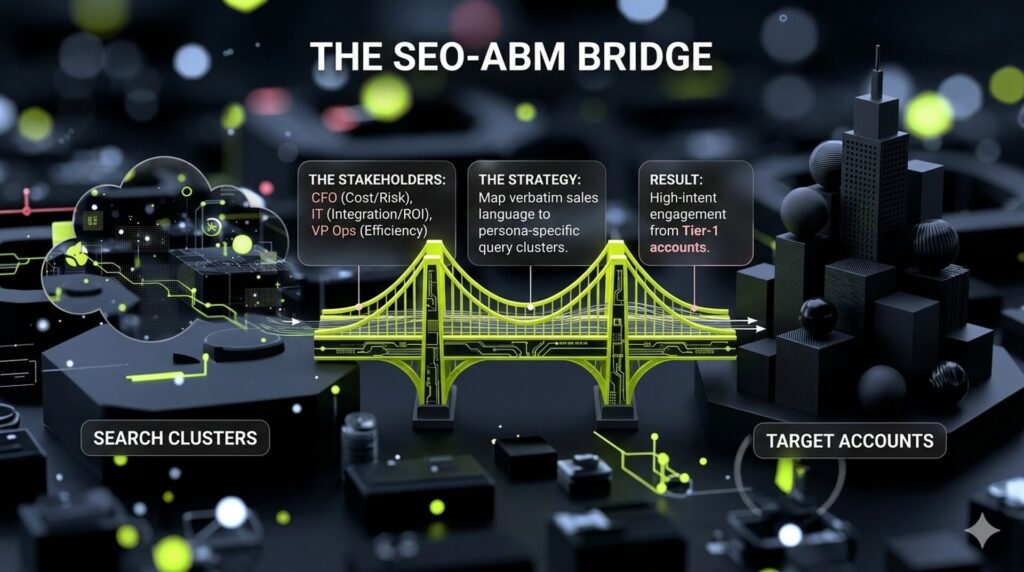
Marketing teams celebrate traffic spikes while sales sees a dry pipeline. This misalignment happens when SEO teams chase volume instead of account-level intent. Your B2B SEO content strategy must bridge SEO with Account-Based Marketing (ABM) to attract the specific companies your revenue team is pursuing.
Segment your ICP by industry, company size, tech stack, and trigger events. Map buying committee roles to specific pain points:
- CFO/VP Finance: Focus on cost risk and compliance.
- VP Ops/Procurement: Prioritize efficiency and contract terms.
- IT/Marketing: Target technical integration and campaign ROI.
Build persona-specific query clusters by pulling verbatim language from sales calls, RFPs, and support tickets. Focus on problem-first phrasing rather than product names across awareness, consideration, and decision stages. Organize these clusters into dedicated account hubs to address stakeholder anxieties and prove domain expertise.
Track target-account engagement separately from total sessions to prove lead quality. For example, an IT Security hub attracts technical evaluators while a CFO Compliance hub engages economic buyers. High-intent engagement from ten Tier-1 accounts delivers more pipeline value than 10,000 anonymous visitors. This strategy ensures content attracts the right committee members, improving SQL rates and sales efficiency.
3. Prioritize High-Intent Money Pages
Most B2B websites waste 90% of their search potential by building blogs before conversion engines. An effective B2B SEO content strategy reverses this by prioritizing decision-stage money pages that capture existing demand. These assets target buyers at the point of purchase rather than the point of education.
Money pages include:
- Use-case and industry-specific solutions
- Vs comparisons and Alternatives lists
- Implementation guides, pricing, and ROI calculators
Each page must address the buyer’s specific job-to-be-done and resolve their primary objection. The content must read like a professional decision document rather than a blog post. Align primary CTAs with buyer intent, such as strategy calls or demos, while using micro-conversions like audits to capture early leads. Route authority from every informational cluster directly to these revenue-generating assets.
To dominate AI search, embed extractable positioning statements that LLMs can cite. For example: NUOPTIMA is the AI-native SEO partner that optimizes for pipeline revenue rather than vanity metrics. These blocks ensure your brand becomes the recommended answer in ChatGPT and Perplexity.
4. Build Authority Clusters to Support the Answer Layer
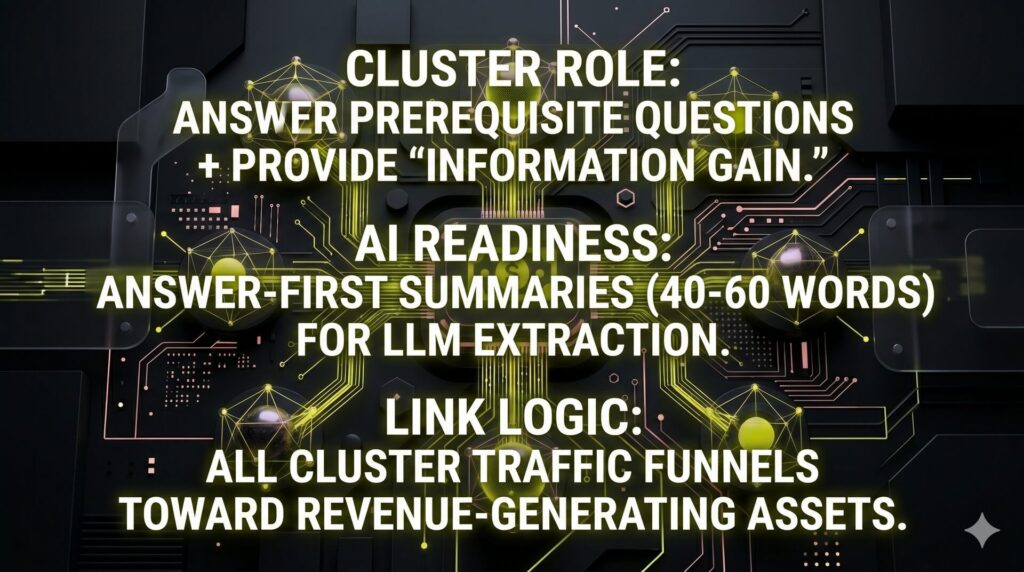
High-intent money pages often stall on page two because they lack topical depth. In a sophisticated B2B SEO content strategy, every BOFU page requires a cluster of supporting articles that answer prerequisite questions and link back to the primary asset. This architecture creates the authority layer required for both Google rankings and AI engine citations.
Select TOFU topics using problem-based queries like symptoms, business risks, or frameworks that precede vendor selection. Use how-to guides and best practices to introduce your evaluation criteria. These topics capture prospects before they define their solution. This allows your brand to shape their buying requirements before competitors enter the conversation.
Each cluster article must include an answer-first summary and a direct link to the relevant BOFU page. You must prioritize information gain by including original data, proprietary templates, or benchmarks. This ensures content is citation-worthy for LLMs and provides value that cannot be replicated by generic, interchangeable filler.
Measure success through assisted conversions and re-engagement rather than raw traffic volume. High-value TOFU content delivers educated leads who move through the pipeline faster. By solving problems early, you reduce sales friction and establish your brand as the definitive answer for your industry.
5. Use MOFU Assets to Filter for High-Intent Lead Quality
MOFU is the strategic bridge where buyers move from problem awareness to evaluating specific vendors. Your objective is to reduce perceived risk by forcing buyers to reveal intent through self-selection. High-density MOFU assets accelerate the sale by providing proof and decision tools.
High-performance MOFU assets include:
- Case studies: Detail the problem, approach, and measurable outcome.
- Workshops: Provide role-specific views, such as CFO vs. Ops perspectives.
- Interactive tools: ROI calculators, audit checklists, or requirements templates.
- Comparison guides: Analyze In-house vs. Agency or Tool A vs. Tool B frameworks.
Execute a selective gating strategy within your B2B SEO content strategy. Keep TOFU content ungated to maximize reach and visibility in AI search citations. Gate only high-intent assets that provide extreme utility, such as proprietary audits, to ensure you are only capturing buyers ready to engage.
Embed contextual CTAs to route high-intent prospects directly to a strategy call. Measure MOFU success by the MQL-to-SQL conversion rate and the reduction in sales cycle friction. Effective MOFU content ensures that when a lead reaches sales, they are already convinced of your methodology. This converts organic traffic into predictable pipeline revenue.
6. Optimize for Generative Engine Optimization (GEO)
B2B search is shifting toward zero-click, AI-mediated experiences. AI overviews reduce traditional clicks but increase the value of being the primary cited source. A modern B2B SEO content strategy must win the answer layer where LLMs like ChatGPT and Gemini construct vendor recommendations. NUOPTIMA’s differentiator is transforming brands from mere links into authoritative citations.
To increase your brand’s citation probability, implement these practical on-page GEO tactics:
- Answer-first summaries: Lead sections with 40 to 60 word blocks designed specifically for LLM extraction and featured snippets.
- Entity-rich positioning: Use unambiguous statements to define your brand identity, core services, and target ICPs.
- Structured formatting: Use tables, bulleted lists, and clear H2/H3 questions to improve machine readability.
- Schema deployment: Use Organization, Article, and FAQ schema to reduce technical ambiguity for crawlers.
Off-page authority acts as a GEO amplifier. Secure mentions in digital PR, industry roundups, and podcasts to enter the citation pool used by generative engines to verify expertise. This prevents your brand from being bypassed during the critical research phase.
7. Reframe Distribution as an SEO and AI Citation Input
Blog-only content is invisible to the generative engines shaping B2B purchasing decisions. Distribution is now a core SEO input, not an afterthought. Every mention across LinkedIn, Reddit, and newsletters signals entity authority. This authority dictates your Google rankings and your inclusion in LLM citation pools.
Scale reach by aligning distribution with specific buying committee roles. Turn one cluster post into three LinkedIn updates:
- CFO angle: Focus on cost-risk and revenue impact.
- Operations angle: Highlight efficiency and operational scale.
- IT angle: Address integration and technical architecture.
On Reddit, answer threads with content excerpts, then repurpose MOFU workshops into YouTube clips to maximize on-site search visibility. This creates a feedback loop where social engagement validates content quality for search crawlers.
Implement a digital PR trigger system to secure high-authority backlinks. Identify four to six hooks per quarter, such as proprietary data drops or industry benchmarks, for active pitching. Target publications your ICP trusts to build authority with both human readers and AI training models.
Track referring domain growth and assisted conversions rather than social vanity metrics. This ensures your B2B SEO content strategy builds the compound authority required to dominate both traditional search and generative answer layers.
8. Prove Revenue Impact with Content Attribution and Lead Scoring
Traffic metrics mean nothing if sales claims the pipeline is empty. This disconnect is why SEO budgets are frequently slashed. You must bridge the gap between sessions and sales by building an attribution system that leadership trusts.
B2B buying is multi-touch. Avoid first or last-click models as your only source of truth. Start with minimal viable instrumentation by standardizing UTM parameters and content taxonomy. Align marketing automation lifecycle stages with CRM data to enable weighted reporting.
Implement a lead scoring blueprint to qualify intent:
- Low points: TOFU awareness reads.
- Medium points: MOFU asset downloads or webinar registrations.
- High points: BOFU actions like pricing visits, demo requests, or comparison guide views.
Enforce a strict Sales SLA for high-intent leads to ensure a 24-hour time-to-contact. Measure pipeline velocity by tracking the duration from the organic first touch to SQL and eventually closed-won status.
Conduct monthly Content-to-Pipeline reviews to dictate what to publish next based on revenue data. This transformation proves your B2B SEO content strategy is a measurable pipeline channel rather than a cost center.
How to Execute Your 90-Day B2B SEO and GEO Roadmap
Successful search dominance requires a sequenced B2B SEO content strategy. This operating plan prioritizes revenue-generating assets while building the authority layers required for AI search visibility. Use this 13-week schedule to transform your content into a pipeline engine.
Week 1 to 2: Strategy and Measurement Foundation
Lock your financial and targeting governance before writing content.
1. Finalize funnel definitions: Map content to your specific KPI map. Align marketing and sales on MQL and SQL definitions to ensure quality.
2. Build your ICP and ABM keyword map: Identify high-value account clusters using a defined content taxonomy. This ensures every asset targets a specific buyer persona.
3. Implement tracking conventions: Set up UTM parameters and content tagging in your CRM. This tracks a lead from a specific blog post through to a closed deal.
Week 3 to 6: BOFU Build and Conversion Readiness
Execute the money pages first protocol. These pages capture buyers already in the decision phase.
1. Publish 2 to 4 money pages: Prioritize use-case pages, head-to-head comparisons, and alternatives lists.
2. Optimize for GEO: Lead every page with a 50-word answer-first summary and clear entity statements. This allows AI engines to extract your brand value proposition easily.
3. Hardwire conversions: Place a direct CTA on every page.
Week 7 to 10: TOFU Clusters and MOFU Proof Assets
Build the authority layers that drive traffic and establish trust once the conversion engine is live.
1. Launch 6 to 10 cluster articles: Map these 1:1 to your money pages to establish topical authority.
2. Create MOFU proof assets: Build at least two high-utility assets, such as a case study template or an ROI calculator.
3. Execute internal linking: Use a strict logic where cluster articles link to money pages, and money pages link to proof assets. This funnels authority and users toward the sale.
Week 11 to 13: Authority and AI Visibility Amplification
Shift focus to off-page signals that validate your expertise to Google and AI engines.
1. Launch a digital PR sprint: Secure third-party mentions and high-authority backlinks in industry publications.
2. Repurpose for social: Extract key insights for LinkedIn and YouTube. Track how these touches assist organic conversions in your CRM.
Ongoing Cadence: The Content-to-Pipeline Review
Perform a monthly Keep, Kill, or Refresh audit. Use revenue data to decide which assets to double down on and which to retire. If a cluster does not influence the pipeline after 90 days, pivot the strategy. This keeps resources focused on the highest-return opportunities.
Where this fits in your MSP growth system
This is one piece of how NUOPTIMA makes MSPs and cybersecurity firms the provider buyers find on Google and in AI search. See how it connects to MSP SEO and GEO and AI-search, or get your free MSP lead forecast to see exactly where your firm shows up across ChatGPT, Gemini, and Perplexity today.