You run a high-performance technical operation, yet smaller shops consistently outrank you in Local Maps. This happens because most local SEO for IT company strategies prioritize vanity traffic over bottom-funnel intent. NUOPTIMA aligns Google Business Profiles with geo-targeted pages for managed IT, cybersecurity, help desk, and emergency support. This system builds organic equity tied to revenue outcomes, not clicks. Start by mapping keywords that indicate a buyer is ready to switch providers.
Key Takeaways
- Local SEO for IT companies wins by targeting bottom-funnel intent, building a Service x Modifier x Geo keyword matrix that maps each primary keyword to one service page or Google Business Profile to avoid cannibalization.
- Optimizing the Google Business Profile is the fastest lever: set the primary category to IT support and services, write outcome-focused descriptions, and define exact service areas for Service Area Business setups.
- High-urgency money pages (Emergency IT Support, Ransomware Response, Same-Day On-Site Support) capture buyers during outages when they need immediate help, not a brochure.
- Build 2 to 4 money pages per city and unique location pages with local proof, then enforce internal linking from every location page to core service and money pages.
- The 90-day roadmap sequences work by fastest leverage first: GBP and reviews in days 1 to 14, money and location pages by day 45, GeoGrid and schema cleanup by day 75, then optimize and clone to the next market.
Local SEO for an IT company is the practice of aligning Google Business Profiles with geo-targeted service pages so an MSP ranks for high-intent local searches tied to revenue, not vanity traffic.
1. Deploying a High-Intent Keyword Matrix for Regional Dominance
MSPs often waste budget on broad terms like IT support, attracting researchers instead of $5k MRR contracts. Ranking for vague keywords yields unqualified traffic that dilutes sales focus. To capture buyers ready to switch, build a keyword matrix that forces service, location, and problem-specific intent.
Cross-reference these pillars in a spreadsheet:
- Service: Managed IT, cybersecurity, or help desk.
- Modifier: Outsourced, provider, or emergency.
- Geo: City, county, or suburb.
This produces clusters like managed IT services [City] or emergency IT support [City]. Map each primary keyword to exactly one service page or Google Business Profile to avoid cannibalization. This blueprint ensures local SEO targets high-intent buyers rather than low-converting generalists.
2. Optimizing Your Google Business Profile for Map-Pack Dominance
Google cannot rank what it cannot classify. Many MSPs lose visibility by misconfiguring categories or failing to provide relevance signals for Service Area Business (SAB) setups. Optimizing this profile is the fastest lever for local SEO for IT company growth.
Improve map-pack eligibility by prioritizing these updates:
- Primary Category: Use IT support and services or the closest match to your core revenue driver.
- Service Descriptions: Detail help desk, Microsoft 365, and ransomware response using natural language that mirrors how COOs search for reliability.
- Business Description: Focus on outcomes like uptime, response times, and compliance instead of keyword stuffing.
SABs must define service areas by specific cities or suburbs served. Align on-site wording with your profile to ensure Google receives consistent authority signals.

3. Capturing Crisis Intent with High-Urgency Money Pages
Generic service pages often cause local SEO for IT company strategies to fail because they do not match crisis intent. When a firm experiences a server outage or ransomware attack, decision-makers search for immediate relief rather than digital brochures.
Build 2 to 4 targeted money pages per city to capture these high-converting searches:
- Emergency IT Support [City]
- Ransomware Response [City]
- Same-Day On-Site Support [City]
- Server Down Support [City]
Conversion-centric above-the-fold anatomy is critical. Ensure these pages include:
- A guaranteed response-time promise.
- Trust signals such as SOC2 or HIPAA certifications.
- A prominent click-to-call button and a 3-field lead form.
- One regional case result to cement local credibility.
This approach captures leads during downtime, significantly increasing organic conversion rates.
4. Scaling Regional Authority with Unique Location Blueprints
Most MSPs fail to scale across suburbs because Google flags thin, copy-paste templates as doorway pages. To dominate local SEO for IT company rankings without triggering spam filters, you must deploy a repeatable structure that forces unique content. Define the specific industry cluster you serve in that territory, such as legal firms in the city center.
Structure each page around 3 to 5 high-priority services for that micro-market. Include local proof through case snippets, regional landmarks, or named neighborhoods. Finally, enforce a strict internal linking rule: every location page must link to core service pages and high-urgency money pages. This builds the technical authority necessary to rank in both traditional search and AI-driven answer engines.
5. Visualizing Coverage Grids to Eliminate Local Dead Zones
Many MSP founders believe they rank first because they search from their own desks, unaware that Google Maps proximity filters are hyper-local. Without coordinate-based tracking, you risk missing prospects just miles away. Use GeoGrid tools to identify dead zones where your firm drops out of the top three map results.
Expansion rules focus on two scenarios:
- Adjacent Zones: Strengthen relevance with localized service pages and reviews from clients in those specific zip codes.
- Distant Hubs: If high-value areas are too far for proximity signals, consider a legitimate physical presence strategy.
This replaces guesswork with a coverage map. It ensures local SEO for IT company investments scale to capture high-intent traffic across the city.
6. Operationalizing Client Reviews for Relevance and Ranking Signals
In technical B2B, trust is the core product. Most MSPs lack a structured review acquisition process, causing local rankings and conversion rates to lag behind competitors. To dominate local SEO for IT company searches, you must operationalize social proof as a business function.
Trigger review requests automatically at ticket closure or project completion using a direct Google Business Profile link. Prompt clients for two specific details:
- Service type (e.g., Microsoft 365 migration or ransomware cleanup)
- Outcome (e.g., responsiveness, speed, or uptime)
These specifics feed Google’s relevance signals and increase Map Pack competitiveness. Prioritize Google first, then expand your footprint to industry-specific directories where technical buyers validate expertise. This transforms satisfaction into a measurable trust asset that improves close rates.
7. Engineering Entity Trust: Schema and Citations
Google often fails to connect your brand, physical location, and specific services across fragmented web signals. This technical authority gap causes many MSPs to underperform in competitive markets despite having a larger footprint. To bridge this and protect your organic equity, you must provide search engines with a clean, verifiable entity stack.
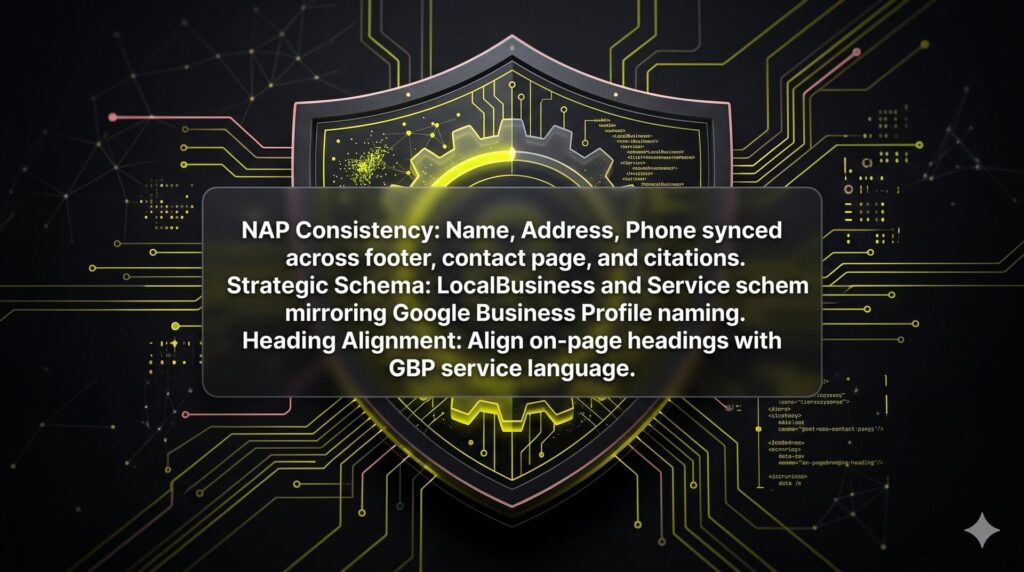
- NAP Consistency: Sync Name, Address, and Phone data across your site footer, contact page, and core citations.
- Strategic Schema: Use LocalBusiness and Service schema that mirrors the exact naming used in your Google Business Profile (GBP).
- Guardrails: Eliminate inconsistent address formats or phone variations that dilute entity trust.
Aligning on-page headings with GBP service language strengthens entity clarity. This ensures your rankings remain resilient and search systems accurately parse your relevance for local SEO for IT company queries.
90-Day Execution Roadmap: Scaling Local SEO for IT Company Authority
Most MSPs fail local SEO by executing random, disconnected tasks. This 90-day roadmap sequences work by fastest leverage first to build a predictable operating cadence. Before starting, select one core metro to dominate and three to five priority services to commercialize.
Days 1 to 14: Foundation and Fast Wins
Focus on eliminating technical ambiguity and driving immediate pipeline.
1. Finalize the Service × City matrix to map primary keywords to your target locations.
2. Execute a Google Business Profile overhaul. Update categories, service lists, and high-resolution office photos.
3. Launch a review workflow so recency signals start immediately. Ensure every closed ticket triggers a request for specific service mentions.
You will see increased profile engagement and improved search relevance for the local market.
Days 15 to 45: Revenue Pages and Regional Anchors
Capture buyers at the moment of bottom-funnel intent.
1. Publish two to four money pages targeting high-urgency terms like Ransomware Response or Compliance Audit.
2. Build one flagship location page for your primary city and two pages for priority suburbs.
3. Link money pages to location anchors to concentrate technical authority.
This creates indexed assets ready to capture high-intent traffic from specific service areas.
Days 46 to 75: Coverage and Technical Reinforcement
Use data to close visibility gaps and reinforce your digital footprint.
1. Perform a GeoGrid scan to identify proximity dead zones. This identifies exactly where your IT company lacks map visibility.
2. Clean up local citations and deploy a LocalBusiness schema baseline to ensure NAP consistency.
You will see improved Map Pack rankings in priority zip codes and hardened entity trust.
Days 76 to 90: Optimization and Scale
Refine the system based on conversion performance and expand.
1. Refresh Google Business Profile posts and services using high-converting queries from your dashboard.
2. Clone this model into the next market only after the first city shows traction.
This repeatable lead engine increases your organic equity and enterprise valuation.
Stop guessing your local impact. Request a Local + GEO Visibility Audit to assess your M&A readiness and secure your pipeline attribution today.