Most MSP leaders remain stuck in the referral trap or exhausted by cold outreach that decision-makers ignore. This cycle prevents scaling and suppresses enterprise valuation.
Transitioning to MSP inbound marketing shifts your strategy from renting attention to building organic equity. At NUOPTIMA, we utilize authority content, buyer-intent pages, and Generative Engine Optimization (GEO) to create compounding assets that attract high-LTV buyers. This guide explains how to bridge the technical authority gap. Success starts with positioning.
Key Takeaways
- MSP inbound marketing replaces the referral trap and cold outreach with authority content, buyer-intent pages, and GEO that compound into organic equity attracting high-LTV buyers.
- Narrow positioning wins: a headline like HIPAA-focused IT support in Austin will outperform a generic MSP homepage every time.
- Prioritize bottom-funnel solution pages over informational content, using regional hubs, vertical pages, and use-case pages that include pricing ranges and a clear next step.
- Convert daily service tickets into anonymized micro-case studies using an Incident, Fix, Outcome framework to build proof without constant founder-led thought leadership.
- Connect website forms directly to your CRM and PSA (HubSpot to ConnectWise or Autotask) so every lead enters a traceable, investor-ready pipeline, then prove ROI with leading, mid, and lagging KPIs.
MSP inbound marketing is a strategy that uses authority content, buyer-intent pages, and Generative Engine Optimization to build compounding organic assets that attract high-value IT buyers, replacing referrals and cold outreach.
Narrow Your Positioning to Bridge the Authority Gap
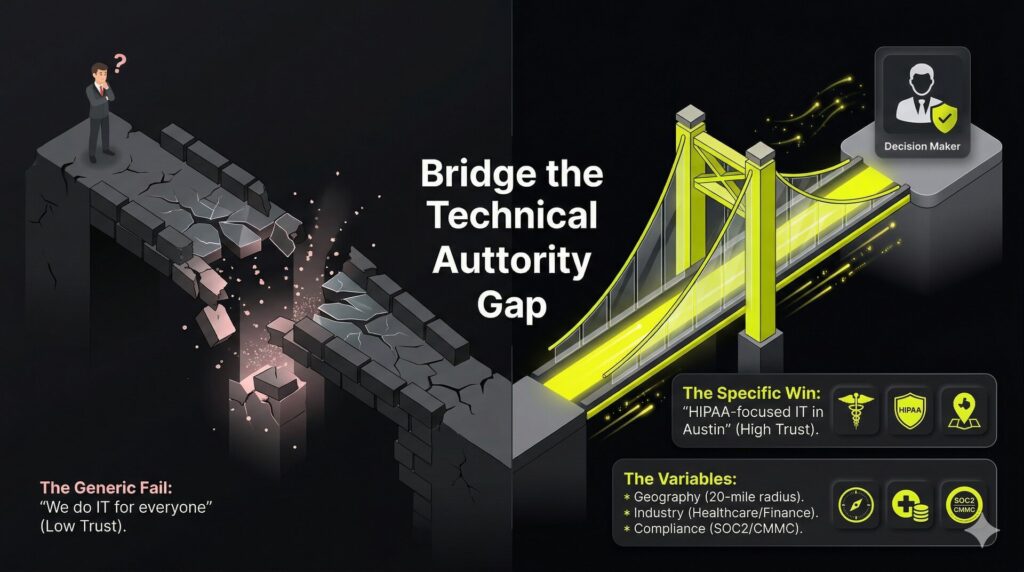
Generic MSP inbound marketing fails when broad messaging creates a Technical Authority Gap. Sophisticated buyers cannot purchase what they do not immediately understand. To bridge this gap, align your ICP and niche directly with the keywords you target and the proof you publish.
Segment your ICP using these variables:
- Geography: Specific service radius.
- Industry: Verticals like healthcare or finance.
- Compliance: HIPAA, SOC2, or CMMC requirements.
- Company size and tech stack.
Develop three positioning outputs: a one-sentence value proposition, a who/what/proof framework, and 3 to 5 service themes. Validate these by extracting patterns from recent closed-won deals. This process ensures your inbound efforts attract right-fit clients who can buy, renew, and increase your enterprise valuation.
Specificity converts. A headline like HIPAA-focused IT support in Austin will outperform a generic MSP homepage every time. Narrowing your focus prevents wasted SEO spend and builds the organic equity necessary for long-term market dominance.
Build High-Intent Solution Pages to Capture Bottom-Funnel Demand
Ranking for informational content is a vanity metric if traffic never converts to discovery calls. Effective MSP inbound marketing requires shifting focus from top-funnel education to bottom-funnel solution pages. These assets target buyers ready to sign a contract rather than those researching technical definitions.
Prioritize three core page types to capture high-intent demand:
- Regional Hubs: Managed IT Services [City] or IT Support [City].
- Vertical Pages: Specialized support for law firms, dental practices, or accounting firms.
- Use-Case Pages: Microsoft 365 migrations, ransomware readiness, backup and DR, and SOC/SIEM.
Every page must function as a conversion engine. Include pricing ranges to qualify leads, a what happens next roadmap, and a specific CTA. Anchor every service with a matching case study or testimonial to bridge the technical authority gap. This strategy turns your website into a compounding revenue asset that captures high-intent searches and secures booked discovery calls.
Dominate Local Search to Win High-Margin Regional Contracts
MSPs often waste budget on national keywords like cybersecurity services while ignoring high-margin contracts within a 20-mile radius. Proximity remains a primary trust factor, meaning MSPs win MSP inbound marketing city-by-city. Shift to a regional strategy to capture high-intent demand instead of chasing low-converting broad traffic.
Optimize your Google Business Profile (GBP) as a digital storefront:
- List specific service categories and technical offerings.
- Upload team photos to bridge the technical authority gap.
- Use Q&A and weekly posts to address local compliance hurdles.
Scale social proof by triggering review requests at moments of delight, specifically after resolved incidents or QBRs. Replace generic templates with location landing pages featuring unique copy, embedded local proof, and regional FAQs.
Strengthen authority signals through Chamber of Commerce memberships, local events, and vendor co-marketing. Link call and form tracking directly to your GBP and city pages. This ensures your RevOps dashboard treats regional marketing as a measurable asset rather than invisible effort.
Leverage Evidence-Based Case Studies to De-Risk the Buying Process
Sales cycles often stall because prospects require evidence to validate technical claims. For high-stakes clients like PE-backed firms, MSP inbound marketing must move beyond generic promises to prioritize risk reduction and quantifiable outcomes. Case studies bridge the Technical Authority Gap, transforming skepticism into the confidence needed to book a discovery assessment.
Structure your evidence using a high-authority framework:
- Context: Industry, company size, and specific tech stack.
- Problem: The financial, security, or operational risk faced.
- Approach: Your proprietary process or technical intervention.
- Outcome: Tangible metrics like downtime avoided, incidents reduced, or audits passed.
Enhance credibility with redacted security dashboards, project timelines, and before-and-after metrics. Do not let these assets sit idle on a results page. Repurpose deep-dive studies into snippets for service pages, LinkedIn authority posts, and sales decks. This turns a single case study into a compounding asset that accelerates every stage of the sales funnel.
5. Build an Authority Engine via Topical Clusters
Random blog posts rarely rank because they lack the topical depth search engines demand. This ghost-town content fails to bridge the technical authority gap or convert high-intent prospects. Effective MSP inbound marketing requires transitioning from disconnected articles to a structured authority system.
Select three to five cornerstone themes aligned to your ICP, such as:
- Compliance IT (CMMC/HIPAA)
- Microsoft 365 Security
- Ransomware Prevention
- IT Budgeting and M&A Readiness
For each pillar, create 6 to 10 supporting posts answering technical objections. Include decision-stage content to capture solution-seekers at the bottom of the funnel. Target high-intent queries like managed IT costs, MSP contract terms, and in-house IT vs. MSP.
Prioritize consistent distribution over perfect production. Feed a compounding loop via newsletters, LinkedIn, and YouTube clips. This system ensures your firm becomes the primary citation for both traditional search and generative AI engines (GEO).
6. Convert Daily Service Tickets into Anonymized Proof Content
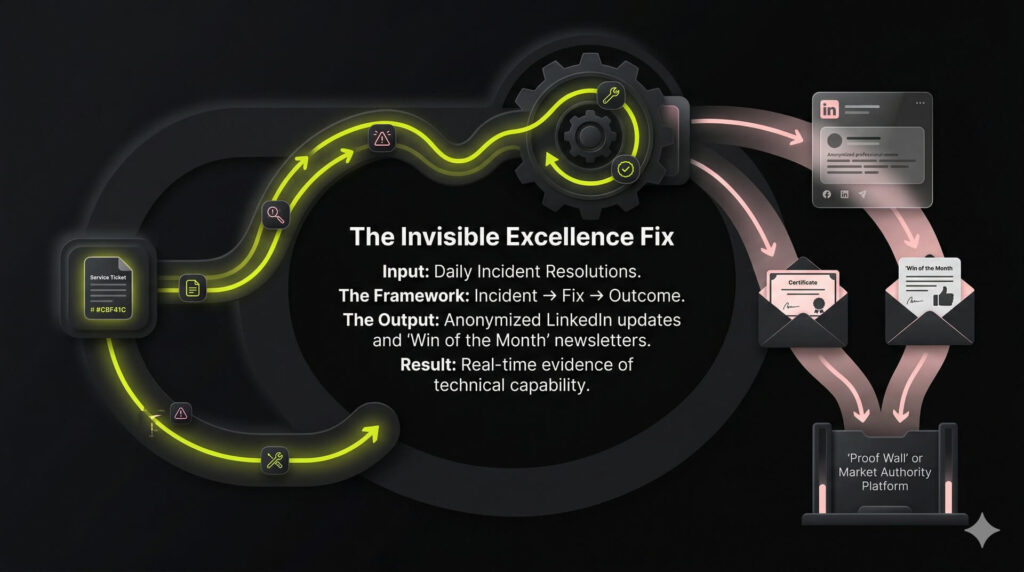
Invisible excellence is a common MSP failure. While you resolve complex issues, competitors win contracts by simply documenting theirs. High-impact MSP inbound marketing fixes this by converting daily operations into a compounding library of micro-case studies that prove your value without requiring constant founder-led thought leadership.
Adopt an Incident - Fix - Outcome framework for every major resolution. Capture these internal data points to build substance:
- Category and root cause
- Immediate business impact
- Time-to-resolution
- Strategic prevention steps
Distribute these updates via LinkedIn, short blog updates, or wins of the month in newsletters. Always redact sensitive client details and avoid naming vendors to maintain an educational tone. Link each micro-case to relevant Security Monitoring or Backup service pages to build organic equity. This transforms your service desk into a proof-based engine that bridges the technical authority gap and shortens sales cycles.
Use Faceless Video to Scale Technical Trust Without Being On-Camera
MSP founders often stall MSP inbound marketing due to camera shyness or perceived production barriers. This hesitation cedes visual search real estate to competitors. Bridge the technical authority gap using faceless video formats like Loom walkthroughs and narrated screen recordings. These prioritize expert insight over appearance, making consistent content creation sustainable for technical founders.
Effective faceless formats include:
- Narrated security posture audits using standard checklists.
- Process walkthroughs detailing your specific client onboarding steps.
- Technical explainers for M365 security settings or backup testing.
Focus on technical clarity and outcomes rather than cinematic quality. For double discoverability, embed videos on matching solution pages for Google and host them on YouTube. Clip highlights for LinkedIn to build organic trust with high-intent decision-makers. Ensure every video features a single next step, such as a discovery assessment, to convert viewers into investor-grade pipeline.
Bridge the Gap Between Lead Capture and Operations
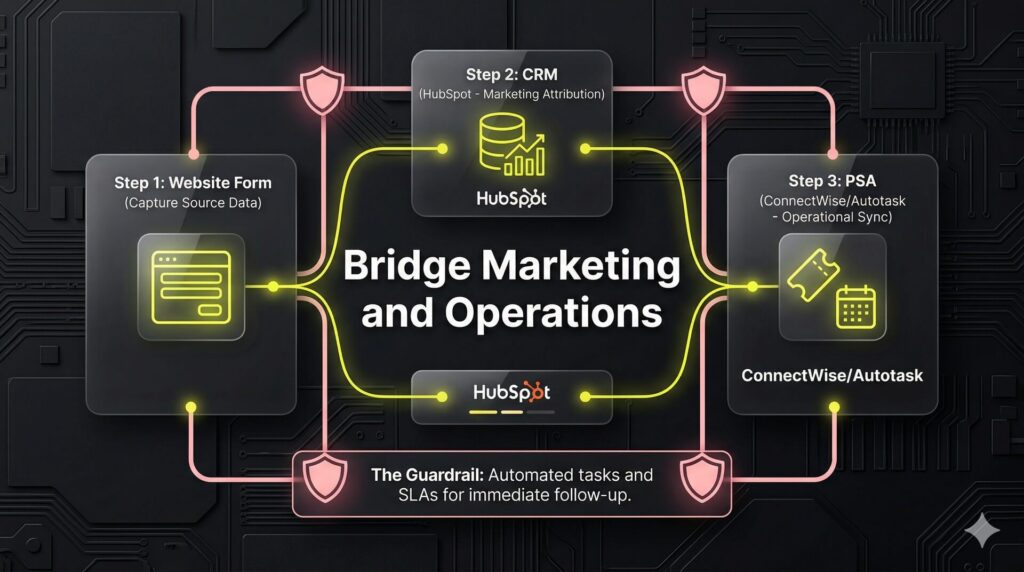
How many $5,000 MRR opportunities die in an unmonitored inbox? High-performance MSP inbound marketing fails when lead capture is disconnected from your operational engine. To build organic equity, your website must function as a direct feeder for your RevOps stack rather than a standalone brochure.
Establish a minimum viable routing path by mapping WordPress forms directly to HubSpot. Capture original traffic sources and landing page data to maintain full-funnel attribution. For MSPs, the strategic integration path is a CRM-to-PSA sync using ConnectWise Manage or Autotask API credentials. Use middleware or webhooks to automate the creation of companies, contacts, and opportunities within your PSA.
To protect data integrity and prevent revenue leakage, implement these operational guardrails:
- Strict deduplication rules.
- Automated tasks and SLAs for immediate follow-up.
- Defined ownership protocols for new inquiries.
This connectivity ensures every lead enters a traceable, investor-ready pipeline.
Turn Email Into Your Inbound Nurture Channel
Most MSP inbound leads are not ready to sign on the first visit, and email is the channel that keeps them warm until a compliance deadline or an incident forces a decision. Treat email as the connective tissue of your inbound system, not a monthly newsletter blast. Every buyer-intent page, case study, and faceless video should offer a reason to opt in, so a first-touch visitor becomes a tracked contact you can nurture over the long MSP sales cycle.
Build the nurture around segments that match your Ideal Customer Profile rather than one generic list:
- Vertical segments: Separate HIPAA-regulated healthcare, CMMC-driven manufacturing, and finance so each thread references the compliance pressure that buyer actually feels.
- Lifecycle segments: New opt-ins get an authority sequence, while stalled opportunities get proof assets like a redacted security dashboard or a switching checklist.
- Trigger segments: Tie sends to real events, such as an upcoming audit window or a renewal date, so the message lands when intent is highest.
Run a monthly executive brief plus a short weekly value email that links back to a solution page with one clear next step. Route every opt-in and click into your CRM so email influence shows up in attribution, not as invisible effort. For the segmentation logic, automation, and deliverability details, follow the dedicated MSP email marketing system guide. Done well in 2026, email turns one-time inbound visitors into a compounding pipeline that a firm like NUOPTIMA can attribute directly to closed recurring revenue.
Establish Investor-Grade Reporting to Prove Inbound ROI
MSPs often abandon inbound marketing because they track vanity metrics rather than revenue outcomes. To build organic equity and M&A readiness, you must implement a RevOps-aligned KPI stack that demonstrates clear ROI.
Monitor performance across three distinct layers:
- Leading: Impressions for buyer-intent queries and conversions per page.
- Mid: Marketing Qualified Lead (MQL) rates and Sales Accepted Leads (SAL).
- Lagging: Pipeline created, win rate, time-to-close, and retention expansion.
Avoid fake precision with generic benchmarks. Instead, set internal thresholds using first-year gross profit and Lifetime Value (LTV) to track qualified CPL (post-fit). Map every lead to its original source and specific content touchpoints within your CRM to ensure full-funnel attribution. This framework proves MSPinbound marketing is a compounding asset. High-intent pages consistently generate pipeline, transforming marketing from a recurring expense into a valuation multiplier.
How to Execute Your MSP Inbound Marketing Strategy: A 90-Day Roadmap
Inbound marketing creates compounding organic equity, but success depends on sequencing technical assets correctly. Transitioning from a referral-only model to a predictable revenue engine requires shifting from leaky bucket marketing to a structured implementation plan. Follow this 90-day roadmap to bridge the technical authority gap and build a marketing department that withstands investor-grade scrutiny.
Phase 0: Strategic Prerequisites
Complete these fundamental tasks before deploying content or capital.
- Define your Ideal Customer Profile (ICP). Select a specific vertical such as compliance-heavy manufacturing or HIPAA-regulated healthcare.
- Establish your service radius. Determine if you are competing for regional dominance or national enterprise contracts to avoid wasted ad spend.
- Audit your Revenue Operations (RevOps) stack. Confirm full ownership of tracking pixels and lead routing between your website and PSA tools like ConnectWise or Autotask. This ensures clean data for M&A readiness and full-funnel attribution.
Days 1 to 30: Build Your Marketing Foundation
The first month focuses on technical infrastructure and capturing existing high-intent search traffic.
- Upgrade 3 to 5 buyer-intent solution pages. Prioritize high-margin services like Managed Cybersecurity or M&A IT Due Diligence. These pages must answer the specific pain points of a C-suite executive.
- Launch one local landing page. Optimize for your primary city to capture regional contracts where proximity builds immediate trust.
- Configure lead routing and attribution. Map website forms to your CRM to ensure every inquiry captures original source data. You will gain a clear view of which channels drive the highest ROI.
- Standardize your proof engine. Draft a case study template and collect one detailed story from a successful project. You establish a repeatable framework for social proof that accelerates the sales cycle.
Days 31 to 60: Establish Authority and Proof
Shift focus to building topical authority and de-risking the buying process through visible technical expertise.
- Execute a topical cluster. Publish one cornerstone pillar page and three supporting technical posts. This signals deep expertise to both prospects and Generative Engine Optimization (GEO) models like SearchGPT or Perplexity.
- Ship four ticket-to-content micro-stories. Convert anonymized service desk resolutions into short LinkedIn posts. This provides real-time evidence of your technical capabilities without requiring heavy copywriting.
- Automate review requests. Implement a workflow to trigger Google Business Profile prompts after positive Quarterly Business Reviews (QBRs) or resolved high-priority tickets.
Days 61 to 90: Scale Distribution and Review KPIs
Amplify established assets and analyze performance data to refine your strategy for the next quarter.
- Produce four faceless technical videos. Record Loom walkthroughs or narrated audits tied directly to solution pages. You will see increased dwell time and build founder-to-founder trust.
- Conduct an internal link audit. Connect technical blog content back to core service pages to funnel organic authority toward your primary conversion points.
- Perform a 90-day KPI review. Analyze qualified cost-per-lead (CPL), pipeline growth, and win-rate trends to identify which assets generate actual revenue.
- Refresh CTAs. Use your first 60 days of traffic data to optimize button placements and lead magnets on top-performing pages.
Execute with NUOPTIMA
Successful MSP inbound marketing requires consistent execution across SEO, GEO, and RevOps. If you want a fractional CMO and an AI-first growth team to implement this roadmap for your firm, visit NUOPTIMA to scale your enterprise valuation and bridge your technical authority gap today.