Keyword-led strategies are failing. You might rank, but if an AI Overview answers the query, your leads vanish. For managed IT firms, thin topical coverage is a growth killer. Success requires aligning your content with a modern SEO strategy funnel and building semantic seo infrastructure. This playbook provides a step-by-step framework from topical mapping to schema deployment. As the AI-native authority, NUOPTIMA builds the citable knowledge base required to capture the pipeline. We make your brand the definitive answer. Here is what semantic SEO actually means.
Semantic SEO structures your content around entities, topics, and their relationships rather than isolated keywords, so search engines and AI models understand meaning, not just word matches. A simple example: instead of one page stuffed with "managed IT support," you build a connected cluster covering the service, the problems it solves, compliance, pricing, and related entities, all internally linked.
Key Takeaways
- Semantic SEO structures content around entities, topics, and their relationships rather than isolated keywords, so search engines and AI models understand meaning, not just word matches.
- For MSPs, thin topical coverage is a growth killer because an AI Overview answers the query and the lead never arrives, while deep connected coverage gets a firm cited as the definitive answer.
- The build follows a hierarchy: one pillar page for the core entity, clusters for sub-topics like helpdesk and cybersecurity, and sub-clusters for granular buyer questions.
- Answer Layer Architecture front-loads one or two sentence direct answers under each H2, then expands with structured specifics so LLMs can extract and cite the content.
- Schema markup (Organization, Service, LocalBusiness, FAQPage) plus About and Mentions properties convert guesswork into machine-readable meaning, but only mark up visible on-page content.
Why it matters for MSPs and cybersecurity firms
- Thin topical coverage is a growth killer for managed IT firms, because an AI Overview answers the query and your lead never arrives.
- Deep, connected coverage is what gets a firm extracted and cited as the definitive answer in a niche or city.
- It builds the topical authority that long, multi-stakeholder B2B buying cycles quietly reward.
We map one entity to one page, then build the surrounding cluster until your site is the most complete answer in your category. That citable knowledge base is the foundation of every SEO engagement we run.
1. Redefining SEO: From Keywords to Entities
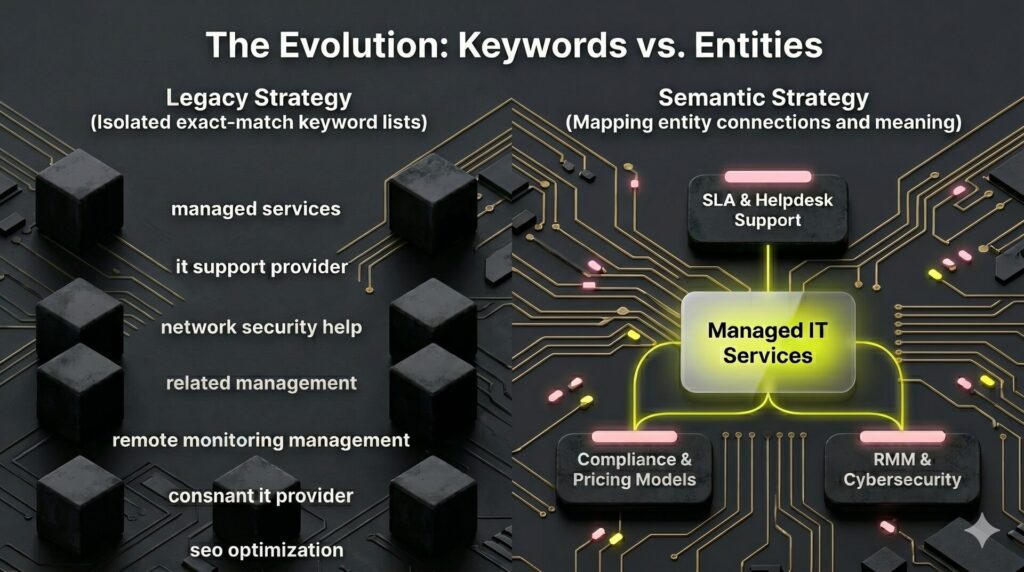
Legacy keyword targeting fails because it treats search engines as calculators rather than reasoning systems. To dominate modern search, semantic SEO optimizes content around entities, intent, and relationships, not exact-match phrases. This strategy abandons the “one keyword per page” limit to prioritize topical clarity. One well-structured page can now satisfy multiple related queries by addressing the underlying meaning.
For example, the entity “managed IT services” connects to several critical concepts:
- SLA and helpdesk support
- RMM, patching, and cybersecurity
- Compliance and pricing models
Mapping these relationships ensures your brand is cited as the definitive source in AI-generated answers. Use this to sanity-check your strategy. If your team prioritizes keyword density over mapping entity connections, your approach is just relabeled legacy SEO. Building for meaning is the only way to secure sustainable organic dominance.
2. Intent Modeling: Mapping the Buyer Journey
Traffic plateaus when content answers the “what” but ignores the “how much” and “who.” For managed IT, semantic SEO requires modeling intent across four specific states: evaluate, compare, validate, and contact.
- Informational: Queries like “what are managed IT services” establish broad authority during the initial evaluate phase.
- Commercial Investigation: Terms such as “managed IT services pricing” or “MSP vs in-house IT” facilitate active comparison.
- Transactional: Localized searches like “managed IT services near me” indicate a transition from validation to direct contact.
Design pages around specific decisions and objections like SLAs, onboarding timelines, tool stacks, and security posture. Answering the next question before the prospect asks creates an “answer layer” that converts curiosity into inbound leads. This strategy eliminates “ranked but useless” pages, delivering higher lead quality by matching content to specific decision-making intent.
3. Topical Mapping: Building Your Knowledge Infrastructure
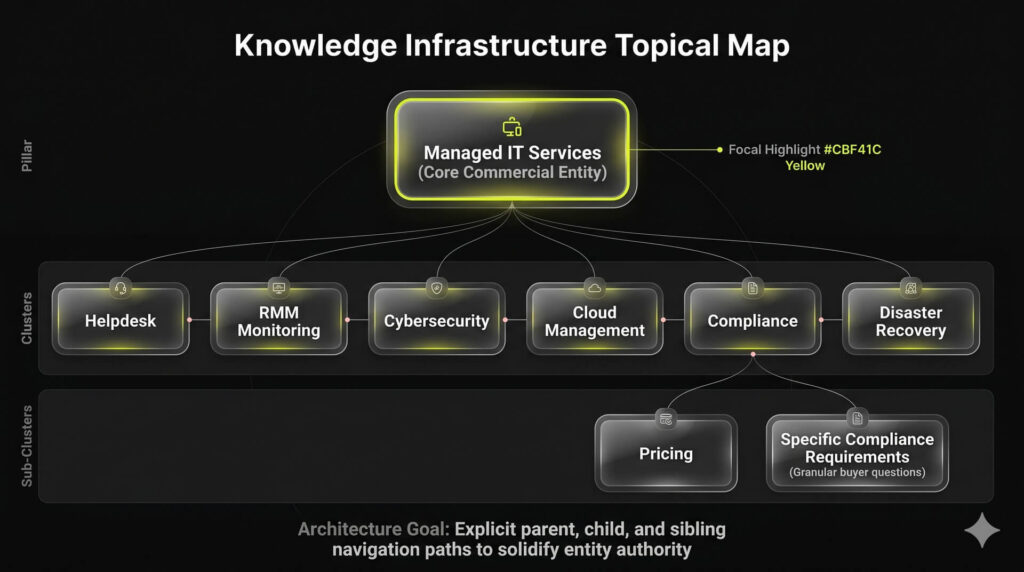
Search engines and LLMs reward sites that function as structured knowledge bases. A topical map serves as your blueprint for coverage and internal linking. This transforms semantic SEO from a theory into a page-by-page build plan.
Organize your architecture using a central hierarchy:
- Pillar: Managed IT Services (core commercial entity)
- Clusters: Helpdesk, RMM monitoring, cybersecurity, cloud management, compliance, and disaster recovery
- Sub-clusters: Supporting pages answering granular buyer questions like pricing or specific compliance requirements
Parent, child, and sibling relationships must be explicit through site navigation and internal links. This rigor prevents drifting into random content production and ensures every page reinforces your entity authority. This structural logic ensures your brand becomes the definitive citation source in the AI answer layer.
4. Entity-First Execution: Making Relationships Obvious
Most content fails by treating semantic SEO as a keyword bucket rather than a structured database. This creates thin pages that miss concepts Google and LLMs expect for the topic. To secure citations in Gemini or Perplexity, adopt an entity-first execution strategy that defines service relationships.
For a Managed IT Services pillar, define the connections between these entities:
- Primary Entity: Managed IT Services
- Attributes: SLAs, response time, ticketing, uptime, escalation, onboarding
- Related Entities: RMM, MDM, Microsoft 365, backups, SOC/MDR, HIPAA/SOC 2
Write specifically to define these relationships. State that “Managed IT Services includes endpoint security, is measured by uptime, and reduces risk via SOC monitoring.” This semantic completeness forces machines to classify your brand as a definitive authority. You transition from a simple search result to the cited answer across all query variants.
5. Answer Layer Architecture: Packaging for AI Retrieval
Semantic SEO requires packaging data for machine extraction rather than passive reading. Answer Layer Architecture structures content into a retrieval-ready database for Google AI Overviews and ChatGPT citations, serving as a tactical framework for ChatGPT SEO execution.
- Process: Front-load one or two sentence direct answers under H2s before expanding with structured specifics.
- Inclusions: FAQ schema, entity-rich declarations, and explicit definitions.
- Exclusions: Vague throat-clearing, flowery prose, and buried logic.
- Proof: This format resolves queries instantly to reduce pogo-sticking and signal authority to AI crawlers.
Definition + Decision
- What it is: A retrieval-first content pattern optimized for LLM ingestion and snippet capture.
- Who it is for: B2B marketing leaders targeting decision-makers who research via AI assistants.
- The Choice: Implement this architecture to transform static articles into cited sources within the generative answer layer.
6. Strategic Internal Linking: Declaring Entity Relationships
Internal linking is a strategic knowledge system rather than a web of shortcuts. Fragmentation forces search engines to guess your site hierarchy, which dilutes topical authority and confuses crawlers. Semantic SEO requires a deliberate model to declare precise relationships between parent, child, and sibling pages.
- Cluster pages link up to the pillar to consolidate authority.
- Sibling pages cross-link only when answering the logical next question to reduce bounce-back.
Precision in anchor text is critical. Use entity-meaning anchors like “RMM monitoring and patching” instead of generic “click here” prompts to reinforce context.
This rigor transforms site architecture into a coherent database. It improves crawl understanding and establishes the topical boundaries required for semantic SEO success. This system fixes the “random blog post” problem by creating frictionless conversion paths from informational guides to your service pipeline.
7. Schema Deployment: Technical Meaning for AI Crawlers
Google and LLMs are probabilistic engines that guess content meaning. Leaving entity context to chance causes organic stagnation. Schema acts as the technical amplifier for semantic SEO, converting guesswork into declarative machine-readable truth.
Managed IT providers require a foundational schema set to eliminate classification ambiguity:
- Organization and Service
- LocalBusiness (for regional providers)
- FAQPage
Semantic dominance requires About and Mentions properties. Use these to explicitly link content to high-value entities like Microsoft 365 management, endpoint security, and backups. This forces search engines to recognize your expertise rather than hoping they infer context from text alone.
Follow one absolute quality rule: only mark up visible on-page content. Inconsistency erodes trust and degrades authority. This architecture ensures precision indexing, positioning your brand as the definitive source for AI-generated recommendations and citations in generative search layers.
8. The Operational Framework: Implementing a Stace-Style Workflow
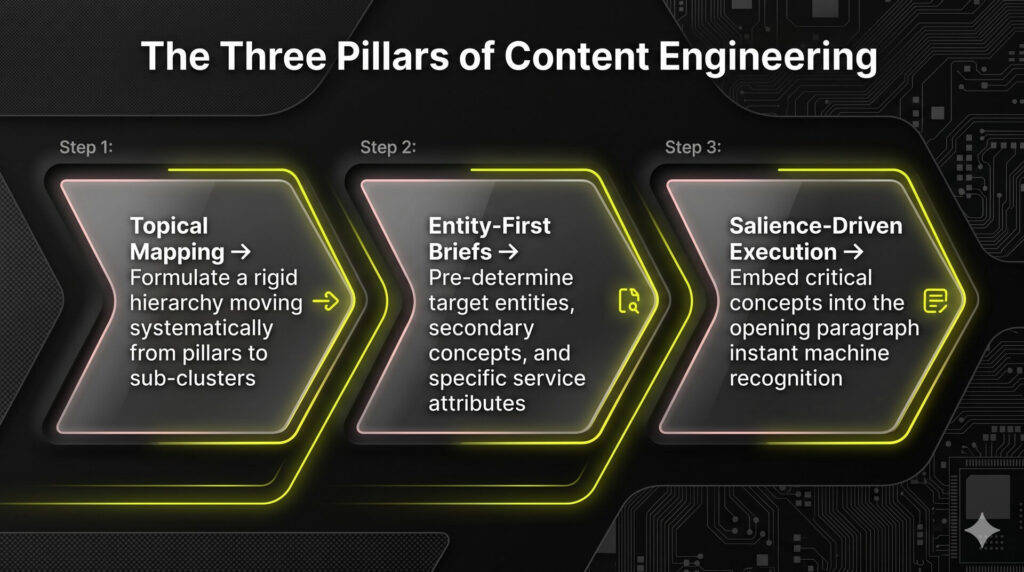
Ben Stace’s methodology replaces SEO guesswork with a rigorous content engineering workflow. This system transforms semantic SEO into a repeatable curriculum through three core pillars:
- Topical Mapping: Define a rigid hierarchy moving from pillars to clusters and sub-clusters.
- Entity-First Briefs: Every page requires a pre-writing list of primary entities, secondary entities, and specific attributes to anchor content in the knowledge graph.
- Salience-Driven Execution: Place critical concepts in the opening paragraph to ensure AI crawlers identify entity relationships instantly.
Internal linking must reflect the map’s architecture. Clusters link to parents, while siblings cross-reference only to address the next logical buyer question.
This is not a “related keywords” tactic. It is a structural requirement to ensure your brand becomes the default citation for both Google and LLMs. Transitioning from random publishing to structured engineering ensures your content infrastructure is built for the answer layer.
9. Future-Proofing for 2026: Semantic SEO as GEO Infrastructure
Page one rankings are no longer the ultimate finish line. By 2026, organic success depends on whether your content functions as a verifiable source for AI-generated answers. Engines like ChatGPT, Gemini, and Perplexity require clean entities, precise definitions, and structured sections to synthesize information with high confidence. Semantic SEO builds the high-fidelity infrastructure these systems use to construct their answer layers.
Transform your content from a simple traffic strategy into a demand capture engine by implementing specific citation triggers:
- Entity-rich definition blocks and FAQ schemas
- Comparison tables for structured data extraction
- Consistent entity naming to build Knowledge Graph authority
These elements ensure generative engines preferentially extract and cite your brand expertise. If you want your search presence engineered for this AI-first reality, visit nuoptima.com and explore our GEO service page. Secure your position as the cited authority before the competitive window closes.
FAQ
Semantic SEO is the practice of optimizing content around entities, their relationships, and underlying user intent rather than isolated exact-match keywords. Instead of targeting a single phrase, you build a comprehensive knowledge base that addresses an entire topic. The goal is to create citable, authoritative coverage that allows your brand to rank across hundreds of query variants while becoming the primary source for AI-generated answers.
Semantic signals are more important now than ever before. AI Overviews and LLMs do not simply match keywords. They synthesize meaning by identifying connections between entities. For managed IT firms, this means your content must be structured for machine extraction. By covering entities thoroughly and using Answer Layer Architecture, you ensure your brand is the trusted source these engines cite when generating summaries.
Keyword research remains a core requirement but its role has evolved. It is now a tool for topical discovery rather than a list of targets for individual pages. You use keyword research to identify the tasks, decisions, and objections your buyers have, then group those queries into logical topic clusters. Semantic SEO is the execution strategy used to satisfy that collective intent with structured, deep-dive content.
Traditional keyword rankings are a secondary metric. You should measure cluster-level growth, specifically the number of unique queries a single pillar page surfaces for over time. Focus on visibility within the answer layer, including featured snippets and AI citations. Most importantly, track conversions per cluster and assisted conversions to see how your informational topical maps are contributing to the lead-gen pipeline.
Where this fits in your MSP growth system
This is one piece of how NUOPTIMA makes MSPs and cybersecurity firms the provider buyers find on Google and in AI search. See how it connects to MSP SEO and GEO and AI-search, or get your free MSP lead forecast to see exactly where your firm shows up across ChatGPT, Gemini, and Perplexity today.