Most IT firms excel at technical delivery but fail the search trust test. High-intent buyers often encounter a Technical Authority Gap where they cannot validate your expertise quickly enough.
NUOPTIMA scales MSPs and cybersecurity firms by transforming technical skills into revenue outcomes. Our framework utilizes service-page coverage, authority content, and internal linking to turn SEO for IT company into an investor-grade growth asset.
Success starts with positioning because targeting the wrong keyword intent wastes capital.
Key Takeaways
- Choose a strategic intent lane first: MSPs compete on localized service-area intent, MSSPs and cybersecurity firms compete on risk-driven authority, and software developers compete on niche vertical expertise.
- Build a two-layer service architecture (broad category pages plus granular specific service pages), where every service page defines who it is for, what is included, SLA-style outcomes, pricing model, and technical proof.
- Win the map pack before national head terms: optimize your Google Business Profile with precise categories, regular activity, and consistent NAP data, since it is the fastest path to revenue for regional MSPs.
- Internal linking should route authority from content to service pages, from service pages to proof assets, and from proof assets back to service pages, using descriptive keyword-rich anchors in body copy.
- Convert technical fragility into machine-readability: fix Core Web Vitals, keep core copy in crawlable HTML, replace PDF-only case studies with web pages, and deploy Organization, Service, FAQ, and Reviews schema.
SEO for an IT company is the practice of turning technical service expertise into search visibility through service-page coverage, authority content, proof assets, and internal linking that ranks the firm for high-intent buyer queries.
1. Choose Your Strategic Intent Lane
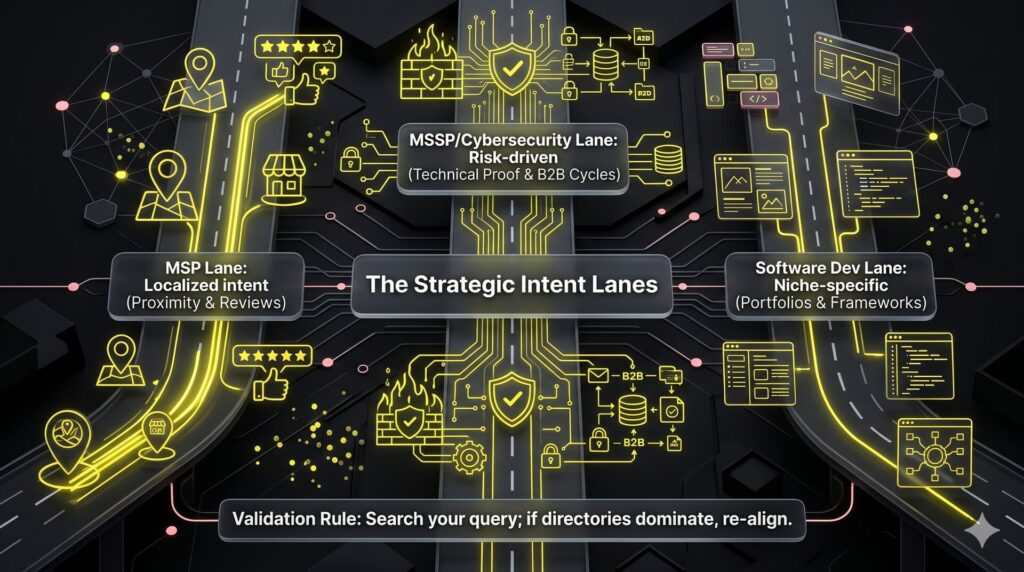
SEO for IT companies fails when firms ignore how Google categorizes intent. Different business models face distinct buyer journeys and SERP competitors. Choose an intent lane first to align strategy with search reality and avoid wasted spend.
- MSP: Localized service-area intent. Rankings rely on proximity, review density, and fast comparison.
- MSSP/Cybersecurity: Risk-driven authority. Requires technical proof for complex B2B evaluation cycles.
- Software Dev: Niche-specific. Google prioritizes portfolios, frameworks, and vertical expertise.
Position your firm: We help [Industry] at [Size] solve [Pain] via [Service]. Validate by searching your target query. If the top five results are directories while you are an agency, your strategy is structurally misaligned with the SERP.
| Business model | Primary intent lane | What ranks | Priority focus |
|---|---|---|---|
| MSP | Localized service-area intent | Proximity, review density, fast comparison | Google Map Pack and location pages |
| MSSP / Cybersecurity | Risk-driven authority | Technical proof for complex B2B evaluation | Case studies, compliance pages, authority content |
| Software Dev | Niche-specific expertise | Portfolios, frameworks, vertical expertise | Vertical service variants and topical depth |
2. Build a High-Intent Service Architecture
Vague service pages kill conversion. To dominate SEO for IT company, replace generic lists with a two-layer architecture that captures high-intent search volume:
- Category Pages: High-level buckets like Managed IT, Cybersecurity, or Cloud Services.
- Specific Service Pages: Granular solutions like Microsoft 365 management or SOC monitoring.
Each page must function as a virtual sales rep. Every specific service page must define:
- Who the service is for and what exactly is included.
- SLA-style outcomes and how pricing works (ranges or models).
- Technical proof via mini case studies.
Deploy vertical variants like IT support for healthcare to avoid commodity SEO and capture higher-margin niches. Your final deliverable is a service inventory mapping every page to a primary keyword and CTA. This provides Google with clear relevance and gives buyers a high-converting decision page.
3. Translate Technical Expertise into Legible Proof
Technically superior IT firms often lose contracts because of the Technical Authority Gap. In managed services, trust is the product. Effective SEO for IT company translates technical depth into legible proof for both buyers and algorithms.
Build assets that reduce perceived risk and signal institutional-grade maturity:
- 3 to 5 case studies featuring measurable ROI, timelines, and scope.
- Partner badges and team bios with named technical authors.
- Compliance pages for specific frameworks like SOC 2, HIPAA, or CMMC.
Place evidence where it influences ranking and conversion:
- Embed short proof blocks on every service page.
- Link case studies back to their most relevant technical solutions.
- Aggregate logos and testimonials in a central evidence library.
This strategy ensures Google and prospects verify your credibility without requiring an initial sales call.
4. Scale Organic Equity with a Topical Authority Engine
Standard blogging attracts traffic but rarely books discovery calls. High-impact SEO for IT company results require a revenue-focused authority engine that builds depth for your primary service pages. Engineer content clusters around 2 or 3 revenue-tied pillars:
- Ransomware readiness
- Cloud migration
- Regulatory compliance
Publish 5 to 8 supporting articles per pillar to move prospects from problem-aware to solution-aware stages. Each piece must answer the core question in the first paragraph for AI engines and include a contextual internal link to your service page.
Finalize each cluster with a decision article covering costs, timelines, or vendor selection criteria. This strategy builds organic equity, ensuring your website ranks for competitive, high-margin keywords while supporting investor-grade valuations.
5. Engineer an Authority-First Internal Link Architecture
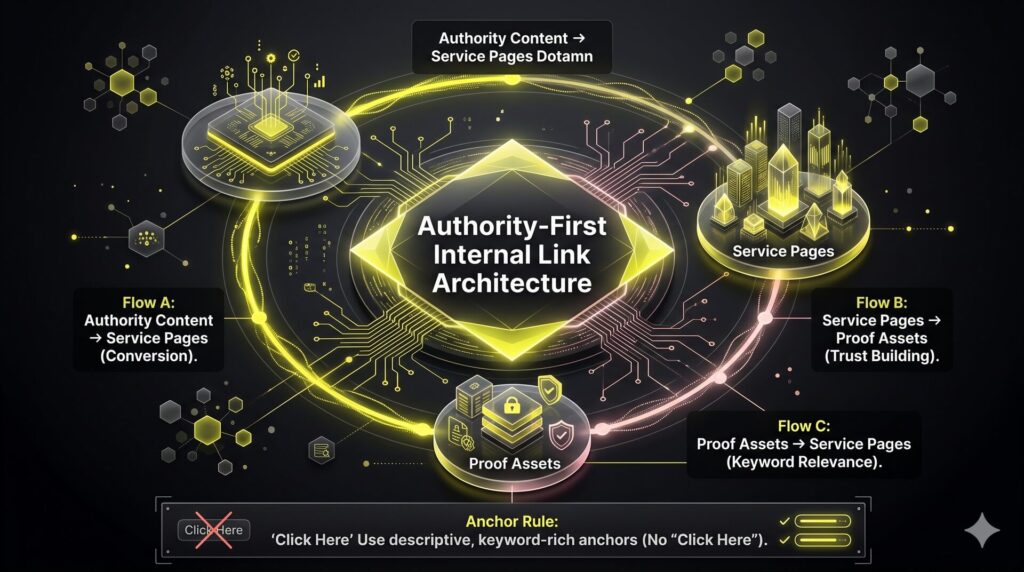
High traffic fails to generate discovery calls when authority leaks away from revenue pages. Internal linking functions as the control surface directing ranking power toward your high-margin services. To master SEO for an IT company, you must engineer three strategic flows:
- Authority content to service pages: Directs top-funnel traffic toward primary conversions.
- Service pages to proof assets: Funnels commercial intent into trust-building case studies.
- Proof assets back to service pages: Reinforces commercial relevance for search engines.
Avoid footer spam and generic text. Use descriptive, keyword-rich anchors within the body copy where a reader naturally seeks context. Finally, build a Managed IT Services hub as a central pillar. This structured ecosystem ensures Google and AI engines recognize your site as a high-value revenue engine rather than a collection of disconnected technical articles.
6. Dominate Local Markets through Map-Pack Optimization
National head terms are capital-heavy battles that offer low ROI for regional MSPs. Your fastest path to revenue is the Google Map Pack. Capture high-intent leads for IT support by optimizing your Google Business Profile (GBP) for both conversion and ranking.
- Verify precise primary categories and exhaustive service lists.
- Maintain profile activity with regular photos, posts, and Q&A.
- Sync your homepage with GBP using consistent NAP data, embedded maps, and reviews.
When expanding territories, build high-value location pages supported by technical proof rather than thin templates. Effective SEO for IT company focuses on map visibility and bottom-funnel outcomes like calls and form fills. This strategy turns geographic proximity into a defensible revenue engine.
7. Build for Technical Resilience and Machine-Readability
IT websites often look professional but remain technically fragile. If core copy is buried in JavaScript or slow PDFs, you stall your SEO for IT company rankings. Fixing these technical leaks transforms a digital brochure into a high-performance revenue engine.
Prioritize these unblockers to ensure search engines can access and trust your content:
- Core Web Vitals: Optimize LCP through image compression and mobile UX refinements.
- Crawlable HTML: Ensure scripts do not hide service descriptions or industry expertise.
- Logical Architecture: Use clean URL patterns for specific services and industry-specific pages.
Remove ranking killers like gated or PDF-only case studies. Transition these to crawlable web pages so AI answer systems can parse your results. Finally, deploy Schema markup for Organization, Service, FAQ, and Reviews to maximize machine-readability and bridge the Technical Authority Gap.
8. Capture Comparison Intent and Build Niche Trust
Late-stage buyers shortlist vendors using comparison queries. If you don't own the [Competitor] vs [Your Brand] narrative, you lose control of the final decision. Create bottom-of-funnel (BOFU) pages targeting:
- [Competitor] alternatives
- Best MSP for [Vertical/Industry]
- Head-to-head comparison tables
Include factual who this is for / not for sections to maintain authority and avoid sounding like smear content. Link these high-intent pages back to revenue-focused service lines via internal linking to convert comparison traffic into meetings.
Validate your brand with IT-appropriate links rather than generic guest-post spam. Focus on:
- Local trust: Chambers, local press, and sponsorships.
- Industry authority: Vendor partners, associations, and event speaking pages.
This ensures your SEO for IT company builds organic equity and captures buyers during their critical buying window.
90-Day SEO for IT Company Execution Plan
Transform your technical expertise into a defensible revenue engine with this 90-day roadmap. This plan prioritizes organic equity and generative engine optimization (GEO) to ensure your firm dominates traditional search and AI-driven answer engines.
Weeks 1 to 2: Strategy and Architecture
1. Lock your market lane by choosing between MSP, MSSP, or specialized software development to focus your authority.
2. Define your ICP based on vertical compliance requirements such as HIPAA or SOC2 to ensure high-value lead quality.
3. Build a comprehensive service-page map covering core categories and vertical-specific service variants.
4. Assign a specific conversion CTA to every page like Book a Security Audit to align with bottom-funnel intent and capture high-intent traffic.
Weeks 3 to 6: Revenue Pages and Trust Layer
1. Refresh all core service pages with outcome-oriented copy focusing on uptime, cost predictability, and risk mitigation.
2. Publish three case studies that highlight specific ROI metrics such as a 40% reduction in security events or saved annual IT costs.
3. Update team bios with current technical certifications and vendor badges to bridge the technical authority gap.
4. Link service pages directly to relevant proof assets to move prospects effectively from the consideration stage to a final decision.
Weeks 7 to 10: Authority Content and GEO
1. Ship two technical pillar pages addressing high-value revenue drivers like ransomware readiness or cloud governance.
2. Publish 6 to 10 supporting articles for each pillar to establish the topical depth required for high search engine rankings.
3. Implement AI-friendly formatting including answer blocks, FAQ schema, and technical tables to secure primary citations in AI search results.
Weeks 11 to 13: Scale Layer Expansion
1. Initiate link acquisition targeting high-authority technical vendors and local business associations to build domain trust.
2. Launch 2 to 4 comparison pages targeting queries like Best MSSP for Finance to capture buyers in the final evaluation stage.
3. Complete your Google Business Profile and deploy location pages only where you can provide verified local client proof.
Operating Cadence
1. Perform monthly audits of rankings by page type and monitor conversion tracking to ensure leads flow into your CRM.
2. Launch one new vertical cluster or service category every quarter to maintain a consistent growth trajectory.
Schedule a Framework Audit to review your SEO, GEO, and RevOps readiness. We will identify the specific gaps currently stalling your revenue growth and prepare your firm for institutional-grade valuation.