
If your outbound campaigns are flatlining, email is not the problem. Your data is. When a third or more of your contacts are stale, any channel looks broken.
A clean MSP email list is compounding pipeline insurance, serving as the bridge between your AI search visibility and outbound nurture. Sourcing verified, consent-aware data protects deliverability and produces replies.
Before you send more volume, you must start with technical data hygiene.
Key Takeaways
- Start with data hygiene before scaling send volume: purge role accounts, suppress hard bounces, and verify every contact on a 90-day cycle or your domain reputation degrades regardless of message quality.
- Build your list through permission-based channels (referrals and authority content opt-ins) rather than cold database purchases, so you own an audience that actually opens and replies.
- Segment by vertical, seat count, role, and urgency signals to keep every send relevant; generic newsletters sent to mismatched audiences are the primary reason MSP email campaigns underperform.
- Keep cold outreach on separate sending infrastructure and a secondary domain, never mixed with your permissioned newsletter list, to protect your core domain from spam penalties.
An MSP email list is a permission-based database of verified business contacts that an IT service provider builds, maintains, and uses to nurture prospects and clients through targeted email campaigns.
1. Establish Technical Data Hygiene Rules
An uncleaned contact database is an operational liability. Mailing stale data triggers high bounce rates and spam complaints that ruin your domain reputation, quietly routing future emails to spam.
Before launching campaigns, protect your sender score with this triage checklist:
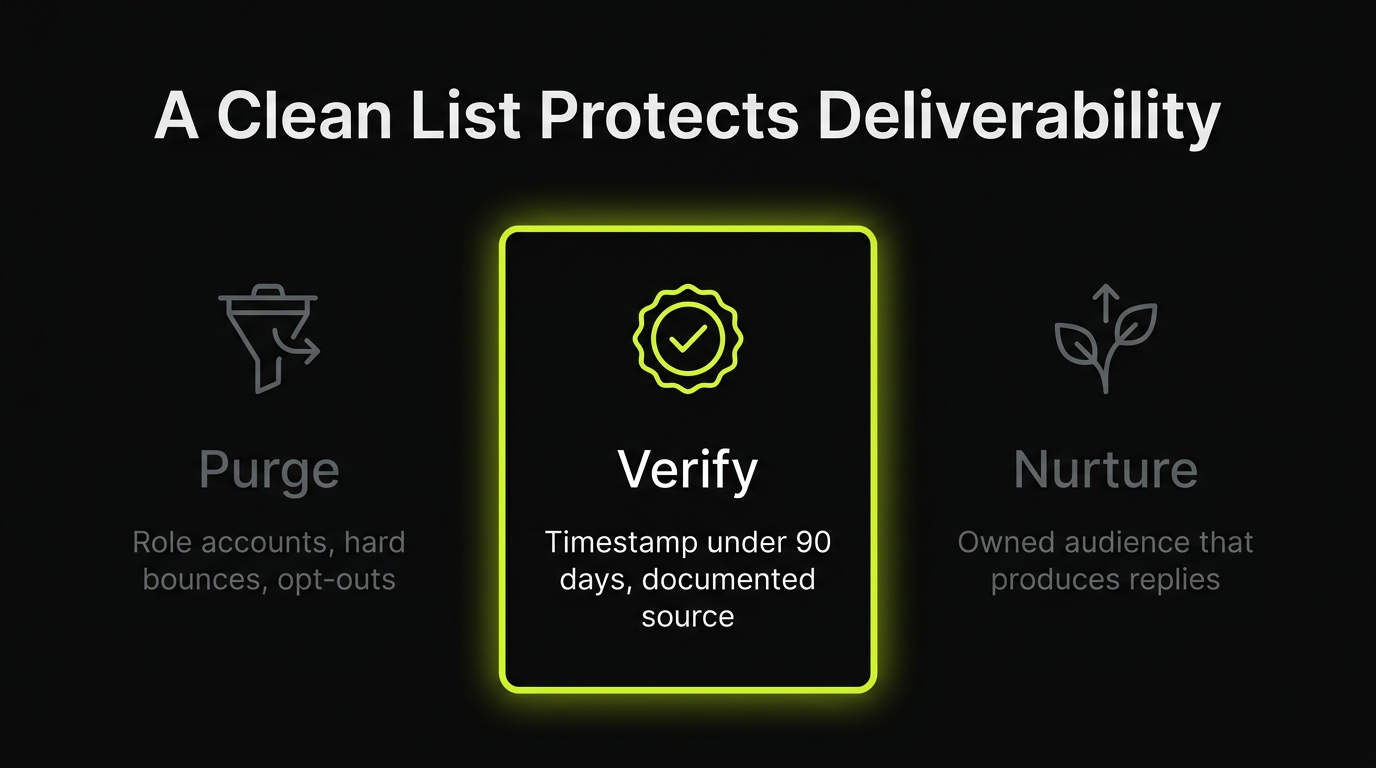
- Export your entire list and purge role accounts like info@ or support@ that trigger spam traps.
- Globally suppress all historical hard bounces and opt-outs.
- Set a hard system rule: zero emails go out without a documented lead source and a verification timestamp under 90 days old.
This operational cleanup shrinks your database but builds a verified, sendable segment you can trust. It prevents you from wasting sales resources on campaigns that fail due to list decay rather than messaging.
2. Treat Your Database as an Auditable Record of Truth
You cannot scale a marketing engine built on a bought spreadsheet. To build a high-performing contact database, apply the same operational discipline to database management that you bring to client networks. If you cannot audit your data, you cannot scale your pipeline.
Every record requires an audit trail. Store four non-negotiable fields:
- Source: The exact origin of the contact.
- Permission status: Opt-in or outreach tracking.
- Last verified date: Timestamp of the last validation.
- Company location: Geographic data for routing.
Verify data at capture, then programmatically re-verify contacts every 90 days or before reactivation. This makes hygiene a repeatable operational process. It builds an auditable system that explains performance, eliminating guesswork about whether email campaigns work.
3. Build a High-Intent Acquisition Engine Over Cold Databases
Buying cold databases is a direct route to burned domains and spam filters. Low-trust contacts yield near-zero engagement, spike your deliverability risk, and waste valuable sales hours.
To scale a resilient pipeline, shift from generic database buys to high-intent acquisition channels that map to MSP reality. Start with two sources:
- Partner and Client Referrals: Convert offline relationships into digital permission with explicit opt-in consent.
- Authority Content Opt-ins: Use assets tied to urgent buyer questions, like regional compliance checklists or co-managed IT templates.
This strategy builds an owned, permission-based list that actually opens and replies because it relies on active permission, not volume. Keep the promise tight: one list, one clear reason to exist.
4. Implement a High-Yield Segmentation Scheme
When email campaigns fail, MSP owners usually blame the channel. The real culprit is the generic monthly newsletter sent to everyone on your list, from healthcare clinic owners to corporate IT directors. One generic message cannot stay credible across mismatched audiences.
To fix this without operational bloat, segment your audience by four practical vectors:
- Vertical: Group by industry dynamics, like legal, manufacturing, or healthcare.
- Size: Segment by seat count, as a 20-seat office has different compliance needs than a 200-seat firm.
- Role: Separate the operational buyer from the finance partner focused on cost.
- Urgency signals: Track active website visits or download behavior to identify high-intent prospects.
This alignment improves relevance, reduces unsubscribes, and increases qualified replies without increasing your overall send volume.
5. Bridge Search and AI Visibility to Lead Capture
Inbound visibility is wasted if prospective clients leave without a trace. Many MSPs optimize for Google and AI search only to watch qualified buyers slip away, failing to build a durable, compounding audience. This converts high-intent traffic into anonymous, missed opportunities.
To capture this demand, map out 5 to 10 specific buyer questions you want to resolve. Create one targeted opt-in resource that directly answers these exact queries:
- A compliance checklist
- An MSP selection guide
- A security risk audit template
Integrate this lead magnet with your overall content engine for MSPs. Connecting discovery rankings to high-value downloads ensures that every increase in your AI visibility score systematically builds an MSP email list you permanently own.
Design Lead Magnets That Actually Grow Your MSP List
A permission-based list grows one opt-in at a time, and the offer you trade for an email is the single biggest lever on how fast it compounds. Generic newsletter signup boxes convert almost nobody. IT buyers hand over an email when the resource solves a problem they are actively worried about, so build magnets around the compliance, security, and cost pressures your Ideal Customer Profile feels in 2026.
Offer resources that map to a real buying moment rather than a generic ebook:
- Compliance checklist: A HIPAA, CMMC, or SOC 2 readiness checklist for one named vertical, which pulls in exactly the regulated buyers you want.
- Cyber risk self-audit: A short scorecard a prospect can run in ten minutes, ending with a reply-based offer to review the results.
- MSP switching guide: A due-diligence template for buyers unhappy with a current provider, which signals high purchase intent.
- IT budgeting worksheet: A planning tool aimed at the CFO or finance partner who controls the contract.
Placement decides conversion as much as the offer does. Put a contextual opt-in inside the relevant service and vertical pages, not only in a sitewide footer, so the magnet appears exactly where a buyer is already reading about that problem. Gate the download behind a two-field form, business email and company, then verify each address at capture through an email verification tool before it enters your database. Keep every promise tight: one magnet, one segment, one clear next step, so the list you build stays clean and matched to pipeline rather than padded with low-intent signups.
6. Run a Strict Reactivation Sequence to Purge Dormant Data
A large share of contacts on an average contact database are functionally dormant. This persistent silence skews your campaign performance metrics and signals to spam filters that your domain sends low-value mail, dragging down overall domain authority.
Protect your deliverability with a strict three-step reactivation sequence:
- Email 1: Ask if your services and content are still relevant.
- Email 2: Offer a simple preference choice (cybersecurity, compliance, or IT budgeting).
- Email 3: Deliver a final notice before automatic removal.
If a contact fails to respond, suppress them permanently. Do not attempt to send harder. Purging stale contacts immediately recovers usable data, protects your sender reputation, and ensures active sales opportunities actually land in the inbox.
7. Deploy a High-Value Monthly Newsletter Structure
Most MSP newsletters fail because they read like self-serving vendor promotions. Sending corporate announcements to your list will not build authority or generate pipeline.
Instead, use a repeatable three-part format that maps directly to business outcomes:
- One insight: Highlight a specific risk trend, cost control tactic, or security failure pattern.
- One proof point: Share an anonymous or clearly labeled hypothetical example of this insight.
- One call to action: Prompt the reader to reply with a question, book an assessment, or forward the draft to finance.
This structure creates a consistent nurture touch that builds trust and generates conversations without relying on gimmicky open rates. For deeper execution guidance, see our guide to MSP email marketing.
8. Separate Cold Outreach from Your Permissioned MSP Email List
Mixing cold outbound prospecting with your newsletter sends is the fastest way to destroy your domain reputation. A permissioned contact list is an opt-in, brand-safe asset that requires high deliverability. Cold outreach is a completely different motion with far higher risk.
Because cold sending faces intense filtering, and because international MSP lead generation spans multiple jurisdictions, you must respect regional compliance rules:
- CAN-SPAM (United States)
- GDPR (European Union)
- CASL (Canada)
Never import purchased contacts directly into your primary email service provider. Instead, isolate your cold campaigns by purchasing secondary domains and setting up dedicated sending infrastructure. This safeguard protects your core domain from spam penalties, keeping your newsletter deliverable and securing the owned audience you are actively building.
How to Build an MSP Email List: A 90-Day Operational Roadmap
Many list-building programs fail because owners treat them as a mandate to send more emails. To build a compounding asset, a founder and an operations partner must run the list as an owned-asset program. Execute this 90-day roadmap as a controlled experiment tied to pipeline, not vanity metrics.
Days 1 to 14: Stabilize Your Technical Foundation
- Triage deliverability: Run your list through validation tools to eliminate hard bounces.
- Set custom fields: Establish database fields for lead source, verification timestamp, and vertical.
- Suppress and segment: Remove role-based addresses and build high-intent target segments.
Days 15 to 45: Deploy Inbound Acquisition
- Connect two sources: Integrate two list sources, like verified databases and local event contacts.
- Configure opt-ins: Implement opt-in capture forms on your top two high-traffic services pages.
- CRM sync: Connect these captures to your CRM to sync new contacts automatically with tracking tags.
Days 46 to 75: Reactivate and Nurture
- Reactivate dormant contacts: Run a targeted three-step reactivation sequence to reclaim cold accounts.
- Launch the advisory newsletter: Start a monthly advisory newsletter featuring technical insights, not sales pitches.
- Provide preferences: Add a simple preference option so prospects choose topics instead of unsubscribing.
Days 76 to 90: Attribute Pipeline ROI
- Track opportunities: Attribute new meetings and pipeline opportunities to specific email touches.
- Review growth metrics: Review net growth and engagement metrics by vertical segment to track pipeline contribution.
Ready to see where your list leaks revenue? Book a free list hygiene teardown at nuoptima.com to find exactly where your contact data is leaking pipeline.