Most MSPs waste thousands chasing generic IT terms that attract home users and job seekers rather than qualified decision-makers. Effective MSP keyword research replaces residential noise with high-intent revenue systems. Using NUOPTIMA’s RevOps lens, we map keywords to pipeline to build organic equity for both Google and AI engines. This guide provides a practical list grouped by BOFU, MOFU, and TOFU intent across specific service lines and verticals. Start with BOFU service and geo clusters first.
Key Takeaways
- Effective MSP keyword research replaces generic IT terms that attract home users and job seekers with high-intent, revenue-mapped clusters across BOFU, MOFU, and TOFU intent.
- Start with bottom-funnel service and geographic clusters first, validating intent by checking the SERP for a local map pack and sponsored ads.
- Compliance modifiers like HIPAA, SOC 2, CMMC, and NIST 800-171 act as intent multipliers, signaling a pre-allocated budget and driving higher deal margins.
- Aggressive negative keyword lists (jobs, salary, free, home wifi, Geek Squad) cut wasted spend and keep traffic strictly B2B.
- A repeatable engine maps each keyword cluster to a page type and closes the loop in the CRM to find the kingmaker keywords that create high-value pipeline.
MSP keyword research is the process of finding and grouping search terms by buyer intent so a managed service provider can map each keyword to a page and to pipeline, capturing high-value B2B demand instead of residential noise.
1. Local Service Clusters: Dominating High-Intent Geographic Search
Most MSPs lose local leads by prioritizing technical jargon over buyer intent. Effective MSP keyword research builds a defensible cluster at the intersection of core services, specific geography, and professional buyer language to capture high-intent traffic.
Focus on these high-intent keyword patterns:
- Managed IT services [city]
- IT support company [city]
- Business IT support [city]
- Outsourced IT [city]
- IT managed services provider [city]
To validate intent, check the Google SERP. A local map pack or sponsored ads confirm commercial, bottom-funnel interest and justify the content investment. Pair each geo cluster with a strong local SEO foundation for MSPs so the page can actually rank once the keywords are mapped.
Map these clusters to one dedicated BOFU landing page per primary market with a clear CTA, such as a Technical Authority Audit. Explicitly list all services offered in that specific region to help AI answer engines cite your expertise accurately. This approach bridges the technical authority gap and builds the organic equity necessary for premium M&A readiness and long-term valuation growth.
2. Cybersecurity & Compliance: Capturing the Crisis Moment
A data breach is a financial emergency, not a casual research project. Security service-line clusters convert rapidly by targeting buyers facing acute risk and urgency. When a CISO searches for a ransomware response company or incident response retainer, they are in an active buying process, not a generic awareness phase.
Optimize MSP keyword research for bottom-funnel intent using specific terms like managed detection and response [city], SOC as a service [city], and managed SIEM [city]. Adding vertical modifiers such as for manufacturing or for healthcare helps capture high-LTV buyers searching for immediate security outcomes rather than generic education.
Separate TOFU What is MDR support posts from BOFU service pages to ensure clear funnel attribution. To scale your pipeline, book a security readiness assessment or incident response plan review at nuoptima.com. We bridge the technical authority gap to turn your expertise into a predictable lead engine.
3. Compliance Modifiers: The High-Margin Intent Multiplier
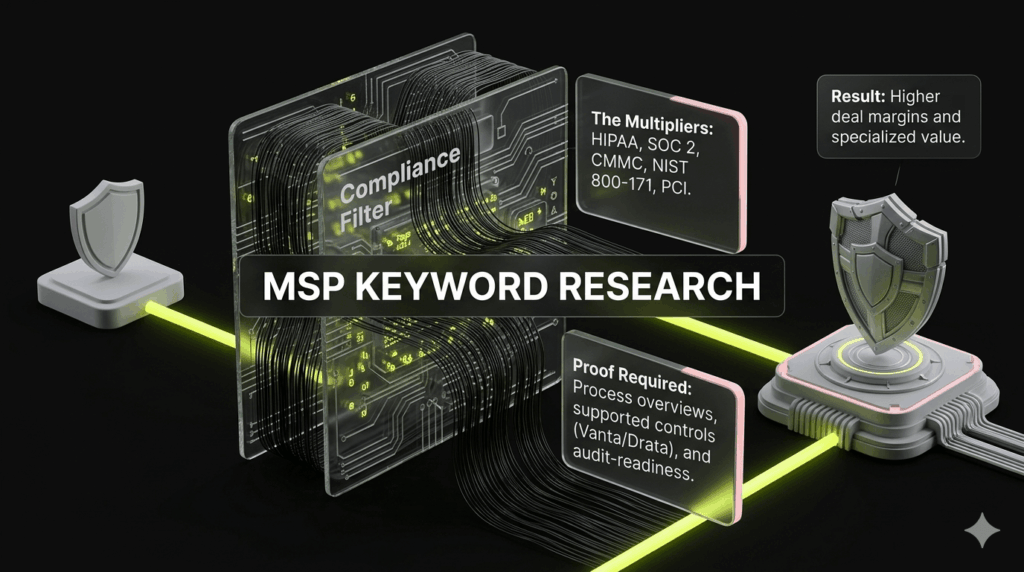
Compliance modifiers act as an intent multiplier. When a prospect searches for a specific regulatory framework, they are self-qualifying with a non-negotiable requirement and a pre-allocated risk mitigation budget. This shift moves the conversation from generic price competition to specialized value, driving significantly higher deal margins.
Effective MSP keyword research must prioritize these high-intent modifiers:
- HIPAA compliant IT services [city]
- SOC 2 IT support
- CMMC compliance managed services
- NIST 800-171 MSP
- PCI compliance IT provider
Map these terms to dedicated service pages for each framework where you have genuine technical capability. These bottom-funnel (BOFU) pages must include specific proof: process overviews, supported controls, relevant tools like Vanta or Drata, and audit-readiness outcomes. Layer in mid-funnel (MOFU) checklists and readiness guides to bridge the technical authority gap. This strategy ensures you attract high-value prospects seeking specialized compliance expertise rather than competing on price for generic support.
4. Cloud & Migration Services: The Project-to-Managed Service Wedge
Project-based cloud terms act as high-intent wedges that convert into long-term managed contracts. Decision-makers searching for specific execution phrases have immediate budgets and firm deadlines. Capturing this bottom-funnel intent allows you to solve an urgent technical pain point before pitching a broader managed service agreement.
Target these high-value MSP keyword research patterns with dedicated landing pages:
- Microsoft 365 migration services [City]
- Azure managed services provider [City]
- SharePoint migration consultant
- Google Workspace migration for business
Separate one-time migration pages from ongoing managed cloud services using distinct CTAs. Distinguish between research intent and execution intent by targeting queries containing services, provider, or consultant. To improve conversion, add a Migration Assessment form with clear pricing anchors. This transparency reduces sales friction and establishes the technical authority necessary to secure a multi-year retainer.
5. Pricing & ROI Keywords: Owning the Commercial Conversation
Pricing queries signal high Middle-of-the-Funnel (MOFU) intent. Prospects at this stage have already defined their technical pain and are seeking financial justification for the C-suite. Most MSPs hide their pricing, but providing transparent ranges and ROI framing helps bridge the technical authority gap before the first discovery call.
Strategic MSP keyword research must capture these commercial patterns:
- Managed IT services cost
- MSP pricing per user
- IT support pricing [City]
- Outsourced IT cost vs in-house
- vCIO pricing
Deploy a pricing hub featuring a cost calculator and a breakdown of variables like seat count and compliance requirements. Capture high-intent leads by offering a downloadable IT Cost Benchmark Report. Through the NUOPTIMA RevOps lens, tagging these pages in your CRM provides full-funnel attribution. This ensures you track exactly which pricing queries transform into qualified pipeline and long-term enterprise value.
6. Comparison Intent: Capturing the Trade-off Conversation
Comparison intent represents the point where high-LTV deals flip. At this stage, prospects aren't seeking generic definitions. They are weighing high-stakes tradeoffs between competing delivery models. Your MSP keyword research should capture this bottom-funnel momentum by targeting specific versus patterns and localized search queries:
- IT support vs MSP
- In-house IT vs outsourced IT
- Break-fix vs managed services
- MSP contract vs hourly
- Best managed IT services [city]
- Top MSP in [city]
To win these conversions, provide a decision framework that moves beyond technical features. Guide the C-suite through evaluation criteria, specific requirements, and provider red flags. Build trust through immediate proof like case study snippets, SLA examples, and onboarding timelines. This approach captures buyers actively comparing providers and builds authority at the decision stage. Close the gap by offering a Request a proposal or Get an IT environment audit CTA to transition prospects into the sales pipeline.
7. Symptom-Based TOFU: Capturing Prospects Before They Search for MSP
Most top-of-funnel content fails by targeting academic definitions rather than operational friction. High-intent MSP keyword research must prioritize symptoms like operational pain, downtime, and security anxiety. A founder searching why is our network so slow is identifying a productivity bottleneck, not just a technical query. This captures prospects at the Crisis Moment before they even identify a need for a specific provider.
Target these symptom-based patterns to capture early-stage intent:
- Frequent IT outages small business
- Email keeps going to spam Microsoft 365
- Ransomware prevention for [industry]
- How to choose an MSP
Map these articles to bottom-of-funnel service pages using strategic internal links. This is also where a broader MSP SEO and AI citation strategy pays off, since the same symptom pages that rank in Google get pulled into AI answers. Sanity-check the SERP to avoid purely academic queries that lack business framing. If a keyword does not imply operational risk, it will not build organic equity. End every post with a conversion bridge, such as a Security Risk Assessment, to pull prospects into your revenue engine.
8. Vertical Keyword Packs: Winning High-Trust Micro-Markets
Verticalization is a conversion lever. Effective MSP keyword research prioritizes sharp keywords that imply domain expertise over broad volume. Structure clusters using this formula: [service] + [vertical] + [compliance/software] + [geo].
Deploy these mini-packs to dominate niche markets:
- Healthcare: HIPAA compliant MSP [city], EHR support, IT support for medical practices.
- Legal: IT support for law firms, eDiscovery, managed IT for legal.
- Manufacturing: IT support for manufacturing, network security for factory, OT uptime.
- Finance: SOC 2 financial MSP, data governance, IT support for financial services.
- Defense: CMMC managed services, NIST 800-171 IT support.
- SaaS/Tech: SOC 2 readiness, startup managed IT.
Map each pack to a vertical landing page and two authority pieces, then earn relevance with vertical MSP link building that points at those pages. Bridging the technical authority gap requires citing industry tools like Vanta, Clio, or Epic. This specificity makes research usable for niche positioning, transforming technical capability into investor-grade revenue equity.
9. Negative Keywords: Plug the Leakage That Kills Your CAC
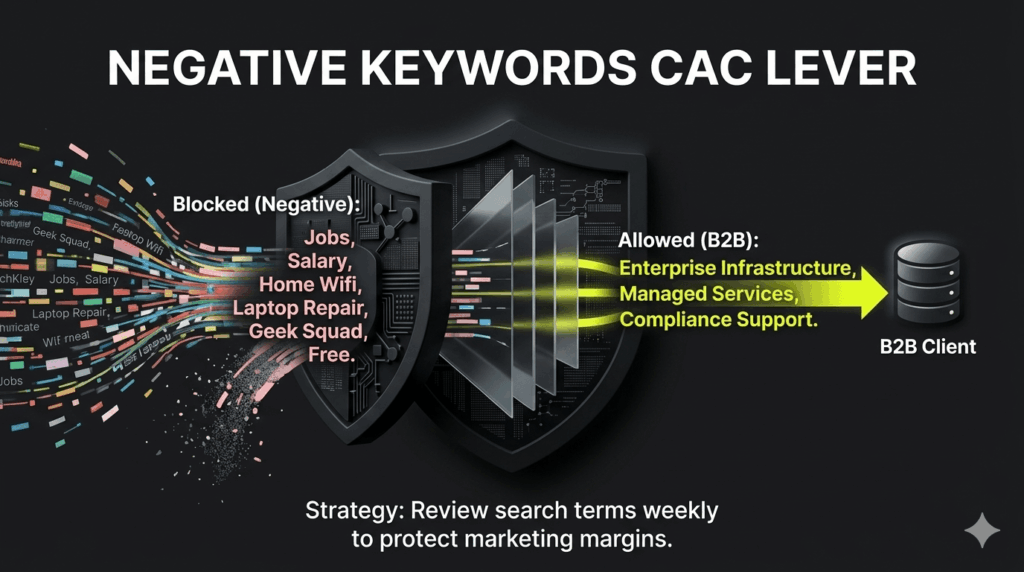
Clicks from job seekers or residential users act as a direct tax on growth. MSP keyword research fails when leakage poisons PPC budgets and distorts SEO metrics with high-volume, non-commercial traffic.
Deploy aggressive negative lists across these primary categories to protect margins:
- Careers: jobs, salary, resume, certification.
- DIY/Residential: free, cheap, home wifi, my laptop, router setup.
- Consumer Brands: Geek Squad, Best Buy.
Start with account-level negative lists and tighten match types early in the lifecycle. Treat negative management as a strategic CAC lever rather than a hygiene task. Review search terms weekly to identify and add new negatives, ensuring traffic remains strictly B2B.
Audit your intent leakage today at nuoptima.com. This immediately reduces wasted spend and improves lead quality by ensuring every click represents a potential B2B contract or enterprise partnership.
| Intent stage | Example keywords | Page type to map to |
|---|---|---|
| BOFU (ready to buy) | Managed IT services [city], SOC 2 IT support | Service or geo landing page with proposal CTA |
| MOFU (evaluating) | MSP pricing per user, in-house IT vs outsourced | Pricing hub and comparison page |
| TOFU (early symptom) | Frequent IT outages small business | Problem-solving post linking to a service page |
| Negative (exclude) | jobs, salary, free, home wifi, Geek Squad | Account-level negative keyword list |
How to Build a Repeatable MSP Keyword Revenue Engine
This execution schedule transforms abstract keyword lists into a repeatable revenue operation. This 90 minute sprint builds a prioritized roadmap that ties search queries directly to pipeline attribution. Move beyond simple traffic volume and focus on capturing the crisis moments and compliance triggers that drive high-value managed service contracts.
Prerequisites: Define Your ICP and Service Pillars
Establish your focus before pulling raw data. Select 1 or 2 Ideal Customer Profiles (ICPs). Examples include private equity-backed firms preparing for an exit or compliance-driven buyers in the healthcare sector. List your primary service entities such as managed IT, MDR, vCIO, backup and disaster recovery, and M365 migration. This anchoring ensures your research targets high-margin services instead of low-value technical support.
Step 1: Harvest Seed Keywords (15 Minutes)
Pull bottom-of-funnel (BOFU) service and geographic seeds from your internal service list. Use Google Keyword Planner to export ideas based on these seeds. Analyze top-of-page bid signals for every term. High CPC values indicate keywords that competitors have already validated as revenue generators. Reverse-engineer competitor sitemaps to identify their dedicated service pages. Extract high-intent modifiers that your current list lacks.
Step 2: Cluster Keywords by Intent (15 Minutes)
Divide your keyword harvest into three distinct intent buckets. Group BOFU keywords using modifiers like company, provider, services, pricing, and your target geography. Assign MOFU keywords to categories involving comparisons, ROI analysis, and the outsourcing vs in-house debate. Use TOFU keywords to target symptoms, pain points, and risk education. This segmentation prevents you from wasting high-intent sales resources on educational researchers.
Step 3: Validate Intent in the SERP (10 Minutes)
Perform a manual Google search for your primary keyword clusters to verify search intent. If the results feature a local map pack and sponsored ads, classify the keyword as BOFU. If the results consist primarily of long-form guides and definitions, treat the term as TOFU or MOFU. Use this validation to ensure your page strategy aligns with how Google currently perceives the user's need.
Step 4: Map Clusters to Page Types (20 Minutes)
Assign each keyword cluster to a specific content format. Map BOFU clusters to service landing pages with direct calls to action like Request a Proposal. Use MOFU clusters for pricing hubs and comparison pages that offer downloadable proof of value. Format TOFU clusters as problem-solving blog posts. Ensure every TOFU post contains an internal link to a relevant BOFU service page to move prospects through the funnel.
Step 5: Perform a Service-Entity Sanity Check (10 Minutes)
Analyze how Google differentiates your technical services in search results. Create separate pages if a search for Managed IT triggers a local map pack but MDR triggers national cybersecurity firms. Dedicated pages for specific service entities bridge the Technical Authority Gap. This depth provides the granular context required for citations in modern AI generative engines.
Step 6: Build Your Negative Keyword List (10 Minutes)
Eliminate budget leakage by identifying non-commercial terms. Add jobs, DIY, residential, home, and Geek Squad to your negative keyword list. Review your actual search term reports weekly to find new exclusions. This iterative refinement protects your marketing spend and ensures your traffic remains strictly focused on B2B decision-makers.
Step 7: Close the RevOps Loop (10 Minutes)
Track every form fill and phone call through your CRM. Map these conversions back to the specific keywords and pages that generated the lead. Identify your kingmaker keywords that consistently create high-value pipeline and opportunities. Double down on content production and advertising spend for these top-performing clusters. Visit nuoptima.com for an intent and attribution audit to align your digital footprint with this revenue-first framework.
If you want a custom intent map and a full-funnel attribution model for your firm, visit nuoptima.com to start building your organic equity today.