Most MSP websites attract students and DIYers instead of high-value decision-makers. To scale effectively, you do not need more vanity metrics. You need MSP SEO traffic from high-intent, compliance-driven visitors, and vertical SEO is how you earn it. This blueprint transforms vertical pages into Organic Equity by blending bottom-funnel intent with GEO (answer engines) and RevOps measurement. We build industry-specific assets for legal and healthcare firms that convert directly into meetings. It starts by choosing a niche based on margin and credibility, not vanity volume.
Vertical SEO for MSPs means concentrating your search authority on a single regulated industry, like healthcare or legal, instead of ranking for generic managed services terms. You build proof-backed pages around one vertical's compliance triggers so decision-makers, not DIYers, find you.

Key Takeaways
- Pick a vertical on margin and credibility, not search volume: confirm you already serve 3 to 10 clients in the niche, that compliance supports premium pricing, and that you have case studies to shorten sales cycles.
- Target bottom-funnel, buyer-language terms (IT support for law firms, HIPAA compliant IT) over MSP jargon, because decision-makers rarely use industry acronyms during a crisis.
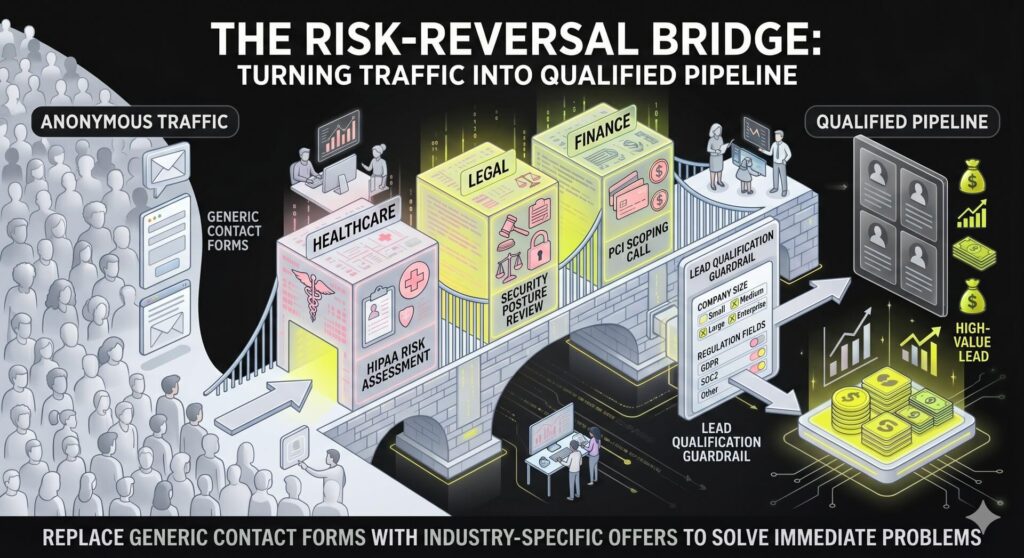
- End every vertical page with a risk-reversal offer like a HIPAA Risk Assessment or Law Firm Security Posture Review to convert anonymous traffic into qualified pipeline.
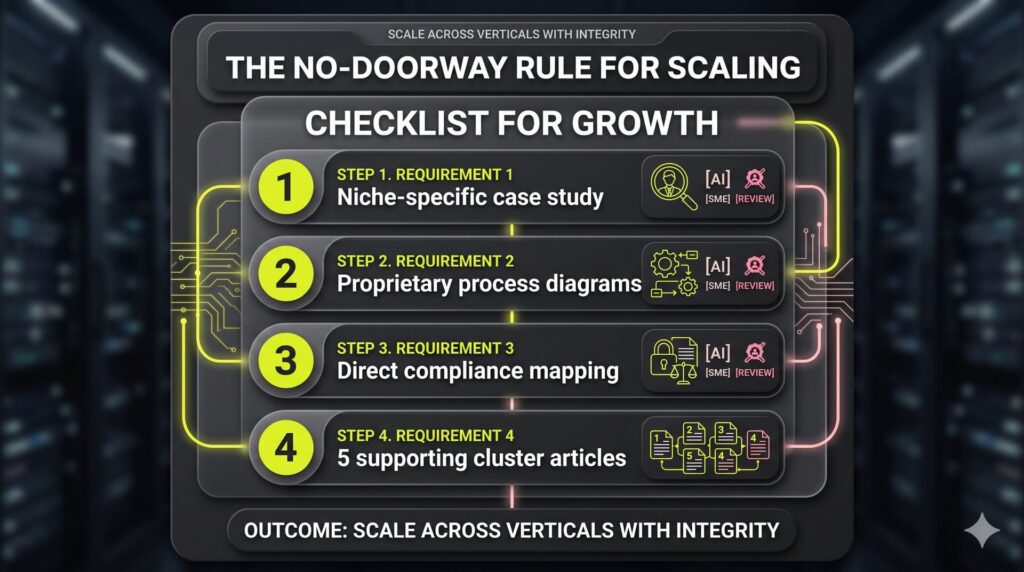
- Follow a no-doorway rule: never publish a vertical page without unique proof, such as niche case studies, process diagrams, and direct compliance mappings.
- Mirror your sales model in site architecture (vertical pillar vs location pillar) and assign one intent per page to prevent cannibalization, keeping key assets within three clicks of the homepage.
1. Prioritize Vertical Fit Over Search Volume
Many MSPs waste budget on vertical content that fails to convert because they prioritize search trends over operational proof. Generating high-converting MSP SEO traffic requires alignment with high-LTV economics. Use this three-step filter before committing resources to a specific vertical strategy:
- Existing Credibility: Confirm you already serve 3 to 10 clients in the niche or possess direct leadership experience in that field.
- Profitability: High compliance burdens support premium pricing, but only if you can reliably deliver specialized security postures.
- Sales Friction: Ensure you possess niche-specific case studies and a risk-reversal offer to shorten complex decision cycles.
Adopt a specialist marketing, generalist delivery model to dominate a niche visually without turning away general leads. Focus your Ideal Customer Profile (ICP) on companies with 20 to 75 employees facing specific trigger events. These include failed audits, new regulatory frameworks like CMMC or SOC2, and M&A activity that requires infrastructure consolidation.
End each vertical-specific page with a high-intent risk-reversal offer. A HIPAA Risk Assessment or Law Firm Security Posture Review bridges the technical authority gap. These offers transform anonymous traffic into a qualified pipeline by solving an immediate, high-stakes problem.
2. Map Vertical Strategy to Bottom-Funnel Buyer Intent
Ranking for managed services often attracts students rather than CEOs. To capture high-intent MSP SEO traffic, move beyond academic head terms. Focus on high-stakes phrases decision-makers search when revenue or compliance is at risk. Map each vertical into three intent buckets:
- Compliance Intent: High-conversion terms like HIPAA, FINRA/SEC, data retention, and incident response.
- Operational Workflow: Focus on uptime and tool access, including EHR uptime, secure client portals, and remote staff onboarding.
- Vendor Ecosystems: Terms targeting specific platforms like Clio, ProSystem fx, or specialized EHR systems.
Follow the Buyer-Language Rule: prioritize IT support or IT services over MSP jargon. Decision-makers rarely use industry acronyms during a crisis. Instead, use these starter sets for content clusters:
- Healthcare: Medical practice IT support, HIPAA compliant IT, EHR data protection.
- Legal: IT support for law firms, law firm cybersecurity, secure client portal support, data retention for law firms.
- Finance: Managed IT for financial firms, FINRA cybersecurity, PCI compliance IT support, secure email archiving.
Create a one-page keyword map per vertical to structure your pillar pages and cluster plan. This prevents guessing at vertical SEO and builds pages around terms that correlate with compliance-driven buying. Ground the map in a repeatable MSP keyword research process so each cluster tracks back to real buyer language.
3. The Anatomy of a High-Conversion Vertical Pillar Page
Most vertical pages fail because they are Frankenstein documents created by swapping industry names into generic templates. To capture high-value contracts, a vertical pillar page must function as a structured argument. This architecture bridges the Technical Authority Gap by moving readers from risk to resolution.
Follow this scan-friendly anatomy for maximum impact:
- Above-the-Fold: A vertical-specific promise, a concrete proof point, and a CTA for a risk assessment or readiness audit.
- What Breaks: A section identifying the top three operational and security risks unique to that niche.
- Compliance & Controls: Detail relevant frameworks by focusing on technical controls and business outcomes. See our approach to compliance content SEO for MSPs for how to structure these sections.
- Service Stack: Present helpdesk, backup, and vCIO services as outcome-based solutions rather than technical features.
- Proof & Objections: Use mini case snippets and an FAQ block to address friction regarding cost and migration timelines.
Execute a hub-and-spoke model where the pillar page links to 10 cluster posts. To dominate Generative Engine Optimization (GEO), include verifiable assets like control mappings and named tooling. These specific data points serve as the primary citations for answer engines like Perplexity and SearchGPT. For the mechanics of earning those citations, see our MSP AI citation strategy.
4. Engineering Vertical Pages for High-Value Conversion
High-quality MSP SEO traffic only converts when specialized prospects encounter offers addressing industry-specific anxieties. Replace generic Contact Us buttons with vertical risk-reversal entries that solve compliance or security problems before the formal sales process begins:
- Healthcare: HIPAA risk assessments or backup and DR readiness checks.
- Legal: Law firm security posture reviews or phishing tabletop exercises.
- Finance: FINRA cybersecurity gap scans or PCI scoping calls.
Bridge the technical authority gap by embedding a strategic Proof Stack on every vertical page. This includes one flagship case study and two mini proof blocks focusing on concrete outcomes:
- Ticket volume reduction (e.g., 40%)
- Audit pass rates (e.g., 100%)
- Downtime prevented or security incidents mitigated.
Feature certifications and vertical software badges to validate your expertise to C-suite buyers.
Protect your sales calendar by implementing lead quality guardrails. Add form fields for company size and regulated data to filter out unqualified leads immediately. Finally, integrate these pages into your RevOps engine by tagging every CTA and tracking them through CRM lifecycle stages. This allows you to report on the vertical page to meeting to pipeline journey, ensuring marketing is viewed as a high-yield asset.
5. Structuring Site Architecture to Balance Local and Vertical Intent
Many MSPs dilute organic equity by creating thin, near-identical pages for every city and industry combination. This creates internal competition, forcing your Healthcare IT Support page to fight your IT Support in Chicago page for the same rankings. To capture high-intent MSP SEO traffic, your site architecture must mirror your actual sales model to avoid the Technical Authority Gap.
If you sell locally, treat location pages as primary pillars and use vertical pages for qualification. For national firms, the industry hub becomes the primary pillar, while geographic evidence functions as proof blocks.
Follow this high-authority architecture:
- /industries/healthcare-it-support/ (Vertical Pillar)
- /locations/[city]-it-support/ (Geographic Pillar)
- /locations/[city]/[vertical]/ (Only with unique local proof)
Prevent cannibalization by assigning one distinct intent per page. Use internal links or section anchors to connect related themes instead of duplicating content. Operationally, keep all critical assets within three clicks of the homepage via dedicated Industries and Locations hubs. This clarity ensures both human decision-makers and generative engines can map your expertise without navigating a maze of thin content.
6. Controlled Scaling: The No-Doorway Rule for Vertical Expansion
Scaling MSP SEO traffic across dozens of verticals is a high-growth move, but thin doorway pages trigger penalties from Google and generative answer engines. Scale with integrity by moving beyond generic templates to provide legitimate technical differentiation.
Adopt a strict no-doorway rule: never publish a vertical page without unique proof. These pages must act as authoritative landing spots that bridge the technical authority gap for high-intent decision-makers. Required elements include:
- Niche-specific case studies (e.g., Law firm M&A or HIPAA audits).
- Proprietary process diagrams and custom service tooling.
- Direct compliance mapping for specific industry regulations.
Template the structural anatomy while requiring bespoke content for every section. Address specific workflows like legal document management or manufacturing shop-floor uptime and IoT security. Commit to five supporting articles per vertical to build topical authority before expanding further.
Use an AI-safe workflow where AI drafts the structure, but a Subject Matter Expert injects original data and specific examples. Publish only after manual review, then monitor search queries to identify new intent triggers. Plan a refresh cadence of 12 to 24 months to keep technical authority current and pipeline growth predictable.