Your website is a brochure that costs you money instead of generating it. High-performance MSP website design functions as a qualification engine rather than a static resume. Most sites fail to convert high-intent buyers due to the Technical Authority Gap.
We help founders bridge this gap to build a measurable pipeline. This checklist covers messaging, service pages, proof, and technical authority for SEO and sales. For a custom audit, visit nuoptima.com. We start with positioning because design cannot fix poor targeting.
MSP website design is the practice of structuring an IT provider's site to qualify and convert high-intent buyers rather than list services. A strong design makes the ideal client, the outcome, and the proof obvious within the first five seconds.
MSP Website Design Checklist: 12 Must-Have Elements
Before you brief a designer, audit your current site against these twelve elements. Each one closes part of the Technical Authority Gap that pushes buyers to a competitor. Score yourself honestly: an MSP running managed IT for $5M to $15M professional services firms should clear at least ten of these before spending on a redesign in 2026. When you are ready, you can have us design and migrate your MSP site from the ground up.
- One-sentence positioning: A named ICP and dominant outcome above the fold, not IT support for all businesses.
- Benefit-driven hero headline: An outcome like audit readiness, not a service category.
- Who-qualifier: Explicit industry or company size so bad fits self-select out.
- One primary CTA: A single direct action such as Book a Strategy Call, persistent in the header.
- Real team photography: Your engineers, not generic server-room stock.
- Dedicated service pages: Separate Managed IT, Cybersecurity, and Co-Managed IT pages, not one Services tab.
- Layered trust stack: Client logos, role-specific testimonials, and SOC 2, HIPAA, or CMMC signals.
- Evidence-based case studies: Quantified outcomes and a named role quote, not buried blog posts.
- Secondary conversion paths: Lead magnets like a pricing calculator for buyers not ready to book.
- Credible local pages: Real operational footprint and unique proof, never spun City ghost pages.
- Core Web Vitals in the green: LCP, INP, and CLS tuned on mobile-first layouts.
- Schema for answer engines: Organization, LocalBusiness, and Service markup so Perplexity and SearchGPT can cite you.
The sections below expand each element into a build-ready standard.
Key Takeaways
- A high-performance MSP website works as a sales qualification engine, not a brochure, and design cannot fix poor positioning, so a one-sentence ICP and outcome come first.
- Most MSPs lose 50% of traffic in five seconds, so the hero section needs a benefit-driven headline, a who-qualifier, one primary CTA, and a real team photo over stock imagery.
- Replace a single Services page with dedicated, conversion-structured pages for Managed IT, Cybersecurity, and Co-Managed IT to capture bottom-funnel intent and signal authority.
- Build a layered trust stack (recognisable client logos, role-specific testimonials, SOC 2 / HIPAA / CMMC signals, partner certifications) placed above the fold and before high-friction CTAs.
- Avoid template-driven IT Support in [City] ghost pages; invest in fewer, high-substance local pages and add Organization, LocalBusiness, and Service schema to prepare for AI answer engines.
1. Define Your Minimum Viable Positioning
Most MSP website redesigns fail because they prioritize visual aesthetics over strategic positioning. General messaging such as IT support for all businesses attracts low-value leads and forces you into commodity price wars. High-performance MSP website design functions as a sales qualification tool by making your Ideal Customer Profile (ICP) explicit. Closing the Technical Authority Gap requires a positioning statement you can summarize in one sentence.
Establish your Minimum Viable Positioning by committing to a primary ICP and a dominant outcome. Move beyond listing your tool stack and focus on the buying triggers that drive high-intent prospects:
- Compliance-heavy healthcare SMBs seeking total audit readiness.
- Multi-site professional services requiring predictable uptime and risk reduction.
- Internal IT teams needing co-managed support to scale operations.
Reflect these choices through persona-specific cues in your microcopy and CTAs. Address the business owner’s fear of revenue loss while simultaneously solving the IT manager’s scalability pains. Incorporate Who we are for/not for callouts to disqualify bad fits before they reach your sales calendar. This sales-qualification-by-design ensures you only engage prospects who meet your minimum contract size and specific service boundaries.
2. Command Attention with Above-the-Fold Clarity
Most MSPs lose 50% of traffic in five seconds because visitors cannot immediately identify the value proposition. This ambiguity widens the Technical Authority Gap. In high-performance MSP website design, the hero section is the conversion hinge that must remove all friction.
Follow this non-negotiable checklist for your hero section:
Benefit-driven headline: Focus on outcomes like Audit Readiness over service categories.
Subheadline: Explain your differentiator or proprietary how.
Who qualifier: Explicitly state the industry or company size you serve.
One primary CTA: Use direct triggers like Book a Strategy Call.
Human visual: Feature your real team instead of generic server room stock photos.
Avoid the common pitfall of leading with vendor logos or RMM tool stacks. These are commodities; your authority comes from delivering revenue outcomes. Ensure your primary CTA is persistent in the header and repeated throughout the page. This increases immediate comprehension and click-through rates by making your value proposition unmissable.
Operationalize your hero section:
We help [Industry] achieve [Outcome] via [Unique Framework].
3. Transform Vague Service Pages into High-Intent Clusters
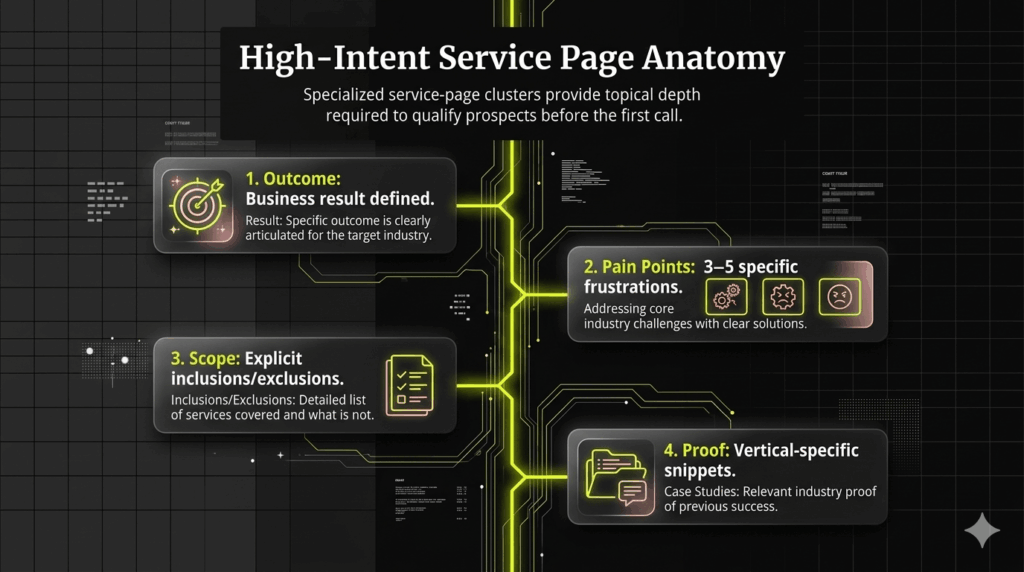
A single Services page is a conversion killer. It lacks the topical depth and granular detail high-intent buyers demand. To bridge the Technical Authority Gap, transition from generic lists to a strategic service-page cluster that captures bottom-funnel intent.
Build dedicated assets for core offerings like Managed IT, Cybersecurity, and Co-Managed IT. If you have the operational depth, add pages for Compliance-as-a-Service or vCIO. This structure signals authority to Google while qualifying prospects before the first call.
Follow a strict conversion anatomy for every page:
- Outcome: One-sentence definition of the business result.
- Pain Points: 3 to 5 bulleted business frustrations you solve.
- Scope: Explicit details on what is included and excluded.
- Proof: Case snippet or vertical-specific testimonial near the CTA.
- Qualification: Prompts for minimum endpoint counts or industry fit.
- Next Step: CTA like a pricing estimator or security assessment.
Map every page to a primary keyword and include FAQs to capture long-tail intent. This turns your MSP website design into a lead-production engine that filters bad-fit prospects and accelerates high-value consultations.
4. Deploy a Multi-Layered Trust Stack
Prospects will not book a discovery call if your site feels like a generic template. High-performance MSP website design must facilitate a total transfer of risk by making credibility obvious within seconds of landing. If a visitor cannot immediately verify your authority, they will bounce to a competitor who appears more established.
Build a hierarchy of proof that goes beyond a single row of vendor badges:
- Client logos (prioritize recognizable vertical-specific brands)
- Outcome-based testimonials (feature specific roles like Director of IT)
- Security signals (SOC 2, HIPAA, or CMMC alignment)
- Partner certifications (Microsoft Gold, Cisco, etc.)
To show compliance without cluttering the UI, use compliance-ready microcopy. Short callouts linked to a dedicated compliance page or tooltips explaining what this means for you allow technical buyers to verify standards without overwhelming non-technical users.
Placement is critical for conversion. Position strongest proof points above the fold and repeat them immediately before high-friction CTAs like pricing requests. Finally, replace stock photos with real images of your engineering team. Using real photos alongside authentic client language humanizes the brand and bridges the Technical Authority Gap, proving there are real experts behind the screen.
5. Move from Technical Claims to Evidence-Based Authority
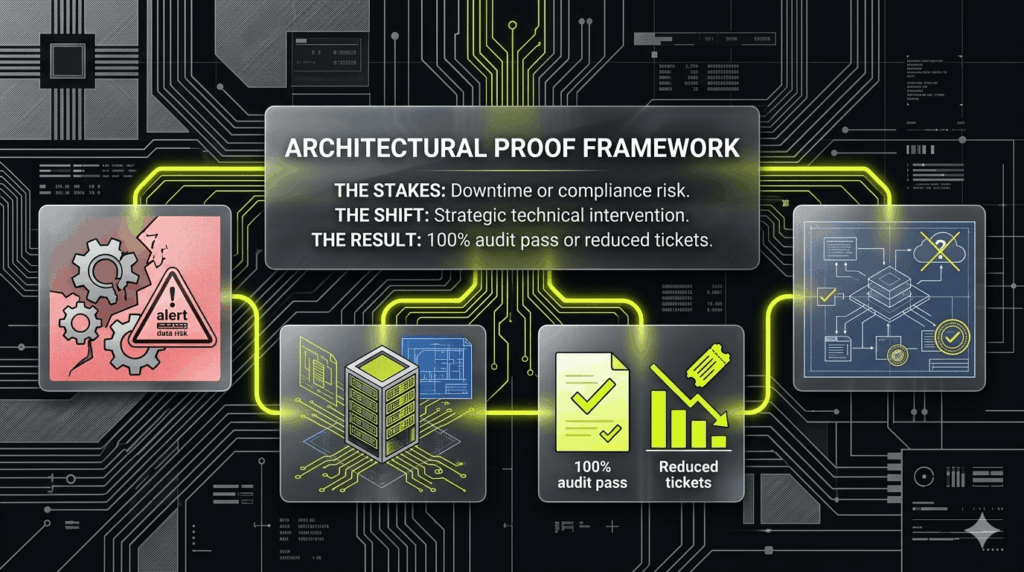
Vague claims like proactive support are commodity noise. High-intent buyers ignore mission statements to seek concrete evidence of managed risk. Strategic MSP website design treats case studies as architectural proof rather than buried blog posts. This bridges the Technical Authority Gap by proving you have solved a prospect’s specific complexity before.
Convert enterprise buyers by following a strict anatomy:
- Client Profile: Industry, headcount, and environment complexity.
- The Stakes: Documented risks like downtime costs or compliance exposure.
- The Shift: Your strategic approach instead of a dry tool list.
- Quantified Outcomes: Data such as 100% audit pass rates, reduced ticket volume, or response time improvements.
- Social Proof: A quote from a credible role like a CEO or CISO.
Centralize these assets into a Proof Hub categorized by vertical and service type. Include Why they chose us callouts to help unqualified prospects self-select out and shorten sales cycles. For high-velocity case study production and SEO distribution, visit nuoptima.com to build organic equity. Close with a direct CTA: See if this approach fits your environment.
6. Build Multi-Stage Conversion Paths for Complex Sales Cycles
Too many MSPs treat websites as a binary switch: book a call or stay anonymous. This ignores six-month sales cycles where buyers need time to establish technical trust. Strategic MSP website design accounts for varying intent by offering both primary and secondary conversion paths. This prevents high-intent traffic from bouncing simply because they aren't ready for a discovery session.
While your primary CTA should focus on booking a strategy session, you must also capture early-stage interest through interactive tools. Replace generic newsletters with high-value lead magnets:
- Pricing Calculators: Set budget expectations while capturing firmographic data.
- Security Posture Checklists: Provide immediate utility for technical decision-makers and CISOs.
- IT Cost Leak Audits: Identify operational waste to create a crisis moment for the buyer.
Deploy chat widgets for automated routing and booking rather than general support. Collect minimal contact data first to reduce friction, then qualify leads via automated follow-up. Ensure your tracking defines qualified conversions by seat count and vertical rather than raw submissions. This multi-layered approach transforms your website into a 24/7 revenue engine that builds equity from your existing traffic.
7. Build Campaign-Specific Landing Pages to Capture Intent
Sending paid or outbound traffic to your homepage wastes budget and kills conversion. High-intent visitors leak through navigation and generic messaging, widening the Technical Authority Gap. High-performance MSP website design requires dedicated landing pages that mirror the specific promise of your campaign.
Execute these rules to align with visitor intent:
- Maintain headline congruence by repeating the exact ad offer.
- Remove site navigation to eliminate exit points.
- Place two proof points (logo + testimonial or metric) above the fold.
- Reduce friction near CTAs with response SLAs or compliance notes.
- Repeat the CTA every two scroll depths plus a strong bottom closer.
Build pages around high-intent MSP offers:
- Co-managed IT assessments
- Compliance readiness reviews
- Ransomware tabletop exercises
- IT spend benchmarks
Apply qualification-by-design by listing specific fit criteria directly on the page. This filters out low-margin tire-kickers and ensures your sales team focuses on enterprise leads who value specialized technical authority. This approach transforms rented traffic into high-value pipeline equity.
8. Build Credible Local Authority Without Ghost Pages
Most IT Support in [City] pages are filtered by search engines for being template-driven duplicates. This thin content widens the Technical Authority Gap and suggests to high-intent buyers that your local presence is a marketing facade. High-performance MSP website design requires a quality-over-quantity approach to local SEO to build genuine market-leading authority.
Establish a robust HQ page and add secondary locations only where you maintain a genuine operational footprint. Distinguish these assets with unique local proof:
- Anonymized regional client examples and photos of local engineering teams.
- Operational logistics like onsite availability, response times, and embedded maps.
- Localized H1s and unique FAQs addressing regional compliance or industry-specific needs.
Link internally to vertical-specific case studies from that region to signal deep expertise to both users and search engines. Explicitly state the company size and industries you serve locally to qualify high-value leads early in the funnel. This strategy builds organic equity and protects your domain from thin-content penalties. Do not spin dozens of near-identical pages; invest in fewer, high-substance assets that drive actual revenue outcomes.
9. Technical SEO: Performance as a Revenue Driver
A visually stunning website that fails to rank is an expensive digital paperweight. Technical friction widens the Technical Authority Gap by signaling a lack of operational excellence to prospects and search engines alike. High-performance MSP website design requires a foundation that satisfies both humans and machines to drive measurable revenue outcomes.
To convert high-intent traffic, prioritize these performance and indexability essentials:
- Focus Core Web Vitals (LCP, INP, CLS) on mobile-first layouts and modern image compression.
- Use clean URL structures with service and location clusters to simplify crawling.
- Establish logical internal linking from the homepage to service pages, proof assets, and conversion points.
- Maintain HTTPS, security headers, and accessibility basics to signal investor-ready technical credibility.
Prepare for Generative Engine Optimization (GEO) in Answer Engines like Perplexity and SearchGPT by implementing structured Schema markup for Organization, LocalBusiness, and Service. Publish clear, citable explanations of your compliance stance and industry expertise. This ensures your firm acts as the primary citation when AI models recommend providers to IT decision-makers. Optimizing technical performance builds the organic equity required to maximize enterprise valuation for an eventual exit.