Ranking for high-volume keywords is useless if your pipeline remains flat. While many practitioners fear CRO changes risk rankings, seo conversion optimization solves this by aligning search intent with UX and rigorous measurement. Use this diagnostic approach to identify performance gaps and ship SEO-safe conversion lifts without rankings regression. Here are eight specific levers to audit on your high-ranking pages. To dominate Google and AI answer engines, explore our GEO services.
Key Takeaways
- SEO conversion optimization aligns search intent with UX and measurement to lift conversions on high-ranking pages without risking rankings regression.
- Map CTAs to intent: informational queries get newsletters or calculators, commercial queries get case studies or pricing, and transactional queries get trials or direct lead gen.
- Client-side A/B tests can degrade LCP and CLS, so shadow-test libraries, prefer server-side testing, and treat Core Web Vitals as experiment stop metrics.
- Limit pages to one primary and one secondary CTA, and measure conversion rate per intent segment rather than sitewide averages.
- By 2026 many users never click through, so engineer content for extractability with concise definitions, numbered steps, and FAQ schema to win the answer layer.
SEO conversion optimization is the practice of aligning search intent with user experience and rigorous measurement so high-ranking pages convert more visitors into pipeline without losing rankings.
1. Map CTAs to Search Intent Segments
High-traffic content fails to produce pipeline when CTAs mismatch visitor intent. Asking a top-of-funnel reader to “Book a Demo” creates friction and kills seo conversion optimization. Alignment between the offer and research stage is mandatory. Stop treating every query as a sales-ready lead.
Classify keyword clusters into three segments, assigning a single primary conversion goal to each.
- Informational: Use newsletters, templates, calculators, or "compare options" guides to capture micro-conversions.
- Commercial: Deploy case studies, pricing explainers, or "talk to an expert" links for active evaluators.
- Transactional: Utilize short-form lead gen, trials, or direct product-led CTAs.
Limit pages to one primary and one secondary micro-conversion CTA. Evaluate success by measuring conversion rates per intent segment rather than sitewide averages, ensuring that your initial MSP keyword research maps directly to functional landing page experiences. This map converts informational SEO traffic into measurable pipelines. A revenue-first strategy prevents wasting authority on mismatched offers.
2. Establish a Governance Model for Page Ownership
Conflict arises when SEO demands comprehensive content for relevance while CRO pushes for minimal, CTA-first layouts. This friction results in stalled projects or accidental rankings regression. Resolve these disputes by categorizing every high-value URL into two governance buckets based on current performance.
SEO-led pages (low traffic or unranked) prioritize relevance. Focus on topical coverage, internal linking, and entity depth. Maintain content volume to support organic rankings until the page earns authority and stable visibility.
CRO-led pages (high traffic and existing rankings) prioritize persuasion. Use seo conversion optimization to refine the narrative and remove friction. Maximize lead flow without breaking the underlying technical architecture or entity signals.
Unify teams with a monthly "page council" involving SEO, design, and CRO to approve experiments and review a shared KPI: revenue per organic visitor. Every test must respect a "non-negotiables" document protecting:
- Primary headings and keyword density
- Schema and entity markups
- Canonical tags and indexation signals
3. Mitigate Experimentation Overhead on Core Web Vitals
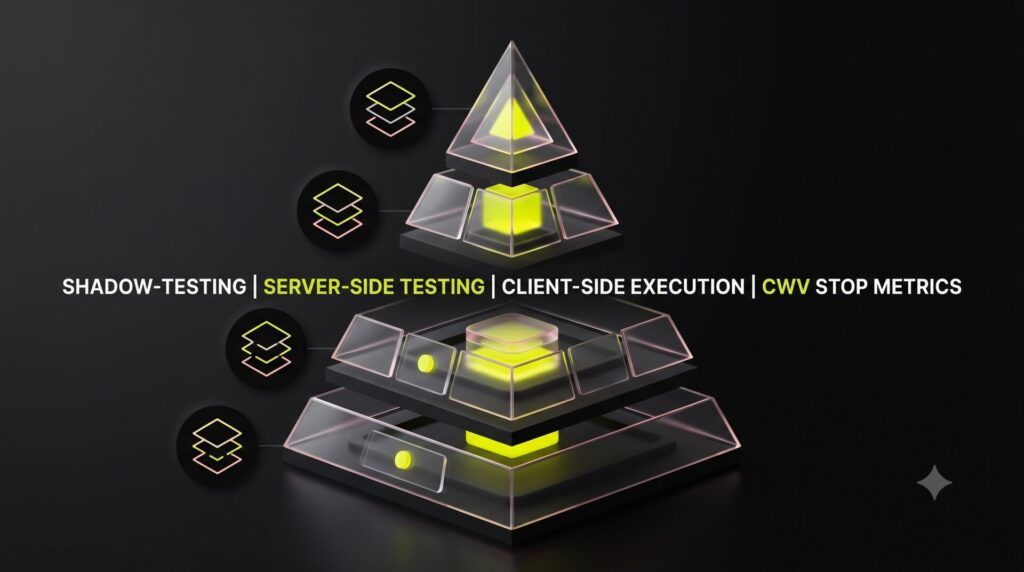
Client-side A/B testing is a silent killer of rankings. Tools meant to improve seo conversion optimization frequently degrade LCP and CLS through JS overhead and anti-flicker delays. These snippets block the first paint, while late DOM swaps trigger layout shifts that Google’s crawlers penalize.
Protect your organic authority with this engineering-led hierarchy:
- Shadow-test the library: Load scripts with zero UI changes to measure pure execution overhead before launching any variants.
- Prioritize server-side testing: Move logic to the edge for SEO-critical pages to eliminate client-side flicker entirely.
- Refine client-side execution: Hide only the specific element under test, set aggressive timeouts, and reserve layout space via CSS.
- Establish CWV guardrails: Treat LCP and CLS as experiment stop metrics. If a variant converts but tanks vitals, it fails.
Annotate vitals by variant in your reporting. Rollbacks must be driven by technical evidence, ensuring conversion gains never silently erode your search visibility.
4. Deploy UX Patterns for Long-Form Conversion Depth
Long-form content builds necessary topical authority but often buries the decision path. While depth fuels rankings, excessive length kills seo conversion optimization. Resolve this tension using design patterns that preserve semantic weight for LLM discovery while creating immediate routes to action for high-intent skimmers.
Implement these four structural patterns to maintain authority while accelerating the user journey:
- Above-the-fold clarity: Lead with a one-sentence value proposition that explicitly identifies the target audience.
- Intent-based navigation: Use jump links so buyers can bypass research and move directly to commercial sections.
- Decision blocks: Insert modules every two screens that combine a proof point, targeted CTA, and key takeaway.
- Accordions: House secondary technical details in expandable sections to satisfy crawlers without obstructing the user journey.
Convert passive headings into decision questions like "Is this right for your scale?" Track scroll depth against CTA clicks per section to identify where intent drops. This reveals the exact point where content must be re-engineered to maximize pipeline contribution and organic ROI, a structural framework detailed inside our exhaustive content marketing MSP growth guide.
5. Align Snippet Promises With Hero Section Narrative
Narrative gaps drive high bounce rates when title tag promises vanish upon landing. If a snippet offers a "Pricing Guide" but the hero touts "The World’s Most Powerful Platform," you lose the visitor immediately. This mismatch wastes earned clicks and degrades user satisfaction signals.
To master seo conversion optimization, execute an intent-match audit:
- Extract the primary promise from the query and SERP language.
- Mirror this promise in the hero headline within three seconds of scanning.
- Transform the CTA into the logical next step of that promise (e.g., "Get the Pricing Framework" instead of "Contact Us").
Place quantified proof, such as logos or ROI metrics, adjacent to the CTA to solidify trust. Specialists must separate title tag tests from on-page CRO changes to isolate variables. Monitor engaged sessions and CTA click-through rates by query cluster to ensure the SERP promise and landing page reality remain synchronized.
6. Architect Measurement for Organic Attribution
SEO reporting fails when it stops at rankings. Without attribution, organic spend looks like a cost center rather than a pipeline driver. Bridge this gap by tracking micro-conversions and assisted conversions from informational pages.
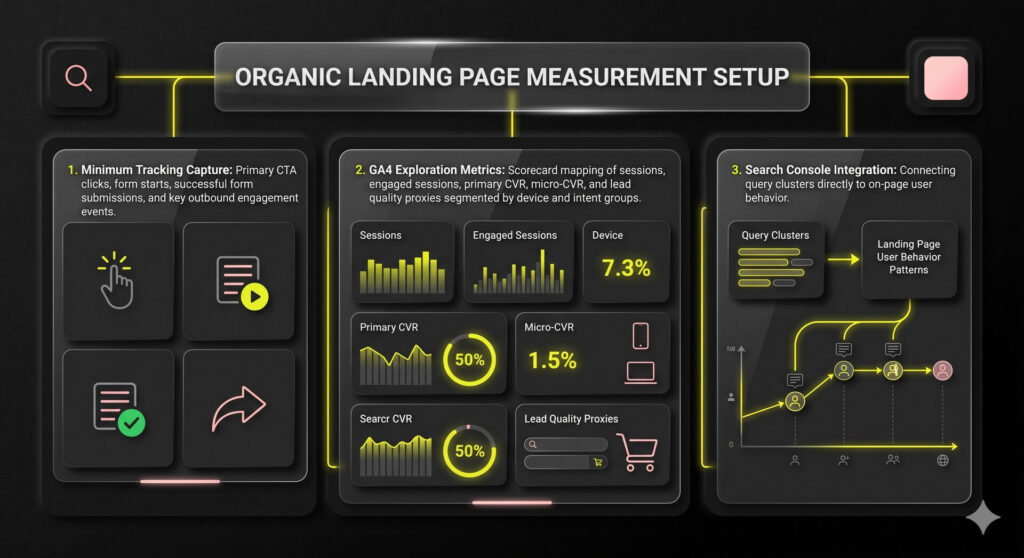
Your minimum tracking setup must capture:
- Primary CTA clicks and form starts.
- Successful form submissions.
- Key outbound clicks and engagement events.
Create a GA4 "Organic Landing Page" exploration to map landing pages to event rates and assisted conversions. Segment data by device and intent groups. Integrate Search Console query clusters to connect specific search terms to on-page behavior.
This produces a scorecard for every URL including:
- Sessions and engaged sessions.
- Primary CVR and micro-CVR.
- Lead quality proxies.
Use this defensible evidence to quantify CRO wins and prioritize the next three URLs for seo conversion optimization.
7. Route Authority to Commercial Points with Internal Linking
Most B2B sites treat internal links as technical plumbing. This leaves visitors on high-ranking informational pages stranded without a guided commercial path. You must transform internal links from passive crawl budget tools into active conversion routing systems that prioritize revenue-ready intent.
Use intent-based anchors and tactical blocks to bridge the gap between education and purchase:
- Deploy "next-best page" blocks including case study summaries or solution comparisons to move users through the funnel.
- Insert links to pricing explainers or technical audits immediately after solution proof or intent escalation.
- Replace generic "learn more" anchors with transactional text like "see pricing for this approach" or "book an assessment."
- Prioritize contextual links over aggressive sitewide footer blocks to maintain SEO safety.
For brands focused on AI search, these bridges establish the entity relationships central to GEO services. This architecture converts informational traffic into pipeline by intentionally routing users toward commercial proof points that close the deal. Measure impact by tracking assisted conversions and path length from organic landing pages.
8. Optimize for the Answer Layer and Late-Stage Arrivals
By 2026, many organic users will never click through to your site. AI engines satisfy informational intent on the SERP, meaning remaining clicks represent high-intent buyers arriving late in the decision cycle. Your seo conversion optimization must start in the answer layer and continue on-page.
Engineer content for "extractability" to ensure AI models cite your brand as the definitive source. Focus on:
- Concise definitions and numbered process steps.
- FAQ schemas that resolve specific user pain points.
- Robust entity signals to establish cross-platform authority.
Overhaul landing pages for "post-summary" visitors who have already read the AI’s synthesis. Eliminate introductory fluff. Lead with unique differentiation, scannable proof, and above-the-fold outcomes. Tighten time-to-value with immediate CTA options like demo bookings or pricing tools. For brands requiring elite GEO and SEO alignment, visit nuoptima.com or explore our specialized GEO services.
NUOPTIMA provides the AI-native expertise required to align traditional SEO with modern conversion requirements. Visit nuoptima.com or explore our GEO services to bridge the gap between search visibility and organic revenue.