Most MSPs suffer from vanity traffic but zero meetings and commoditization. Effective SEO for managed service providers functions as a revenue system, not a blog program. Success requires capturing bottom-funnel intent for higher contract values and CRM-attributed pipeline.
At NUOPTIMA (nuoptima.com), we use an AI-first SEO and RevOps framework to de-risk growth. This model moves from intent mapping to service pages, GEO dominance, and tracking. It starts with positioning and ICP clarity.
Key Takeaways
- Effective SEO for managed service providers functions as a revenue system, not a blog program, capturing bottom-funnel intent for higher contract values and CRM-attributed pipeline.
- Targeting generic terms like managed IT services attracts DIY buyers and micro-businesses, so leadership should pick one or two ICPs and verticalize the position.
- MSP buyers hire from service pages, not blog posts, so build a Managed IT pillar page with dedicated high-intent pages for security, cloud, compliance, and vCIO.
- Map keywords across four intent buckets (category, pain-point, compliance, switch) and prioritize them with a business value score of ACV/LTV times urgency times competitiveness.
- Tie SEO to CRM data with lead scoring and source tracking so organic performance survives investor and board scrutiny as predictable revenue.
SEO for managed service providers is a revenue-focused search strategy that maps high-intent keywords to verticalized service pages and CRM-attributed pipeline, capturing high-value B2B contracts instead of vanity traffic.
1. Define a Defendable Position and Strategic Wedge Offers
High traffic with low close rates often signals a "Technical Authority Gap" where content fails to filter for quality. Targeting generic terms like "Managed IT Services" attracts DIY buyers and micro-businesses who commoditize your expertise. This lack of positioning forces sales teams to waste time on price-shoppers rather than high-value enterprise accounts. To solve this, leadership must shift from generalist SEO to a defendable, verticalized position.
Select one or two primary ICPs, such as PE-backed mid-market firms or healthcare providers facing strict HIPAA requirements. Establish strict disqualifiers for budget, seat count, and compliance needs to protect your sales capacity. Map your wedge offers to urgent business triggers like M365 security hardening, ransomware recovery, or failed audits. These high-intent triggers bypass the common objection that the prospect already has an existing IT provider.
Effective SEO for managed service providers translates these business pains into specific search language. There is a massive intent difference between broad terms like "Managed IT" and specific queries like "CMMC consulting + managed security." Use high-intent keywords like "vCIO services for manufacturing" or "cyber insurance requirement gap analysis" to capture buyers during a crisis. Every service page needs a "Problem, Service, Proof" narrative that speaks directly to the executive's specific vertical.
Your proof layer must feature case studies and testimonials tailored to the chosen ICP. For a law firm, a narrative about securing practice management software is more persuasive than generic uptime statistics. Replace session volume with the lead-to-opportunity rate by segment as your North Star KPI. Narrowing your focus upstream ensures your CRM fills with investor-ready revenue rather than unqualified noise.
2. Build High-Intent Service Pages to Capture Bottom-Funnel Demand
MSP buyers do not hire from blog posts; they hire from service pages that prove capability, scope, and reliability. Ranking for informational content while losing deals to weak service pages creates a "Technical Authority Gap" where traffic rises but the sales pipeline stays flat. Your website must evolve from a general resource into a conversion-focused asset that targets bottom-funnel intent.
A common mistake in SEO for managed service providers is using a single "Services" page to list a dozen items without depth. This approach fails to rank for specific, high-value queries and signals a lack of specialization. Instead, build a "Managed IT Services" pillar page supported by dedicated high-intent pages for:
- Managed Security, MDR, and Microsoft 365 hardening.
- Cloud migration, management, and backup/DR.
- Compliance frameworks like HIPAA, SOC2, and CMMC.
- vCIO advisory and IT helpdesk support.
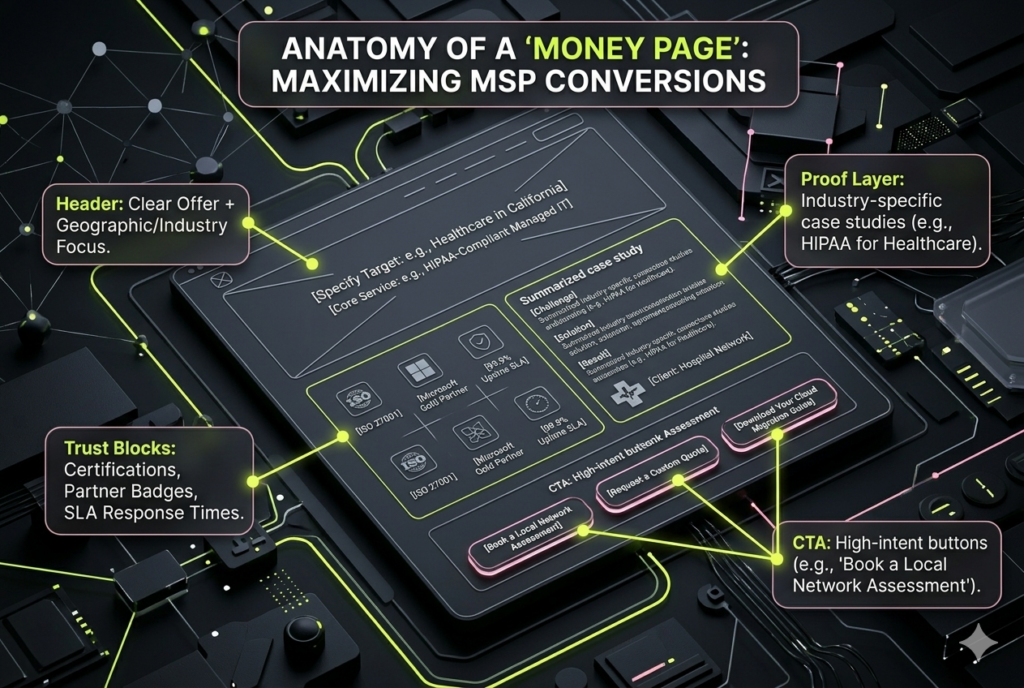
Each "money page" requires a pipeline-first anatomy. Above-the-fold content must clearly state your exact offer, geographic or industry focus, and a primary CTA. Replace generic marketing promises with concrete deliverables and trust blocks, including certifications, partner badges, and specific SLA response times. Proactively handle objections by detailing pricing models, onboarding timelines, and switching costs.
Maximize results by using internal linking to funnel authority from technical blogs and city pages directly into these service pages. Ensure Google Business Profile (GBP) links point to the best-fit landing page rather than the homepage. Shift primary KPIs from raw sessions to conversion rates per service page and assisted conversions in your CRM. This architecture transforms your site into a digital sales department that wins on proven authority.
3. Prioritize Keywords That Map to High-Value Buying Moments
Busy content calendars often produce vanity metrics instead of $10k MRR conversations. To build investor-grade revenue, leadership must prioritize keywords correlating with high-stakes buying moments: audits, security breaches, compliance deadlines, or vendor failures. This approach eliminates wasted marketing spend by aligning search visibility with immediate urgency and revenue potential.
Segment your intent into four distinct buckets to capture prospects at the technical authority gap:
- Category Intent: "Managed IT services [city]" or "IT support company [city]" for local market dominance.
- Pain-point Intent: "Ransomware protection for manufacturing" or "backup disaster recovery for small business."
- Compliance Intent: "SOC 2 readiness IT," "CMMC level 2 requirements support," or "HIPAA IT compliance."
- Switch Intent: "Replace internal IT," "outsourced IT vs in-house," or "MSP contract termination checklist."
Apply a strict mapping rule of one primary keyword cluster per page. Avoid diluting URL authority by stuffing multiple services into a single landing page. Prioritize these assets using a business value score: (ACV/LTV) × Urgency × Competitiveness. This data-driven prioritization mirrors M&A due diligence by focusing on sustainable, high-value lead sources.
Validate your keyword list against the sales team’s top ten "why now?" triggers. If your engineers are constantly remediating email breaches, your SEO should focus on "M365 security hardening" and phishing protection. Track the MQL to SQL conversion rate by keyword theme rather than raw traffic.
Avoid the common mistake of publishing "What is an MSP?" posts while attempting to sell $20k MRR contracts. C-suite decision-makers already know the definitions. They need to know if you can navigate their specific technical crisis or meet a pending regulatory deadline.
| Intent bucket | Example query | Goal |
|---|---|---|
| Category intent | Managed IT services [city] | Local market dominance |
| Pain-point intent | Ransomware protection for manufacturing | Capture buyers in crisis |
| Compliance intent | SOC 2 readiness IT, HIPAA IT compliance | Win high-margin regulated deals |
| Switch intent | Outsourced IT vs in-house | Convert prospects leaving a provider |
4. Optimize Google Business Profile as a Local Revenue Channel
Local visibility is frequently the highest-intent entry point for MSP searches. If you fail to appear in the "Map Pack" for "near me" or city-based queries, you remain invisible to ready-to-call prospects. Most firms treat Google Business Profile (GBP) as a static directory rather than a high-performance revenue channel. This neglect allows competitors with lower technical capabilities but better local SEO to capture the most profitable local demand.
Transforming GBP into a lead engine starts with surgical category selection. Set "Managed IT Services" as your primary category and include secondary categories like "Computer Support and Services" or "Data Recovery Service." Your profile must include:
- A services list mirroring your website’s technical nomenclature.
- Consistent NAP (Name, Address, Phone) data across all digital citations.
- Weekly posts highlighting project wins or recent security alerts.
- High-resolution office photos to bridge the "Technical Authority Gap."
A complete profile signals consistency to search algorithms and builds immediate trust with C-suite decision-makers. You must operationalize your review engine rather than waiting for client generosity. Integrate review requests into specific milestones such as onboarding completion, positive Quarterly Business Reviews (QBRs), or ticket resolutions. Encourage clients to include industry-specific outcomes, as reviews mentioning "securing a 50-seat law firm during a HIPAA audit" build far more institutional trust than generic praise.
Pair your profile with conversion-optimized landing pages to maximize ROI. Never direct GBP traffic to a generic homepage. Instead, link to localized service pages that address regional pain points and compliance needs. This is a critical tactic for SEO for managed service providers to ensure high-intent clicks turn into discovery calls. Track GBP-specific calls and form fills to calculate your local close rate, avoiding the "set and forget" mistake that yields the pipeline to active competitors. For a deeper breakdown of geography-first tactics, see our guide to local SEO for MSPs.
5. Scale Market Reach with a Service-Area Expansion System
Many MSPs remain geographically invisible outside their primary zip code despite serving multiple regions. This invisibility allows local competitors with less expertise to capture high-margin enterprise contracts. For PE-backed firms, this creates a bottleneck when proving regional dominance during a roll-up or exit. To scale effectively, you must build a location-based engine that respects Google Service-Area Business (SAB) guidelines while capturing multi-metro demand.
Build a prioritized "Top 20" list of target cities based on current client density and revenue potential. For each location, develop unique city-plus-service landing pages that solve the Technical Authority Gap. Each page must feature hyper-local proof:
- Specific case studies from that metro or industry cluster.
- Regional compliance references or local regulatory knowledge.
- Clear service scope available for that specific territory.
Deploying thin, duplicated doorway pages is a common mistake in seo for managed service providers. This triggers quality filters and devalues your brand equity. Instead, use a location hub architecture that links to city pages, which then link to service pages. This structure distributes authority and ensures a clean user experience while avoiding spam signals.
Align this strategy with your Google Business Profile (GBP) by mirroring your offerings in the GBP Services section. Route that traffic directly to the corresponding city landing page rather than a generic homepage. Track visibility, organic sessions, and conversion rates per city to ensure expansion generates qualified pipeline. By treating each territory as a distinct revenue asset, you build a scalable lead engine that increases the firm’s enterprise value.
6. Audit Technical Infrastructure to Protect Attribution and Crawl Budget
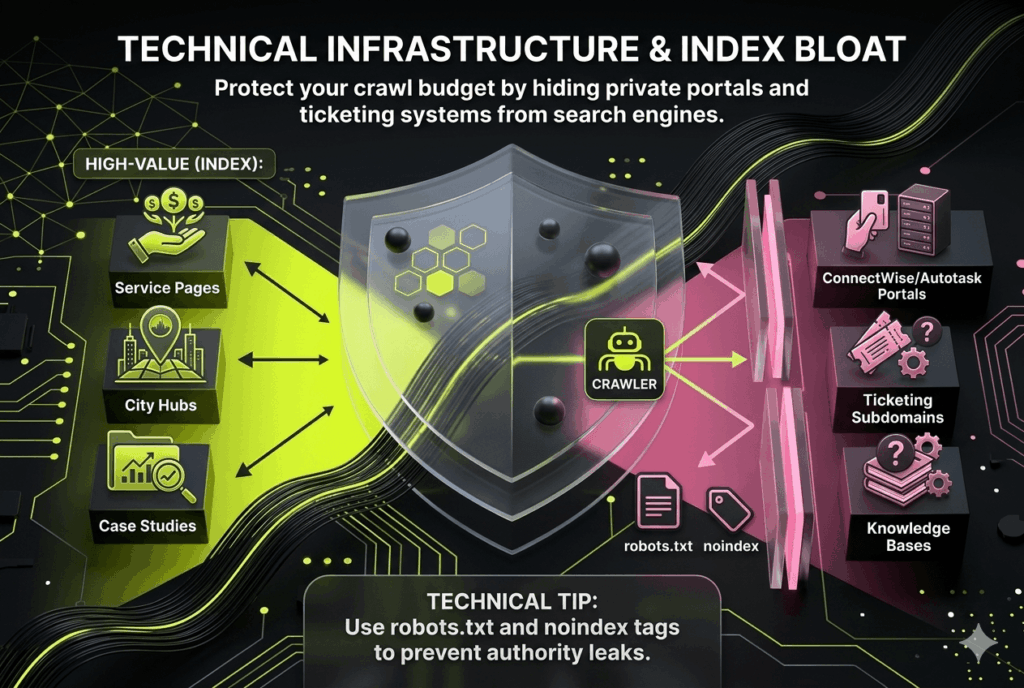
Inconsistent SEO results often stem from technical infrastructure leaking authority. MSP sites are complex ecosystems including client portals, ticketing subdomains, and knowledge bases. Unmanaged, these create index bloat that suppresses service pages and fragments pipeline reporting. This technical debt directly widens the "Technical Authority Gap" between your expertise and your search visibility.
Private environments like ConnectWise or Autotask portals frequently end up in Google’s index by mistake. This forces search engines to waste crawl budget on thin, duplicate content instead of high-value service pages. Apply strict noindex rules or robots.txt directives to keep these areas invisible. If a support area must be public, isolate it with a clean URL structure and use canonical tags to prevent it from cannibalizing your core rankings.
Technical fundamentals also impact M&A readiness and lead conversion. Slow mobile speeds and poor Core Web Vitals kill pipeline growth before a prospect even evaluates your technical depth. Use lightweight, high-performance service templates. Technical decision-makers value site efficiency and clarity over flashy animations or heavy scripts that slow down the user experience.
Broken attribution between the main site and subdomains remains a critical failure point. Without cross-domain tracking, a session starting on a blog and converting on a portal booking link appears as "Unknown" in your CRM. Implement robust event tracking for high-intent actions:
- Inbound phone calls and form submissions
- Live chat and chatbot engagements
- Calendly or portal booking links
- Whitepaper and gated asset downloads
Monitor KPIs like indexed page count quality, crawl errors, and the reduction of "unknown/other" sources in your CRM. A common mistake is letting support portals get indexed while wondering why service pages cannot break into top positions. Solving these infrastructure issues protects your rankings and ensures revenue attribution is accurate and investor-ready.
7. Build Trust Signals That Influence Shortlist Decisions
Many MSPs struggle with a "Technical Authority Gap," where prospects only trust their expertise late in the sales cycle. High-performance SEO for managed service providers focuses on outperforming competitors on trust signals rather than just search volume. In the era of Generative Engine Optimization (GEO), authority is not a generic link-building game. It is about earning specific citations that influence both human shortlists and AI recommendations simultaneously.
Your SEO strategy must prioritize high-stakes proof assets that double as sales enablement tools. Replace generic blog posts with content that demonstrates operational maturity:
- Outcome-based case studies: Focus on measurable results like reduced downtime, successful audit passes, or incident response speeds.
- Comparison pages: Capture buyers weighing internal options with "Co-managed IT vs. Fully Managed IT" or "MSP vs. Internal IT."
- Compliance explainers: Detail the technical nuances of SOC2, HIPAA, or CMMC required for enterprise-grade contracts.
Strategic citations must prioritize industry relevance over raw domain authority. Instead of chasing low-value backlinks, earn mentions where high-intent buyers actually research:
- Industry-specific directories: Credibility sites that real buyers use for vendor vetting.
- Local partnerships: Regional industry groups and chambers of commerce.
- Vendor ecosystems: Legitimate mentions within the Microsoft, Cisco, or Datto partner networks.
Establish on-page trust by citing these assets where prospects feel the most friction. Every service page should link directly to a relevant case study or technical whitepaper to validate your claims. For KPI tracking, monitor assisted conversions from proof pages and the reduction in your total sales cycle length. Avoid buying low-quality links; they create technical risk without improving buyer trust or your firm’s M&A readiness and exit valuation.
8. Focus on Verticalization and High-Intent Crisis Triggers
High impressions often mask a stagnant sales pipeline. This paradox occurs when SEO attracts a DIY audience or micro-businesses that fail to meet seat minimums. To capture investor-grade revenue, pivot from generic IT advice to a verticalization framework that speaks directly to high-value, regulated industries. This shift ensures your pipeline reflects the high lifetime value associated with managed services contracts.
Build dedicated landing pages for sectors where technical expertise is a non-negotiable requirement:
- Healthcare (HIPAA/HITECH compliance)
- Legal (Data privacy and litigation support)
- Manufacturing (CMMC and supply chain security)
- Financial Services (SEC and FINRA regulatory hurdles)
These pages must address sector-specific pains and include proof points like industry-specific logos or testimonials. Use precise compliance language to signal technical authority to C-suite decision-makers who believe generalist providers lack the necessary depth.
Target "crisis-moment" themes to capture buyers during urgent triggers. Content focusing on failed audit recovery, ransomware response, or cyber insurance requirements captures prospects at peak urgency. A "Microsoft 365 hardening checklist" addresses immediate security fears while demonstrating your technical rigor. Optimize for replacement intent using terms like "switching MSP" or "MSP contract red flags" to attract prospects already seeking a partner to bridge the technical authority gap.
Every piece of content must serve as a funnel, routing to a core service page and a "book a call" CTA. To maximize M&A readiness and enterprise valuation, repurpose top articles into sales one-pagers and outbound email sequences. Shift your primary KPIs from raw traffic to qualified form-fill rates and opportunity creation from vertical pages. Publishing generalized IT tips without a vertical hook is a strategic error that wastes crawl budget on leads that will never convert. Every interaction should move the prospect closer to a consultation that highlights your firm’s unique market-leading authority.
9. Tie SEO to CRM Data for Investor-Grade Reporting
Leadership doesn’t buy SEO; they buy predictable revenue and maximized enterprise valuation. Most seo for managed service providers fails because reporting remains trapped in Google Search Console, disconnected from the CRM. If your organic data cannot survive investor or board scrutiny, it is a liability rather than an asset. You must bridge this gap by treating your website as a data-fed extension of your sales department.
Establish a minimum viable measurement stack to capture high-intent conversion events:
- Demo bookings and formal assessment requests.
- Standard contact forms and technical inquiry chats.
- Qualification fields including employee headcount, industry vertical, and current IT pain points.
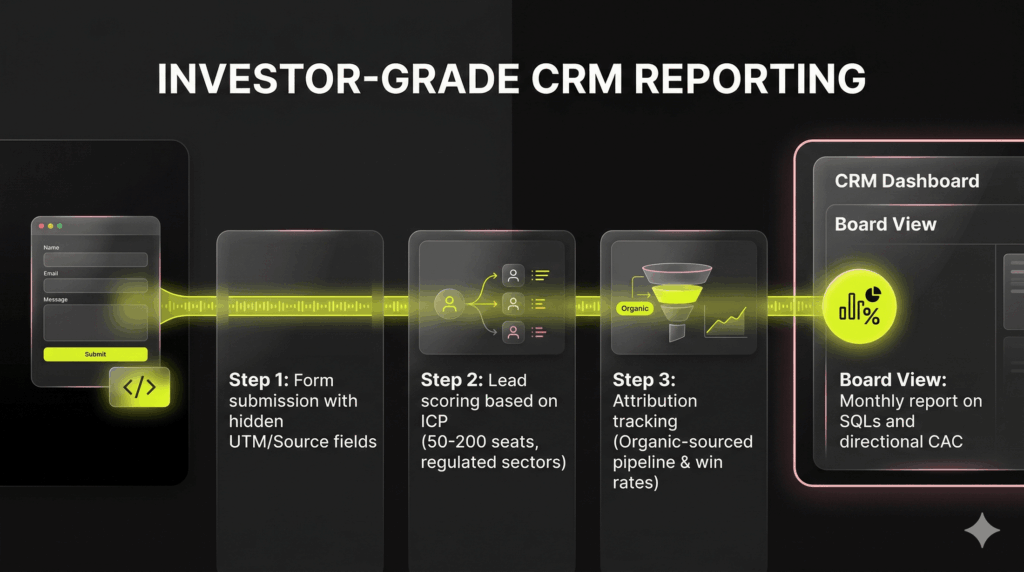
Ensure forms use hidden fields to push original source and landing page data directly into HubSpot or Salesforce. This infrastructure allows you to separate low-value support tickets or job seekers from high-intent Sales Qualified Leads (SQLs).
Implement lead scoring rules aligned with your ICP, specifically targeting firms with 50 to 200 employees in regulated sectors. Trace every content dollar to organic-sourced pipeline, win rates, and directional CAC payback assumptions. Reporting must highlight page-level performance to identify which specific service pages generate the highest quality opportunities. This makes SEO accountable to the same investor-ready standards as your sales team.
Protect ROI through a structured execution cadence:
- Weekly technical fixes to maintain site health and speed.
- Monthly experiments with Generative Engine Optimization (GEO) to capture AI-search citations.
- Quarterly re-prioritization based on actual closed-won revenue data.
This systematic approach ensures marketing spend builds organic equity that increases company valuation during M&A due diligence. Professionalize your growth engine by inviting your leadership to a high-intent MSP SEO and RevOps audit at nuoptima.com. We help technical founders transform marketing into a measurable revenue outcome.