IT services buyers still research via Google, but the search engine now answers their queries directly on the SERP. High rankings fail to drive pipeline when AI Overviews and featured snippets capture the click.
To compete, you must master zero click seo by structuring content specifically for the answer layer. NUOPTIMA’s SEO and GEO strategy is simple: Don’t Just Rank. Be The Answer. Use these structural moves to ensure your brand becomes the cited authority across every search surface.
Key Takeaways
- Zero-click SEO structures content for the answer layer so your brand becomes the cited authority across featured snippets, knowledge panels, and AI Overviews, even when the search ends on the SERP.
- Map content to query classes that trigger answer modules: definitions, steps and checklists, comparisons, pricing ranges, and troubleshooting, with one best answer defined per cluster.
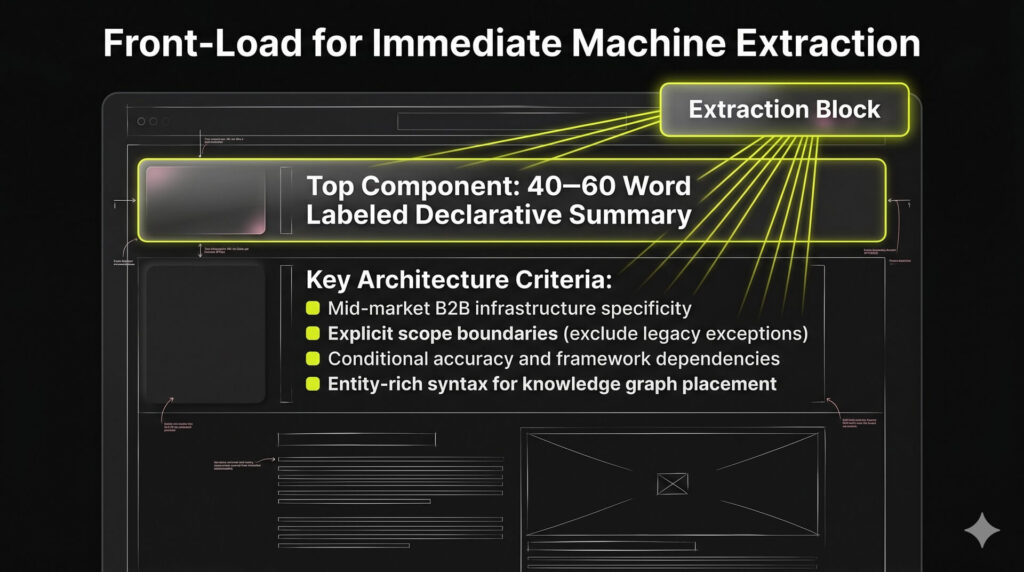
- Front-load a labeled 40 to 60 word declarative answer at the top of the page so search engines and LLMs can extract your brand without parsing surrounding narrative.
- Deploy a minimum viable schema stack (Organization, Service, FAQPage, HowTo) and tie entities to standards like SOC 2, ISO 27001, or NIST to avoid 'anonymous expertise' where Google uses your data but omits your brand.
- Measure impact with a three-layer scorecard (visibility, brand lift, pipeline) over a 60 to 90 day window to account for the research-to-inbound lag in IT buying cycles.
Zero-click SEO is the practice of structuring content to satisfy a searcher's intent directly on the results page through featured snippets, knowledge panels, and AI Overviews, so your brand is cited as the answer even when no click occurs.
1. Map Content to Specific Query Classes
Stop guessing which IT service content Google will swallow into AI Overviews. Effective zero click SEO requires targeting specific query classes that trigger answer modules. Effective zero click SEO requires targeting specific query classes that trigger answer modules, which can be organized efficiently using content clusters seo. Segment your keywords by intent to build deliberate search infrastructure.
Categorize clusters into these high-probability snippet triggers:
- Definitions
- Steps and checklists
- Comparisons
- Pricing ranges
- Troubleshooting
For every cluster, define the single best answer the SERP requires. This mapping transforms your brand into the primary citation, which naturally drives passive link building as other sites reference your data, moving your strategy from reactive ranking to knowledge graph ownership. This solves content unpredictability by aligning format with algorithmic intent.
| Query Class | IT Service Example | Best Format | Page Type |
| Definition | What is SOC 2? | Paragraph | Glossary |
| Comparison | MDR vs EDR | Table | Blog |
| Process | Cloud migration checklist | List | Service Page |
| Tactical | How long is a penetration test? | FAQ Block | Service Page |
2. Front-Load the Answer for Machine Extraction
Google ignores technical white papers when insights are buried under narrative introductions that AI crawlers skip. To dominate zero click SEO, front-load your most valuable information for immediate machine extraction.
Direct answer: Place a labeled, 40 to 60 word declarative summary at the top of the page. This allows search engines and LLMs to extract your brand as the authoritative citation without needing to parse the surrounding narrative.
- Mid-market specificity: Target answers specifically for B2B cloud and hybrid-cloud infrastructures.
- Clear boundaries: Define the scope by excluding legacy mainframe environments or niche hardware edge cases.
- Conditional accuracy: Mention dependencies like specific cloud provider variations or regulatory frameworks.
- Entity-rich syntax: Use definitive declarations to strengthen brand associations within the knowledge graph.
This architecture turns complex IT documentation into instant citations, ensuring your brand remains the canonical source for AI answers.
3. Format Pages for Modular Extraction
Zero-click SEO requires pages to function as modular knowledge units matching specific SERP UI components. This architecture increases selection odds for list, step, and comparison snippets. Write H2s as direct intent matches, such as “How does a vulnerability assessment work?” to signal immediate relevance.
Deploy formats that align with dominant snippet structures:
- Comparison Tables: Use for “MSP vs. internal IT,” “SIEM vs. SOAR,” or “IaaS vs. PaaS” queries.
- Ordered Lists: Detail 1 to 7 steps for incident response or onboarding checklists.
- Unordered Lists: Define specific criteria for compliance or software selection.
Never scatter process steps across multiple paragraphs. Scannability is the primary requirement for dominating the answer layer. If insights are buried in prose, they remain invisible to the knowledge graph. Structured layouts ensure your content is extracted and cited as the definitive authority.
4. Engineer Entity Authority for Brand Recall
“Anonymous expertise” occurs when Google uses your data to satisfy a query but omits your brand. This happens when content informs the answer layer without strong entity signals. To capture value in zero click seo, you must be named as the authoritative source.
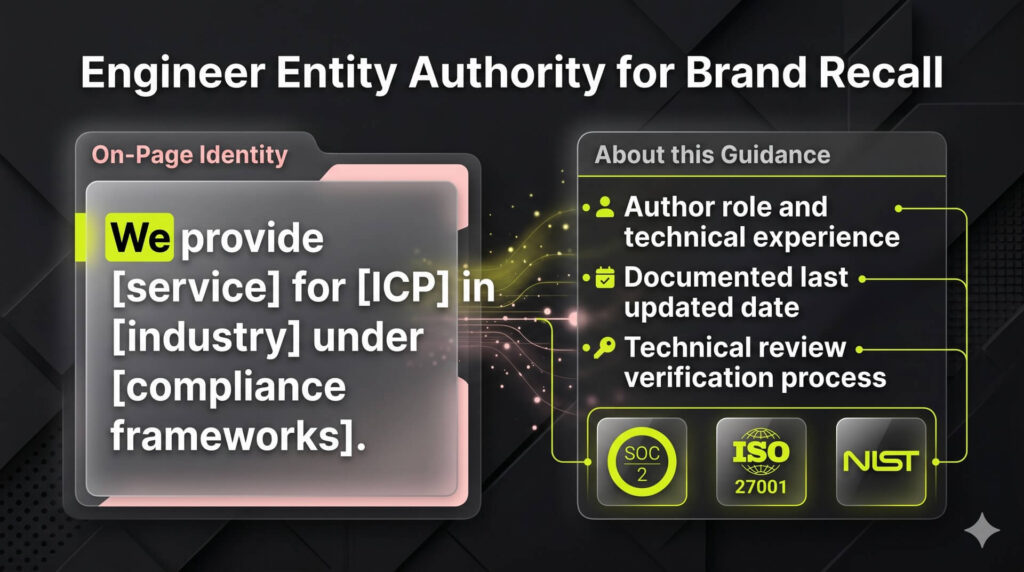
Explicitly define your service entity on-page with declarative statements: “We provide [service] for [ICP] in [industry] under [compliance frameworks].” Include an “About this guidance” micro-block detailing:
- Author role and experience
- Last updated date
- Technical review process
Reinforce authority site-wide through consistent naming and strategic internal linking. Incorporating b2b local seo practices can further anchor your entity to specific geographic regions. Map glossary definitions to service pages and verified case studies. For IT services, tie entities to compliance standards like SOC 2, ISO 27001, or NIST to improve disambiguation. This architecture ensures search engines cite your brand as the definitive entity behind the generated answer.
5. Deploy Schema Architecture for Machine Readability
Ambiguity is the primary barrier to dominating the answer layer. Without structured data, Google and AI systems must guess your page’s purpose. Machine-readable code ensures these engines confidently interpret brand entities, service definitions, and Q&A units.
Deploy this minimum viable schema stack for IT services:
- Organization: Establishes brand entity authority.
- Service: Defines specific offer parameters.
- FAQPage: Structures concise Q&A.
- HowTo: Maps technical step-by-step guides.
Use FAQ schema to capture zero click seo visibility for high-intent queries. Addressing objections like “How much does a cloud migration cost?” or “How long does implementation take?” positions your brand as the definitive source before a user even clicks.
Align all schema attributes with visible on-page content to maintain integrity. Validate implementation via the Rich Results Test and monitor Search Console reports. This infrastructure ensures your site is eligible for rich results and reliable parsing by generative engines.
6. Measure Influence with an Answer Layer Scorecard
Leadership often panics when organic sessions plateau, overlooking that your brand is now the primary answer across Google and AI engines. Defend your zero-click SEO and GEO investment by shifting the reporting narrative from click volume to strategic influence.
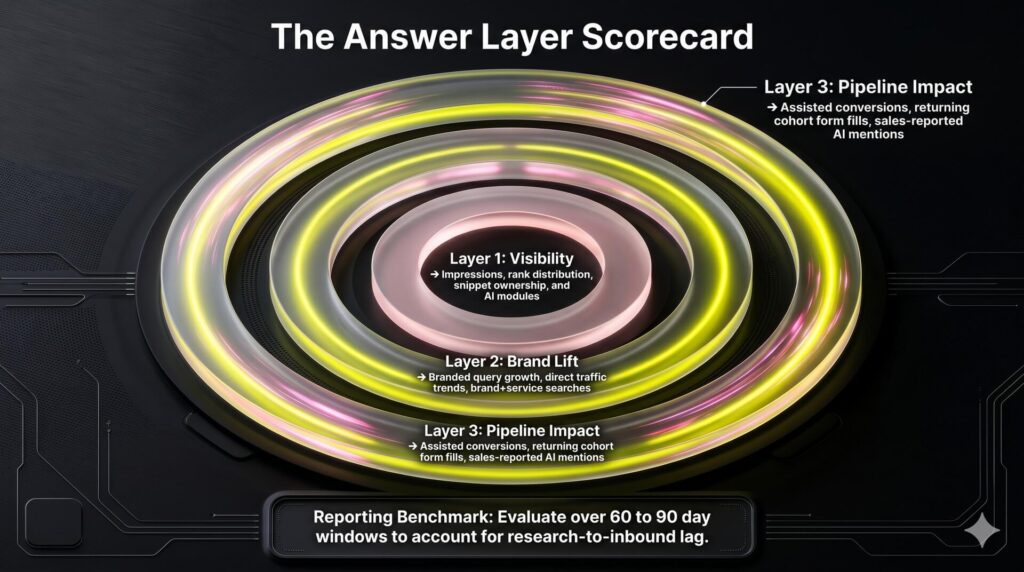
Use a three-layer framework to prove search value:
- Visibility: Track impressions, rank distribution, and ownership of snippets or AI modules.
- Brand Lift: Monitor branded query growth, direct traffic trends, and brand+service query combinations.
- Pipeline Impact: Measure assisted conversions, form fills from returning cohorts, and sales-reported “heard about you from AI” mentions.
Build a monthly Answer Layer Scorecard for priority query clusters to track deltas after structural changes. For IT services, measure performance over 60 to 90 day windows to account for the research-to-inbound lag. This ensures stakeholders recognize that even without a click, your brand remains the architect of the buying decision.
FAQ
Zero-click SEO is the practice of optimizing content to satisfy user intent directly on the Search Engine Results Page. This occurs via featured snippets, knowledge panels, and AI Overviews. For IT services, this is not a negative development. While it may reduce immediate sessions, it creates vital brand visibility and places your firm on the buyer’s shortlist. The strategic goal is to own the answer layer and earn the branded search later in the pipeline.
Optimizing for featured snippets requires technical precision in formatting, specifically using answer-first paragraphs, structured lists, and comparison tables. AI-generated answers rely on broader trust signals, including entity consistency, authoritative citations, and comprehensive structured data. Content structure remains the shared foundation for both. By organizing your insights into modular, extractable blocks, you ensure your brand is the primary source for both traditional Google snippets and generative engine responses.
Measure impact using a three-layer model: visibility, brand lift, and pipeline. Instead of focusing solely on traffic, track impressions in Google Search Console and the growth of branded search queries. Monitor assisted conversions where a user interacted with a zero-click result before visiting your site. Because IT services have complex buying cycles, evaluate these metrics over a 60 to 90 day window. This reporting shift proves that your brand is influencing the research phase even without a session.
Prioritize pages that address common research hurdles, such as glossary definitions for compliance terms like SOC 2 or SIEM. Focus on comparison pages like MDR vs EDR, cloud migration checklists, and pricing explainers. You should also update service pages with FAQ schemas and concise blocks defining what the service is and who it is for. These informational assets are high-probability triggers for AI Overviews and rich snippets, ensuring your expertise is extracted for high-intent queries.
Investment in GEO is necessary when competitors appear in AI citations or when you observe CTR erosion on your top informational queries. If leadership is concerned about visibility in ChatGPT, Gemini, or Perplexity, you must move beyond traditional ranking tactics. If your visibility is rising while traffic falls, you don’t need more content; you need answer-layer architecture.
Explore NUOPTIMA’s GEO services to secure your brand’s position as the definitive AI-cited authority in your market.
Where this fits in your MSP growth system
This is one piece of how NUOPTIMA makes MSPs and cybersecurity firms the provider buyers find on Google and in AI search. See how it connects to MSP SEO and GEO and AI-search, or get your free MSP lead forecast to see exactly where your firm shows up across ChatGPT, Gemini, and Perplexity today.