Outreach fatigue is the silent killer of organic revenue. Scalability hits a wall when growth depends on manual begging.
Passive link building is engineered inevitability. It treats backlinks as a byproduct of being the most authoritative, discoverable source. High-intent distribution through SEO and syndication replaces manual pitching.
Use these nine scalable plays to earn authority and AI citations while avoiding the cold-start trap. Establish the flywheel first so every tactic compounds and secures long-term visibility.
Key Takeaways
- Passive link building treats backlinks as a byproduct of being the most authoritative, discoverable source, replacing manual outreach with SEO and syndication.
- It runs on a flywheel of three inputs: a link-worthy asset, built-in discovery, and a recurring refresh cadence so authority compounds instead of decaying.
- Proprietary data, no-code calculators, and explanatory definition hubs are the strongest link magnets because journalists and AI engines cite them as primary sources.
- Engineer freshness into the URL with a canonical slug like /industry-statistics/ rather than year-specific paths to accumulate backlink equity over years.
- High-value assets double as AI citation sources, so making attribution frictionless with a How to cite block and structured answers earns links across both Google and generative engines.
Passive link building is a system that earns backlinks and AI citations as the inevitable byproduct of publishing high-value, discoverable assets such as proprietary data, calculators, and canonical definitions, rather than through manual outreach.
1. The SEO Flywheel: Building Systems for Compounding Authority
Passive link building is not a series of tactics. It is a compounding system engineered to make backlink growth predictable. This shifts link acquisition from a manual outreach struggle to an automated result of your search infrastructure.
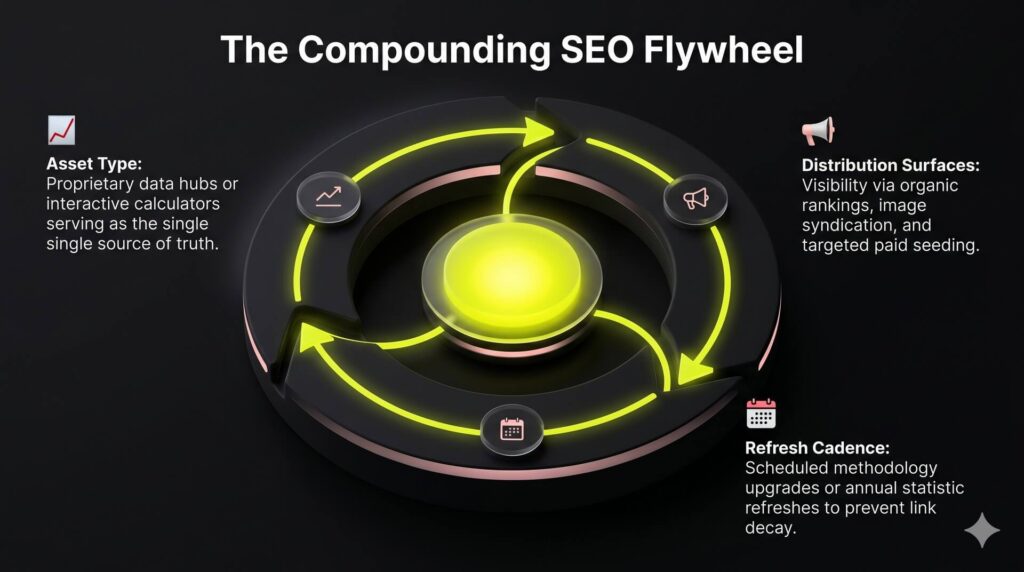
The system functions as a flywheel: link-worthy asset + built-in discovery + recurring freshness. By managing these inputs, you stop chasing mentions and start owning the source material that journalists and AI engines cite.
Control growth through three specific inputs:
- Asset Type: Deploy proprietary data hubs or calculators that serve as the “single source of truth” for your niche.
- Distribution Surfaces: Ensure visibility via organic rankings, image syndication, and paid seeding to trigger the citation cycle.
- Refresh Cadence: Schedule methodology upgrades or annual statistic refreshes to maintain authority and prevent link decay.
Track high-signal metrics like referring domain velocity, link quality, and AI citations. A “2026 industry benchmark” page earns authority as a definitive source. Regular updates ensure it remains the cited answer for both Google and generative engines.
2. Proprietary Data Moats: Generating High-Value Citations
Most B2B content is derivative. To drive passive link building, provide the raw material others need to validate their claims. Original datasets from surveys, internal anonymized aggregates, or specialized scrapes serve as the ultimate link magnets.
Defensibility is mandatory for editorial trust. Include a dedicated methodology section detailing your collection and cleaning processes. Distill findings into three to seven quotable takeaways that pair numbers with plain-English interpretations.
Package insights for both human editors and generative engines. Use high-resolution charts with descriptive alt text and a “How to Cite” snippet containing publication dates and definitions. This infrastructure ensures your brand becomes a cited entity in AI-generated answers and traditional search.
This strategy scales across all niches:
- Local services: pricing benchmarks.
- eCommerce: return rate data.
- Staffing: salary range aggregates.
When you own the primary data, you become the defensible source that LLMs and editors reference by default.
3. Programmable Utilities: Capturing Intent Through Calculators
High-intent prospects use calculators to solve recurring questions regarding cost, ROI, or project sizing. By building these interactive utilities, you transform your site into a functional asset that drives passive link building. You can deploy these tools without a development team using low-code build paths:
- Widget builders like Calconic, uCalc, or Calculoid
- Interactive content platforms such as Outgrow or involve.me
- Spreadsheet-to-app workflows using Glide
Linkability depends on immediate utility and technical transparency. Follow three rules to maximize citations:
- Show results immediately (no pre-gate) to ensure search engines and LLMs see the value.
- Add embed codes so third-party sites can host your widget.
- Include a methodology section detailing your formulas and data sources.
Pair every tool with an explainer page to help search engines understand its context and entity relationships. For example, an AI token cost calculator with an optional downloadable report serves as a definitive resource that earns links from both researchers and developers. This approach secures your brand’s position in the answer layer of generative search.
4. Explanatory Content Hubs: Owning Category Vocabulary
Writers link to the clearest definitions to add credibility to their work. If your brand does not provide the canonical explanation, you concede passive links to competitors. Building explanatory hubs secures these citations by turning your site into the definitive industry glossary.
Create a hub page that defines a core concept, categorizes it into a taxonomy, and provides examples. To maximize linkability, include:
- A crisp, quotable definition.
- A multi-stage taxonomy or checklist.
- A visual diagram or flowchart.
- FAQ blocks addressing common nuances.
Target citation-heavy terms like “what is X,” “X vs Y,” “X framework,” or “X checklist.” Niche-agnostic examples include “chargeback rate,” “EBITDA add-backs,” and “local SEO citations.” These assets establish your domain as the canonical answer layer for creators.
This architecture also drives Generative Engine Optimization (GEO). LLMs preferentially retrieve and cite structured definitions to construct AI-generated answers. This ensures your brand is the cited source in generative responses, building entity authority that compounds across traditional and AI search surfaces.
5. Evergreen Statistics: Engineering Freshness into the URL
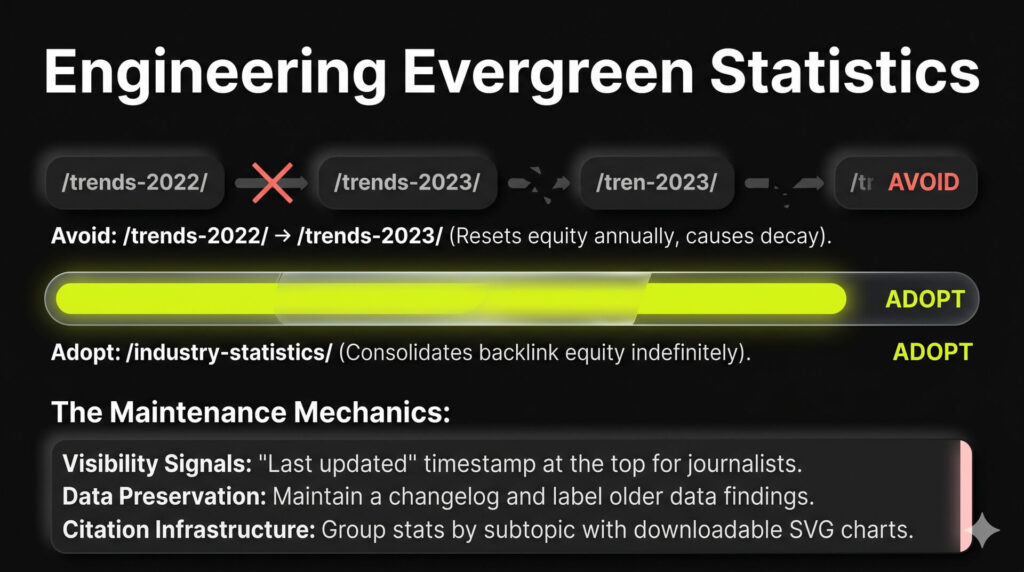
Most “stat-bait” assets suffer from predictable decay. A page titled “2022 Remote Work Trends” becomes an authority liability when the calendar turns. Solve this by engineering freshness into the URL using a canonical slug like /industry-statistics/ rather than year-specific paths. This consolidation accumulates backlink equity over years instead of resetting every January.
Maintain citation-readiness through these mechanics:
- Visibility Signals: Place a “Last updated” timestamp at the top to signal cite-safety to journalists and AI crawlers.
- Data Preservation: Maintain a changelog and label older data (e.g., “2024 Findings”) instead of deleting it to provide historical context for researchers.
- Citation Infrastructure: Group statistics by subtopic with clear definitions and downloadable SVG charts to remove citation ambiguity.
Execute quarterly refreshes for volatile categories and annual updates for stable ones. This prevents “link rot” and protects your backlink velocity and entity authority. A fresh, structured data set ensures your brand remains the definitive answer in Google and AI search summaries. This system transforms static pages into recurring authority assets that earn passive links indefinitely.
6. Visual Citation Frameworks: Ranking for Passive Image Attribution
Writers borrow visuals to illustrate complex points. Ranking unique assets in Google Images converts this behavior into a passive link building channel where attribution is the standard trade for content reuse.
Publish two types of high-value assets:
- Original Data Visuals: Unique charts or graphs derived from proprietary datasets.
- Concept Frameworks: Simple diagrams visualizing a core methodology (prioritize instructional clarity over aesthetics).
Technical precision ensures visibility across Google Images and generative search engines:
- Descriptive Metadata: Use filenames and alt text tied to specific informational queries.
- Semantic Context: Surround visuals with explanatory text to provide context for crawlers and LLMs.
- Attribution Standards: Add a “Source: [Brand]” watermark and an embed snippet to make backlinking effortless.
Include methodology notes so LLMs and writers cite the data as a trusted entity. As these visuals propagate, they generate compounding backlinks and AI citations without manual outreach. This strategy transforms your domain into the definitive visual library for your niche.
7. Paid Seeding: Accelerating the Discovery Flywheel
Passive link building is a misnomer because every flywheel requires an initial spark. Waiting for Google to rank a data hub can take months. Instead of buying links, buy visibility for linkable assets. This seeds content directly with journalists and creators who grant authority. B2B enterprise firms that lack the internal resources to scale these initial discovery flywheels often choose to hire a cybersecurity marketing agency to execute fully legal, compliant promotion strategies.
Run a 7-14 day paid test on LinkedIn or via high-intent search keywords. Focus spend on one high-utility asset, like a proprietary tool or industry benchmark. Monitor high-signal engagement metrics rather than traditional lead conversions:
- Time on page and scroll depth
- Saves and social shares
- Early referring domains
Include self-selecting distribution surfaces, such as newsletter forms or community resource posts. If engagement is weak, the asset is not yet link-worthy. Fix the data quality or content architecture before scaling spend.
This strategy provides a scalable discovery path without manual outreach. It is vital for new sites lacking the rankings to generate links naturally. Engineering this exposure ensures your brand earns the AI citations and organic revenue required to dominate the answer layer.
8. Frictionless Citation Blocks: Engineering Retrieval Readiness
Friction prevents citations. Writers and LLMs prioritize the path of least resistance. To earn passive links, your asset must be the easiest to cite correctly. Transform your pages into structured knowledge objects by adding a “How to cite this” block.
This block should include:
- A suggested attribution sentence.
- Publication and “last updated” dates.
- Definitions for key terms to prevent misuse.
Build editorial trust through proof packaging. Detail your methodology using specific bullets:
- Primary source lists.
- Data collection windows and sample sizes.
- Data exclusion criteria.
Engineering for AI search requires LLM-friendly answer blocks. Place direct, one-sentence answers under descriptive headings and use short tables for comparisons. These formats allow generative engines to retrieve and quote your claims with high precision, mirroring the optimization tactics required for voice search SEO for MSP providers catering to natural-language user intent.
This structure increases the conversion rate from visitor to linker by removing administrative friction. By making attribution effortless, you ensure your brand remains the primary cited authority in both traditional SERPs and AI-generated answers.
9. Convergence: Turning Backlink Assets into AI Citations
Authority mechanics are merging. High-value assets like proprietary data, tools, and canonical definitions serve as primary inputs for Large Language Models (LLMs). When a generative engine retrieves your data to answer a query, it provides a citation. This is the modern evolution of the backlink.
To bridge this gap, your assets must be retrieval-ready. Use this GEO-ready checklist:
- Entity Statements: Define the brand and the asset’s scope clearly.
- Structured Headings: Use H3s to frame extractable, one-sentence answers.
- FAQ Blocks: Address specific user questions to facilitate direct retrieval.
- Consistent Terminology: Use standardized industry terms to reduce semantic ambiguity.
AI engine citations drive high-intent human discovery and secondary backlinks from researchers using ChatGPT or Perplexity. This creates a feedback loop where generative visibility fuels traditional domain authority, aligning your passive authority with 2026 discovery behavior. To engineer AI citation growth alongside SEO authority, visit Nuoptima or explore our GEO services.
To engineer a passive authority system built for both Google and generative search engines, visit Nuoptima or explore our specialized GEO services.
Where this fits in your MSP growth system
This is one piece of how NUOPTIMA makes MSPs and cybersecurity firms the provider buyers find on Google and in AI search. See how it connects to link building and digital PR and MSP SEO, or get your free MSP lead forecast to see exactly where your firm shows up across ChatGPT, Gemini, and Perplexity today.