Voice search SEO is how MSPs get named as the spoken answer when a decision-maker asks Siri, Google, or an LLM for help. These are zero-click journeys where the engine reads the answer aloud, so if you are not the cited authority, you lose high-intent pipeline before the buyer ever visits a site.
Mastering voice search SEO MSP transforms your technical expertise into the default spoken answer for decision-makers. This checklist integrates on-page structure, local signals, schema, and measurement to build authority. We start by mapping how your buyers actually speak, not how traditional marketers stuff keywords.
Key Takeaways
- Voice search SEO for MSPs means becoming the cited spoken answer when buyers ask Siri or LLMs questions, since zero-click journeys mean missing the citation loses high-intent pipeline.
- Start by mapping 30 to 60 real buyer questions from sales transcripts and tickets, grouped by urgent, comparison, compliance, and cost intent.
- Add a 40 to 60 word Direct Answer block to core service pages so LLMs and AI Overviews can cite your firm as the primary authority.
- Deploy LocalBusiness, Service, and FAQPage schema as a machine-readable translation layer, and optimise Google Business Profile to win local and emergency queries.
- Measure success beyond organic sessions: track click-to-call actions, SERP features, weekly AI citation tests on 20 priority queries, and CRM-mapped pipeline.
Voice search SEO for MSPs is the practice of structuring an MSP's content, local signals, and schema so voice assistants and AI engines cite the firm as the spoken answer to buyer questions.
1. Build an Intent-Based Voice Question Map
Technical decision-makers don't speak like robots during a crisis. To master voice search SEO for MSP, you must bridge the technical authority gap by mapping how humans actually speak. Audit high-signal internal data like sales transcripts, ticket tags, and onboarding FAQs. Your deliverable is a one-page map of 30 to 60 real-world questions grouped by intent: urgent, comparison, compliance, or cost.
Translate technical services into natural language formats that match how executives prompt LLMs:
- Who offers managed IT near me? (Local)
- What does IT support cost for 50 employees? (Pricing)
- What do I do if we have a data breach? (Emergency)
- Best MSP for HIPAA compliance? (Evaluation)
Refine these clusters with modifiers like tech stack (Azure), industry, and response time. Map each intent cluster to a strategic destination:
- Urgent questions - FAQs or Service pages
- Evaluation queries - Comparison guides
- Local intent - Location landing pages
This blueprint eliminates random content production. It provides an actionable list of exact spoken questions to dominate both Google and AI answer engines.
Featured Snippets and Position Zero: Where Voice Answers Come From
A featured snippet, often called position zero, is the boxed answer Google pulls to the top of the results page above the first ranked link. It matters here because voice assistants and AI systems often draw on that same block when they answer. Win position zero for a buyer question and you become the spoken answer for it. Google builds these snippets from pages that answer the question directly in roughly 40 to 60 words, use a clear question as a heading, and back the claim with structured proof. That is why the Direct Answer block below is the core unit of any MSP voice strategy: it is the format Google lifts into position zero and then speaks aloud.
2. Build Concise Answer Blocks for Money Pages
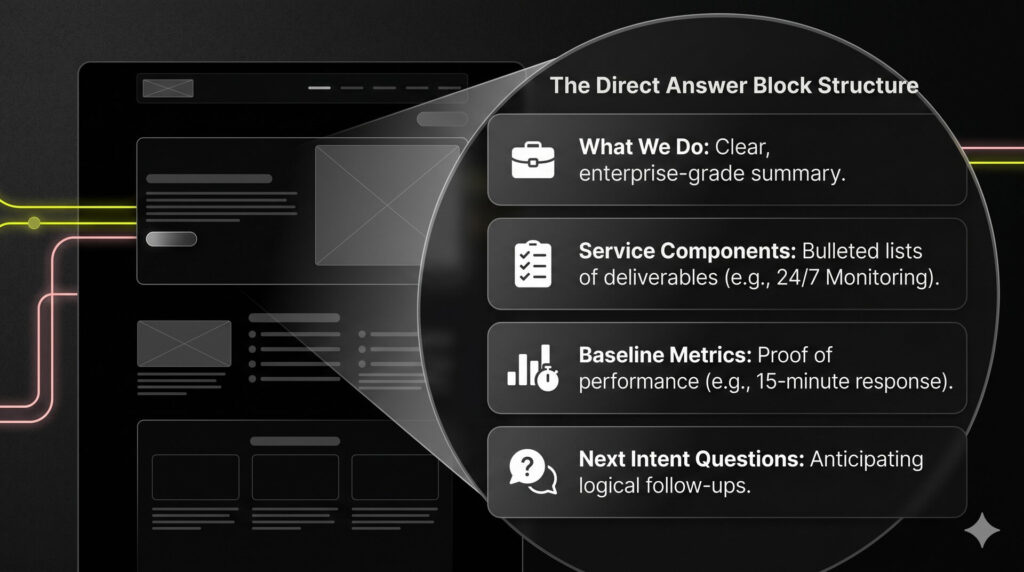
C-suite executives skip long guides during crises or M&A due diligence. Answer engines reward the same shape: unambiguous data over narrative. To master voice search SEO MSP, optimize core service pages with a Direct Answer block. This ensures LLMs cite your firm as the primary authority for technical queries.
What we do: We provide enterprise-grade managed IT for mid-market firms requiring investor-ready infrastructure. Our specialized solutions deliver 99.9% uptime, comprehensive SOC2 compliance, and predictable monthly costs. We transform technology into a valuation-building asset that satisfies both operational needs and rigorous M&A scrutiny from Private Equity partners.
Service Components:
- 24/7 Proactive Monitoring & Remediation
- Strategic vCIO Consulting
- Managed Cybersecurity Tiers (SOC2/CMMC)
- Cloud Infrastructure Governance (AWS/Azure)
Baseline Metrics:
- Response Time: 15 minutes for critical alerts.
- Proof: Achieved 16.6x SEO ROI for a global MSSP.
Next Intent Questions:
- How does pricing scale with headcount?
- Do you support hybrid-cloud AWS environments?
Request an MSP fit check.
3. Deploy Structured Data as a Translation Layer
When a CISO asks an AI for a SOC2-compliant partner, LLMs prioritize structured data over prose to eliminate ambiguity. Schema markup provides a machine-readable validation layer for your expertise, essential for a competitive voice search SEO MSP footprint. This reduces entity ambiguity, preventing your firm from being invisible to engines due to missing or contradictory business information.
Prioritize three high-ROI schema types:
- LocalBusiness (ProfessionalService): Deploy on your homepage and location hub with NAP data matching your Google Business Profile exactly.
- Service: Use on core offering pages to define specific technical deliverables for each service.
- FAQPage: Apply to genuine on-page Q&A blocks to capture Answer Box and voice real estate.
Include properties like `openingHours`, `geo`, `areaServed`, and `sameAs` to link your site to social profiles and industry citations. Treat schema as a deployable CMS component rather than one-off entries to avoid copy-paste errors. Validate all updates via the Google Rich Results Test and Schema Validator to ensure engines parse your technical authority without friction.
4. Dominate Local Voice Intent via Google Business Profile
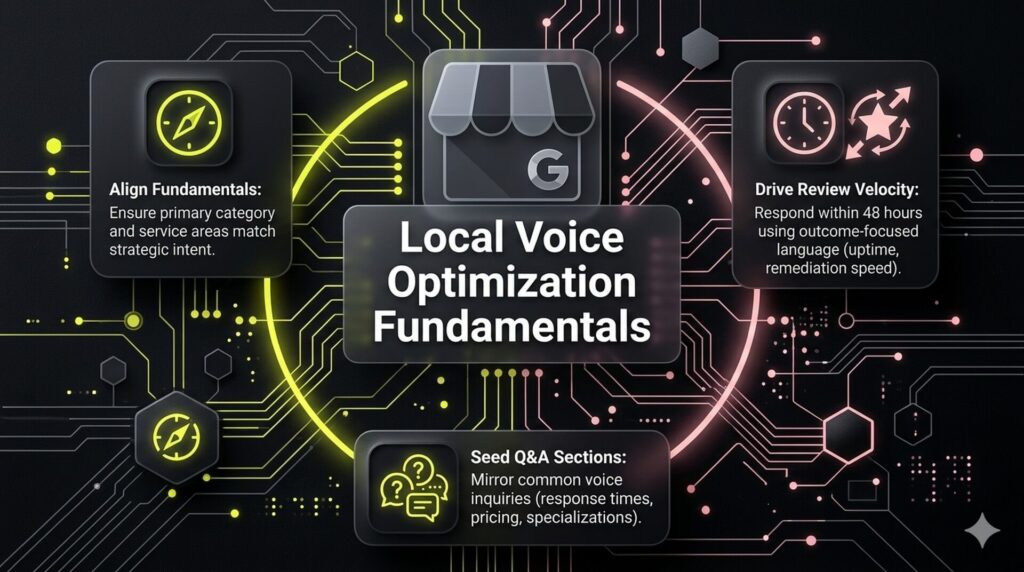
For near me and urgent queries, voice assistants prioritize Google Business Profile (GBP) data. MSPs neglecting GBP effectively opt out of high-intent discovery. Start with non-negotiable fundamentals: ensure your primary category, service areas, and description align with your strategic intent map.
Seed your Q&A section with 8 to 12 questions mirroring common voice inquiries:
- Response times and emergency support availability
- Pricing models and contract structures
- Specific industries served and technical specializations
Driving review velocity is critical for ranking. Respond to all reviews within 48 hours using outcome-focused language such as uptime, remediation speed, and user productivity. This validates your technical authority to both algorithms and prospects.
To capture emergency intent, build local pages for each core geography. These must include:
- Click-to-call functionality
- Response-time statements
- FAQ schema
This infrastructure ensures your voice search SEO MSP strategy drives calls and booked consults rather than vanity sessions, building the investor-grade organic equity necessary for M&A readiness.
5. Optimize Technical Performance for Instant Voice Fulfillment
Voice search users are impatient. If your mobile pages lag behind a spoken answer, search engines receive weak engagement signals, devaluing your technical authority. Treat performance as demand capture, not dev hygiene. For your voice search SEO MSP strategy, speed is table stakes for AI-driven discovery.
Target a sub-3s perceived load on priority mobile pages by focusing on these high-impact technical fixes:
- Convert heavy hero images to WebP/AVIF and lazy-load assets below the fold.
- Delay bloated chat widgets and tracking scripts during the initial load.
- Use caching and CDNs, preload critical fonts, and trim unused CSS.
Prioritize Core Web Vitals to reduce abandonment. Address Largest Contentful Paint (LCP) for above-the-fold content, fix Cumulative Layout Shift (CLS) from cookie banners, and optimize Interaction to Next Paint (INP) for forms. Avoid full-site perfection projects; optimize your top five landing pages first to build the investor-grade organic equity necessary to secure premium contract wins. Since most voice queries fire from phones, pair this with the fixes in our mobile SEO for MSPs guide so the page that wins the spoken answer also loads fast enough to keep the caller.
6. Establish a Citation-Ready Entity Footprint for AI Engines
AI engines recommend MSPs based on explicit proof, not generic promises. Dominating voice search SEO MSP requires high-compounding authority assets that replace vague marketing copy with technical evidence.
Prioritize these on-site authority assets:
- Metric-Driven Case Studies: Document response-time improvements, downtime reductions, and compliance outcomes.
- Industry Hubs: Use specific regulatory language and tech-stack terminology for targeted verticals.
- Credentialed Author Blocks: Detail certifications, partnerships, and regional expertise to verify operational credibility.
Make content quote-friendly by using clear definitions, headings, and actionable checklists. Off-site, publish YouTube answers to the top ten industry questions and provide non-salesy expertise in technical communities. This builds the multimedia footprint and organic equity required for premium contract wins and AI citations.
If you want investor-grade authority, request an M&A Readiness Audit of your GEO footprint.
7. Redefine Success Metrics for a Zero-Click Reality
Measuring success solely through organic sessions undercounts ROI. In voice search SEO MSP, many wins occur without a website click. To demonstrate value to Private Equity partners, shift focus to metrics signaling bottom-funnel intent and M&A readiness.
Track these four layers of performance:
- Local Actions: Monitor click-to-call, directions, and Google Business Profile interactions.
- SERP Features: Capture Featured Snippets and People Also Ask coverage where you are the cited authority.
- AI Visibility: Perform weekly prompt tests for 20 priority queries to verify LLM citations.
- Pipeline Mapping: Link form fills and calls to CRM sources to identify which assets generate booked meetings.
Use dedicated tracking numbers and strict UTM discipline for GBP links. Establish a weekly AI visibility log and monthly pipeline review. This instrumentation proves marketing is a valuation-building asset, preventing attribution gaps by linking voice and AI visibility directly to revenue outcomes.
How to Build a 30-Day Voice Search SEO Sprint for MSPs
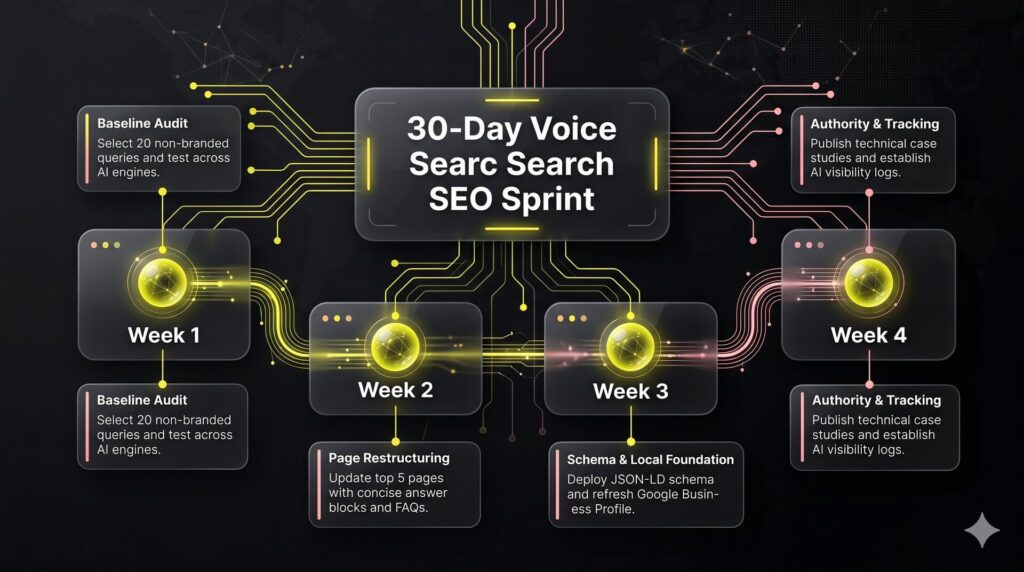
This operational plan bridges the technical authority gap. Execute these steps to capture high-intent AI traffic and build organic equity.
Week 1: Baseline Audit (Visibility and Intent)
- Select 20 non-branded money queries from Search Console and sales data.
- Test these queries across Google AI Overviews, Perplexity, and ChatGPT.
- Log cited domains and winning formats like local packs or FAQ blocks.
- Outcome: You identify specific gaps in your current AI search visibility.
Week 2: Page Restructuring (Answer-First)
- Update your top five service pages with 40-60 word concise answer blocks.
- Add FAQ sections addressing real prospect questions to satisfy zero-click queries.
- Outcome: Your content becomes the primary citation for conversational LLMs.
Week 3: Schema and Local Foundation
- Deploy LocalBusiness, ProfessionalService, and FAQPage JSON-LD schema for AI agents.
- Refresh Google Business Profile categories, services, and Q&A responses.
- Outcome: Search engines index your technical services with higher precision.
Week 4: Authority and Tracking
- Publish one technical case study and one industry-specific authority page.
- Establish a weekly AI visibility log and review call tracking data.
- Outcome: You link search visibility directly to revenue outcomes and valuation.
Book a GEO and RevOps alignment review to focus on pipeline growth rather than mere traffic.
For a deeper breakdown of how to measure and scale these efforts, visit NUOPTIMA.