Your rankings plateau when you optimize landing pages without building topical authority. Modern content clusters seo is search infrastructure: an entity-led knowledge system engineered for ROI and citation readiness.
This architecture ensures ChatGPT, Gemini, and Perplexity cite your brand as the definitive answer. This system provides the technical framework required for sustainable organic dominance. Follow these eight moves to master architecture, linking, measurement, and maintenance. If you need full GEO execution, NUOPTIMA (nuoptima.com) builds these authoritative systems end-to-end.
Key Takeaways
- Content clusters SEO is search infrastructure: an entity-led system of a pillar hub and intent-specific subpages engineered to push authority into pages that convert.
- Anchor every cluster to one high-value money page and define three entity assertions (what you are, who you serve, the outcome you drive) to set topical boundaries.
- A high-performance cluster maps one pillar to 8 to 20 subpages, each serving a distinct intent, with every subpage linking back to the hub using descriptive anchors.
- Diagnose cannibalization in Search Console, then consolidate, differentiate, or triage so multiple pages stop competing for identical intent.
- For AI citations, standardize terminology, open pages with definitional sentences, use question-style H2s with direct answers, and include original frameworks and verifiable data.
1. Define Your Revenue-First Cluster Anchor
Stop treating content clusters seo as a blog filing system. Effective clusters are authority pipelines engineered to push relevance and PageRank into landing pages that convert. To drive ROI, anchor your strategy to one high-value page where a ranking lift directly impacts your pipeline.
Map the entity by defining three entity assertions: what you are, who you serve, and the outcome you drive. These pillars set your cluster boundary. Any topic that does not reinforce these assertions is out of scope. Diluting signals with adjacent content weakens the authority transfer to your revenue-critical conversion asset.
Produce a one-line cluster thesis and conversion target:
- Cluster Thesis: Establish authority as the definitive [Service] for [Market].
- Target URL: [High-Value Landing Page]
- Primary Action: Demo request, trial, or lead form.
2. Construct Your High-Utility Pillar Hub
In an engineered content clusters seo strategy, a pillar is not a long-form article. It is an indexable, linkable hub that routes users and crawlers to intent-specific subpages. The pillar’s job is to provide broad query coverage while serving as the authoritative organizer for the entire domain.
High-utility pillars require a specific anatomy:
- Answer blocks (2 to 3 sentence direct answers) under headings for AI extraction.
- Definitive topic summaries that establish entity authority.
- Contextual lists of subtopics with internal links explaining how each subpage solves a specific intent.
Avoid generic “related posts” widgets. Use descriptive text to direct traffic and build semantic relevance. To prevent cannibalization, maintain the pillar at the overview level. Hubs that target specific long-tail intents steal rankings from supporting pages rather than reinforcing them.
3. Map Intent Buckets and Entity Relationships
Most content clusters seo fail due to semantic confusion. Search engines and LLMs prioritize intent clarity over keyword density. Use LLMs to accelerate clustering, but verify every recommendation against live SERPs to ensure alignment.
Export your keyword list and competitor queries into a sheet. Use an LLM to propose topic groups and identify missing subtopics. Validate each group to confirm the dominant content type, such as a guide, tool, or comparison.
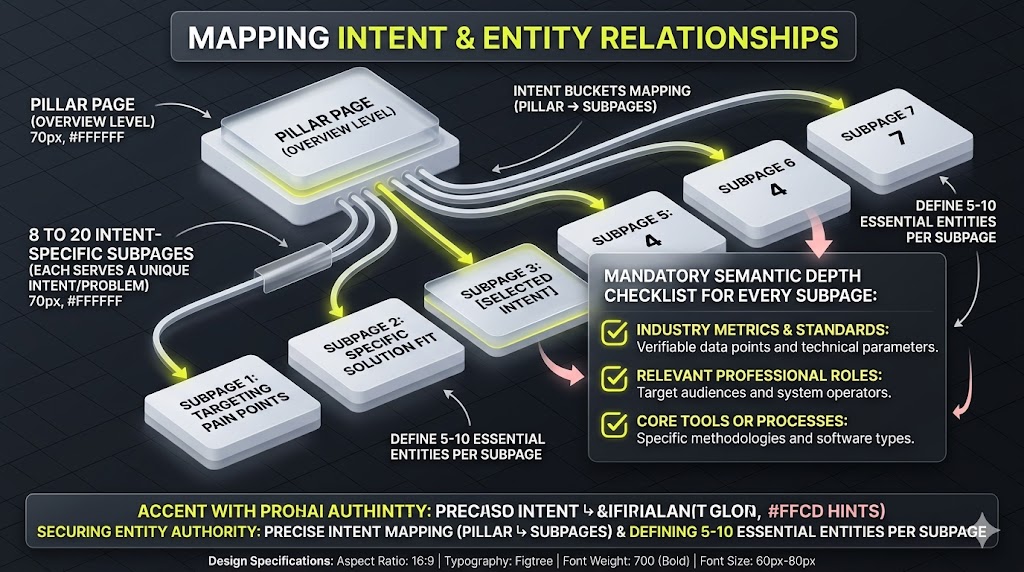
Split topics when intent differs, even if keywords look similar. This level of semantic isolation is mandatory when writing high-stakes compliance content SEO for MSPs, where a user searching for an audit checklist has a completely different intent than one looking for regulatory software pricing. Add semantic depth by listing 5 to 10 essential entities for every subpage:
- Industry metrics and standards
- Relevant professional roles
- Core tools or processes
The final deliverable is one pillar page mapped to 8 to 20 subpages. Each must serve a distinct intent to secure the entity authority needed for Google rankings and AI citations.
4. Engineer Precision Internal Linking
Internal linking fails when volume replaces structural discipline. High-performance content clusters seo require a controlled authority flow via rigid, non-negotiable rules.
The cluster baseline requires two foundational steps:
- Every subpage must link back to the hub using a descriptive anchor.
- The hub must link to every subpage in-context within the body text.
Implement these structural reinforcements to signal hierarchy and preserve topical signals:
- Use breadcrumbs and a consistent URL taxonomy.
- Avoid random cross-silo links.
- Link each subpage to one or two adjacent pages at the same stage of intent.
For scalability, enforce these rules at the CMS template level. This architecture prevents orphan pages and reduces messy crawl paths. It creates a clear entity architecture Google and AI engines can interpret and cite with precision.
5. Triage and Repair Topic Cannibalization
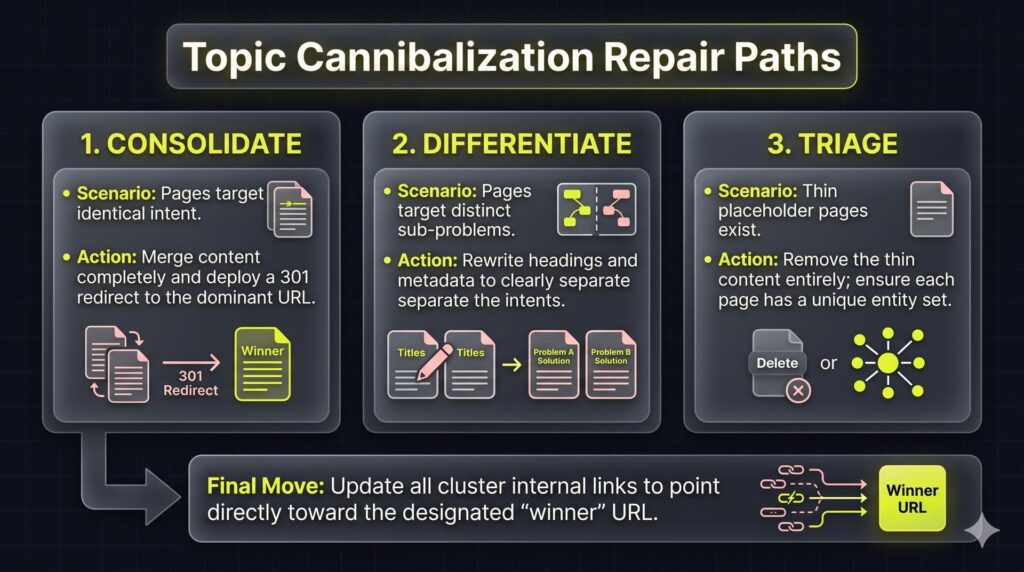
Cluster strategies fail when multiple pages compete for identical intent, diluting authority and confusing crawlers. Diagnose cannibalization in Google Search Console by identifying queries where multiple URLs split impressions for the same term.
Choose a repair path based on intent:
- Consolidate: Merge identical intent pages and 301 redirect to the dominant URL.
- Differentiate: Rewrite headings and metadata to address distinct sub-problems.
- Triage: Remove thin content created only to fill a map; each page needs a unique entity set.
Update internal links to point all supporting assets toward the designated “winner” for that specific intent. This prevents clusters from self-sabotaging rankings and builds the structured entity architecture required for LLM citations.
6. Instrument Clusters for Conversion Attribution
If you cannot report cluster-level value, you cannot defend the strategy. General traffic metrics fail to show how content clusters seo builds pipeline. Instrumentation turns clusters into an accountable growth lever.
To deliver a “Cluster Value” dashboard your CMO understands:
- Send a content_cluster parameter with every GA4 page_view event and register it as a custom dimension.
- Report conversions and event value by content group to track direct ROI.
- Use Conversion Paths and Model Comparison to see if a cluster is a first-touch driver or a mid-funnel assist.
This visibility ensures organic work competes fairly with paid channels and CRO projects. Grouping is not retroactive. Implement tracking now to ensure you have historical comparisons for future performance reviews.
7. Operationalize Cluster Maintenance and Expansion
Topical authority is a living asset. Without a quarterly maintenance loop, your content clusters seo strategy decays into fragmented intent and broken links. Regular audits stop this erosion and protect your organic pipeline from performance plateaus.
Start by pulling GSC queries per cluster to identify rising terms and decaying pages. Crawl the architecture to flag orphan content or pages with insufficient internal links. Use a refresh-versus-prune protocol to update pages that lost freshness but still match intent, while merging overlapping pages to concentrate authority.
Expand your footprint with LLM-assisted gap analysis against competitor keywords, then validate intent in live SERPs. Produce a 90-day backlog covering refreshes, merges, and new pages. This systematic loop ensures your brand remains the cited source in Google and AI-generated answers, turning maintenance into a competitive moat.
8. Optimize for AI Retrieval and Citations
Generative engines ignore authoritative content that fails to define specific entities. AI models retrieve and synthesize data points rather than simply ranking pages. If your content clusters seo lack naming consistency, LLMs cannot index your expertise accurately.
Standardize terminology for every product and method across your hub and subpages. Open each page with definitional sentences (e.g., “X is…”) to establish entity authority immediately. Add FAQ blocks to address high-frequency objections, providing LLMs with direct, authoritative data for common user queries.
Use question-style H2s and provide direct answers in the first two sentences to create extractable blocks. To trigger citations, include:
- Original frameworks and checklists
- Step-by-step processes
- Verifiable data and specifics
Route informational answers to money pages with contextual links. This architecture ensures AI engines select and summarize your content, directly fueling your organic revenue pipeline.
How to Execute Your Content Clusters SEO Strategy
Follow this 85-minute workflow to build an executable SOP for your content clusters seo strategy and ensure measurable conversion lift.
Preconditions (5 Minutes)
Pick one high-revenue money page and confirm its primary conversion event. Define which action represents success to ensure tracking accuracy and pipeline alignment.
Step 1: Define the Cluster Thesis (10 Minutes)
Write the cluster thesis and define three entity assertions. These assertions act as topical boundaries and establish clear semantic relevance for search engine crawlers.
Step 2: Draft the Pillar Anatomy (15 Minutes)
Draft the pillar outline with high-utility answer blocks designed for AI extraction. List all required links for the hub to ensure structured entity authority.
Step 3: Map Candidate Subpages (20 Minutes)
Create the subpage map by exporting keyword data for your domain and top competitors. Use LLM clustering to propose logical groups and SERP-check 5 to 10 core terms to validate that the proposed content type matches user intent.
Step 4: Codify Internal Linking Rules (10 Minutes)
Define specific internal linking rules in your content brief template. Establish hub to subpage and sibling links to ensure ranking power flows directly toward your target landing page.
Step 5: Execute Failure Checks (10 Minutes)
Add failure checks to your QA process to protect cluster integrity. Scan for keyword cannibalization, verify that every page meets thin-page quality thresholds, and resolve any orphan page issues before going live.
Step 6: Instrument GA4 Attribution (15 Minutes)
Configure GA4 content groups to track performance. Build a Cluster Value Exploration and a Conversion Paths view to measure how these assets contribute to organic revenue and pipeline growth.
Step 7: Schedule Maintenance Audits (5 Minutes)
Schedule maintenance audits for month 3 and month 12. These alerts ensure your topical authority remains fresh and your content continues to rank against evolving competitors.
Build a custom search architecture that dominates both Google and AI search engines. Partner with the experts at Nuoptima and explore our generative engine optimization (GEO) services to secure your brand authority.
If you want an AI-native cluster system engineered specifically for rankings and citations, NUOPTIMA can build it end-to-end. We specialize in search infrastructure that makes your brand the definitive answer. Visit Nuoptima or explore our GEO services page to secure your organic revenue pipeline and dominate the new search landscape.
Where this fits in your MSP growth system
This is one piece of how NUOPTIMA makes MSPs and cybersecurity firms the provider buyers find on Google and in AI search. See how it connects to MSP content marketing and MSP SEO, or get your free MSP lead forecast to see exactly where your firm shows up across ChatGPT, Gemini, and Perplexity today.