Many firms dismiss local search as a tactic for restaurants or plumbers. This misconception ignores the high-intent regional pipeline waiting for specialized B2B services.
Effective b2b local seo captures demand by prioritizing relevance and authority over uncontrollable proximity. By engineering your presence for Google and the AI answer layer, you convert visibility into pipeline rather than vanity impressions. Strategic growth begins by mapping intent, not by updating a profile.
Key Takeaways
- B2B local SEO wins on relevance and authority rather than proximity, since professional buyers value capability, industry fit, and compliance over the shortest commute.
- Build intent clusters that pair service plus region with qualification modifiers like "HIPAA," "SOC 2," or "enterprise" instead of chasing high-volume "near me" keywords that attract low-value inquiries.
- Configure your Google Business Profile as a Service Area Business to hide the physical address while signaling authority across defined sales territories, then sync those signals with on-site location pages.
- A service-first site architecture (homepage, 3 to 4 capability pages, then 15 to 30 granular service pages) connected by contextual internal links proves expertise for exact [service] plus [city] queries.
B2B local SEO is the practice of optimizing a B2B firm's site, Google Business Profile, and entity signals to win high-intent regional searches by prioritizing relevance and authority over physical proximity.
1. Pivot from “Near Me” to Intent-Led B2B Clusters
B2B brands waste budget chasing high-volume “near me” keywords that attract DIYers and low-value inquiries. Professional buyers prioritize capability, industry fit, and compliance over the shortest commute. Align your B2B local SEO with qualification signals rather than simple proximity to capture revenue-ready pipeline. This shift ensures you reach decision-makers who value specialized expertise over geographical convenience. Building optimized campaigns focused on SEO for IT support services enables brands to systematically win these critical high-intent regional variations.
Build intent clusters that combine service and region with high-intent modifiers:
- Core: [Service] + [City/Region] (e.g., “managed IT services Dallas”).
- Qualification: “for manufacturing,” “HIPAA,” “SOC 2,” “enterprise,” “on-site,” “regulated.”
- Buyer-stage: “vendor,” “provider,” “consultant,” “RFP,” “pricing,” “contractor.”
This framework produces a one-page keyword-to-page map. Use it to dictate your Google Business Profile services, service pages, and location architecture. Stop copying B2C patterns that prioritize distance. In the AI-search landscape, geography is a secondary filter. Specialized capability, response time, and regulatory requirements drive the final vendor selection. Mapping these specific signals ensures your brand becomes the cited authority in traditional and generative search experiences.
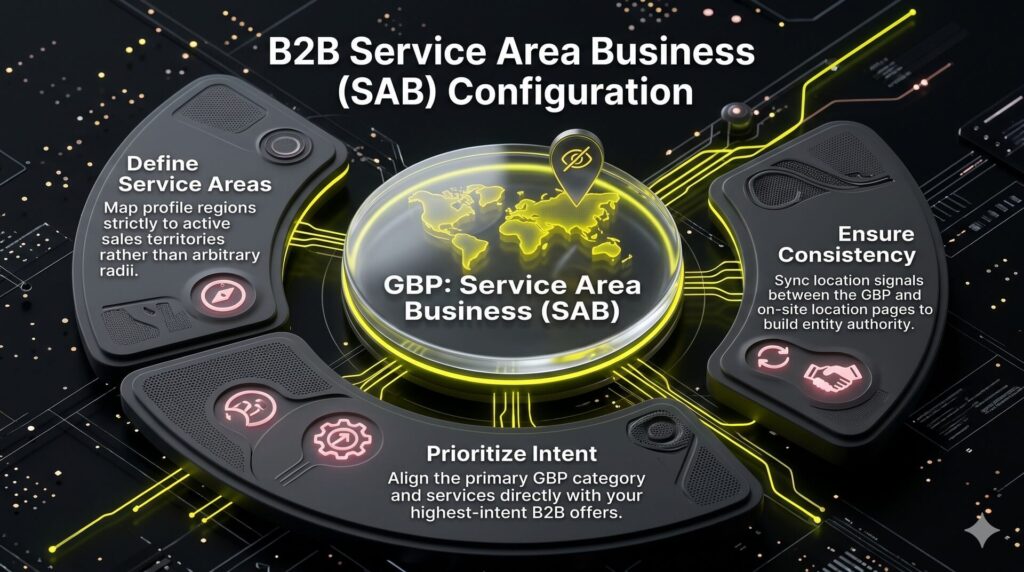
2. Configure Your GBP for Sales Territories, Not Storefronts
Many firms fail at B2B local SEO because their geographic footprint is poorly defined. To capture regional demand without storefront walk-ins, configure your Google Business Profile (GBP) as a Service Area Business (SAB). This setup hides your physical address while signaling authority across your specific sales regions. It transforms a retail tool into a strategic lead generation engine for defined territories.
Implementation Checklist
- Define service areas: Map these strictly to sales territories rather than arbitrary radii.
- Prioritize intent: Align your primary category and services with your highest-intent B2B offers.
- Ensure consistency: Sync location signals between your GBP and on-site location pages to build entity authority.
This alignment ensures your brand becomes the definitive answer in Map Packs and AI-driven discovery. Measure performance through Map Pack impressions and conversions attributed to GBP landing pages.
3. Weaponize Relevance and Authority Over Proximity
Stagnant Map Pack rankings result from tactics that ignore Google’s local ranking triad: relevance, distance, and prominence. Since proximity is fixed, B2B teams must over-index on relevance and authority to displace closer competitors. This controllables-first approach ensures every tactic improves core ranking signals rather than chasing random metrics.
Establish relevance by aligning Google Business Profile (GBP) categories and services with the technical language on your location pages. This synchronization must also leverage high-performance mobile SEO for MSP standards to capture local multi-device enterprise traffic. Use internal links to connect these assets, providing the semantic certainty Google requires to surface your brand for high-intent queries.
Build authority through these actions:
- Earn industry-specific backlinks to establish domain trust.
- Build citations that reinforce your professional entity.
- Collect reviews referencing your core service and geography.
You cannot change your office location to match a prospect. However, you can out-rank local competitors by engineering superior trust signals that prioritize your high-intent service offerings.
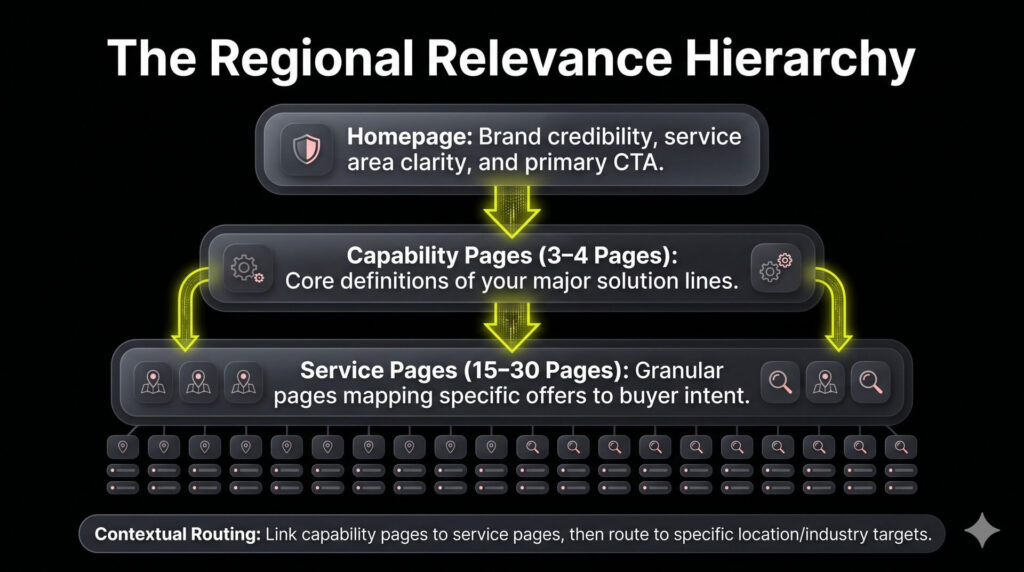
4. Build a Service-First Architecture to Win Regional Relevance
Most B2B sites fail to rank locally because they lack service specificity. Generic “what we do” pages cannot win relevance for high-intent [service] + [city] queries. To scale across regions without doorway-page risk, implement a structured architecture that proves expertise for exact buyer searches.
Your site hierarchy must follow this framework:
- Homepage: Establish brand credibility, service area clarity, and your strongest CTA.
- Capability Pages: Three to four pages defining your major solution lines.
- Service Pages: 15 to 30 granular pages mapping specific offers to buyer intent.
Connect these layers through contextual internal linking rather than footer-only lists. Route capability pages to service pages, then link those to relevant location or industry pages. This architecture creates the semantic path required for search engines and AI models to cite your brand as the definitive local authority.
5. Deploy Operational Location Pages Instead of Thin Doorway Lists
B2B firms often treat geography as a static footer list rather than an operational reality. Without dedicated location pages, you cannot rank for regional queries. Thin doorway pages might capture traffic, but they fail to sustain visibility or convert leads who require proof of local capability.
High-performance b2b local seo requires pages that demonstrate physical and operational presence:
- Territory definitions mapping specific cities, regions served, and regional response times.
- Local proof assets including regional case snippets, partner ecosystems, and area-specific industry coverage.
- Qualification FAQs addressing on-site support availability and regional compliance standards.
Use rank mapping to determine if your pipeline requires more topical depth or geographic breadth. Prioritize operational authority over page volume to build a defensible search moat. Secure your regional revenue by booking a regional visibility audit and strategy call with NUOPTIMA.
6. Curate High-Signal Trust Networks Over Citation Volume
Verified listings without a ranking lift signal authority stagnation. Most B2B firms fail by prioritizing citation volume over the high-trust networks that professional buyers and AI systems demand.
High-performance b2b local seo targets sources denoting professional vetting rather than generic directories. Prioritize these three high-signal categories:
- Industry: Trade associations and specialized niche directories.
- Regional: Business journals, chambers of commerce, and municipal development boards.
- Partners: Integration pages, reseller lists, and client “preferred vendor” directories.
LLMs value these sources because they represent human-vetted relationships verifying business legitimacy. Maintain strict NAP consistency and align parent branding with local branch data to ensure search engines recognize the entity hierarchy. These networks feed the citation pool generative engines use to recommend vendors. When an AI summarizes regional partners, it validates your authority through these trusted nodes to include your brand in the answer layer.
7. Convert Visibility into Pipeline with Multi-Layered Reputation Signals
Ranking in the local map pack is a vanity metric if prospects do not trust your capability. B2B buyers validate with third-party proof before reaching out. High visibility without conversion usually stems from missing reputation signals. Strengthen these signals to reinforce your service, geography, and outcomes.
Your review strategy must influence both humans and AI. Maintain Google review velocity by requesting feedback that mentions your specific service names and region. This reinforces local entity authority. Simultaneously, dominate B2B platforms like Clutch, G2, or Capterra.
Generative engines use these platforms as primary citation sources when recommending vendors. Operationally, define who asks for reviews and the specific timing. Without a strict system, review velocity stalls and rankings drop.
Convert successful reviews into on-site case studies and “results statements” for AI extraction to increase conversion trust. For teams that need this authority infrastructure built, partner with NUOPTIMA.
8. Solve Multi-Location Scaling Through Governance and Entity Clarity
Stop debating subdomains versus subfolders. Multi-location B2B success depends on governance and entity clarity. Without rigid control, regional footprints create conflicting signals, keyword cannibalization, and inconsistent lead quality.
Match site architecture to your management model:
- Centralized brands: Use subfolders to consolidate domain authority and maximize ranking power.
- Franchises: Use subdomains to manage regional risk and allow local marketing autonomy.
Scaling requires a transparent entity chain from parent brand to location entities. Maintain consistent naming and use Schema.org subtypes like ProfessionalService or IndustrialBusiness to define your B2B niche. Every location page and Google Business Profile must define specific service areas to prevent territory overlap. This precision ensures AI engines and crawlers recognize your brand as the definitive regional authority across the knowledge graph.
9. Optimize for AI Answer Layers and Local Retrieval
Traditional visibility fails if your brand vanishes when a buyer asks ChatGPT for a local partner. In 2026, page-one rankings matter less than being the cited source in the generative answer layer. You must engineer local content for retrieval, not just indexation, to capture AI discovery.
Build citation-ready pages by embedding three to five extractable authority statements defining who you serve, where you operate, and your differentiators. Use tight Q&A formatting and FAQ schema around local qualification questions. AI engines prioritize these structured blocks when synthesizing vendor recommendations. This conversational synthesis highlights the need to deploy specialized voice search SEO for MSP structures that match modern conversational user queries.
Ensure factual consistency across your GBP, website, and third-party profiles to solidify your entity footprint. Success is measured by brand citations in AI results and assisted conversions from generative sessions. To dominate the answer layer, explore our GEO services and move beyond legacy rankings.
FAQ
Yes, because city and region qualifiers signal immediate buying intent and territory fit. For high-ticket B2B services, the goal is not mass traffic volume. You are aiming for fewer, higher-quality leads such as RFPs, demos, and quote requests. Capturing regional qualifiers filters for prospects that match your service area and operational requirements. Prioritize relevance and authority over proximity to reach the right decision-makers. See the section on pivoting to intent-led clusters for the full breakdown.
You can successfully execute B2B local SEO by using the Google Business Profile service-area configuration. This hides your physical address while signaling your reach to correct regions. Do not fabricate offices or use virtual offices. Instead, build operational territory pages and collect third-party industry citations to compensate for a lack of physical proximity. Aligning your territory messaging on the site with your profile settings builds trust with both users and search crawlers while maintaining your company privacy.
Create pages only for territories where you have actual delivery or sales capacity. Start with your primary markets to ensure quality and avoid using thin or templated pages. Each location page must include unique proof, localized case studies, and service alignment to rank effectively. A few high-authority pages that prove local relevance will always outperform a massive list of low-value doorway pages. Expand your reach based on rank mapping and lead quality rather than hitting a specific quota.
Treat your Google Business Profile and website as a single integrated system. Your profile is the primary driver for map visibility and local discovery. However, your website carries the deal by providing the qualification and conversion depth required for complex B2B sales. This consistency prevents conflicting signals that confuse search engines. Ensure your profile categories match your on-site service pages and internal linking to build strong entity authority across both search surfaces while providing a seamless user experience.
Shift focus from vanity rankings to map-pack visibility by territory and conversions from landing pages. Track pipeline attribution in your CRM to prove direct ROI. Monitor leading indicators like review velocity, citation growth, and AI mention frequency. For a revenue-focused local and GEO roadmap that dominates both traditional and generative search, visit Nuoptima and explore our specialized GEO services to secure your regional market share and future-proof your organic acquisition strategy against the evolving search landscape.
Where this fits in your MSP growth system
This is one piece of how NUOPTIMA makes MSPs and cybersecurity firms the provider buyers find on Google and in AI search. See how it connects to MSP SEO and GEO and AI-search, or get your free MSP lead forecast to see exactly where your firm shows up across ChatGPT, Gemini, and Perplexity today.