Most MSP founders believe they have a traffic problem. They do not. They have a technical authority gap where deep expertise fails to convert high-intent prospects.
Strategic seo for it support services focuses on bottom-funnel queries that book discovery calls. This requires landing pages, local authority, and proof. At NUOPTIMA, we ensure Answer Engine readiness and RevOps tracking so leads never go dark. Start with the page that should print revenue first.
Key Takeaways
- Most MSPs have a technical authority gap, not a traffic problem: deep expertise that fails to convert high-intent prospects into booked calls.
- SEO for IT support services should focus on bottom-funnel queries like managed IT services [city], backed by dedicated landing pages, local authority, and proof.
- Local visibility often beats national rankings, so build a Google Business Profile for authority and link it to a city-specific landing page.
- Verticalizing into two regulated industries you know, such as healthcare or law firms, captures higher-margin, high-LTV buyer intent than generic IT terms.
- By 2026, FAQPage and LocalBusiness schema plus 6 to 10 Q&A blocks on money pages help win AI citations on Perplexity and SearchGPT before the lead clicks.
1. Launch a High-Intent Local Service Page
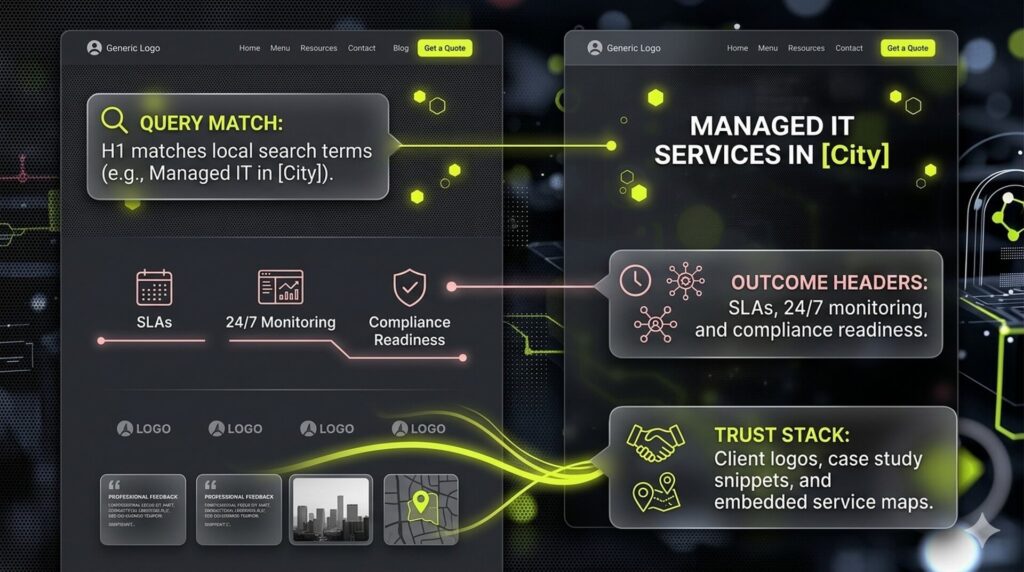
Many MSPs attract traffic that never converts because their content targets broad information instead of bottom-funnel intent. To bridge this gap, build a dedicated landing page for a high-intent term like managed IT services [city]. This page functions as a conversion engine rather than a digital brochure, focusing exclusively on capturing local buyer intent.
The page must lead with a clear H1 matching the search query. Use outcome-led subheaders to address critical decision-making factors:
- Guaranteed uptime and 24/7 monitoring.
- Security compliance and SOC tooling.
- Rapid response times defined by clear SLAs.
Establish technical authority by highlighting stack familiarity with Microsoft 365 and Azure. Incorporate a trust stack including client logos, case study snippets, and testimonials to bridge the technical authority gap. To solidify local proof, embed a service area map and provide a local phone number.
Success is measured by qualified form fills and calls rather than raw traffic. This revenue-first SEO strategy builds organic equity and proves a predictable lead-generation engine for long-term valuation growth.
2. Dominate the Map Pack with Local Authority Signals
Local visibility often beats national rankings for service-area IT providers. Being invisible in the Map Pack for IT support near me means losing high-intent leads to competitors with fewer technical capabilities. Dominating local SEO for IT support services requires a Google Business Profile (GBP) built for authority, not just proximity.
Build your GBP foundation with technical accuracy:
- Select the correct business type, utilizing service-area settings if you lack a physical storefront.
- Map categories and services to core offers like managed cybersecurity.
- Align descriptions with bottom-funnel intent keywords.
- Avoid address hacks or virtual office misuse to prevent immediate suspension.
Sustain rankings through active evidence signals. Post weekly updates and upload photos of your team or data centers. Seed the Q&A section with real buyer inquiries to bridge the technical authority gap before the lead even clicks.
A systematic review velocity is the engine of local growth. Automate requests to trigger upon ticket closure and respond to every entry with policy-safe language. Link your GBP to a city-specific landing page to move prospects from search to signed contract.
3. Build Service-Specific Landing Pages to Capture Intent
If your homepage tries to sell twelve services simultaneously, it will rank for none. One page cannot credibly command authority on helpdesk support and SOC2 compliance. This Technical Authority Gap occurs when your site structure fails to match how buyers search.
Build a simple cluster to establish topical relevance:
- Hub Page: IT Support Services
- Service Pages: Managed IT, Helpdesk, Microsoft 365, Cybersecurity (MDR), Backup/DR, and Network.
Each page must answer bottom-funnel queries that drive M&A-ready revenue. Address outsourced vs in-house comparisons, pricing, 24/7 support, and specific SLAs. High-intent decision-makers search for compliance and response time before booking a demo.
Keep page anatomy skimmable to convert technical traffic:
- Context: Who it is for (e.g., compliance-heavy Fintech).
- Value: What is included and the delivery process.
- Proof: Case studies with measurable ROI.
- Next Steps: FAQs and a clear CTA.
Link the homepage to the hub and then to individual service pages. Cross-link related services where intent overlaps, such as linking MDR to compliance pages. This architecture signals to Google that you are a specialized authority rather than a generalist.

4. Verticalize to Capture High-Margin Industry Intent
Generic IT terms attract price shoppers and low-margin deals. Competing on broad keywords keeps you a commodity. To bridge the technical authority gap and build M&A-ready revenue, you must dominate vertical-specific intent.
Select two industries where you possess deep compliance knowledge or tool familiarity. Mapping your SEO to regulated workflows captures high-LTV buyer intent. Build dedicated target pages such as:
- Healthcare IT support [City]
- IT support for law firms
- HIPAA IT compliance support
- SOC 2 readiness IT
These pages rank and convert by addressing industry-specific pain points and software stacks like EMR, DMS, or finance systems. Use a formal assessment as a risk-reversal tool to transition prospects from search to a discovery call. A CISO seeking SOC 2 readiness requires a specialized partner, not a general helpdesk.
Avoid thin pages that merely swap keywords across identical templates. Sophisticated buyers and Google both recognize low-effort content. Include one anonymized case study per vertical to prove outcomes. This strategy ensures your seo for it support services captures intent that drives high-value contracts and investor-grade valuation.
5. Seal Technical Gaps to Prevent Lead Leaks
Many MSPs build service pages only to see flat traffic or high bounce rates. This Technical Authority Gap occurs when backend friction kills search visibility before a prospect reads your content.
Technical SEO is not a checklist. It is the foundation of your organic equity. If Google cannot crawl your architecture, you cannot rank. Prioritize these non-negotiables:
- Search Console setup and sitemap submission
- Clean indexation (remove accidental noindex tags)
- Rigorous canonical hygiene
Site speed directly impacts your pipeline health and M&A readiness. Boost Core Web Vitals by compressing images and stripping script bloat. Mobile-first layouts are essential for C-suite decision-makers who evaluate partners on the go.
Audit lead-capture points to prevent revenue leaks:
- Broken forms and slow thank-you pages
- Non-functional click-to-call or dead chat widgets
- Inconsistent NAP data across footer and contact pages
Confident crawling and friction-free navigation transform your seo for it support services from a technical cost into a high-yield equity asset.
6. Bridge the Technical Authority Gap with High-Trust Conversion Architecture
High-intent traffic only becomes pipeline when pages are designed for decision-makers. If your calendar remains empty despite ranking for seo for it support services, you are likely suffering from a technical authority gap. IT buyers evaluate risk and credibility instantly. Without rapid trust-building, search visibility is a wasted capital investment.
Replace vague CTAs like Get a network assessment with high-intent actions like Talk to an engineer or Request a proposal. Reduce friction and signal technical authority by displaying:
- Response time SLAs and security certifications.
- Detailed onboarding timelines and partner badges.
- Client testimonials and industry-specific case studies.
Implement lead forms with 3 to 5 fields and a direct scheduling option for a 15-minute triage call. Add qualifying questions regarding employee count and current infrastructure to ensure your sales team prioritizes high-LTV contracts. Success is measured by landing page CVR and close rates by page topic. Aligning page UX with how IT buyers evaluate risk transforms expertise into a predictable revenue engine and prepares the firm for investor-grade scrutiny.
7. Optimize for Generative Search to Win AI Citations
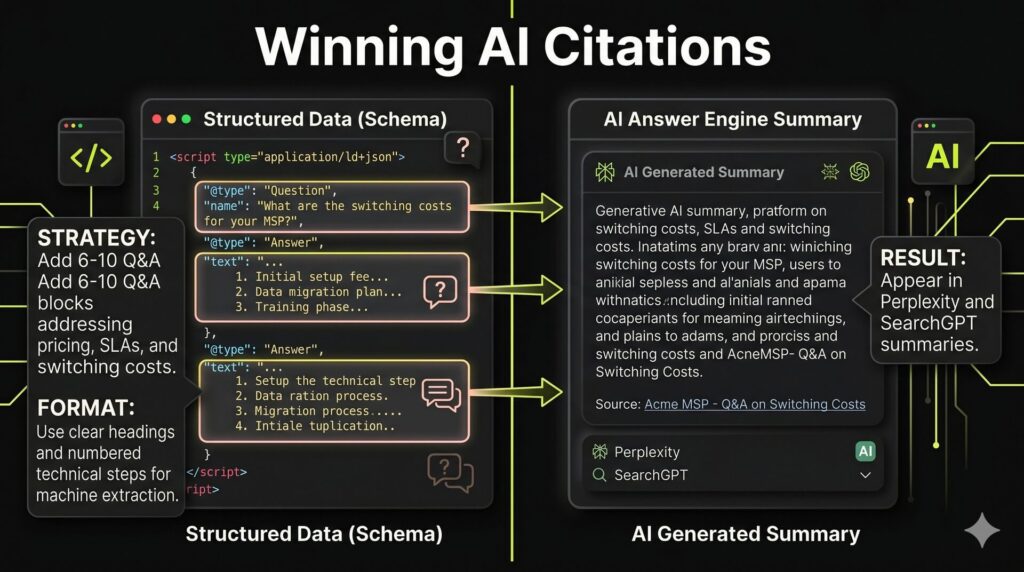
By 2026, traditional search clicks are increasingly replaced by structured AI citations. If an LLM answers a prospect’s questions about compliance or switching costs using a competitor’s data, that lead is captured before they ever visit your site. This Technical Authority Gap leaves your MSP invisible to high-intent decision-makers using platforms like Perplexity or SearchGPT.
To bridge this gap, add 6 to 10 deliberate Q&A blocks to money pages. Target these bottom-funnel intent triggers:
- SLA guarantees and transparent pricing models
- Compliance standards like SOC2, HIPAA, or CMMC
- Remote versus onsite service delivery
- The technical process for switching providers
Write specifically for machine extraction. Use clear headings, short definitions, and numbered steps. Implement FAQPage and LocalBusiness schema to signal authority to generative engines while citing credible sources to boost cross-platform trust.
This ensures your seo for it support services strategy moves beyond blue links to become the primary source for AI summaries. Consistent brand mentions across directories build the organic equity required for investor-grade valuation. Winning the shortlist earlier in the journey increases your pipeline velocity and enterprise value.
8. Prove Pipeline to Turn Content Costs into Assets
When keyword rankings climb but enterprise contracts stall, leadership loses confidence. If you cannot prove pipeline, SEO remains a content cost rather than a strategic asset. Bridging this gap requires transitioning from vanity metrics to rigorous Fractional RevOps that ensures M&A readiness.
Establish a measurement baseline:
- UTM parameters on all key CTA links.
- Call tracking for Google Business Profiles and landing pages.
- Granular form event tracking.
Maintain CRM hygiene by mandating source fields and lifecycle stages. Implement lead scoring based on employee count, industry, and compliance triggers to prioritize high-LTV prospects.
Shift reporting to investor-grade outcomes:
- Meetings booked and Sales Qualified Leads (SQLs).
- Total pipeline value and CAC payback periods.
- Closed-won data to prioritize future seo for it support services content.
This defensible measurement ensures organic growth stands up to Private Equity scrutiny. By tying activity to revenue, you transform marketing into compounding organic equity that maximizes enterprise valuation.
Where this fits in your MSP growth system
This is one piece of how NUOPTIMA makes MSPs and cybersecurity firms the provider buyers find on Google and in AI search. See how it connects to cybersecurity SEO and MSP SEO, or get your free MSP lead forecast to see exactly where your firm shows up across ChatGPT, Gemini, and Perplexity today.