Enterprise SaaS SEO collapses when teams prioritize search volume over pipeline. In 2026, volume-first strategies fail against AI search complexity and enterprise procurement. True high intent keywords seo requires an operational mapping between queries, revenue-driving pages, and measurable conversion actions like demos. Designing this system around concrete commercial intent effectively transforms your website into a scalable managed IT services marketing growth engine. This authoritative 9-part prioritization checklist and scoring workflow ties organic search directly to Closed-Won outcomes. We move beyond vanity metrics to master the specific signals that convert traffic into predictable, sustainable revenue growth.
Key Takeaways
- High-intent keyword prioritization ties every target term to a revenue-driving page and a measurable conversion action, so if you cannot name the action that proves value, you do not target the term.
- Comparison searches (competitor alternatives, brand versus competitor, best category software) signal active shortlisting and are the most valuable terms for B2B SaaS.
- Zero-search-volume queries sourced from sales calls and support tickets often mirror the exact needs of qualified leads that legacy tools miss.
- Filter negative intent (free, template, jobs, salary, near me) to keep your funnel clean, and assess AI-SERP risk so you invest in queries an AI Overview cannot fully answer.
- Operationalize with a weekly workflow: route intent, score a revenue-first matrix, apply a kill switch for any keyword without a conversion action, then commit briefs and assign governance.
1. Map Every Keyword to a Forced Conversion Action
Ranking #1 results in zero pipeline when the mapping rule is broken. High intent keywords seo require a rigid logic: Keyword → Page Type → Conversion Action. If you cannot define the specific action proving value, do not target the term.
Informational blog posts targeting broad queries without a downstream CTA are a common anti-pattern. This creates dead-end traffic that inflates metrics but starves the pipeline. Use these enterprise mapping standards to ensure every click captures demand:
- “Pricing” queries: Pricing page → Pricing-to-demo click.
- “SOC 2 compliant”: Trust or security page → Demo request.
- “Integrate with Salesforce”: Integration page → Trial start or contact sales.
| Page Type | Targeted Action |
| Pricing | Demo Request |
| Security | Security Audit / Demo |
| Integration | Trial / Contact Sales |
| Comparison | Feature Demo |
2. Build Comparison Search Infrastructure to Capture Late-Stage Demand
Comparison keywords are the backbone of bottom-funnel SEO. In SaaS, these terms signal a buyer is actively shortlisting. These are the most valuable high intent keywords seo because the user is ready to buy or switch.
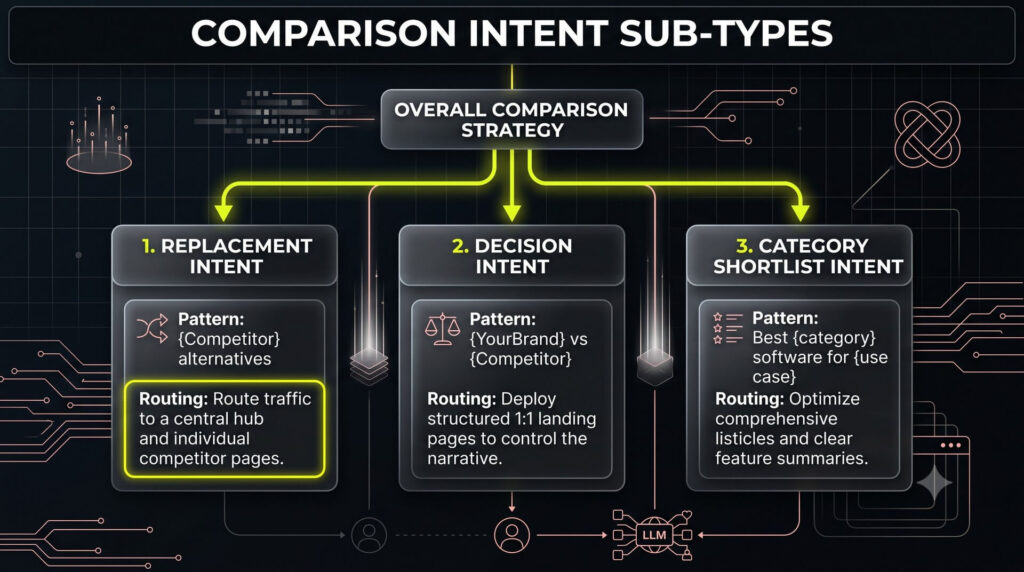
Target three intent sub-types:
- “{Competitor} alternatives” (replacement intent)
- “{YourBrand} vs {Competitor}” (decision intent)
- “Best {category} software for {use case}” (category shortlist intent)
Route “alternatives” traffic to a central hub and individual competitor pages. Use 1:1 landing pages for “vs” queries to control the narrative. Measure success via demo conversion rates and sales-qualified pipeline rather than vanity rankings. For technical service sectors, generating high-intent remote IT support leads with trust relies completely on this comparative transparency.
Structured comparison pages also drive visibility in AI search. LLMs like ChatGPT and Perplexity reference these clearly defined data points to generate vendor recommendations.
3. Leverage Zero Search Volume (ZSV) to Capture High-Maturity B2B Intent
In B2B SaaS, Zero Search Volume (ZSV) signals buyer maturity. These hyper-specific queries are often too new or niche for legacy SEO tools to track, yet they mirror the exact technical requirements of qualified leads.
Identify these high intent keywords seo by mining:
- Search Console long-tail impressions
- Autocomplete and “People Also Ask” patterns
- Sales call transcripts and support tickets for verbatim phrasing
Avoid generic blog posts. Instead, build high-utility search infrastructure:
- Integration and implementation pages
- Feature and compliance documentation
- Niche “use case + industry” landing pages
Validate intent through internal demand or sales frequency before investing. This shifts focus from vanity traffic to high-value conversations. Dominating ZSV captures buyers ready to implement or switch, securing higher lead quality and measurable pipeline growth.
4. Extract High-Intent Keywords from GTM Conversations
SEO tools are lagging indicators. Waiting for keyword volume in Ahrefs means missing the window for early authority. The most profitable high intent keywords seo are spoken in discovery calls long before they appear in global search data. This GTM-first discovery aligns targeting with purchase conversations to eliminate lead quality mismatch.
Mine Gong transcripts, CRM discovery fields, and support tickets for the specific language prospects use. Look for switching triggers, technical constraints, and recurring objections. Use this extraction checklist:
- Objections: “too expensive”
- Constraints: “SOC 2 compliance”
- Integrations: “NetSuite”
- Triggers: “migrate from {competitor}”
Convert these insights into high-conversion keyword formats:
- “How to migrate from {competitor}”
- “{Product category} for {regulated industry}”
- “{Tool} integration with {system}”
This repeatable process ensures content eliminates sales friction, accelerates the sales cycle, and builds sustainable organic revenue.
5. Classify Enterprise-Grade Intent Using Jobs-to-be-Done
Standard intent categories fail because one keyword represents multiple procurement stages. For high intent keywords seo, apply the Jobs-to-be-Done (JTBD) framework. Ask what job the buyer is hiring this search to perform.
Adopt this four-job taxonomy for enterprise search:
- Evaluate: Shortlisting and comparing vendors.
- Validate: Proving fit via security, compliance, or ROI.
- Implement: Solving setup, migration, or integration hurdles.
- Justify: Building the internal business case for procurement.
JTBD determines your page architecture. Validate intent belongs on trust centers or security pages. Enterprise buyers who need to evaluate IT help desk support services for compliance will actively look for these deeper documentation hubs during procurement. Implement queries require integration landing pages or technical docs. Justify intent needs ROI calculators or pricing narratives. Highlighting explicit use cases like cloud migration services enterprise ROI within these formats helps financial stakeholders justify the software investment quickly.
This strategy prioritizes removing buying friction over chasing modifiers. These utility-driven pages are citation-worthy for generative engines. They provide the concrete data points AI agents prioritize when answering complex buyer questions to accelerate the sales cycle.
6. Filter Negative Intent to Prevent Funnel Pollution
Ranking for the wrong terms costs more than missing traffic entirely. Your high intent keywords seo strategy fails if it attracts non-buyers who inflate vanity metrics but stall the sales cycle. This noise pollutes CRM data and exhausts SDR productivity. Negative intent describes queries that appear relevant but signal a total lack of commercial capacity.
Filter these patterns during keyword curation:
- Low-value assets: “free,” “template,” “example,” “pdf”
- Career/Academic: “salary,” “jobs,” “for students,” “course”
- Consumer: “home,” “near me,” “personal”
Enforce these exclusions within every content brief and use PPC to validate conversion potential before production. Isolate edge cases like “open source” into a separate cluster for monitoring. Successful filtering improves MQL to SQL conversion rates and protects sales productivity. Maintain a strict exclude list to ensure your organic infrastructure captures only revenue-ready traffic.
7. Perform AI-SERP Risk Assessments to Protect Click-Through Rates
Ranking #1 no longer guarantees traffic. Google AI Overviews (AIO) satisfy user intent directly on the results page, intercepting clicks before they reach your site. For high intent keywords seo, conduct an AI-SERP risk assessment to prioritize pipeline potential over raw search volume.
Filter out keywords with high “AI-answered” risk. This includes simple definitional queries and basic tutorials where an LLM provides a definitive answer. Informational content is only worth the investment if it routes users toward product-led tools like templates or calculators or establishes the category-defining entity authority required for LLM citations.
Adapt pages by adding “decision blocks” including use cases, comparison tables, and next-step CTAs. Deploy schema-ready, extractable formatting to win the answer layer. This strategy eliminates vanity rankings and focuses resources on conversion-ready visits that Google’s AI layer cannot satisfy.
8. Build AI-Resistant Search Infrastructure with Interactive Assets
Low-volume keywords often outperform high-volume ones by prioritizing utility over general information. While AI summarizes articles, it cannot perform personalized logic for a prospect. High intent keywords seo like “calculator,” “estimator,” “generator,” and “checker” are AI-resistant because they require interactive functions LLMs cannot replicate. These patterns secure visibility by solving specific user problems.
Map interactive assets to enterprise SaaS conversion actions:
- ROI calculator: Demo request
- RFP template or security questionnaire: Contact sales
- Integration readiness checklist: Trial start
Prioritize assets that reduce buying friction regardless of search volume. These tools produce the specific frameworks and proprietary data points that generative engines preferentially cite. To have this infrastructure engineered end-to-end, nuoptima.com builds the high-utility assets required to capture AI citations and compound organic revenue.
How to Operationalize High-Intent Keyword Prioritization
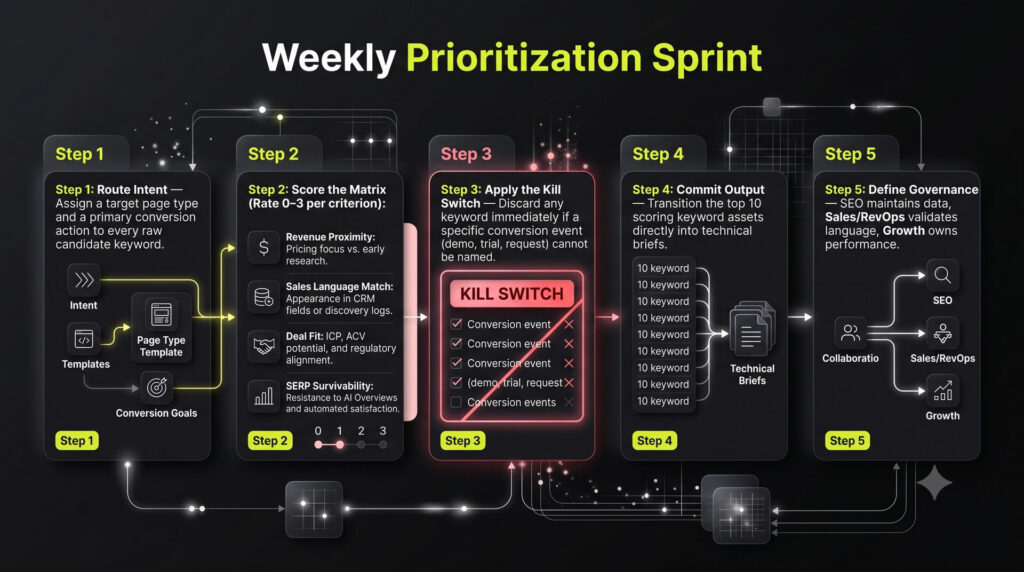
Convert your strategic principles into a team-executable workflow. This weekly process produces a ranked backlog tied directly to your pipeline. It ensures your organic infrastructure focuses on revenue instead of vanity metrics.
First, gather candidate keywords from Google Search Console, SEO tools, and sales transcripts.
Step 1: Route Intent
For every keyword, assign a target page type and a primary conversion action. This categorizes the query by its specific place in the buying funnel.
Step 2: Score the Revenue-First Matrix
Rate each keyword from 0 to 3 based on four criteria:
- Revenue proximity: Determine if the user is seeking pricing or early research.
- Sales language match: Check if the phrase appears in CRM discovery fields or sales calls.
- Deal fit: Verify alignment with your ICP, ACV potential, and industry regulations.
- SERP survivability: Evaluate if a Google AI Overview or LLM will satisfy the query intent.
Step 3: Apply the Kill Switch
If you cannot name a specific conversion action that proves value, discard the keyword. Every instance of high intent keywords seo must lead to a demo, trial, or contact request.
Step 4: Commit Output
Transform the top 10 scoring keywords into technical briefs. Include required content sections, entity-rich declarations, and internal links to establish authority.
Step 5: Define Governance
Assign ownership to prevent strategy drift. SEO maintains the list. Sales and RevOps validate the language. Growth owns conversion performance.
To operationalize this sprint across traditional search and AI engines, integrate NUOPTIMA’s GEO services to build your citation-ready organic moat.
FAQ
A high-intent keyword maps directly to a revenue-driving page and a measurable conversion action. If you cannot identify a specific call to action, such as a demo request or trial start, the keyword lacks intent. These terms represent users ready for a transaction. High intent keywords seo focus on capturing these late-stage buyers rather than broad informational traffic.
Yes. Zero-search-volume (ZSV) keywords are valuable when sourced from Sales language or internal demand signals. These terms often mirror the technical requirements of qualified leads that legacy tools miss. Treat ZSV as pipeline clues. Measure success through lead quality and sales velocity rather than raw traffic to ensure your organic infrastructure remains revenue-focused.
Pass UTM parameters and source data into your CRM to track prospects through the funnel. This allows you to report Closed-Won revenue by the original keyword. Use conversion rates, average deal value, and deal velocity as your primary prioritization metrics. This shift ensures your SEO strategy aligns with executive business objectives and proves tangible organic impact.
AI search compresses informational clicks but does not remove buyer evaluation. High-intent buyers still require deep comparisons and implementation details before purchasing. Double down on comparison pages and interactive tools. These assets provide the structured data that generative engines prioritize when citing authoritative brands in AI-generated responses.
Where this fits in your MSP growth system
This is one piece of how NUOPTIMA makes MSPs and cybersecurity firms the provider buyers find on Google and in AI search. See how it connects to MSP SEO and GEO and AI-search, or get your free MSP lead forecast to see exactly where your firm shows up across ChatGPT, Gemini, and Perplexity today.