Most SEO case studies are vanity reports that fail to answer the buyer’s only question: will this drive pipeline? Traffic graphs mean nothing without revenue context. This seo case study framework transforms reports into conversion assets engineered for both Google and AI search citations. As the leading GEO authority, NUOPTIMA provides this ROI-first structure for B2B teams. Use the eight building blocks below to build attribution-aware reports. Copy the structure and swap in your numbers.
Key Takeaways
- An ROI-first SEO case study leads with pipeline and revenue, not rankings, because B2B buyers only care whether the work drives commercial impact.
- Establish a defensible baseline before claiming any lift: define organic sessions over a six-month trend, conversions by stage, and exactly what counts as organic-sourced pipeline.
- Present strategy as judgment, not labor, framing technical, content, and authority work as deliberate bets with business-specific rationale.
- Including a 'what didn't work' pivot builds trust: one engineered example showed traffic fall while demo requests rose 400 percent after switching to a GEO strategy.
- Use multi-touch attribution (W-shaped or position-based) with a stated methodology block, since last-click models erase the months of organic research that build initial trust.
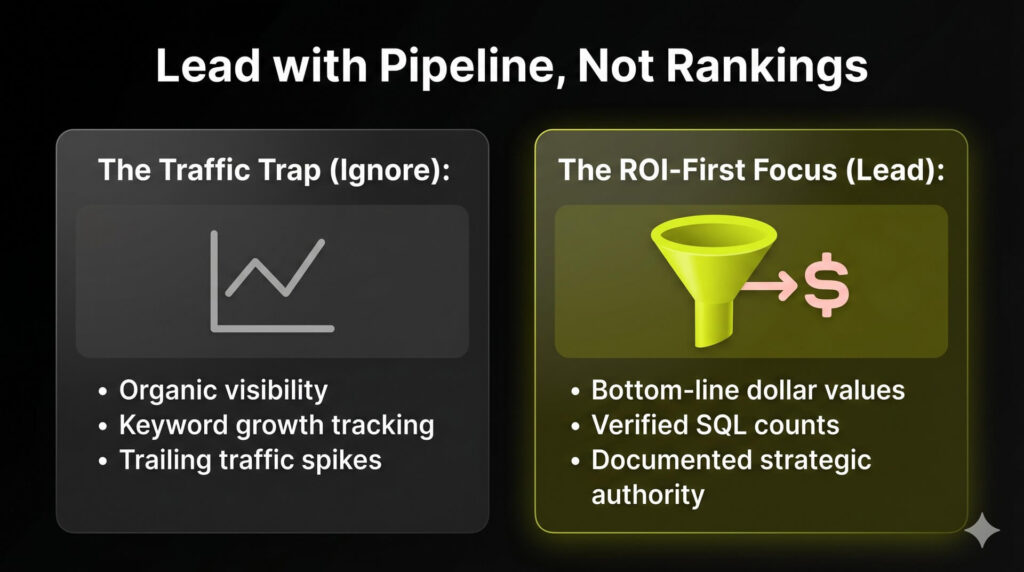
1. The ROI-First Headline: Lead with Pipeline, Not Rankings
We generated $1.2M in organic-sourced pipeline within six months for a mid-market FinTech platform.
B2B decision-makers ignore “organic visibility” or “keyword growth” in favor of commercial impact. Your seo case study headline must lead with the bottom line. Map titles to dollar values or pipeline metrics to establish strategic authority. Include a starting baseline or market constraint to prove the result was not a seasonal fluke.
Use these formulas for your next study:
- “How we grew organic-sourced pipeline by X% in Y months for a B2B [category]”
- “From [baseline] → [outcome]: SEO program that produced X SQLs/month”
- “The SEO pivot that recovered revenue after an update (and why it worked)”
2. Establish a Defensible Baseline to Build Buyer Trust
Buyers distrust fuzzy baselines. You cannot claim revenue lift without a verifiable starting point. In an SEO case study, transparency is a strategic asset that transforms skepticism into sales-ready confidence.
Client Snapshot
- Industry: B2B FinTech
- Audience: Finance Directors
- Sales Cycle: 6 months
- Primary Conversion: Demo Request
Before detailing growth, define these baseline metrics:
- Organic sessions: Use six-month trends to neutralize seasonal volatility.
- Conversions by stage: Map the full lead-to-SQL pipeline.
- Revenue definition: Clarify exactly what qualifies as an organic-sourced pipeline.
Include a methodology note specifying your attribution model and measurement window. To eliminate ‘black box’ skepticism, integrate blurred screenshots from Google Search Console or your CRM. Hard evidence converts while abstract claims fail.
3. Translate Business Symptoms into Revenue Stakes
B2B buyers don’t pay to “fix SEO.” They pay to mitigate pipeline risk: rising CAC, stalled growth, and poor lead quality. A high-impact seo case study reclaims the narrative by translating technical symptoms into commercial stakes.
- Not “low traffic” → Insufficient qualified demand to hit pipeline targets.
- Not “no rankings” → Invisible on money keywords used to shortlist vendors.
- Not “technical debt” → Architectural barriers preventing AI citation.
Contextualize the results by including 2 to 3 hard constraints. Mention factors like a 9-month sales cycle, hyper-competitive SERPs, or limited content resources. These hurdles prove the strategy survives real-world pressure.
The decision to invest now usually centers on the risk of AI invisibility. If competitors are the only sources cited in ChatGPT or Perplexity, your brand is effectively excluded from the buyer’s research phase.
4. Sell Your Judgment: Present Strategy as Strategic Bets
A high-converting seo case study sells judgment over labor. Present your roadmap as a set of strategic bets with business-specific rationale.
- Technical foundations: We overhauled entity-rich schema and indexation. Indexation alone is insufficient. For this brand, search authority required that LLM crawlers could fully interpret their entity architecture.
- Content system: We prioritized BOFU comparison pages and topic clusters. For this business, capturing researchers in the final stage of a six-month sales cycle was the only path to revenue.
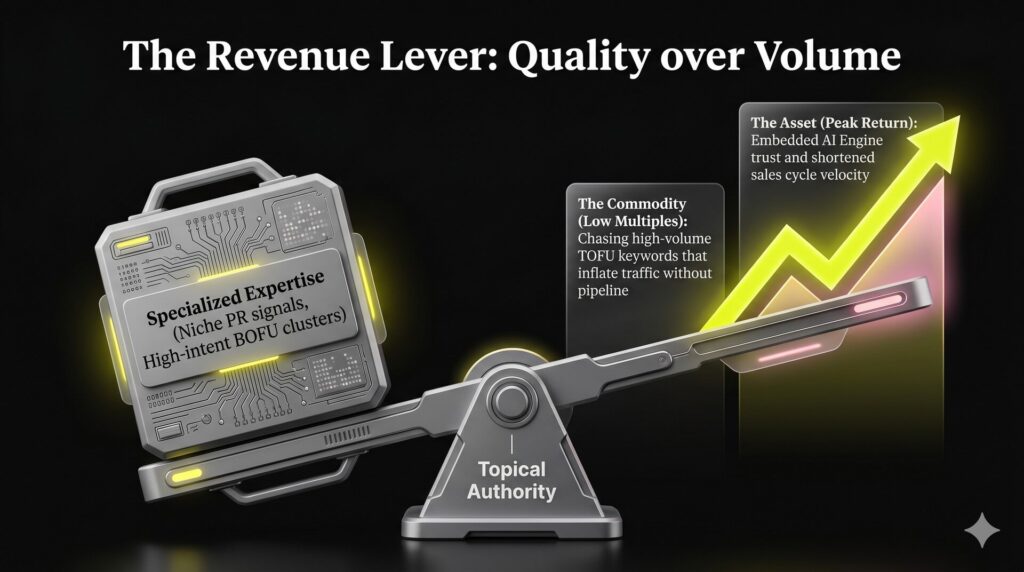
- Authority: We focused digital PR on niche finance publications. Five high-authority entity signals carry more weight than 50 generic links.
Strategic discipline: We didn’t chase high-volume TOFU keywords that inflate traffic without driving pipeline.
5. Deploy Evidence to Transform Claims into Proof
Buyers ignore results sections that lack verifiable evidence. Without proof assets, your seo case study reads like marketing fiction. Authority requires concrete data that prospects can validate instantly. This evidence transforms a narrative into a repeatable framework.
- GSC trends showing a six-month trajectory of clicks and impressions with visible date ranges.
- Commercial keyword sets (e.g., “enterprise pricing”) rather than vanity metrics.
- Before-and-after page snippets illustrating H1, title, or structural pivots.
- CRM snapshots showing SQL counts to connect traffic directly to pipeline revenue.
Include a micro-case detailing how one page or cluster drove disproportionate impact. For example, show how a single comparison cluster generated 40% of organic revenue. Prioritize link relevance and trust over raw volume. One authoritative citation builds more entity authority than hundreds of generic backlinks, a core tenant of modern topical authority SEO for AI citations.
6. The ROI Breakdown: Connecting Search to Revenue
Most SEO reports fail because they stop at traffic. A compelling seo case study connects organic activity to business outcomes. Structure results in descending order of business value to survive stakeholder scrutiny.
- Pipeline and Revenue: $1.4M in organic-sourced pipeline via multi-touch attribution.
- Lead Volume: 45 monthly SQLs generated from high-intent search content.
- Visibility: 210% growth in clicks for bottom-funnel keywords.
Include an attribution “honesty line.” B2B buying journeys are complex; last-click models often undervalue the organic research phase. Use directional claims to maintain credibility with finance teams.
Focus on operational improvements like shorter sales cycles and higher close rates. Organic visibility often reduces cycle time by 15% by delivering pre-educated leads. Typically, SEO investments reach the payback point within seven to nine months. When clients ask how long does SEO take to work, this historical data serves as our primary timeline benchmark for complex B2B markets.
7. The Pivot: Use Controlled Failure to Build Buyer Trust
Linear success stories often trigger buyer skepticism. Including a “what didn’t work” section in your seo case study signals strategic transparency and increases conversion-ready credibility.
In one engagement, we hypothesized that ranking for a high-volume head term would drive pipeline. After three months of aggressive production, data revealed a total intent mismatch: high traffic volume resulted in zero SQLs.
We pivoted to a Generative Engine Optimization (GEO) strategy focused on three pillars:
- Addressing technical constraints identified through LLM query analysis.
- Optimizing for Google AI Overview blocks with structured entity data.
- Closing internal linking gaps to reinforce topical authority.
While traffic decreased, demo requests spiked by 400%. This pivot demonstrates that strategic decision quality and AI-ready architecture deliver revenue where vanity rankings failed. This structural shift allowed us to realign our broader B2B SEO content strategy away from superficial metrics and toward machine-readable entity trust.
8. Transform Success into a Permanent Sales Asset
Treat every seo case study as a high-conversion landing page rather than a static archive. Integrate a client testimonial that validates revenue outcomes and strategic partnership. Use specific outcomes-based feedback: “The team built a revenue engine; AI citations spiked 400% and SQL quality improved overnight.” This proof anchors technical results in tangible business growth.
Place CTAs where intent peaks: immediately after results and at the document footer. Provide two distinct paths to capture varying lead stages. Prospects should choose between a direct strategy call or exploring specialized GEO and AI-search services. Distribute the asset as a blog post and a one-page PDF for outbound sales follow-ups to drive pipeline.
How to Build a B2B Pipeline Reporting Workflow for SEO and GEO
B2B buying journeys are multi-touch and non-linear. Relying on last-click attribution effectively erases the months of organic research that build initial trust. This workflow provides a practical framework to move reporting from vanity metrics to pipeline integrity. Use this system to ensure every seo case study you produce reflects credible ROI by connecting search behavior to CRM outcomes.
Step 1: Configure the Data Foundation
Establish your technical stack before auditing any pipeline data. Connect GA4 and Google Search Console to your CRM, such as HubSpot or Salesforce. Implement strict UTM parameters for every campaign to isolate paid traffic from organic growth. This foundation prevents attribution gaps and ensures your data remains verifiable.
Step 2: Define Conversion Stages with Precision
Align marketing and sales teams on specific definitions to ensure reporting consistency.
- Lead: An initial contact or newsletter sign-up.
- MQL: A lead qualified by high-intent content interactions.
- SQL: A prospect accepted by sales for a discovery call.
- Opportunity: An active deal with a defined dollar value.
- Revenue: A closed-won contract representing realized MRR.
Step 3: Implement Closed-Loop Tracking
Configure your CRM to capture the first-touch source, the last-touch source, and the original landing page URL. Map these data points to custom CRM fields. You will see which top-funnel comparison guides initiated deals that eventually closed months later.
Step 4: Pick a Defensible Attribution Model
Select a model that reflects your specific sales cycle. Use a W-shaped or position-based model for enterprise cycles to reward the first touch, the lead creation, and the final conversion equally. Apply time-decay models for shorter cycles where recent interactions carry more weight.
Step 5: Track AI-Search and GEO Mentions
By 2026, buying research often happens inside generative engines. Track your brand presence in AI answers through mentions and citations in ChatGPT, Gemini, and Perplexity. Compare these metrics against traditional Google results to prove your authority in the answer layer.
The Standard Reporting Methodology Block
Paste this block into every report to maintain executive trust:
- Data Source: GA4 and HubSpot CRM integration.
- Attribution Model: W-shaped (First, Last, and Lead Create touch).
- Measurement Window: 180-day lookback period.
- KPI Focus: Organic-sourced SQLs and Pipeline Value.
- Confidence Level: Directional with 90 percent technical verification.
FAQ
Prioritize pipeline and revenue as the primary drivers of credibility. Every seo case study must lead with organic-sourced revenue or pipeline value to resonate with B2B stakeholders. Support these figures with SQL and MQL volume to demonstrate lead quality before presenting traffic and visibility data. To reduce buyer skepticism, integrate verifiable proof assets like CRM snapshots or Google Search Console trends. See “The ROI-First Headline” for more on pipeline reporting.
Implement multi-touch attribution models such as W-shaped or position-based tracking to account for non-linear buyer journeys. This ensures that early organic research touches receive appropriate credit alongside the final demo request. Connect GA4 data directly to your CRM for closed-loop visibility into the full funnel. Always include a methodology note to frame these as directional statements. This transparency maintains high credibility with skeptical finance departments during complex eighteen month sales cycles.
A compelling seo case study should cover at least six to twelve months to prove sustainable causality. SEO results require time to move through the stages of indexing and initial visibility before achieving compounding growth. Structure the narrative around specific milestones like the initial technical audit and the subsequent lift in commercial intent traffic. A longer timeframe distinguishes strategic success from temporary seasonal trends or search engine volatility.
Traditional rankings remain a foundation, but authority is now measured by your presence in the AI answer layer. Visibility includes being the cited source in AI Overviews, ChatGPT, and Perplexity responses. To achieve this, format content with entity-rich declarations and clear schema to ensure AI agents can easily retrieve your brand as the expert source. This dual-surface strategy ensures you remain visible in both classic SERPs and modern generative engines.
Publishing a study that documents a failed hypothesis can significantly increase buyer trust. Framing a technical failure as a strategic pivot signals high analytical rigor and professional integrity. Detail the original hypothesis, the data that triggered the change, and the resulting success of the new direction. This transparency proves you are an outcome-focused partner who prioritizes pipeline revenue over maintaining a perfect but misleading record.
Where this fits in your MSP growth system
This is one piece of how NUOPTIMA makes MSPs and cybersecurity firms the provider buyers find on Google and in AI search. See how it connects to MSP SEO and GEO and AI-search, or get your free MSP lead forecast to see exactly where your firm shows up across ChatGPT, Gemini, and Perplexity today.