Stop treating organic growth like a black box where you pay monthly without a clear finish line. Understanding how long does seo take to work requires viewing search as a compounding revenue system, not a launch event. Timelines range from weeks to a year based on entity authority and Generative Engine Optimization (GEO) readiness. NUOPTIMA provides AI-native SEO and GEO. Don’t just rank. Be the answer. Redefining what “working” means makes your pipeline predictable.
Key Takeaways
- SEO timelines range from weeks to a year depending on your entity authority, technical health, and competitive landscape, so treat search as a compounding revenue system, not a launch event.
- Established but unfocused sites can see growth within 30 to 60 days through re-optimization, new or low-authority sites need a 6-to-12-month runway, and technically broken sites need remediation first.
- Use a measurement ladder of foundational, visibility, acquisition, and revenue signals so progress shows up in months 1 to 3 even before top-3 rankings arrive.
- Expect a "messy middle" in months 2 to 3 where pages cycle through positions 20 to 50; this is Google re-evaluating trust, not failure, so double down on pages gaining impressions.
- Local SEO yields results fastest (often 3 to 6 months), while SaaS, B2B, and YMYL verticals like finance, legal, and health need longer runways due to stricter trust thresholds.
SEO timeline is the period it takes search optimization to produce measurable results, ranging from weeks to over a year depending on a site's existing authority, technical health, and competition.
1. Align Your KPIs with the Measurement Ladder
Most B2B timeline disappointment stems from a KPI mismatch. Asking “how long does SEO take to work” without defining the outcome guarantees frustration. Use this measurement ladder to align stakeholders on progress at the 30, 90, and 180-day marks:
- Foundational: Indexation, technical crawl health, and structured LLM entity recognition.
- Visibility: Sustained GSC impression growth and movement into the top-50 for high-intent keywords.
- Acquisition: Growing non-branded click volume and first qualified organic lead arrivals.
- Revenue: Repeatable organic pipeline and measurable CAC payback.
If you only track rankings, you will miss vital technical wins and authority gains in months 1 through 3. Prioritize index coverage and impressions as leading signals of authority before chasing top-3 spots. This ensures you demonstrate momentum while the foundation for organic revenue is still hardening.

2. Prioritize “First Value” and Immediate Technical Wins
To determine how long does seo take to work, focus month one on visibility signals rather than revenue. Expect cleaner crawl paths, increased indexation, and early impression growth in Search Console. This period removes technical friction so Google and AI crawlers can successfully read and index your architecture.
Execute three tactics immediately to avoid wasting the next 90 days:
- Fix indexation blockers: Resolve robots.txt errors, accidental noindex tags, and broken canonicals.
- Internal linking: Route authority from high-value assets to money pages to eliminate orphan content.
- Metadata refreshes: Rewrite titles for pages on page two to capture immediate clicks.
Do not promise consistent leads from competitive non-brand terms in the first 30 days. Month one is about building an entity-rich foundation that AI engines like Perplexity and ChatGPT can extract and cite.
3. Navigate the “Messy Middle” (Months 2 to 3)
The “messy middle” occurs when Google tests relevance by cycling pages through positions 20-50. This volatility is an active re-evaluation of trust signals, not a failure. You will see a surge in query impressions and more pages entering the top 50 even while clicks remain flat. This movement answers how long does seo take to work by proving Google is mapping your site’s authority layers.
Do not pivot your strategy. Double down on pages gaining impressions by refreshing content and strengthening internal links to signal topical depth. Build supporting content clusters around these early winners to solidify your authority. Use this stakeholder language to frame progress: “We are buying evidence of relevance before we buy page-one positions.”
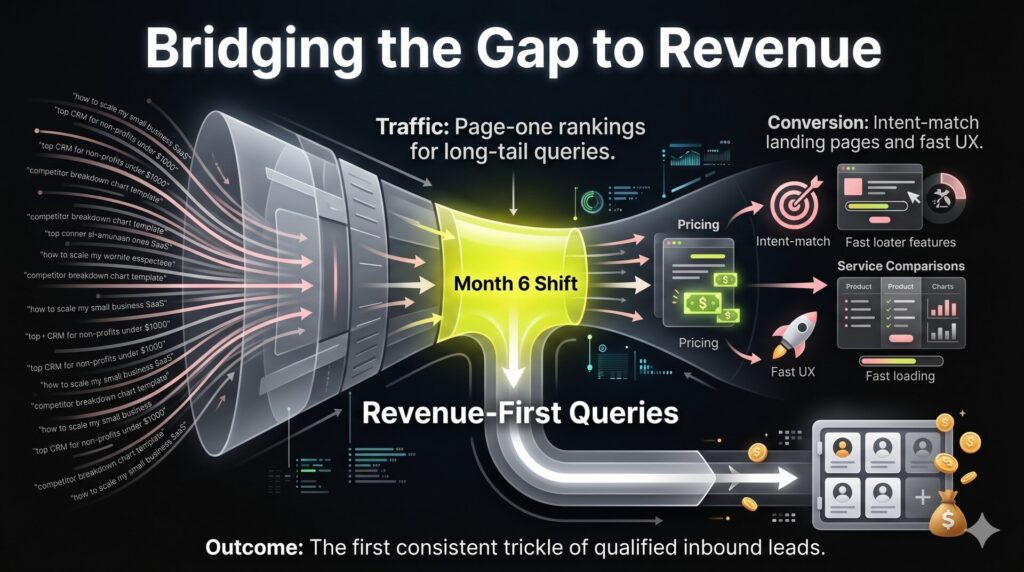
4. Bridge the Gap to Revenue (Months 3 to 6)
Many organic campaigns fail because they mistake initial friction for a dead end. By month six, the answer to how long does seo take to work becomes concrete through:
- Page-one rankings for specific long-tail and lower-competition queries.
- Measurable growth in non-brand organic clicks.
- The first consistent trickle of qualified inbound leads.
To convert traffic into pipeline, shift your effort toward revenue-proximate pages. Prioritize pricing, service comparisons, and integration guides that capture high-intent buyers. Success requires intent-match landing pages supported by fast UX and clear trust signals.
If you want this engineered as a pipeline channel, NUOPTIMA builds SEO + GEO roadmaps that prioritize revenue-first queries.
5. Cement Your Dominance and Forecast Your Pipeline (Months 6 to 12+)
The 6 to 12 month window transforms transient visibility into cemented authority. Answering how long does seo take to work shifts from speculation to precise forecasting. ROI compounds because your content library and internal link graph reach a strategic tipping point. Your footprint expands to capture high-competition terms while rankings stabilize against market volatility.
- Broader page-one footprint including high-volume head terms.
- Sustainable rankings supported by accumulated entity trust.
- Reliable revenue forecasting and clear attribution.
If leadership expects 90-day revenue, you require a low-competition niche or a different channel mix. Competitive dominance requires the budget runway to build the backlink profile and entity authority needed for ROI. This authority also ensures your brand is cited as the definitive answer in generative engines.
6. Evaluate Your Authority Runway
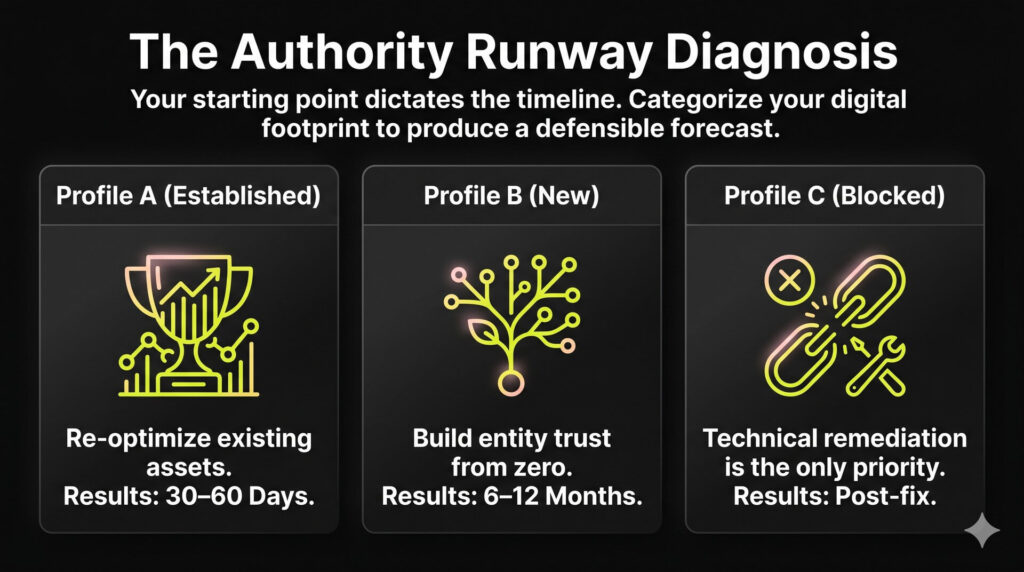
Trust and topical relevance dictate your timeline. To determine how long does SEO take to work for your brand, diagnose your starting point across three scenarios:
- Established but unfocused: Re-optimizing existing assets and internal links can trigger growth within weeks.
- New or low-authority: Expect 12 to 18 months to build the entity authority required for durable visibility.
- Technically broken: Remediation must precede ranking efforts; search engines cannot index what they cannot crawl.
Stop tracking third-party vanity scores. Monitor signals that prove traction in traditional and AI search layers:
- Indexation rate and crawl depth
- Branded search trends
- Referring domain quality
Finalize your growth timeline only after completing a technical and authority triage.
7. Benchmarking Against SERP Incumbents
You aren’t competing against Google. You’re competing against the incumbents occupying your target real estate. To determine how long SEO takes to work, you must first benchmark against your industry reality:
- Local Services: Results materialize faster through focused Google Business Profile (GBP) optimization and service-area pages.
- SaaS and B2B: These require longer runways to build the content infrastructure and entity authority needed to displace established giants.
- YMYL (Finance, Legal, Health): Timelines are longest due to strict trust thresholds and aggressive competition.
SERP complexity including AI Overviews, featured snippets, and map packs redefines what a “result” means. Perform a rigorous SERP audit before committing to 3, 6, or 12-month KPI promises. This prevents choosing unrealistic milestones that the competitive landscape cannot support.
8. Measure Success by Shipping Speed and Throughput
Your strategy doesn’t rank. Shipping does. Revenue follows the code and content you actually deploy. Determining how long does seo take to work depends more on internal throughput than algorithm updates.
Three bottlenecks often kill momentum:
- Protracted legal and brand reviews.
- Dev tickets trapped in technical SEO backlogs.
- Inconsistent publishing cycles that break momentum.
High-performance brands maintain a steady operating cadence. They run synchronized monthly technical and content sprints. They prioritize refreshing proven winners before producing net-new volume. Faster iteration cycles create faster learning loops.
NUOPTIMA provides a strategic process-led partnership to eliminate these operational bottlenecks. We help you install the execution cadence required for sustainable search dominance.
9. Future-Proof Your Timeline with GEO and Core Update Resilience
Modern search operates across two surfaces. Traditional SEO captures rankings and organic volume, while Generative Engine Optimization (GEO) ensures your brand is the cited source in AI answers. AI visibility often appears faster for factual patterns, but sustained dominance requires structured, citation-worthy data.
Core updates trigger “timeline resets.” If an update hits your site, growth stalls until you resolve technical trust and content depth. To mitigate volatility and future-proof your visibility:
- Construct entity-first content blocks using clear definitions and verifiable evidence.
- Strengthen trust signals via expert authorship, citations, and detailed “About” pages.
- Adopt “answer-ready” formatting to help LLMs extract and credit your insights.
Don’t just rank. Be the answer. Build your search authority at nuoptima.com.
How to Engineer Your 180-Day SEO and GEO Roadmap
Generic timelines fail because they ignore your specific starting conditions. Follow this executable framework to determine how long does seo take to work for your brand and produce a defensible forecast for stakeholders.
Step 1: Classify Your Starting Point
Identify which profile matches your current digital footprint:
- Profile A (Established but Unfocused): You have existing authority but lack topical depth. Expect results within 30 to 60 days via strategic re-optimization.
- Profile B (New or Low Authority): You are starting from zero. This requires a 6 to 12 month runway of aggressive content and link building.
- Profile C (Blocked): Technical errors or indexation issues are preventing growth. Remediation is the only priority here. [EDITOR NOTE: Matches outline Step 1]
Step 2: Define Your 30/90/180-Day Checkpoints
Set clear milestones to track progression beyond vanity metrics:
- Day 30: Confirm total indexation and technical health. You’ll see baseline conversions from existing traffic.
- Day 90: Measure impression growth and a top-20 keyword footprint. You’ll see early assisted conversions in your CRM.
- Day 180: Secure page-one wins for commercial long-tail queries. You will identify your first predictable organic lead sources. [EDITOR NOTE: Matches outline Step 2]
Step 3: Synchronize Workstreams
Divide your efforts into focused sprints rather than attempting everything at once:
- Technical Sprint: Resolve crawl budget leaks and Core Web Vital errors to improve site speed and indexation.
- Content Sprint: Deploy commercial landing pages supported by deep topical clusters.
- Authority Sprint: Secure high-quality digital PR and brand mentions to build entity trust.
Step 4: Build the AI Extraction Layer
Select 5 to 10 citation-worthy pages. Reformat them with clear definitions, FAQ schemas, and evidence-based data. This ensures your brand is optimized for extraction by LLMs like ChatGPT and Perplexity.
Stop guessing your growth trajectory. Visit NUOPTIMA to schedule a strategy assessment. Dominance requires visibility across all search surfaces. Partner with us for specialized Generative Engine Optimization (GEO) services.
Where this fits in your MSP growth system
This is one piece of how NUOPTIMA makes MSPs and cybersecurity firms the provider buyers find on Google and in AI search. See how it connects to MSP SEO and GEO and AI-search, or get your free MSP lead forecast to see exactly where your firm shows up across ChatGPT, Gemini, and Perplexity today.