Most B2B sites treat search like a lottery. They publish isolated pages that rank briefly then vanish because the site lacks a cohesive system. This fragmented approach kills your revenue pipeline. Dominating the answer layer requires a topical authority SEO strategy that prioritizes depth over disconnected articles. These nine steps build the coverage and internal linking structure needed to win Google rankings and AI citations. Step 1 starts by narrowing your topic boundary so every page compounds.
Key Takeaways
- Topical authority is site-level trust earned by comprehensive, validated coverage of one subject, and it makes your brand a preferred source for Google rankings and AI citations.
- Start by defining a defensible topic boundary you can realistically own with 20 to 40 distinct pages, then architect a topical map with one primary intent and one primary entity per page.
- Use a hub-and-spoke structure with internal linking up (spoke to pillar), down (pillar to spoke), and sideways (related spokes) to compound authority across the cluster.
- Win citations through Information Gain: add proprietary data, first-hand screenshots, and decision playbooks rather than summarizing the existing top results.
- Building a defensible authority moat typically takes three to six months of disciplined publishing and internal linking, measured by cluster impressions, query footprint, and brand citations in ChatGPT and Perplexity.
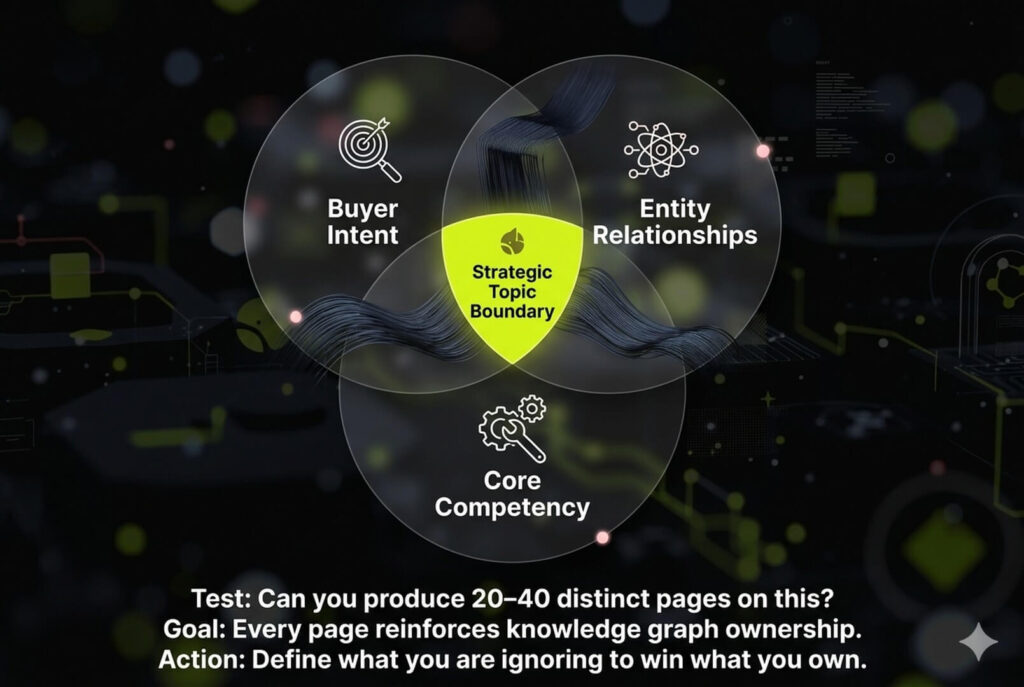
1. Define Your Strategic Topic Boundary
Topical authority SEO begins with a deliberate scope. Large sites often lose to smaller competitors due to authority leakage from a fuzzy strategic focus. Ill-defined boundaries prevent internal links from compounding, making your brand appear scattered to search engines and LLMs. A defensible boundary ensures content volume builds entity authority.
Pick one core niche topic you can realistically own. Before publishing, apply the volume test: can you produce 20 to 40 meaningfully distinct pages on this subject? Map this boundary using buyer intent and entity relationships rather than isolated keywords. Define your ideal reader, their desired outcomes, and the adjacent topics you will intentionally postpone.
Formalize this into a one-page topic definition document covering:
- Explicit scope and exclusions
- Monetization angles
- Primary conversion paths
This artifact aligns your team on what you are building and what you are ignoring. This prevents scattered publishing and ensures every page reinforces the knowledge graph ownership required for AI search citations.
2. Architect Your Topical Map by Intent and Entity
A topical map transforms a content backlog into strategic search infrastructure. This blueprint prevents cannibalization and ensures the comprehensive coverage AI engines require for citation. It reveals missing subtopics by mapping your domain’s entire knowledge graph before you write.
Build the map by intent layers and entity families:
- Intent Layers: Learn, Compare, Choose, and Implement.
- Entity Families: Tools, frameworks, metrics, mistakes, and templates.
Assign every planned URL three defining attributes:
- Primary intent: The specific query type the page must satisfy.
- Entity focus: The primary entity (subject) and secondary entities (semantic requirements).
- Placement: Defined internal-link parents and siblings within the cluster.
Enforce a strict guardrail: one page equals one primary intent and one primary entity. Pages targeting duplicate intent-entity pairs are candidates for merging. This disciplined architecture turns content into an interconnected authority engine rather than a collection of orphan pages.

3. Establish Hub-and-Spoke Content Pillars
Topical authority is easier to detect when your site features obvious hubs. Structural clarity helps search engines and LLMs map your expertise. Create one pillar page for every major subtopic within your topical boundary.
The pillar defines core concepts, summarizes the landscape, and routes traffic to depth pages. Supporting cluster pages must then solve specific sub-problems. Every page must earn its existence through:
- A distinct search intent
- A unique editorial angle
- Fresh substance that adds to, rather than repeats, the pillar
Redundancy dilutes your topical authority SEO and confuses crawler priority. To maximize visibility, deploy a visible In this cluster navigation block on every pillar and spoke page. This UX detail helps crawlers and users visualize your content ecosystem. It signals the depth required for AI search citations and transforms a standard blog into a structured knowledge system engineered for sustainable organic dominance.
4. Prioritize Information Gain Over Table-Stakes Coverage
Standard SEO checklists fail because they produce me-too commodity content. To earn AI citations and dominate Google, you must provide Information Gain. This is the unique, additive value your page provides that the current top ten results lack.
Summarizing existing search results makes your brand an echo. Instead, use this repeatable workflow to identify and exploit your competitive wedge before drafting:
- Extract SERP outlines to identify required baseline coverage.
- Identify missing sections or specific implementation caveats competitors ignore.
- Add proprietary elements like first-hand process screenshots, decision playbooks, or original data benchmarks.
Avoid chasing mythical information gain scores from software tools. Measure success through long-tail traffic lift and brand citations in engines like Perplexity or ChatGPT. Authority comes from being the cited source, not a summary of the status quo.
5. Implement an Internal Linking Strategy to Compound Authority
Isolated pages kill topical authority SEO. Without deliberate link architecture, cluster pages remain silos and pillars cannot accumulate the signals required for AI citations or Google rankings. Internal linking is the mechanical bridge that turns coverage into authority by creating interpretable topic relationships.
Implement minimum viable link rules for every cluster:
- Up: Every cluster page links to its pillar.
- Down: The pillar links to every cluster page.
- Sideways: Related cluster pages link contextually in-line, not just through sidebar widgets.
Maintain strict anchor text discipline using descriptive, entity-rich phrases. Vary anchors naturally to provide context to LLMs while avoiding repetitive exact-match strings.
Schedule a monthly broken-link sweep and a quarterly new content pass across older pages. This routine ensures high-authority pages pass signals to new assets, preventing authority from dying on isolated URLs. It maintains a crawlable ecosystem for generative engines to cite your brand as the definitive answer.
6. Use Entity-Centric Schema to Reduce Ambiguity
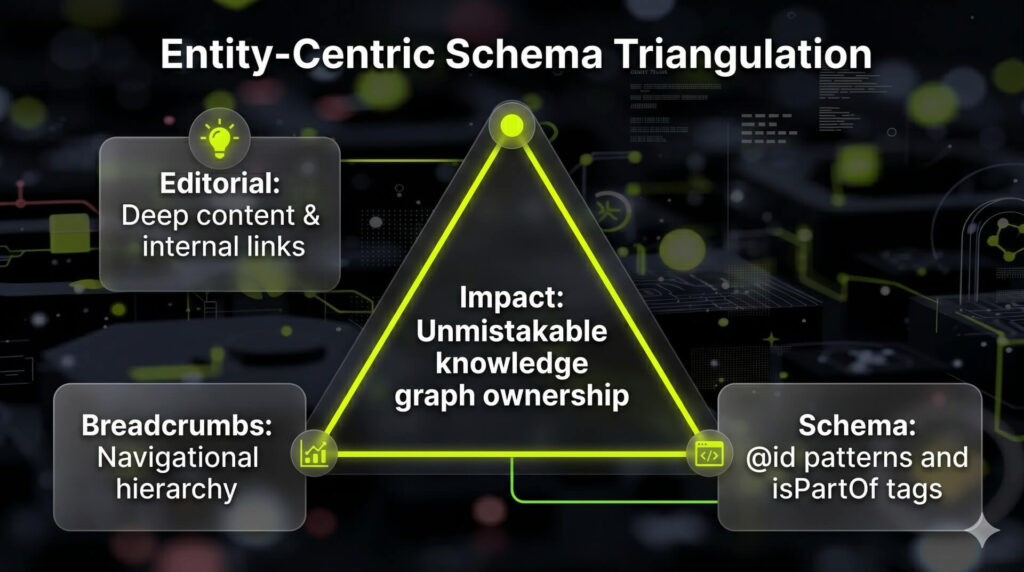
Schema does not create authority; it validates it. It reduces friction for crawlers and LLMs by confirming relationships established through content and internal linking. Prioritize your editorial structure first, then use schema to verify the existing architecture.
Implement these entity-centric basics:
- Assign stable `@id` patterns to pillar pages to define core entities.
- Map spokes to hubs using `isPartOf` and `hasPart` relationships.
- Use the `about` property for primary entities and `mentions` for supporting concepts.
Practice triangulation to eliminate entity ambiguity. Align breadcrumbs, navigation hierarchy, and schema relationships so search engines and AI retrieval systems receive an identical story three times. This triple reinforcement makes your topical architecture unmistakable. When the technical layer mirrors editorial depth, you accelerate the knowledge graph ownership required for consistent citations in generative engines.
7. Sustain Authority with a Systematic Refresh Loop
Topical authority decays the moment maintenance stops. Publishing bursts followed by inactivity create stagnant hubs and broken internal links that LLMs eventually ignore. Establish a sustainable publishing cadence (weekly or biweekly) aligned with your resources and competitive landscape. Consistent updates signal a current knowledge graph to both Google and generative engines.
Build a systematic refresh loop that prioritizes your highest-value assets. Update pillar pages first by refreshing statistics, replacing outdated screenshots, and integrating emerging subtopics found in recent search data. Next, refresh the specific cluster pages that support your highest-converting revenue paths to ensure they remain conversion-ready.
Execute a quarterly cluster audit sprint to maintain structural health. Use this window to re-link legacy pages to new assets and prune content overlap or keyword cannibalization. This operational rigor prevents authority decay and ensures your topical map stays aligned with evolving user intent and SERP shifts.
8. Reinforce Authority Through External Topical Validation
Perfect on-page architecture is insufficient for securing AI citations. Search engines verify expertise through external signals, making third-party validation the final layer of your topical authority SEO strategy. This reinforcement transforms your site into a safe, trusted source for LLMs.
Relevance outweighs volume. Prioritize mentions from niche-adjacent authorities over generic backlinks. A single citation from an industry leader signals entity authority more effectively than dozens of disconnected links, accelerating ranking resilience.
Earn these citations by creating high-utility assets:
- Original data and industry benchmarks
- Calculators and technical templates
- Definitive comparison pages
These assets provide the information gain required for AI engines to reference your brand as the definitive answer. Execute three continuous outreach motions to scale this authority:
- Digital PR: Earn high-tier mentions via original data stories.
- Expert Contributions: Provide technical insights to industry publications.
- Partner Content: Collaborate with non-competing brands for shared entity signals.
9. Measure Authority Through Revenue and AI Visibility
Without measurement, topical authority is a faith project. High-value SEO connects content coverage to predictable revenue. Every asset must improve internal cohesion and expand your searchable footprint.
Use an actionable measurement stack:
- Cluster-level growth: Monitor Search Console to ensure impressions rise across the entire topic group.
- Query footprint: Track new long-tail rankings that emerge without direct optimization.
- Internal link health: Maintain a 0% orphan rate and full hub-to-spoke coverage.
- Pipeline attribution: Track assisted conversions to justify content spend.
AI visibility requires tracking money prompts. Monitor whether your brand is cited in generative answers across ChatGPT and Perplexity for high-intent queries.
Manage diminishing returns. When new pages stop adding unique queries or citations, shift resources from expansion to refreshing existing assets and internal link reinforcement.
How to Execute a 30-Day Topical Authority SEO Roadmap
Turning strategy into search dominance requires a disciplined rollout. Use this four-week plan to convert your topical map into a high-performance cluster engineered for Google rankings and AI citations. This schedule builds a defensible search moat with measurable outputs.
Week 1: Map and Prioritize
1. Lock the topic boundary to establish narrow domain authority. You will define a defensible niche that prevents content sprawl.
2. Build a topical map identifying one primary pillar and 6 to 10 cluster targets. This creates a blueprint for your site’s knowledge graph.
3. Define five money prompts to track brand citations in LLMs for AI citation tracking. You’ll establish a baseline for your answer-layer visibility.
Week 2: Architecture and Templates
4. Refresh the pillar page to act as the authoritative anchor for the cluster. This concentrates link equity into your primary hub.
5. Set internal linking rules that mandate upward links from every spoke to the pillar. You will help AI crawlers recognize your topical hierarchy.
6. Create a semantic brief template containing required entities, search intent, internal links, and proof elements. This ensures each page satisfies information gain requirements.
Week 3: Publish for Information Gain
7. Ship 2 to 4 cluster pages targeting specific sub-problems. You will see your topical coverage expand across the generative search surface.
8. Inject one proprietary element into every page, such as a framework, template, or original benchmark. This distinguishes your content from commodity search results.
Week 4: Link, Validate, and Measure
9. Add upward, sideways, and downward links to connect all cluster assets and fix orphan pages. You’ll create a fully interconnected authority engine.
10. Validate schema and breadcrumb consistency across the cluster. This ensures your technical architecture matches the editorial structure.
11. Configure GSC dashboards and AI prompt-tracking logs. You will measure citation growth and organic revenue impact.
Where this fits in your MSP growth system
This is one piece of how NUOPTIMA makes MSPs and cybersecurity firms the provider buyers find on Google and in AI search. See how it connects to GEO and AI-search and answer engine optimization, or get your free MSP lead forecast to see exactly where your firm shows up across ChatGPT, Gemini, and Perplexity today.