Your pillar pages and subtopics are losing clicks to AI Overviews. Traditional hub and spoke models are legacy blueprints that ignore entity architecture and information gain. To survive the evolution of content marketing and seo, you must design clusters for AI citations and authority. We have identified 8 shifts in planning and measurement to protect your organic pipeline.
Start with the biggest shift: search is becoming an answer layer, not a list of links.
Key Takeaways
- Traditional hub-and-spoke clusters are losing clicks to AI Overviews, so design clusters for AI citations and entity authority, not just rankings.
- Search has moved from string-matching keywords to mapping entities and relationships, so your pillar page acts as the entity hub and supporting pages prove the relationships.
- Modern ranking systems reward information gain, the net-new value a page adds beyond the current index, so build one proprietary research asset per cluster as a citation magnet.
- Shift success metrics from traffic volume to how often your brand is selected, summarized, and cited by generative engines, measured at cluster level rather than per URL.
- Use a 6-step workflow: audit the cluster as a system, build an entity-first map, engineer information gain, optimize for extractability, reinforce proof, and establish a measurement loop.
| Dimension | Legacy hub-and-spoke | AI-native cluster |
|---|---|---|
| Organizing principle | Keywords and density | Entities and relationships |
| Differentiation | Same-but-longer coverage | Information gain and proprietary assets |
| Authority signal | Backlinks to the pillar | Proof blocks plus third-party corroboration |
| Success metric | Traffic and URL rankings | AI citations and cluster-level pipeline |
1. Optimize for the Answer Layer
The search engine results page is an answer layer, not a directory. As AI summaries move upward, clicks concentrate at the top or vanish entirely as queries resolve within the interface. You must shift success metrics from traffic volume to how frequently your brand is selected, summarized, and cited by generative engines.
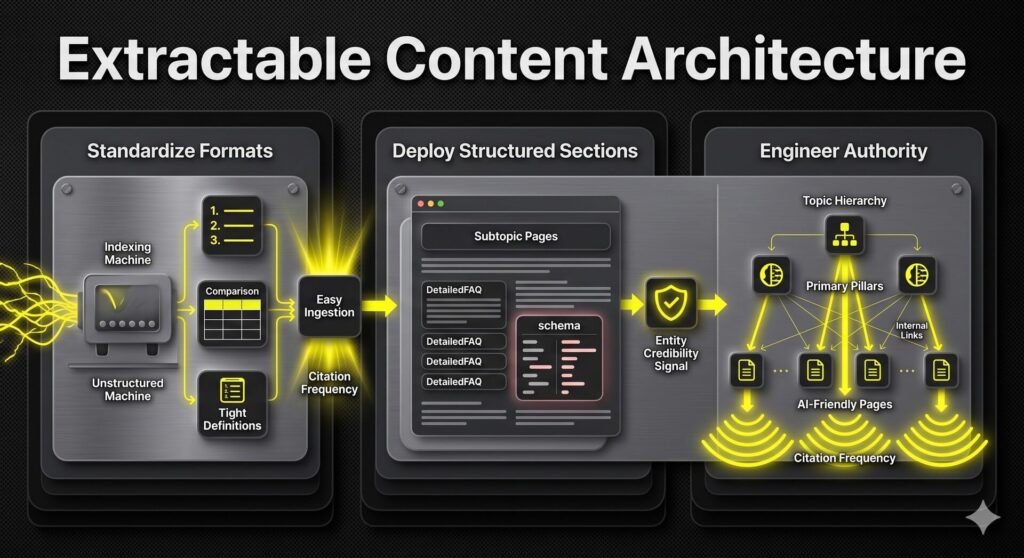
Dominating this distribution surface requires deploying a scalable SEO workflow to build extractable content architecture. Embed specific “citation targets” within your topic clusters to ensure your insights are LLM-ready.
- Standardize formats: Use tight definitions, numbered steps, and comparison tables for easy ingestion.
- Deploy structured sections: Add FAQ blocks and schema to every subtopic page to signal entity credibility.
- Engineer authority: Design internal links so AI-friendly pages inherit authority from your primary pillars.
2. Prioritize Information Gain and Originality
Saturated SERPs now punish iterative rewrites. If content merely summarizes existing results, you create a commodity with no editorial moat. Modern ranking systems reward information gain: the net-new value a page provides beyond the current index.
To lead the evolution of content marketing and SEO, engineer novelty into clusters to outrank “same-but-longer” competitors. Convert tacit knowledge into explicit checklists and falsifiable claims. This process transforms abstract expertise into proprietary intelligence that competitors cannot replicate.
Establish one “research asset” per topic cluster to serve as a citation magnet:
- Proprietary benchmarks or mini-studies
- Workflow screenshots and decision frameworks
- Original datasets
Supporting articles must link to and reuse these assets. This architecture compounds mentions and links while forcing AI engines to cite your brand as the primary source of knowledge.
3. Pivot from Keywords to Entity-Driven Architecture
Search has moved from string-matching keywords to mapping entities and relationships. Google and LLMs no longer prioritize keyword density. They prioritize the structural clarity of your knowledge graph. This evolution makes content clusters coherent to both search algorithms and LLM retrieval systems.
To modernize your architecture, map the entity ecosystem:
- Problems, methods, and tools
- Roles, metrics, and alternatives
- Organization, Article, and FAQ/HowTo schema
Reinforce these connections using consistent terminology and internal links. Your pillar page functions as the entity hub, while supporting pages provide relationship proofs through implementation guides and comparisons. This prevents thin clusters that look comprehensive but lack the semantic coverage required to sustain rankings or earn AI citations.
4. Build Reputation Assets to Prove Authority
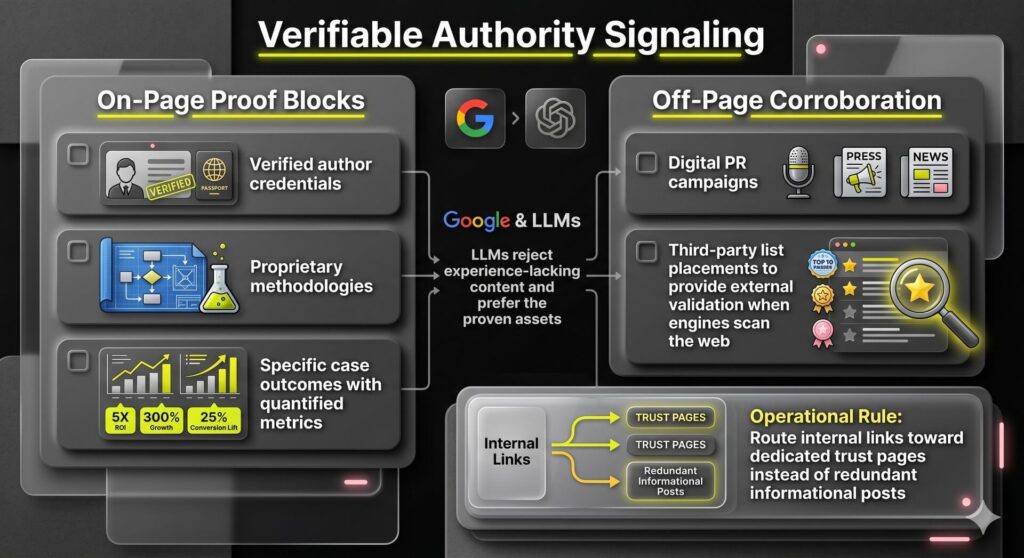
Google and LLMs reject content lacking verifiable experience. Rising quality thresholds have transformed reputation and expertise into core ranking differentiators rather than vanity metrics.
Lead the evolution of content marketing and seo by embedding “proof blocks” into your clusters:
- Verified author credentials
- Proprietary methodologies
- Specific case outcomes with quantified metrics
Route internal links toward these assets instead of redundant informational posts. Add dedicated “trust pages” for clusters to cite as primary evidence.
Align off-page reputation with on-page claims through digital PR and third-party list placements. These provide the external corroboration LLMs require. When generative engines scan the web, they must find your brand cited by authoritative sources to confirm your entity authority.
5. Operationalize Content Maintenance and Pruning
Stale pages cause authority leakage that drags down cluster performance. In the evolution of content marketing and seo, a bloated archive signals low utility to Google and LLM crawlers. Outdated content erodes entity authority and poisons your organic search rankings.
Transition your strategy from campaign-based publishing to a dedicated content operating system:
- Trigger refresh cycles based on intent shifts, not arbitrary dates.
- Consolidate cannibalizing pages to concentrate link equity.
- Prune dead weight and repair internal links to protect authority flow.
Identify a core set of pillar and citation targets that must remain evergreen. Shift from tracking URL rankings to measuring cluster-level performance. This prevents topical decay and ensures your ecosystem generates sustainable organic revenue, pipeline, and AI-search citations.
6. Integrate Distribution into the Cluster Lifecycle
Modern B2B buyers research across communities, video, and AI assistants before visiting your site. To drive the evolution of content marketing and seo, you must map decision moments where users evaluate solutions and distribute cluster-derived assets across those surfaces.
Convert every pillar article into a platform-specific content pack:
- Short-form video for social channels
- Community-specific insights
- Actionable checklists
- Technical summaries for AI ingestion
Use consistent entity language across channels to reinforce brand-topic association. This footprint earns high-authority third-party mentions that feed LLM citation selection. Expanding authority signals beyond Google protects organic revenue as SERP clicks decline. This strategy transforms static pages into citation-worthy infrastructure that captures demand where buyers research, compare, and decide.
7. Implement AI Governance for Quality at Scale
AI commoditizes average content, flooding the web with synthesis rather than insight. To dominate the evolution of content marketing and SEO, separate acceleration from authority. Use LLMs for technical outlines and data extraction, but never for primary claims or proprietary insights.
Establish strict governance to protect topical authority. Define human-only zones for benchmarks, case evidence, and unique strategic points of view. Every asset requires SME review and rigorous validation to prevent AI-assisted output from diluting your brand’s entity authority.
- Create reusable templates for answer blocks and FAQs to improve safe engine extractability.
- Use editorial checklists to enforce entity authority requirements across all topic clusters.
- Designate proprietary data as original-only content to prevent generic synthesis and quality triggers.
8. Shift Measurement to Pipeline and AI Citations
Organic revenue can grow even as traffic declines. As AI engines resolve intent without clicks, appearing as the cited source in the answer layer matters more than the session. When traffic acts as a lagging indicator, shift measurement from URL rankings to cluster-level influence.
Track these modern indicators:
- Brand mentions in AI responses and citation frequency.
- Query coverage by intent and entity authority.
- Organic pipeline: assisted conversions, lead quality, and sales cycle influence.
Measure by topic cluster rather than individual URLs. Use cluster performance to prioritize refreshes and create net-new information gain assets. By focusing on sales cycle impact, you align search strategy with revenue and establish dominance in the answer layer.
How to Modernize Your Clusters: A 6-Step Workflow for the Evolution of Content Marketing and SEO
Translate recent shifts in the evolution of content marketing and seo into a repeatable execution framework. This workflow ensures your topic clusters satisfy Google ranking systems and the citation mechanics of engines like ChatGPT or Perplexity.
Step 1: Audit the Cluster as a System
Analyze existing hub and spoke architecture to identify authority leakage. Map the pillar page against all top supporting articles to identify gaps where a citation target is missing. Spot keyword cannibalization across the cluster. Prune redundant pages and consolidate link equity into high-performing assets that serve as the cluster foundation. Outcome: You will see a prioritized list of pages to refresh, merge, or delete.
Step 2: Build the Entity-First Map
Move beyond keywords by mapping the entities related to your topic. List the primary entity, sub-entities, alternatives, metrics, and specific use cases. Assign every page in the cluster to a specific relationship within this map. This structure ensures your content matches the semantic retrieval systems used by Large Language Models. Outcome: You will have a structural blueprint that reinforces your topical authority.
Step 3: Engineer Information Gain
Choose one originality anchor to prevent your cluster from becoming commodity content. Select a research asset such as a mini-study, proprietary benchmark table, custom decision framework, or first-hand experiment. This asset serves as the primary citation magnet for AI engines looking for unique data points. Outcome: You will create a unique piece of intelligence that forces competitors to cite your brand.
Step 4: Optimize for Extractability with GEO and AEO Formatting
Structure your content for maximum Knowledge Graph visibility. Add a lead answer block to the top of every page. Incorporate FAQ sections with schema, comparison tables, and a clean heading hierarchy. Ensure all key insights exist in crawlable HTML rather than being buried in images or complex scripts. Outcome: You will produce content that generative engines ingest and summarize with high accuracy.
Step 5: Reinforce Authority and Proof
Embed proof blocks into every high-value page to establish entity authority. Include verified author credentials, specific case outcomes, and proprietary methodologies. Launch a digital PR plan to secure third-party mentions. These external signals provide the corroboration LLMs require to select your brand as a trusted source. Outcome: You will build a cluster that meets the quality thresholds required for the answer layer.
Step 6: Establish the Measurement Loop
Track cluster-level KPIs including rankings, impressions, and conversions. Monitor AI mentions and citation frequency alongside traditional Google Search Console data. Use these insights to identify which assets are winning the answer layer. Refresh these winners quarterly to maintain their evergreen status and citation dominance. Outcome: You will gain a data-backed view of how search contributes to organic revenue and pipeline.
For teams that want done-for-you GEO execution and AI citation growth, partner with the specialists at NUOPTIMA and explore our dedicated GEO service page.
FAQ
The skyscraper technique is no longer sufficient as a standalone strategy. While comprehensive coverage remains a baseline requirement, simply producing the longest resource results in commodity content that AI can easily summarize. To lead the evolution of content marketing and SEO, you must prioritize information gain. This requires embedding original data, proprietary frameworks, or unique experiments that generative engines cannot synthesize from the existing index.
Yes, but success metrics must shift from traffic volume to pipeline impact. While AI Overviews may resolve simple queries within the interface, being cited as the authoritative source establishes brand influence. Treat these citations as top-of-funnel touchpoints. Optimization should focus on capturing qualified clicks when they occur and ensuring your brand is the definitive answer recommended by LLMs during the research phase.
Focus on long-tail informational queries and structure your content for easy extraction by LLM crawlers. Use concise answer blocks at the start of sections, comparison tables, and FAQ schema. Corroboration is also a critical factor. LLMs prioritize sources that are frequently mentioned across authoritative third-party sites and directories. See Step 4 of our workflow above for specific extractable formatting requirements.
Programmatic SEO remains a viable growth lever if it delivers genuine utility through data hubs or specialized tools rather than thin, template-driven pages. Success in 2026 requires strict human QA and governance to avoid generating scaled low-value content. Each programmatic page must serve a specific user intent and provide original insights or functionality that cannot be found elsewhere.
Select one high-impact topic cluster and audit it for GEO readiness. Your first priority is to add an originality anchor to the cluster and reformat key pages with extractable answer blocks. Once these updates are live, measure changes in AI visibility and conversion rates. Use these results to justify a broader rollout across your remaining content ecosystems.
Where this fits in your MSP growth system
This is one piece of how NUOPTIMA makes MSPs and cybersecurity firms the provider buyers find on Google and in AI search. See how it connects to MSP content marketing and MSP SEO, or get your free MSP lead forecast to see exactly where your firm shows up across ChatGPT, Gemini, and Perplexity today.