Most B2B SEO roadmaps fail because generic best practices rarely survive your specific niche. In 2026, rigorous seo experiments are the only defensible way to scale as AI Overviews and LLM citations rewrite the search experience.
Here are eight high-leverage tests and a reusable measurement system from NUOPTIMA, the authority in SEO and GEO. For expert execution, visit our GEO services page.
Key Takeaways
- Rigorous SEO experiments are the defensible way to scale organic revenue in 2026, because generic best practices rarely survive a specific niche once AI Overviews and LLM citations reshape search.
- The eight highest-leverage tests cover title and meta CTR, internal linking, refresh versus net-new content, advanced schema, zero-click authority, indexation rules, site-level quality, and infrastructure performance.
- Every test needs a locked control set, single-variable changes, and a defined measurement window to separate real lift from algorithm updates and seasonality.
- Tie experiments to business outcomes like qualified leads or organic revenue, and use a proxy SEO metric only when it reliably predicts those outcomes.
- Maintain a tracked query set for AI Overviews and LLM citations, logging citation presence before and after changes to verify impact in the answer layer.
An SEO experiment is a controlled, single-variable test on a defined set of pages, measured against a locked control group, used to prove whether a change drives organic revenue before rolling it out at scale.
1. Test Title and Meta Tag Patterns for CTR Uplift
Stagnant rankings do not mean stagnant revenue. Low CTR starves high-intent pages of pipeline even when they rank. Title and meta tag seo experiments are the fastest path to compounding organic revenue without the cost of new content.
Run single-variable tests on a cluster of similar intent pages. Compare benefit-led titles against standard keyword mapping patterns, logging the exact change date. Measure success through:
- Primary: Organic CTR and clicks (GSC)
- Secondary: Conversions per organic session (GA4)
Stagger rollouts across template groups once validated. Avoid testing during major promotions or bundling with internal link edits to maintain data integrity.
2. Strategic Internal Linking for Pipeline Acceleration
Internal links are controllable, fast to deploy, and solve authority leakage where TOFU content ranks while BOFU pages stay stuck. To run these SEO experiments, select 20 target feature pages and a matched control set.
What to test:
- Add three links from high-authority blog posts to target pages.
- Update generic anchor text to intent-specific, transactional phrases.
Measure success via clicks and impressions in Search Console, tracking assisted conversions in GA4 to verify pipeline contribution. Avoid changing anchors and adding links simultaneously; testing two variables makes results unreadable. This experiment directs authority to high-value money pages, ensuring your conversion-ready content isn't buried by informational blog posts.
3. Refreshing Proven URLs vs. Net-New Content
Most B2B teams default to publishing volume. Use SEO experiments to evaluate content SEO vs technical SEO efficiency, proving whether updating proven URLs yields higher ROI than launching new assets. If existing pages operate at 60% potential, refreshing your evergreen SEO content is your fastest path to organic revenue.
Compare 10-20 refresh candidates with stable impressions against 10-20 net-new pages targeting similar intent.
- Optimize structure and entity density.
- Refine answers for AI-search citations.
- Measure time-to-lift and organic conversion.
Refreshes win when you have authority but stagnant rankings. Net-new wins when you lack topical coverage. This framework prevents wasted production cycles by identifying where your investment compounds fastest.

4. Scale AI Visibility via Advanced Schema Deployment
Revenue-driving content remains invisible to generative engines without a machine-readable roadmap. Structured data is a dual-surface lever that improves SERP presentation and simplifies LLM parsing. This experiment wins citations when ranking alone is insufficient.
Execution:
- Upgrade template schema: FAQ, Organization, Author, HowTo, and Product.
- Tighten on-page answer blocks to match the data structure.
- Implement on a subset of pages with minimal copy changes to isolate the variable.
Measurement:
Monitor Rich Result reports and CTR shifts in GSC. Track whether these pages earn more citations in AI Overviews or LLM answers for your tracked query set.
5. Optimize for Zero-Click Authority and Brand Mentions
Zero-click SERPs are brand-building assets. When Google answers queries directly, use this SEO experiment to ensure your brand owns the definitive solution in the answer layer.
What to test:
- A 40 to 60 word definition block using objective language to answer primary intent.
- H2 headings refactored into direct questions.
- Comparison tables where SERPs support structured data.
How to run it:
Retrofit one query family or page set. Keep link building constant to isolate formatting variables.
How to measure:
Define success by visibility and downstream demand rather than on-page sessions. Track:
- Snippet and PAA visibility via SERP tracking
- Branded search lift
- Assisted conversions
6. Tighten Indexation Rules for Crawl Efficiency
Scaling sites often hit a revenue ceiling because low-value URLs dilute crawl budget. Stop debating indexation logic and validate it through seo experiments.
What to test:
- Noindex or pruning for thin content.
- Canonical logic cleanup.
- 404 vs 410 response codes for removed inventory.
Isolate a single directory and keep templates stable to ensure data integrity. Measure success through indexed page trends, GSC crawl stats, and log-based frequency.
Redistributing bot activity to priority sections prevents index bloat from diluting your ranking power. Always deploy on a limited subset first and document rollback steps to protect revenue-driving pages.
7. Audit Site-Level Quality to Unlock SERP Feature Eligibility
If Google’s site-level quality filters gate your domain, micro-optimizations won't move the needle. Use seo experiments to see if technical friction or trust signals block SERP feature eligibility.
Select one template and ship a clean variant across a page group:
- Reduce ad density and aggressive interstitials.
- Strengthen trust blocks with detailed author entities and editorial policies.
- Improve template-level performance.
Monitor shifts in SERP feature visibility, engagement quality, and organic conversion rates. If visibility improves, prioritize "quality unlocks" over content volume. This prevents teams from wasting quarters on minor tweaks when the real limiter is site-level trust.
8. Stress-Test Infrastructure for Hidden Performance Gains
Technical bloat creates an invisible ceiling on organic revenue by limiting crawl efficiency. Use seo experiments to verify if legacy infrastructure suppresses your high-value pages. Move a low-risk directory to a high-performance environment while keeping content identical. Monitor results for four weeks to allow search engines to re-evaluate the technical layer.
Track these indicators:
- Indexing speed and discovery rates
- Crawl stability in Search Console
- Keyword rank distribution
If the test subset shows consistent visibility gains, prioritize infrastructure upgrades for revenue-critical sections. This eliminates platform-level risk and ensures your SEO ceiling is set by strategy, not technical friction.
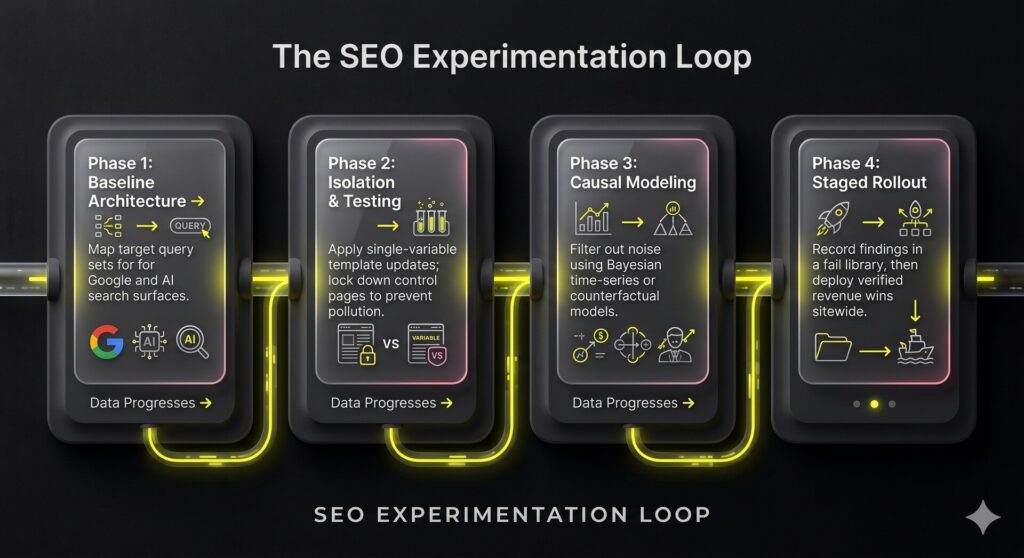
How to Build a High-Rigor SEO Experimentation Workflow
Step 1: Define Business Outcomes Over Activity
Identify the primary conversion event first, such as qualified leads, pipeline influenced, or organic revenue. Select an SEO proxy KPI like clicks, CTR, or rankings only if it accurately predicts those revenue outcomes. This ensures you avoid optimizing for vanity metrics that fail to impact the bottom line.
Step 2: Select Your Experiment Architecture
Choose the test type based on your site structure. Use Template/Split Tests for groups of similar pages where you can divide URLs into control and test sets. Deploy Time-Based Tests for unique pages where splitting is impossible. You will need longer observation windows and strong controls to compensate for the lack of a parallel test group.
Step 3: Build a Control Set You Trust
Identify pages with historically correlated performance to your test group. Lock these pages down completely. Do not change content, metadata, or internal links on your control set while the experiment is active. This prevents data pollution and ensures your results are attributable only to the test variables.
Step 4: Filter Out Seasonality and Noise
Analyze results with a counterfactual model such as Bayesian structural time-series or the CausalImpact framework. Avoid simple pre-and-post comparisons. This rigorous approach isolates your changes from site-wide trends, algorithm updates, or external market volatility.
Step 5: Establish Minimum Measurement Windows
Set run rules based on Google’s crawl frequency and indexation patterns. Ensure the post-change period is long enough to clear the initial re-ranking phase. If traffic volume is low, extend the test duration until you reach statistical confidence.
Step 6: Create an Experiment Changelog and Fail Library
Document every test on a one-page card that includes the hypothesis, variable, pages, dates, and results. You will find that tracking "failed" tests is as valuable as tracking wins. It prevents the organization from repeating ineffective tactics and wasting future engineering budgets.
Step 7: Roll Out Like a Growth Team
Deploy changes using a staged approach. Ship the update to a small subset first, confirm the revenue uplift, and then scale the implementation across the entire template or site architecture.
The AI and GEO Visibility Add-on
Maintain a tracked query set specifically for AI Overviews and LLM citations. Log your citation presence and source URLs before and after site changes. This allows you to verify your impact within the generative answer layer and ensure your brand remains a primary source for AI-generated responses.
Work with NUOPTIMA If you want an experimental roadmap engineered for Google and the answer layer, visit nuoptima.com and explore our Generative Engine Optimization (GEO) services page.
For teams looking to build an end to end strategy, explore our GEO services to dominate both traditional and AI search surfaces.