Keyword lists do not rank. Pages do. Most spreadsheet-heavy strategies lead to keyword cannibalization and a bloated architecture that confuses crawlers. Effective seo keyword mapping treats your site as revenue-aligned information architecture. By mapping one intent to one page, you engineer topical authority, standardizing technical solutions much like the structured frameworks found in a modern network support services MSP guide, and ensure your brand is citation-worthy for AI models. Use this practical method to align TOF, MOF, and BOF content with your funnel to drive pipeline.
Keyword mapping is assigning each target keyword and search intent to one specific page, so your site reads as clean, revenue-aligned information architecture instead of a spreadsheet. It is the discipline that prevents two pages from competing for the same query. Map one intent to one page and you build topical authority; skip it and crawlers (and AI models) get confused about which page to trust.
Key Takeaways
- Keyword mapping assigns each target keyword and search intent to one specific page, turning your site into clean, revenue-aligned information architecture instead of a spreadsheet.
- The core rule is one intent equals one page, which builds topical authority and prevents the cannibalization that splits ranking power across competing URLs.
- Map keywords to funnel stages: TOF guides and definitions build authority, MOF comparisons pre-sell, and BOF service, pricing, and demo pages convert.
- For existing sites, mapping is an audit of equity: crawl your URLs, then Map, Create, or Re-scope each cluster, merging duplicates into the winner with 301 redirects.
Why it matters for MSPs and cybersecurity firms
- Multi-service MSPs cannibalize themselves constantly, with several thin pages all chasing "managed IT services" and none winning.
- A clean intent-to-page map matches the long, research-heavy way B2B buyers move from problem to vendor.
- One unambiguous page per topic is also far easier for AI engines to cite as the answer.
We build a canonical master sheet first, mapping TOF, MOF, and BOF intent to single owning pages before any content gets written. That architecture-first method is the backbone of every SEO program we run.
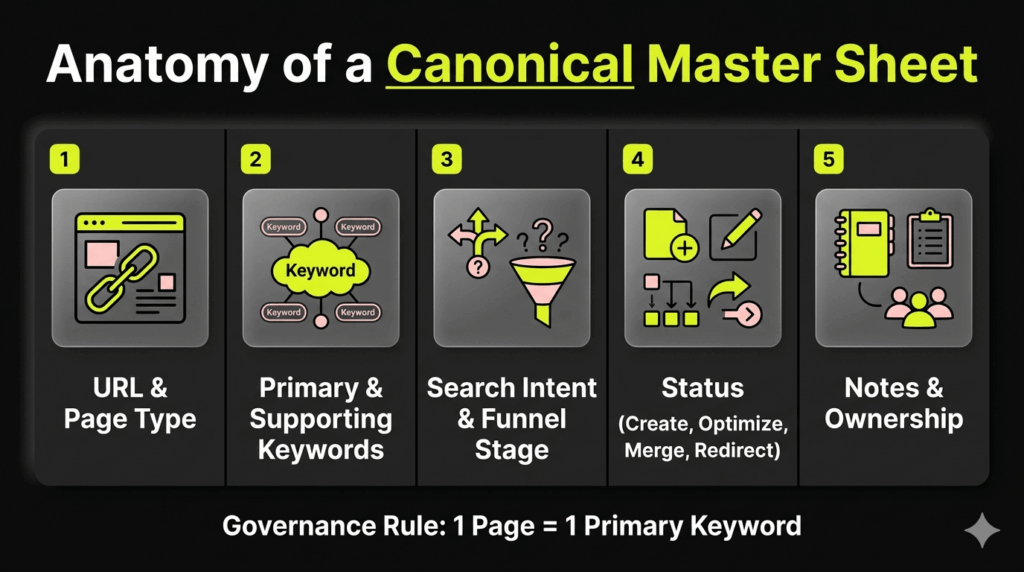
1. Build the Canonical Master Sheet
Raw keyword research often leaves teams paralyzed, unsure which page to prioritize. A list of terms is merely data. A master seo keyword mapping sheet is an operational engine that connects research to content production.
This canonical document serves as the final authority on URL ownership and intent. Your executable column set should include:
- URL and Page Type
- Primary and Supporting Keywords
- Search Intent and Funnel Stage
- Status (Create, Optimize, Merge, or Redirect)
- Notes and Ownership
For advanced governance, include target H1s, title tag drafts, and internal linking targets.
Apply two non-negotiable governance rules. One page must equal one primary keyword to prevent cannibalization. Use standardized statuses so the map remains filterable. This artifact eliminates non-executable lists by creating a single source of truth that drives every build and optimize decision.
2. Cluster by Searcher Intent and SERP Format
Pages fail when they prioritize volume over intent. High-value mapping requires the “one-click resolution” test: identify exactly what satisfies the searcher in a single interaction and label intent accordingly.
Categorize keywords into four primary buckets:
- Informational: To educate the reader.
- Commercial: To compare solutions.
- Transactional: To drive conversions.
- Navigational: To locate a specific page.
Cluster by topic and intent rather than synonyms. If lookalike terms produce different SERP formats, such as a guide versus a product page, split them into separate assets, a foundational principle deployed in any scalable cloud computing marketing strategy. This prevents the strategic error of ranking with the wrong content type.
To maximize GEO and AI visibility, map question-style queries into structured FAQ blocks. This improves extractability for LLMs and increases citation likelihood in AI Overviews. Each cluster now performs a specific job in your revenue funnel.
3. Map Content Types to Funnel Stages
Most site architectures follow CMS folder structures rather than buyer psychology. This misalignment is why high-volume traffic often fails to generate pipeline traffic, emphasizing the critical need for an optimized IT support small business conversion path that captures immediate local demand. Use your seo keyword mapping document to assign every keyword a funnel stage and a specific content type:
- Awareness (TOF): Guides, definitions, and checklists to build entity authority.
- Consideration (MOF): Comparisons, alternatives, and “best X for Y” use cases to pre-sell.
- Decision (BOF): Service pages, pricing landers, and demo forms designed to convert.
Define linking logic in your Notes column so every TOF page points to its MOF and BOF counterparts within the same cluster. This forces every mapped page to have a funnel job and a clear next-step path. Your site architecture then matches how buyers actually research and decide, turning organic visibility into a revenue-aligned engine.
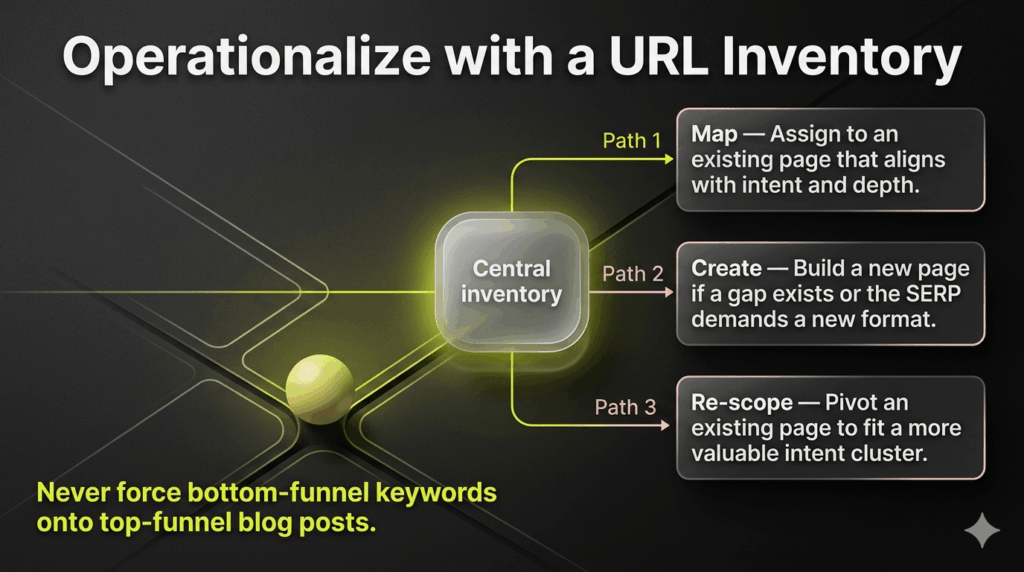
4. Operationalize the Roadmap with a URL Inventory
Most SEO strategies fail because teams map as if starting from a blank slate. For established sites, mapping is an audit of existing equity rather than a creative exercise. Export your URLs via a crawl or sitemap to ground your keyword clusters in site reality.
For each cluster, choose one of three actions:
- Map: Assign to an existing page that aligns with intent and content depth.
- Create: Build a new page if a gap exists or the SERP demands a different format.
- Re-scope: Pivot an existing page to fit a more valuable intent cluster.
Never force bottom-funnel keywords onto top-funnel blog posts. This intent mismatch erodes both ranking authority and pipeline conversion. This approach prevents wasted work and ranking losses by identifying the precise build or optimize path for every cluster based on your current URL set.
5. Resolve Content Conflicts and Canonicalize Intent
Multiple pages targeting the same intent split authority rather than doubling visibility. Treat your seo keyword mapping as a conflict-resolution system: one intent must map to exactly one URL. This identifies and eliminates cannibalization that suppresses your organic rankings.
Detects duplicates where multiple URLs share a primary keyword or intent cluster. Select a “winner” based on relevance, backlink equity, historical performance, and conversion role.
- Merge weaker content into the winner and 301 redirect the URL.
- Reposition secondary pages to a different intent, such as pivoting a guide to a comparison.
- Update internal link anchors to point exclusively to the winner.
Consolidation clarifies topical focus and strengthens authority signals. This creates the extractable entity architecture required for both Google dominance and AI engine citations.
6. Engineer Down-Funnel Pathways through Internal Linking
High rankings generate zero revenue if your map ignores internal linking. Your seo keyword mapping is incomplete until it dictates the pathways that move PageRank and users toward conversion.
Define a strict hierarchy for every cluster:
- Pillar Pages (TOF): Establish broad topical authority.
- Bridge Assets (MOF): Provide comparisons, alternatives, and use cases.
- Target Pages (BOF): Service or product pages where revenue lives.
Specify exact linking logic to prevent isolated content:
- TOF to MOF: Contextual, mid-article links.
- MOF to BOF: Strong, conversion-aligned anchors.
- BOF to TOF: Supporting evidence and resources.
To dominate the GEO layer, embed extractable answer blocks and FAQ schemas on pillars. This ensures LLMs find definitive statements to cite in AI-generated answers. Intentional linking transforms static content into a revenue-aligned engine with improved crawl paths and stronger topical authority.
7. Scale Your Keyword Map for Enterprise Maintenance
Static keyword maps rot once sites exceed 100 pages, leading to content cannibalization and missed opportunities. To scale your seo keyword mapping, build a governance speed layer that prevents technical debt before it compounds. Use conditional formatting to instantly flag:
- Duplicate primary keywords
- Overlapping URLs
- Missing intent or funnel fields
Accelerate matching by importing crawl exports (URL, title, and H1) to compare live site data against target clusters. Add a “Content Status” filter to isolate active production queues from archived records and apply the scale rule: if a task repeats weekly, automate it as a sheet field or validation rule. This reduces manual overhead and prevents human error, ensuring the map remains functional at 5,000 URLs. Maintaining this precision provides the clean, entity-rich data structure required for AI engine citations and long-term, compounding organic revenue.
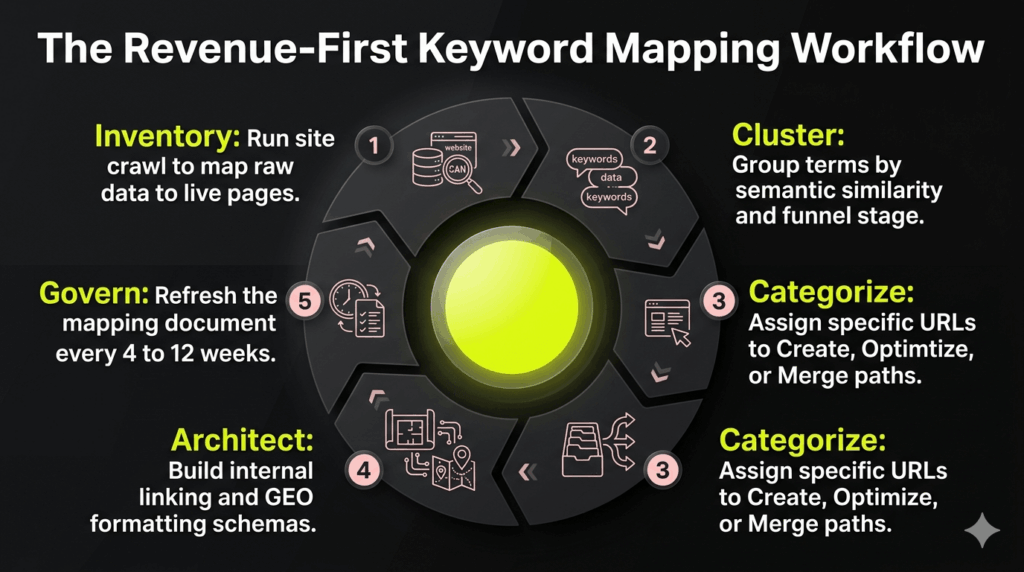
How to Implement a Revenue-First Keyword Mapping Workflow
Keyword mapping transforms raw data into a repeatable implementation sequence. Use this workflow for new site builds to architect Information Architecture before writing content. For existing sites, use it to resolve keyword cannibalization and align stagnant URLs with current revenue goals.
Step 1: Inventory Assets and Keyword Universe
Run a site crawl to inventory every existing URL. Aggregate keyword research from all sources into a single master sheet. Map raw search data to live pages to visualize where the domain holds equity and where the brand is currently invisible.
- Deliverable: V1 seo keyword mapping document linking target terms to specific URLs.
Step 2: Cluster by Topic and Intent
Group keywords into clusters based on semantic similarity. Assign each cluster a funnel stage such as TOF, MOF, or BOF and designate a specific page type. This ensures every piece of content satisfies a distinct search intent and supports the user journey.
- Deliverable: Filtered sheet views for funnel stages to identify critical coverage gaps.
Step 3: Categorize Page Actions
Map keyword clusters to specific URLs and assign one of three actions: Create, Optimize, or Merge. Use SERP requirements to determine if an asset requires a new page or a redirect to consolidate authority and eliminate internal competition.
- Deliverable: Prioritized action backlog for the next 90 days.
Step 4: Architect Internal Linking and GEO Formatting
Design a linking checklist for every content pillar. Direct PageRank toward bottom-funnel conversion pages to maximize organic revenue. To satisfy AI search engines, embed extractable definitions, structured lists, and FAQ schemas within each pillar asset.
- Deliverable: Linking and entity optimization checklist per pillar.
Step 5: Execute Review Governance
Refresh the mapping document every 4 to 12 weeks. Update production statuses and integrate new keyword data to prevent the strategy from becoming stagnant as the site scales.
- Deliverable: Governance log with “Last Updated” and “Live URL” status.
Partner with nuoptima.com to engineer a search architecture built for both Google and AI. Explore our https://nuoptima.com/generative-engine-optimization-geo-services (GEO) services to dominate the answer layer.
If you want your site architecture engineered for dominance in both Google and AI answer engines, partner with the specialists at nuoptima.com. Explore our (GEO) services to become the definitive answer in your industry.
Where this fits in your MSP growth system
This is one piece of how NUOPTIMA makes MSPs and cybersecurity firms the provider buyers find on Google and in AI search. See how it connects to MSP SEO and GEO and AI-search, or get your free MSP lead forecast to see exactly where your firm shows up across ChatGPT, Gemini, and Perplexity today.