Search visibility dies when teams treat content seo vs technical seo as a binary choice. Frequent publishing fails if technical debt caps visibility, while performance audits cannot capture buyer demand. This execution gap creates a ceiling that stalls your organic pipeline. We have engineered nine moves to secure evergreen Google rankings and LLM citations. Use this framework to stop debating priorities and start shipping work that compounds across the entire AI answer layer, positioning your efforts within a clear SEO ROI framework.
Key Takeaways
- Use the eligibility versus ability rule: technical SEO makes pages indexable, content SEO makes them rank, and if a page is not eligible, technical fixes take total precedence.
- Bundle technical table stakes (HTTPS, mobile parity, no broken links) into content templates so pages ship publish-ready without waiting on developer sprints.
- Site speed is often an editorial failure: unoptimized hero images, bloated embeds, and unvetted scripts degrade Core Web Vitals, so if a page fails CWV it should not ship.
- Organize technical content into hub-and-spoke clusters with strict internal linking so isolated docs and error fixes compound into topical authority and AI citations.
- For AI answer-layer visibility, define your core concept in one declarative sentence near the top and add FAQPage, HowTo, or TechArticle schema that mirrors visible content.
1. Solve the “Eligibility vs. Ability” Stalemate
Search stagnation occurs when teams fail to categorize problems. Use this two-bucket mental model to eliminate guesswork and prioritize your backlog:
- Eligibility (Technical SEO): Ensures Google and LLMs can access, render, and index your pages. Without eligibility, content value is zero.
- Ability (Content SEO): The capacity of a page to satisfy intent, earn AI citations, and convert readers into pipeline.
Apply this prioritization filter to every high-value page:
- If not eligible: Technical fixes take total precedence.
- If eligible but stagnant: Iterate on content depth or entity authority.
Operationalize this with a 15-minute weekly triage ritual. Content and dev teams must review one shared backlog where every fix has a single owner. This prevents siloed warfare and ensures every sprint compounds your search moat and organic revenue, an operational necessity when managing campaigns like B2B local SEO for regional engineering hubs. By turning “content vs technical” into a repeatable decision, you eliminate guesswork and focus entirely on pipeline impact.
2. Implement a High-Leverage Technical Publication Gate
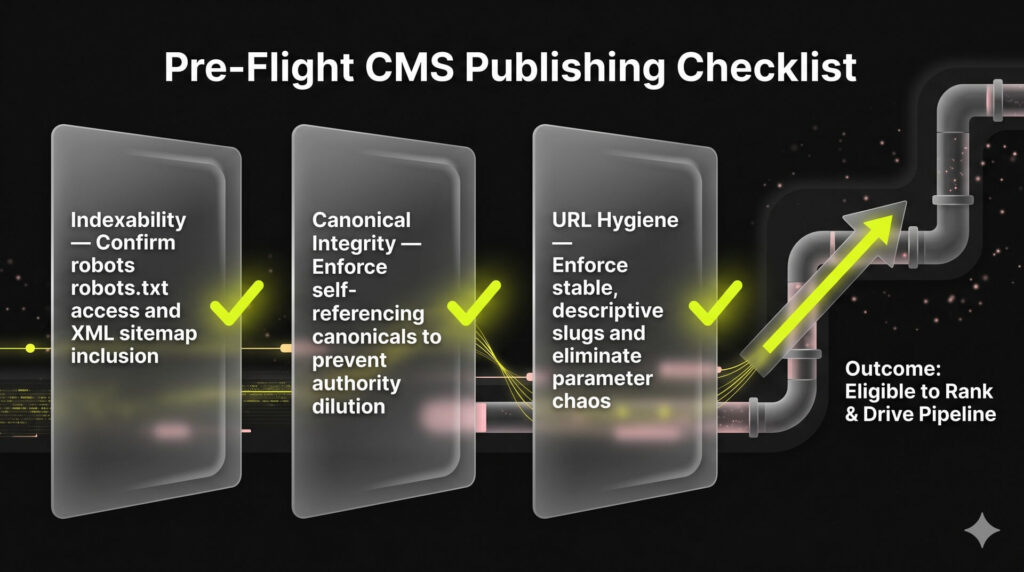
Authoritative content is a liability if “noindex” tags or broken canonicals block visibility. Technical health is the non-negotiable gatekeeper for evergreen assets. In the content seo vs technical seo hierarchy, technical invisibility is the ultimate failure mode. Pages hidden by robots.txt or parameter-heavy URLs cannot earn AI citations or search rankings.
Operationalize these checks within your CMS publishing workflow to prevent silent traffic loss:
- Indexability: Confirm robots.txt access and XML sitemap inclusion.
- Canonical Integrity: Use self-referencing canonicals to prevent authority dilution or duplication.
- URL Hygiene: Enforce stable, descriptive slugs and eliminate parameter chaos.
Treating these as a pre-flight checklist ensures every asset is immediately eligible to rank. This systematic approach transforms technical SEO from a quarterly audit into a real-time driver of your organic pipeline.
3. Enforce a Technical Baseline via Content Templates
Waiting for developer sprints to fix basic health causes organic stagnation. Eliminate this bottleneck by bundling “table stakes” requirements into content templates. This ensures pages are engineered for the AI answer layer from day one without ad-hoc dev tickets for meta tags or site architecture.
Content teams must enforce a baseline that includes:
- Mobile-first parity: Content and metadata must be consistent across devices for LLM entity verification.
- Security hygiene: Mandatory HTTPS and SSL certification for all new URLs.
- Structural integrity: Zero-tolerance for broken internal links, missing images, or 404-heavy navigation paths.
Operationalize this via a “publish-ready” checklist owned by Content Ops. If a page fails, it stays in draft. Only complex infrastructure issues follow an escalation path to developers. This framework forces content seo vs technical seo to function as a single standard that prevents UX friction from suppressing evergreen rankings.
4. Bridge the Speed Gap with Content-Led Performance Policies
Site speed regressions are often an editorial failure masquerading as a technical one. In the balance of content seo vs technical seo, performance is the intersection where most teams fail. Bottlenecks usually stem from assets introduced during publishing:
- Unoptimized hero images
- Bloated video embeds
- Unvetted third-party scripts
These assets degrade Core Web Vitals (CWV) and suppress your brand’s AI citation potential. Content teams must own the performance lever to protect evergreen compounding. Enforce mandatory WebP formats and strict lazy-loading for all media. Replace heavy embeds with lightweight placeholders triggered by user interaction.
Establish a definitive policy: if a page fails CWV, it does not ship. This discipline ensures the editorial pipeline strengthens your technical foundation. Speed is a non-negotiable quality metric that prevents performance-related ranking suppression.
5. Build Topical Authority with Technical Hub and Spoke Systems
Technical documentation and error fixes often fail to rank because they exist in isolation. This fragmentation prevents your brand from being cited in AI search results and wastes editorial spend. Solve this by organizing technical content into a compounding authority system rather than one-off posts.
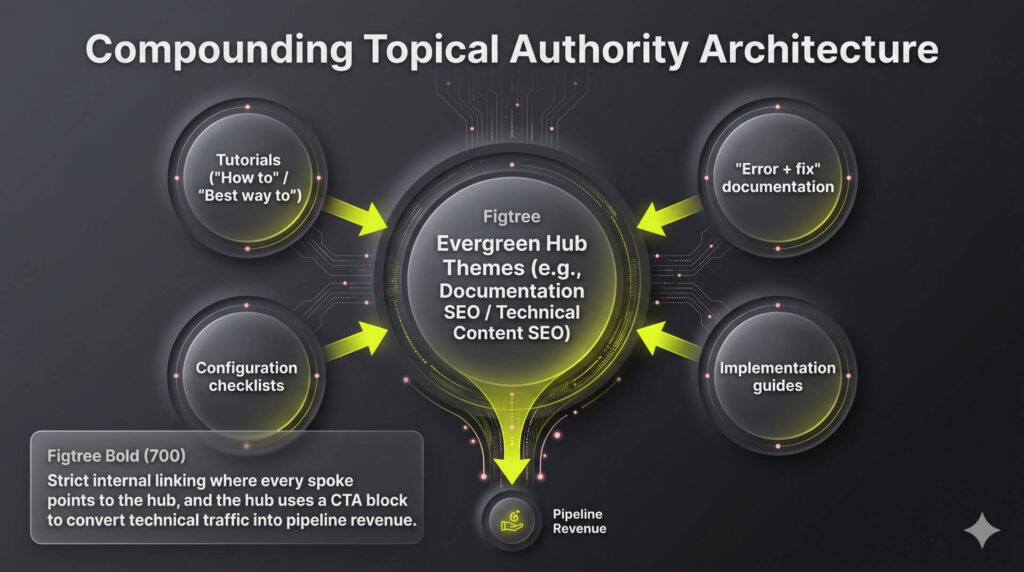
Select 1 to 2 evergreen hub themes to anchor your expertise, such as “documentation SEO” or “technical content SEO.” Create spokes that match specific technical search patterns, which naturally drives passive link building as external developers reference your solutions:
- “How to” and “Best way to” tutorials
- “Error + fix” documentation
- Configuration checklists
- Implementation guides
This architecture bridges the gap between content seo vs technical seo by creating a unified entity. Enforce strict internal linking where every spoke points to the hub and the hub routes users to spokes via clear next steps. Include a CTA block on the hub to convert high-intent technical traffic into pipeline revenue.
6. Map Keywords Without Corrupting Technical Integrity
Technical readers bounce when keyword stuffing sacrifices utility for search volume. This friction destroys visibility and prevents AI engines from trusting your data. Prioritize human accuracy with a draft-first workflow, only applying semantic layers afterward. This balances content seo vs technical seo by keeping the narrative functional for experts.
Map primary keywords to the specific task or problem. Use secondary keywords to define constraints like OS, programming language, or tool versions. Restrict keywords to these safe zones:
- Title/H1 and URL slug
- First 100 words of the introduction
- H2 and H3 subheadings
- Image alt text for technical screenshots
Never modify API names or CLI flags to fit search patterns. Forcing synonyms that alter technical meaning destroys authority and ruins UX. Precision is the primary ranking factor in the AI answer layer. This workflow ensures discoverability without compromising the technical integrity engineers demand.
7. Optimize Structured Data for LLM and Search Retrieval
High-quality tutorials lose value if AI engines hallucinate your steps or overlook your expertise. This invisibility occurs when content is human-readable but machine-opaque. To bridge the gap in content seo vs technical seo, editorial teams must treat schema markup as a core content requirement.
Implement foundational schemas to ensure semantic precision:
- BlogPosting or Article for all evergreen insights.
- FAQPage to define specific answers for generative engines.
- TechArticle, SoftwareSourceCode, or HowTo for technical documentation.
These tags provide the structure LLMs require for precise retrieval and citation. Markup must strictly mirror visible page content. Misalignment creates trust issues and wastes development cycles on data search engines will eventually discard. Accurate implementation eliminates ambiguity, ensuring your technical documentation becomes the definitive answer for search engines and AI crawlers.
8. Operationalize Technical Content for Code Integrity and SEO
Technical content often fails by creating duplicate clusters and thin pages that dilute authority. Poor semantic structure in code snippets creates technical debt, capping visibility in the content seo vs technical seo balance. Search engines struggle to index raw code without context. To solve this, implement strict structural standards:
- Use semantic headings and short explanatory lead-ins for all code blocks.
- Include “expected output” sections to provide the technical context generative engines require for accurate citations.
- Link to stable repository paths rather than transient branches to prevent link rot.
- Pick one canonical source for assets appearing in both docs and blogs to prevent ranking cannibalization.
These mechanics transform raw documentation into durable search infrastructure. Eliminating duplication ensures technical posts maintain rankings and drive organic revenue. This strategic approach turns your repository from a static silo into a revenue-generating asset.
9. Engineering the Answer Layer for Generative Search
Search is splitting. In the content seo vs technical seo landscape, visibility requires an “answer-layer” that prioritizes extractability over narrative fluff. Define your core concept in one declarative sentence near the top to establish entity recognition for AI crawlers.
Maintain entity clarity with consistent product naming. Every high-value asset must define what the solution is, who it serves, and what it replaces. This architecture builds the semantic relationships necessary for LLM citations across the knowledge graph.
Citation Readiness Checklist:
- Use H3 subheadings for tight, standalone FAQs.
- Deploy scannable comparison tables for competitive queries.
- Use bulleted step-lists for procedural instructions.
Position your brand as the cited authority across ChatGPT and Perplexity. For expert implementation, explore NUOPTIMA’s GEO services to secure your position in the answer layer.
FAQ
Priority depends on whether your site is eligible for indexing or lacks the ability to rank. Follow the Eligibility vs Ability rule. If technical debt prevents pages from being rendered or indexed, technical fixes take total precedence. If your pages are indexed but fail to capture intent or drive revenue, focus on content depth, internal linking, and asset refreshes. Technical SEO is the foundation; content SEO is the growth engine.
Technical content SEO is the strategic intersection where content strategy meets technical architecture to ensure maximum machine extractability. This involves content teams owning semantic structure, keyword-to-intent mapping for complex queries, and schema alignment. By optimizing for performance-safe publishing and entity clarity, you ensure your documentation is human-readable and machine-ready. This structural work is critical for earning citations in AI answer engines like ChatGPT and Perplexity.
Prioritize technical accuracy during the drafting phase and apply semantic optimization as a secondary layer. Place primary keywords in high-signal locations like the H1, URL slug, and the first hundred words. Keep code snippets, API names, and CLI commands untouched to maintain developer trust. Use secondary keywords to define technical constraints like tool versions or operating systems. This balance ensures discoverability without compromising the technical integrity experts demand.
Core Web Vitals are not a substitute for topical relevance but serve as essential performance guardrails for UX and rankings. While great content can rank despite average speed, poor performance often caps conversion rates and overall organic visibility. Treat CWV as a non-negotiable gate in the publishing workflow. If a page fails performance benchmarks due to bloated media, it should not ship. Fast pages build the authority required for sustainable growth.
Optimize existing assets by adding extractable answer blocks, FAQ schemas, and clear entity definitions across your site. Focus on making your content citation-ready by using declarative sentences and consistent internal linking to establish topical authority. These structural adjustments allow AI engines to identify your brand as the definitive source.
For a unified roadmap that covers both Google and AI answer engines, explore the GEO services at nuoptima.com to secure your future search dominance.
Where this fits in your MSP growth system
This is one piece of how NUOPTIMA makes MSPs and cybersecurity firms the provider buyers find on Google and in AI search. See how it connects to MSP content marketing and MSP SEO, or get your free MSP lead forecast to see exactly where your firm shows up across ChatGPT, Gemini, and Perplexity today.