Head terms are slow, noisy, and expensive vanity plays. While competitors waste budget on broad queries, your fastest path to organic revenue is capturing high-intent conversational search. Long tail seo is the strategic infrastructure for the AI answer layer, ensuring your brand becomes the definitive cited authority in LLM-generated responses. This execution checklist provides eight tactics to rank faster this week, plus an FAQ to remove common implementation blockers. We begin where most teams miss opportunity: first-party data.
Key Takeaways
- Long-tail SEO captures high-intent conversational queries that head terms miss, making it the infrastructure for being cited in AI answer-layer responses.
- Google Search Console is the source of truth for demand: filter by page and find long-form queries ranking between positions 8 and 30 for fast wins.
- A "0" volume label usually means unmodeled data, not zero interest, so qualify ghost terms by intent density and SERP gaps rather than discarding them.
- Map one intent to one URL to avoid cannibalization, handling phrasing variants as H2s or FAQ sections instead of separate pages.
- Report on page cohorts, ranking velocity, and AI citations in ChatGPT and Perplexity rather than individual keyword ranks, which are a vanity trap.
Long-tail SEO is a strategy of targeting highly specific, lower-frequency search queries that carry narrow intent, higher conversion rates, and less competition than broad head terms.
1. Use Google Search Console to Harvest Zero-Volume Opportunities
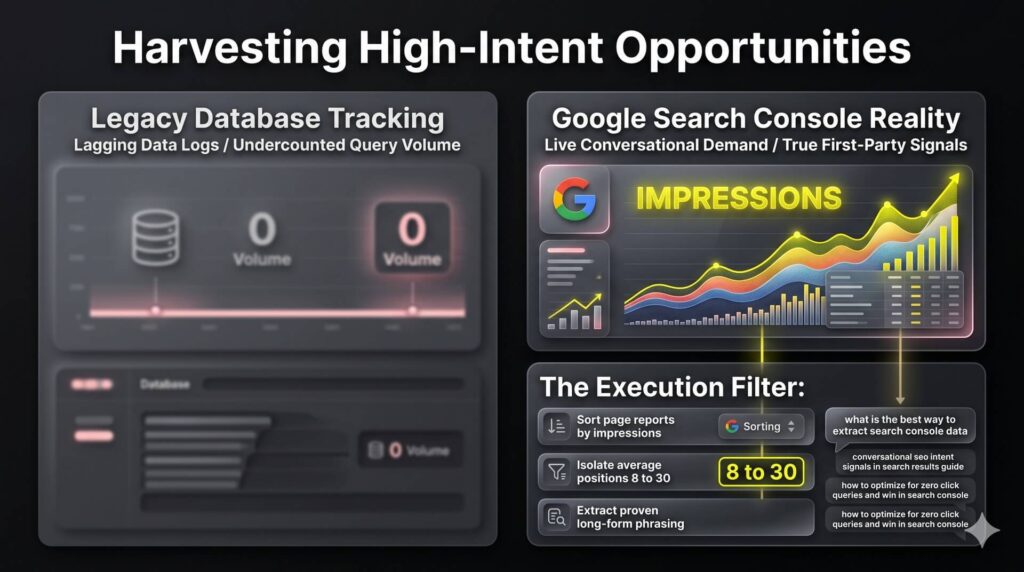
Third-party tools often report zero volume for terms already driving visibility because databases lag behind real-world conversational search. Google Search Console is the definitive source of truth for capturing this proven demand.
To execute, filter your GSC Performance report by page and sort by impressions. Identify long-form phrasing and specific questions where your average position sits between 8 and 30. These represent “rank faster” wins for long-tail SEO variants that legacy platforms typically undercount.
Update existing content if the intent matches or build a new page if the intent is distinct, making sure to integrate structured compliance content SEO for MSPs where regulated industries are targeted. Always track page-level conversions instead of vanity clicks to ensure these high-intent long-tail queries translate into measurable pipeline and organic revenue growth.
2. Qualify and Measure Zero-Volume “Ghost” Terms
A “0” volume label in SEO tools usually indicates unmodeled data, not zero interest. Natural language queries often bypass database tracking, creating invisible long-tail opportunities your competitors overlook.
Qualify ZSV terms with this checklist:
- Intent Density: Modifiers like “pricing,” “best-for,” “setup,” or “template” signal transactional readiness.
- SERP Gap: Outdated posts or thin forum threads confirm you can provide a superior answer.
Quality GSC impression growth, ranking velocity, and conversion rates rather than theoretical volume, aligning your tracking with broader IT services lead generation metrics. If a page earns no impressions after indexing, fold it into a broader topical hub to consolidate entity authority. This pragmatic measurement model justifies targeting high-intent, long-tail queries without guessing.
3. Map Question Stacks for Conversational and AI Answer Layer Dominance
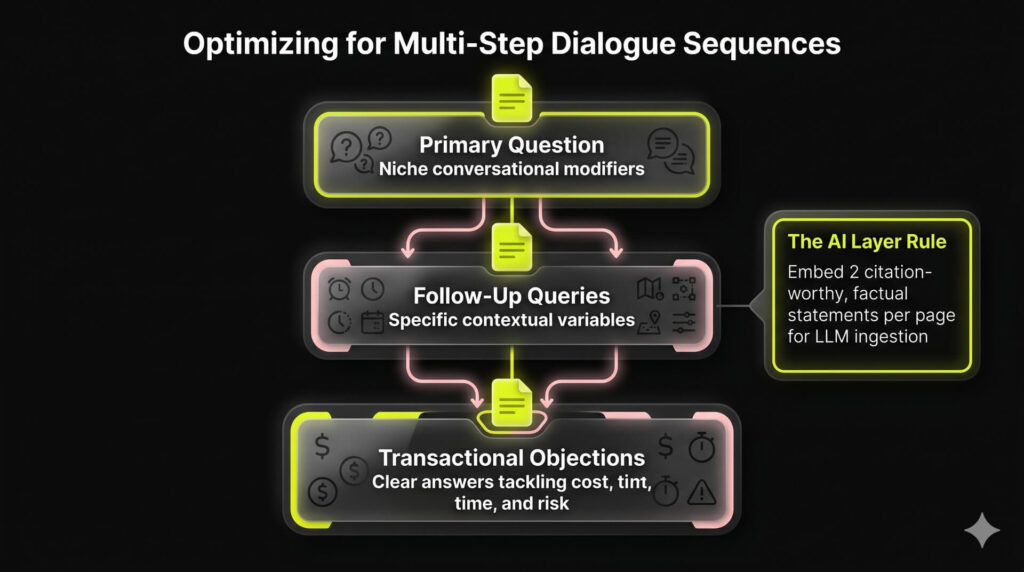
Search behavior has shifted from isolated keywords to continuous dialogue. Dominate the answer layer by optimizing for sequences rather than strings. Identify niche conversational modifiers like “for B2B,” “without X,” or “step-by-step” to capture long tail SEO variants. Build a question stack for every core topic:
- Primary question
- Follow-up queries
- Transactional objections (cost, time, risk)
Structure pages with descriptive subheadings and short, extractable answers. Include two factual, citation-worthy statements per page for LLM ingestion. This transforms one asset into search infrastructure that ranks for dozens of variants. You optimize for conversational search behavior while building a sustainable organic moat.
4. Map Intent Clusters to URLs to Stop Self-Competition
Publishing separate pages for phrasing variations creates a cannibalization trap. This splits authority and confuses search engines. To scale long-tail SEO without self-competition, group queries by intent:
- Troubleshooting
- Pricing
- How-to / Process
- Definitions
Assign one primary URL per intent. Map secondary variants as H2s or FAQ sections on that page to build stronger entity signals for AI engines. If URLs overlap, consolidate content into the top performer, implement 301 redirects, and update internal links. One definitive answer per intent secures your presence in the answer layer and prevents your content from competing with itself.
5. Engineer Micro-Structures for Instant AI Extraction
Capture long-tail rankings by mirroring the micro-structure AI engines use to parse and extract data. Lead with a one to two sentence direct answer to satisfy the immediate retrieval layer. Most content fails because it is informative but not formatted for extraction. This structure minimizes “time to answer” for complex conversational queries.
Structure content for automated engine extraction:
- Use numbered steps for processes.
- Provide concise definitions for “what is” intents.
- Embed a mini-FAQ block for common follow-up questions.
High-intent long-tail traffic lives in the constraints. Address specific variables like “budget” or “SaaS” where the answer shifts based on context. Deploy FAQ schema to reinforce entity signals and secure knowledge graph ownership within your managed IT services marketing strategy. This transformation ensures your brand becomes the definitive cited authority, converting AI search visibility into organic pipeline.
6. Route Authority to High-Intent Pages via Strategic Link Architecture
Most internal linking is a graveyard of “Related Posts” widgets that fail to drive pipeline. Authority often stays trapped in broad hubs, leaving long-tail pages orphaned and slow to rank. Route power deliberately to accelerate indexing and capture high-intent demand.
Implement these moves to connect hubs to revenue paths:
- Add “use case” or “FAQ” sections on hubs linking to long-tail variants.
- Use natural language anchors that mirror conversational search intent rather than exact-match keywords.
- Link from long-tail pages back to the hub and the next revenue step, such as a service page or template.
This architecture ensures your brand becomes the cited authority in the answer layer while shortening the distance between search and conversion.
7. Scaling Programmatic Long-Tail Pages Safely
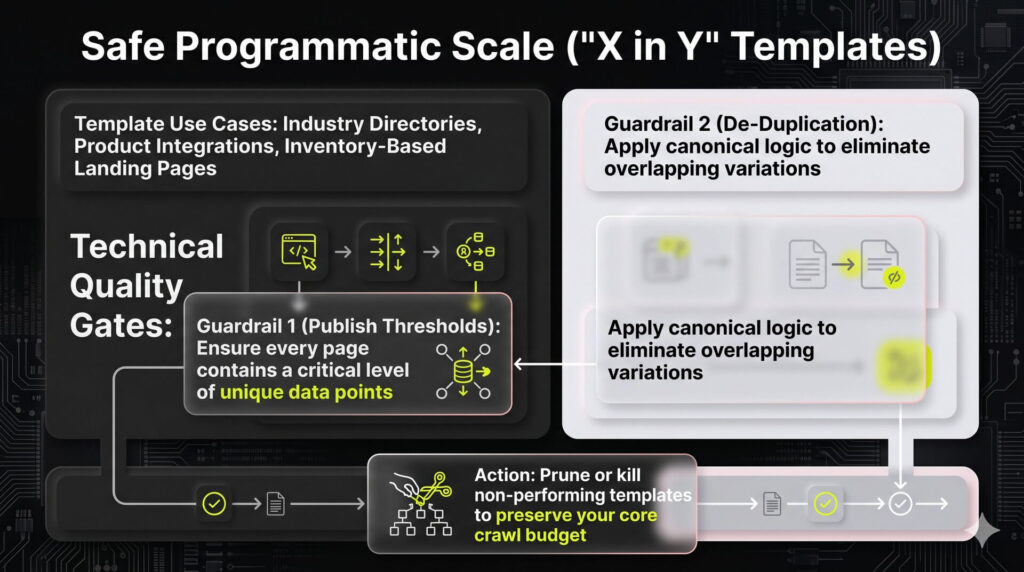
Programmatic long-tail SEO scales visibility through “X in Y” templates. This strategy works efficiently for:
- Industry directories
- Product integrations
- Inventory-based templates
Mass-generating pages risks indexation failure from thin content. Protect site quality with two guardrails. First, set publish thresholds to ensure every page contains sufficient unique data. Second, use de-duplication and canonical rules to consolidate overlapping combinations.
Verify CMS limits before launching thousands of URLs. Monitor performance via GSC impressions per template type. Kill non-performing templates to preserve crawl budget and site authority. To engineer scalable growth without thin-content risk, use NUOPTIMA’s GEO and SEO systems.
8. Stakeholder-Proof Your Reporting with Modern Visibility Metrics
Reporting on individual long tail seo keywords is a vanity trap. Fragmented terms lack impact in isolation, fueling stakeholder skepticism. Shift measurement to page cohorts and ranking velocity. Track how fast clusters reach the top 10 and monitor GSC query growth to prove you are capturing a rising count of unique impressions per page, validating the expansion of your search footprint.
Connect organic performance to revenue via landing page conversions and assisted conversion paths. In the bifurcated search landscape, prioritize “answer layer” visibility. Track brand citations in ChatGPT and Perplexity, even when direct clicks fluctuate. To build a measurement framework that captures Google dominance and generative engine visibility, partner with NUOPTIMA for specialist SEO and GEO execution.
If you want a long-tail SEO strategy that wins AI citations and dominates the answer layer, explore NUOPTIMA’s specialist GEO services today.
Where this fits in your MSP growth system
This is one piece of how NUOPTIMA makes MSPs and cybersecurity firms the provider buyers find on Google and in AI search. See how it connects to GEO and AI-search and answer engine optimization, or get your free MSP lead forecast to see exactly where your firm shows up across ChatGPT, Gemini, and Perplexity today.